Understanding Resistance Color Codes for Beginners
If you want to know how to read resistance color code, start by looking at the colored bands on a resistor. Each band shows

If you want to know how to read resistance color code, start by looking at the colored bands on a resistor. Each band shows a number or value. You can learn resistor color coding by following a few simple steps for reading resistors. Most resistors have three to six color bands, but the most common types use four or five. These bands represent the resistor color code basics. Anyone can master how to read resistor color codes with a little practice.
- Resistors commonly use:
- Three to six color bands
- Four and five bands are most prevalent
- Each band shows a specific value
Key Takeaways
- Resistor color codes use colored bands to indicate values. Learn the color meanings to read resistors accurately.
- Always start reading from the end where the bands are closest together. This helps you find the correct value.
- Use a color code chart to match colors to numbers. This tool reduces mistakes and speeds up your reading process.
- Practice regularly to improve your skills. The more you read resistors, the easier it becomes.
- If colors are faded or hard to see, use a multimeter to measure resistance. This ensures you get the right value.
What Is a Resistor Color Code?

A resistor color code is a system that uses colored bands to show the value of a resistor. You see these bands on the body of most resistors. Each color stands for a number or a multiplier. This system helps you quickly find out the resistance without needing special tools.
Why Resistors Use Color Codes
Manufacturers use the resistor color code for several reasons:
- Tradition plays a big role. People have used color bands for decades, so you find them familiar.
- Color bands are easier to apply to the small, round shape of resistors than printed numbers.
- You can read color codes from any angle, which helps when resistors sit in different positions on a circuit board.
You also benefit from a standardized system. The resistor color code makes it easy to identify and swap resistors. Other marking systems, like printed numbers, do not work as well for small or round resistors. Color bands stay reliable and accurate, even when you look at the resistor from different sides.
If you look at the history, you see how the resistor color code became the standard. Manufacturers once used their own systems, which caused confusion. Over time, experts agreed on one method. Here is a timeline that shows how the resistor color code developed:
| Year | Event |
|---|---|
| 1920s | RMA resistor color code developed by the Radio Manufacturers Association. |
| 1930 | First radios with RMA color-coded resistors built. |
| 1952 | Standardized in IEC 62:1952 by IEC. |
| 1963 | Published as EIA RS-279. |
| 1968 | Extended to cover capacitors with IEC 62:1968. |
| 2016 | Current international standard defined in IEC 60062:2016 and EN 60062:2016. |
Where to Find Color Codes
You find the resistor color code on the body of most through-hole resistors. These colored bands wrap around the resistor and show its value and tolerance. For small resistors, like 1/4 watt carbon or film types, color bands work best because there is not enough space for printed numbers. Larger resistors sometimes use printed numbers or letters, but color codes remain common. When you look at a circuit board, you will notice these color bands on many resistors, making it easy for you to check their values.
How to Read Resistor Color Codes
Reading Direction
When you want to learn how to read resistance color code, you need to start with the correct orientation. The direction you read matters because it affects the value you get. You always begin from the end where the color bands are closest to the edge of the resistor. This side marks the starting point.
- Look for the group of color bands that sit closer together and nearer to one end.
- Notice that the last band, often gold or silver, sits farther apart from the others. This band shows the tolerance.
- Always read from the end opposite the gold or silver band.
Note: Orientation matters. The tolerance band (often gold or silver) is usually spaced farther apart or positioned last. Start reading from the opposite side.
The color bands on a resistor are designed so you can see them clearly, no matter how the resistor sits on the board. This design helps you avoid mistakes when reading resistor color codes.
Quick Tips for Finding the Starting End:
- Begin at the end where the bands are closest to the edge.
- The tolerance band (gold or silver) is usually the last band and sits farther away from the others.
Band Meanings
Each band on a resistor has a special meaning. When you learn how to read resistance color code, you need to know what each band tells you. The number of bands can change, but the basic idea stays the same.
Step-by-Step: How to Read Resistance Color Code
- Orient the Resistor Correctly
Hold the resistor so the color bands are on the left and the gold or silver band is on the right. - Read the Significant Digits
Look at the first two or three bands (depending on the type). These bands give you the main numbers of the resistor value. - Apply the Multiplier
The next band shows the multiplier. Multiply the digits you found by this number. - Check the Tolerance
The last band tells you the tolerance. This shows how much the real value can differ from the stated value.
You will see different types of resistors with different numbers of bands. Here is how the meanings change:
- A 4-band resistor has two significant digits, a multiplier, and a tolerance band.
- A 5-band resistor has three significant digits, a multiplier, and a tolerance band. These resistors usually have a tighter tolerance.
- A 6-band resistor adds a temperature coefficient band, which tells you how the resistance changes with temperature.
What Each Color Means
You can use this table to help you when reading resistor color codes:
| Color | Digit | Multiplier | Tolerance |
|---|---|---|---|
| Black | 0 | 1 | – |
| Brown | 1 | 10 | ±1% |
| Red | 2 | 100 | ±2% |
| Orange | 3 | 1,000 | – |
| Yellow | 4 | 10,000 | – |
| Green | 5 | 100,000 | ±0.5% |
| Blue | 6 | 1,000,000 | ±0.25% |
| Violet | 7 | 10,000,000 | ±0.1% |
| Gray | 8 | 100,000,000 | ±0.05% |
| White | 9 | 1,000,000,000 | – |
| Gold | – | 0.1 | ±5% |
| Silver | – | 0.01 | ±10% |
Gold and silver bands play a special role. Gold means a multiplier of 0.1 or a tolerance of 5%. Silver means a multiplier of 0.01 or a tolerance of 10%.
Example
Suppose you see a resistor with these color bands: red, violet, yellow, gold.
- Red = 2
- Violet = 7
- Yellow = 10,000 (multiplier)
- Gold = ±5% (tolerance)
So, the value is 27 × 10,000 = 270,000 ohms, with a tolerance of ±5%.
Learning how to read resistance color code gets easier with practice. You will soon spot the starting end, read the color bands, and find the value quickly. If you keep practicing reading resistor color codes, you will gain confidence and speed.
Resistor Color Code Chart

When you want to read resistor values quickly, a resistor color code chart helps you every time. This chart shows you the meaning of each color band, so you can match the colors on your resistor to the correct numbers and tolerances.
Color-to-Number Table
You can use the following table to find the value for each color. This table follows the international standard for resistor color codes:
| Color | Value |
|---|---|
| BLACK | 0 |
| BROWN | 1 |
| RED | 2 |
| ORANGE | 3 |
| YELLOW | 4 |
| GREEN | 5 |
| BLUE | 6 |
| VIOLET | 7 |
| GREY | 8 |
| WHITE | 9 |
| Tolerance Color | Tolerance |
|---|---|
| VIOLET | 0.10% |
| BROWN | 1% |
| RED | 2% |
| GREEN | 0.50% |
| BLUE | 0.25% |
| SILVER | 10% |
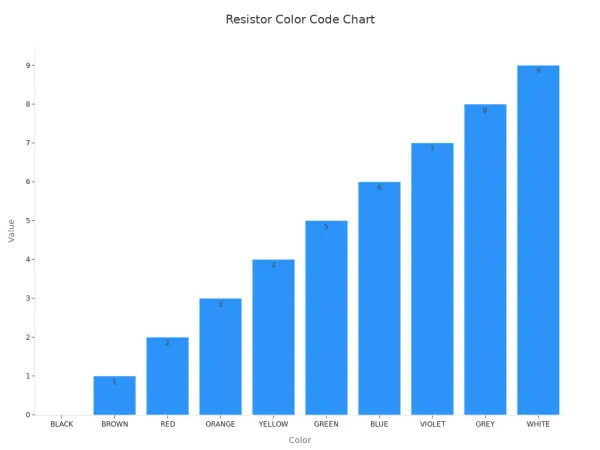
A resistor color code chart helps you avoid mistakes. You can check the chart to make sure you read the bands in the right order. You also reduce errors by checking for faded colors and making sure you do not mix up similar colors like red and brown.
Tip: Always read the bands from left to right, starting at the end closest to the color bands.
Special Colors
Some colors have special meanings in the resistor color code chart. Gold and silver do not stand for numbers. Instead, they show multipliers or tolerance.
| Color | Meaning | Tolerance |
|---|---|---|
| Gold | 0.1 Ω (10^-1) | 5% |
| Silver | 0.01 Ω (10^-2) | 10% |
| None | — | 20% |
- Gold means a tolerance of 5%.
- Silver means a tolerance of 10%.
- If you see no tolerance band, the resistor has a tolerance of 20%.
You can use these details to read any resistor you find. With practice, you will use the resistor color code chart with confidence.
How to Read Resistance Color Code for 4, 5, and 6 Band Resistors
When you want to read resistors, you need to know how each type of resistor uses color bands. You see 4-band, 5-band, and 6-band resistors in many circuits. Each type has a different way to show its value. You can learn to read resistors by following clear steps and using helpful tools like mnemonics.
4-Band Resistors
You find 4-band resistors in most basic electronics. These resistors use four color bands to show their value and tolerance. You can read resistors with four bands by following these steps:
- Look at the first two bands. Use a resistor color code chart to find the value for each color.
- Check the third band. This band shows the multiplier, which tells you how many zeros to add.
- Use this formula: Resistance (Ω) = (1st digit × 10 + 2nd digit) × Multiplier.
- Find the fourth band. This band shows the tolerance, which tells you how much the actual value can change.
You see 4-band resistors in general use. These resistors work well for most projects where you do not need high precision. You can read resistors quickly when you know the meaning of each band.
Tip: Always start reading from the end where the bands are closest together. The tolerance band sits farther apart.
5-Band Resistors
You use 5-band resistors when you need more precision. These resistors have three bands for significant digits, one for the multiplier, and one for tolerance. You can read resistors with five bands by looking at each color and matching it to the chart.
Here is a table that shows the difference between 4-band and 5-band resistors:
| Feature | 4-Band Resistor | 5-Band Resistor |
|---|---|---|
| Significant Digits | 2 | 3 |
| Precision | Less precise | More precise |
| Use Case | General use | High precision needs |
You find 5-band resistors in circuits that need exact values. These resistors help you control current and voltage with more accuracy. You can read resistors with five bands by using the same method as 4-band resistors, but you add one more digit before the multiplier.
Note: The extra digit in 5-band resistors gives you a more exact value. You see these resistors in measurement tools and sensitive devices.
6-Band Resistors
You see 6-band resistors in high-precision applications. These resistors have six color bands. You can read resistors with six bands by following the same steps as with five bands, but you need to look at the sixth band for extra information.
The sixth band tells you about the temperature coefficient. This value shows how much the resistance changes when the temperature changes. You use 6-band resistors when you need stable performance in different environments.
Here is a table that explains the sixth band:
| Attribute | Description |
|---|---|
| Sixth Band | Shows the temperature coefficient (ppm/K) |
| Importance | Gives maximum precision and stability for high-precision circuits |
You may also find that the sixth band shows reliability or failure rate. You use these resistors in scientific equipment, medical devices, and other places where accuracy matters.
Tip: Always check the sixth band if you need to know how the resistor reacts to temperature changes.
Mnemonic for Memorization
You can remember the color codes for resistors by using a simple mnemonic. The phrase "BB ROY of Great Britain had a Very Good Wife" helps you recall the order of colors and their values. Each word stands for a color:
- B: Black
- B: Brown
- R: Red
- O: Orange
- Y: Yellow
- G: Green
- B: Blue
- V: Violet
- G: Gray
- W: White
You use this mnemonic to read resistors faster. The phrase creates a strong mental link between the colors and their values. Many beginners find this tool helpful when they start to read resistors.
Remember: The best way to memorize resistor color codes is to use mnemonics like "BB ROY of Great Britain had a Very Good Wife." You can read resistors with confidence when you use this trick.
You see that learning to read resistors gets easier with practice. You can use charts, tables, and mnemonics to help you. You find that each type of resistor uses color bands in a clear way. You can read resistors in any project when you know these steps.
Practical Tips for Reading Resistors
Orientation Tips
You can read resistors accurately when you hold them the right way. Start by finding the tolerance band. This band is usually gold or silver and sits farther apart from the other color bands. Hold the resistor so the tolerance band is on the right side. This position helps you read the color bands in the correct order.
Follow these steps to orient resistors:
- Identify the tolerance band, which is spaced apart and often gold or silver.
- Hold the resistor with the tolerance band on the right.
- Begin reading the color bands from the left, starting with the bands that are close together.
Proper orientation helps you avoid mistakes. You can also double-check your reading by comparing the calculated value with a multimeter if you have one.
Mnemonics
Remembering the order of colors on resistors can feel tricky at first. You can use mnemonics to make it easier. The phrase "BB ROY of Great Britain had a Very Good Wife" helps you recall the color order: Black, Brown, Red, Orange, Yellow, Green, Blue, Violet, Gray, White. This trick works well when you need to read many resistors quickly.
You can also use online calculators for resistor color codes. These tools let you enter the colors you see on resistors and give you the value right away. Online calculators help you check your answers and learn faster. They also reduce errors, especially when you start learning about resistors.
Common Mistakes
Many beginners make similar mistakes when reading resistors. You might misinterpret colors if the lighting is poor or if the colors look faded. Some people confuse the order of the color bands or overlook the tolerance band. It is easy to mix up colors like red, orange, and brown, especially on older resistors.
To avoid these mistakes:
- Always use good lighting when you read resistors.
- Double-check the order of the bands, starting from the end closest to the grouped bands.
- Pay close attention to the tolerance band, as it helps you find the correct starting point.
- If you feel unsure, use a multimeter or an online calculator to confirm the value.
You can read resistors with confidence when you follow these tips. Practice helps you get better at spotting the right values and avoiding common errors.
Special Cases
Zero-Ohm Resistors
You might see a resistor with only one black band. This is a zero-ohm resistor. It looks like a regular resistor, but it works differently. You use zero-ohm resistors to connect two traces on a printed circuit board (PCB). These resistors act as a simple wire or jumper. They help you make connections without changing the design or using extra parts.
Here is a table that shows the main features of zero-ohm resistors:
| Feature | Description |
|---|---|
| Type | Zero-ohm resistor |
| Identification | A single black band |
| Purpose | Used to connect two traces on a printed circuit board (PCB) |
You can spot a zero-ohm resistor quickly. Look for the single black band. You do not need to calculate any value. You use these resistors when you want to bridge a gap or make a connection easy to change later.
Faded or Damaged Bands
Sometimes, you find resistors with faded or damaged color bands. This makes reading the value hard. You need to check the resistor in other ways to avoid mistakes.
- Use a multimeter to test the resistance. Set the multimeter to the Ω mode. Touch each probe to one side of the resistor. Compare the reading with the value you decoded from the color bands.
- Always double-check with a multimeter, even if the color bands look clear. This helps you make sure you have the right value.
- If the color bands are unclear, you can also test for capacitance and diode polarity with a multimeter. This gives you more information about the component.
If you have no clue about value nor tolerance you can decode both possibilities and then check them against the E96 preferred numbers. The one that matches E96 is the correct value.
You can avoid errors by using these methods. You make sure your circuit works as planned. You also protect your project from problems caused by wrong resistor values. Practice using a multimeter to build your skills and confidence.
You can read resistor color codes by following a few simple steps.
- Look for the starting end and read each band in order.
- Use a color code chart to match colors to numbers.
- Work in good lighting and check values with a multimeter.
- Practice often to improve your speed and accuracy.
Regular practice helps you spot resistor values quickly and build better circuits. You will find that reading resistor color codes gets easier every time you try.
FAQ
How do you know which end of the resistor to start reading?
Look for the band closest to the edge. The tolerance band, usually gold or silver, sits farther apart. Hold the resistor with the tolerance band on the right. Start reading from the left.
What should you do if the color bands are hard to see?
You can use a multimeter to measure resistance. Good lighting helps you see faded bands. If you feel unsure, check both possible values against a resistor chart.
Can you use a resistor color code calculator online?
Yes, you can use online calculators. Enter the colors you see. The tool gives you the resistor value instantly. This helps you avoid mistakes and learn faster.
What does the temperature coefficient band mean on a 6-band resistor?
| Band Color | Temperature Coefficient (ppm/K) |
|---|---|
| Brown | 100 |
| Red | 50 |
| Orange | 15 |
| Yellow | 25 |
You use this band to know how much resistance changes with temperature.