Do CAN Bus Systems Really Need 120 Ohm Resistors in 2025
Yes, CAN bus systems still require a 120 ohm resistor in 2025. This need comes from the unchanged standards set by ISO 11898

Yes, CAN bus systems still require a 120 ohm resistor in 2025. This need comes from the unchanged standards set by ISO 11898 and the physics of signal transmission. Engineers place a 120 ohm resistor at both ends of the controller area network. This matches the cable's impedance, keeps signal integrity, and stops reflections. CAN bus systems will not work reliably without the correct 120 ohm resistor. The 120 ohms resistor remains critical for high-speed CAN and CAN FD networks.
Key Takeaways
- Two 120 ohm resistors must be placed at each end of a CAN bus to keep signals clear and prevent data errors.
- These resistors match the cable’s impedance, stopping signal reflections that cause communication problems.
- Without proper termination, CAN bus networks face noisy signals, lost data, and unstable operation, especially at high speeds.
- Measuring about 60 ohms between CAN High and CAN Low confirms correct resistor placement and network health.
- The ISO 11898 standard still requires these resistors in 2025, and following this rule ensures reliable CAN bus performance.
120 Ohm Resistor in CAN Bus
Signal Integrity
A 120 ohm resistor plays a vital role in every controller area network. Engineers install this resistor at each end of the bus to maintain signal integrity. When a CAN system sends data, the signals travel along the twisted-pair cable. If the cable ends do not have proper termination, signals bounce back and create reflections. These reflections distort the original message and cause data errors. The 120 ohm resistor absorbs these unwanted signals, keeping the communication clear and reliable.
Signal integrity depends on the correct use of termination resistors. Without them, the CAN bus suffers from ringing and unstable waveforms. This leads to poor signal quality and frequent communication failures. The 120 ohm resistor ensures that signals remain strong and clear, even in noisy environments. It also helps the system resist interference from other electronic devices. When both ends of the bus have the correct resistor, the network achieves the best signal clarity.
Tip: Always check for the presence of two 120 ohm resistors at the ends of the CAN bus. This simple step prevents many common communication problems.
Impedance Matching
Impedance matching is another key reason for using a 120 ohm resistor in CAN systems. The typical CAN bus cable has a characteristic impedance of about 120 ohms. If the resistance at the cable ends does not match this value, signals reflect back into the cable. These reflections cause data corruption and reduce the reliability of the network.
The ISO 11898-2 standard requires two 120 ohm resistors, one at each end of the CAN bus. These resistors connect between the CAN_H and CAN_L wires. When installed correctly, they create a total resistance of about 60 ohms across the bus. This matches the cable's impedance and prevents reflections. The termination resistor also speeds up the discharge of parasitic capacitances, allowing faster transitions between signal states.
A single 60 ohm resistor cannot replace two 120 ohm resistors. Only the correct placement of two 120 ohm resistors at the physical ends of the bus ensures proper termination. This setup supports high-speed communication and stable operation, even at data rates up to 1 Mbps. The 120 ohms resistor is not just a suggestion; it is a requirement proven by both theory and experiment.
- Key points about 120 ohm resistor use in CAN:
- Two 120 ohm resistors are needed, one at each end of the bus.
- These resistors must connect between CAN_H and CAN_L.
- Proper termination matches the cable's impedance and maintains signal integrity.
- The total resistance across the bus should measure about 60 ohms.
- Only the two endpoints need termination resistors; extra resistors cause errors.
The 120 ohm resistor remains essential for every controller area network. It protects signal integrity, matches impedance, and ensures reliable data transmission. Without it, CAN systems cannot function as designed.
CAN Bus Terminal Resistance

Why Termination Matters
Proper can termination with a 120 ohm resistor at each end of the network keeps data transmission stable and reliable. The 120 ohm resistor matches the cable’s impedance, which stops signal reflections from bouncing back into the wires. When engineers install the correct resistance, the can bus terminal resistance allows signals to travel smoothly from one end to the other. This setup prevents ringing, which looks like extra waves or noise on the signal line.
If the 120 ohm resistor is missing or in the wrong place, the can bus terminal resistance does not match the cable. This mismatch causes signal energy to reflect at the ends, creating random noise and voltage spikes. These problems lead to spurious error frames and can make some nodes fail to communicate. The can bus can sometimes work at very low speeds with only one 120 ohm resistor, but errors appear quickly as data transmission speeds increase. At speeds above 250 kbps, the network often becomes unstable or stops working.
Note: The 120 ohm resistor also helps discharge parasitic capacitance in the cable. Without it, the voltage falls slowly, and the signal edges become weak. This weak signal makes it hard for the system to tell the difference between a “1” and a “0,” which leads to more communication errors.
Effects of Incorrect Resistance
Incorrect terminal resistance causes many problems in can networks. If the resistance is too high or too low, the 120 ohm resistor cannot do its job. This leads to signal reflections, distorted waveforms, and unreliable data transmission. The most common symptoms include:
- Distorted or noisy waveforms on the can lines.
- Increased error frames and corrupted messages.
- Intermittent or lost data transmission between nodes.
- Unstable communication, especially at higher speeds.
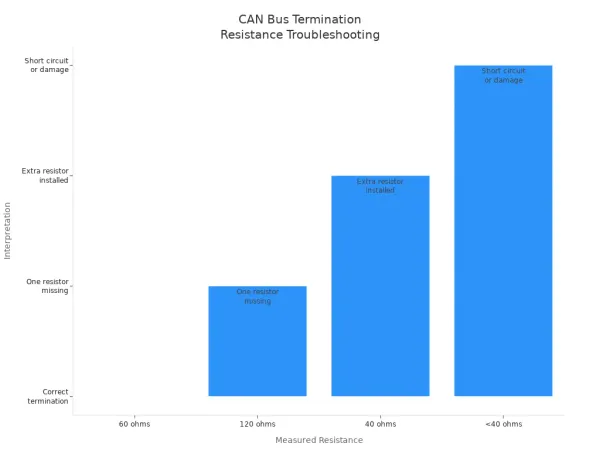
A simple resistance check helps diagnose these issues. With the power off, measuring between CAN High and CAN Low should show about 60 ohms. This value means two 120 ohm resistors are present and correct. If the measurement shows 120 ohms, only one resistor is installed. If the resistance is 40 ohms, a third resistor is present and should be removed. Less than 40 ohms may mean a short circuit or damaged wiring.
| Measurement Condition | Expected Resistance | Interpretation |
|---|---|---|
| Measure resistance between CAN Hi and CAN Low with power off | 60 ohms | Both 120 ohm resistors are present and correct |
| Measure 120 ohms | Only one resistor | Second 120 ohm resistor is missing |
| Measure 40 ohms | Third resistor | Extra 120 ohm resistor installed; remove the extra resistor |
| Less than 40 ohms | Short circuit | Possible short or damaged CAN port |
Real-world troubleshooting often reveals how important the 120 ohm resistor is. In one case, a car’s modules stopped communicating. Testing showed no resistance between the CAN lines, pointing to a short circuit. By disconnecting modules one by one, the technician found a damaged ABS module and faulty wiring. After repairing the wires and restoring the correct can bus terminal resistance, communication returned to normal.
Another example involved a vehicle that would not start. An oscilloscope showed no proper waveform on the can lines. Resistance testing found a short, and disconnecting the anti-lock brake module fixed the problem. These cases show that incorrect resistance, whether from missing resistors or damaged wiring, can stop data transmission and cause major failures.
Tip: Always check for exactly two 120 ohm resistors at the ends of the network. Adding extra resistors or missing one will cause problems. Use a multimeter to measure resistance and confirm proper can termination.
Common mistakes include mixing up CANH and CANL wires, loose connectors, or adding devices without checking for proper termination. Each of these mistakes changes the resistance and can lead to communication errors. Engineers should always measure resistance and inspect wiring when troubleshooting can bus terminal resistance issues.
The 120 ohm resistor is not just a suggestion. It is a requirement for stable data transmission, correct signal edges, and reliable network operation. Only the two endpoints of the can bus should have a 120 ohm resistor. This setup ensures the right terminal resistance and keeps the network running smoothly.
120 Ohms Resistor and Standards
ISO 11898-2 Compliance
The iso 11898 standard sets clear rules for can bus termination. It requires a 120 ohm resistor at each end of the bus. These resistors connect between CAN_H and CAN_L. They suppress signal reflections and keep the differential signals stable. The 120 ohm resistor helps the bus return to its idle state and keeps noise out. High-speed can networks rely on this setup for reliable communication. Major chip manufacturers also recommend using a 120 ohm resistor at both ends. For example, the MCP2515 module includes a jumper for the termination resistor. EBYTE technical guides confirm that the 120 ohms resistor prevents waveform distortion and keeps voltage levels correct.
The 120 ohm resistor forms a low-impedance path. This allows the can bus to show dominant and recessive states clearly. Only the two endpoints need termination. Adding more resistors or missing one causes errors.
Updates in 2025
In 2025, the requirement for the 120 ohm resistor remains unchanged for high-speed can bus systems. New devices like roboRIO and power distribution modules often include built-in or switchable termination resistors. Some advanced can bus systems, such as CANivore, offer programmable 120 ohm resistors that users enable through software. If a device does not support CAN FD, a manual 120 ohms resistor must be added. Manufacturers advise users to follow their recommendations for termination.
| Device or Method | Termination Details |
|---|---|
| roboRIO | Built-in 120 ohm resistor at one end |
| Power Distribution Devices | Jumpers or switches for 120 ohm resistor; place at last device |
| CANivore CAN Bus | Programmable 120 ohm resistor; enable via software or add manually |
| Third-party Devices | Some have built-in resistors; follow manufacturer instructions |
| Bus Topology | Daisy chain recommended; star topology discouraged |
Alternative termination methods exist but are rare. Split termination uses two 60-ohm resistors and a capacitor to improve noise immunity. Distributed termination appears in low-speed can networks, but it reduces speed and increases risk of signal reflections. AC termination and polyfuses help with power dissipation and board space, but they require careful design.
The 120 ohm resistor remains essential for high-speed can bus operation. The iso 11898 standard and manufacturer guidelines confirm this. Only rare exceptions use alternative methods, and these often come with trade-offs in speed or reliability.
CAN bus systems in 2025 still depend on 120 ohm resistors for proper termination and reliable communication. Engineers see common can communication issues when termination is missing or incorrect:
- Signal reflections and noise disrupt the network.
- Error frames and bus-off states appear.
- The system may fail as speed or length changes.
The table below shows best practices for CAN bus compliance:
| Method | Description |
|---|---|
| Termination Resistors | Place 120 Ω resistors at each end of the bus to prevent reflections. |
| Bus Topology | Use a linear bus with daisy-chained nodes for stable operation. |
Always check for proper termination to keep the network stable and error-free.
FAQ
Do all CAN bus systems need 120 ohm resistors?
Yes. Every high-speed CAN bus system needs two 120 ohm resistors, one at each end. These resistors keep signals clear and prevent errors. Low-speed CAN systems may use different values, but most vehicles and machines use the 120 ohm standard.
What happens if someone adds more than two 120 ohm resistors?
Extra resistors lower the total resistance. This change can cause weak signals and communication errors. The CAN bus may stop working. Always use only two resistors, one at each end.
Can a CAN bus work with only one 120 ohm resistor?
A CAN bus may work at low speeds with one resistor. At higher speeds, missing a resistor causes reflections and errors. The network becomes unreliable. Two resistors are always best for stable operation.
How can someone check if the CAN bus has proper termination?
Use a multimeter. Turn off the power. Measure resistance between CAN_H and CAN_L. A reading near 60 ohms means two resistors are present. A different value shows a problem.