How to Use 330 Ohm Resistors in Modern Electronic Projects
You often reach for a 330 ohm resistor when you want to power a project and protect delicate components. This resistor helps

You often reach for a 330 ohm resistor when you want to power a project and protect delicate components. This resistor helps you limit current in a circuit, especially when you connect LEDs or other sensitive devices. Many electronics hobbyists and professionals trust 330 ohm resistors for their versatility and reliability.
Even though 330 ohm resistors usually come with a tolerance of ±10% or ±20%, they remain dependable for most projects that do not demand high precision.
| E-Series | Typical Tolerance (%) | Availability for 330 Ohm Resistor | Reliability Implication |
|---|---|---|---|
| E6 | ±20 | Yes | Lower precision, general use |
| E12 | ±10 | Yes | Moderate precision, common in consumer electronics |
You will find many ways to power a project using this resistor, making it a key part of your circuit-building toolkit.
Key Takeaways
- 330 ohm resistors limit current to protect LEDs and sensitive components, making circuits safer and more reliable.
- Choose a resistor with a power rating higher than your circuit's needs to prevent overheating and damage.
- These resistors work well in microcontroller circuits, signal conditioning, and prototyping for stable and efficient performance.
- Reading color codes or using a multimeter helps you identify the correct resistor value and avoid mistakes.
- 330 ohm resistors are affordable, easy to find, and versatile, making them essential for many electronic projects.
Versatility of 330 Ohm Resistors
Electrical Properties
You often choose a 330 ohm resistor because it offers a balanced mix of resistance, power rating, and tolerance. This balance makes it a favorite for many electronic projects. When you look at the electrical properties, you see why these resistors fit so many needs.
Here is a table that shows the standard electrical properties of a 330 ohm resistor:
| Property | Value |
|---|---|
| Resistance | 330 Ohms |
| Tolerance | ±5% (standard), ±10% |
| Temperature Coefficient | ±100 ppm/°C |
| Power Rating | 0.25 Watt |
| Package Size | 1206 (3.2mm x 1.6mm) |
You can find 330 ohm resistors in different power ratings. The power rating tells you how much heat the resistor can handle before it gets damaged. For most projects, a 0.25 watt resistor works well. If your circuit needs to handle more current, you should pick a higher power rating. Here is a table that helps you match the power rating to your application:
| Power Rating (W) | Typical Applications | Physical Size | Heat Dissipation Capability |
|---|---|---|---|
| 1/8W (0.125W) | Low-power logic circuits, signals | Very small, often SMD | Very low |
| 1/6W (0.167W) | General signal processing, low power LEDs | Small, breadboard suitable | Low |
| 1/4W (0.25W) | Most common, general purpose | Common through-hole, some SMD | Moderate |
| 1/2W (0.5W) | Higher power LEDs, small motor drivers | Larger through-hole, some SMD | Higher |
| 1W | Higher power applications, audio amplifiers | Larger through-hole | High |
| 2W | Demanding power needs, power circuits | Very large through-hole | Very High |
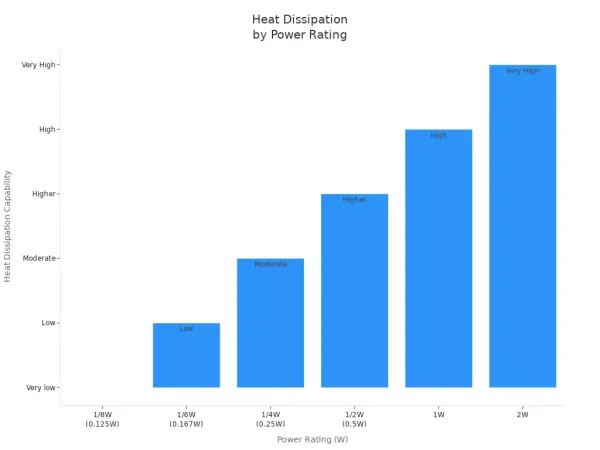
Tip: Always choose a resistor with a power rating at least twice the calculated power dissipation in your circuit. This helps prevent overheating and keeps your project safe.
The compact size of 330 ohm resistors, especially in surface mount packages, lets you fit them into tight spaces on your circuit board. This feature supports the miniaturization of modern electronics. You can use these resistors in everything from small gadgets to large industrial systems. Their adaptability means you can fine-tune your circuit for the best performance, whether you work with a power supply, microcontroller, or audio device.
Reliable Performance
You want your project to work every time you power it up. 330 ohm resistors help you achieve this goal because they offer stable and reliable performance in many circuit environments. Here are some reasons why you can trust these resistors:
- 330 ohm resistors control current to protect sensitive components like LEDs, making sure your devices last longer.
- They provide stable transistor biasing, which keeps your transistors working properly in your circuit.
- You can use them as pull-up or pull-down resistors in digital circuits. This stabilizes input signals and prevents glitches.
- Their compliance with E-series standards ensures you get consistent resistance values, even when temperature or voltage changes.
- You can find them in different tolerance classes, such as ±5% and ±10%, which lets you pick the right precision for your project.
- Their widespread use in both simple and complex electronics shows how dependable they are.
If you need a resistor for a high-power supply or a safety-critical circuit, you can choose a 330 ohm 5 watt wirewound cement resistor. This type has a flame-proof body and strong cement housing. It works well in harsh environments, from -55°C to 155°C, and handles surges without failing. The wirewound element gives you low noise and excellent thermal stability, which is important for both AC and DC circuits.
The small size of 330 ohm resistors also helps with heat management. When you use compact resistor blocks, you spread out heat more evenly on your circuit board. This reduces the risk of overheating and extends the life of your device. Engineers have found that this design choice improves reliability, especially in high-density or portable electronics.
You can rely on 330 ohm resistors for many types of circuits, from simple LED drivers to advanced power supply systems. Their stable performance, compact design, and adaptability make them a smart choice for almost any project.
330 Ohm Resistor Applications
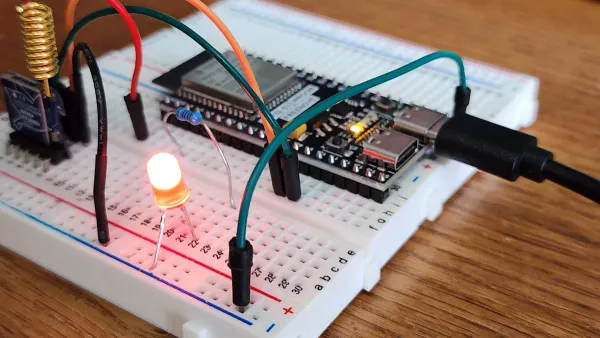
330 ohm resistors play a key role in many modern electronic projects. You will find these resistors in circuits that protect LEDs, connect microcontrollers, condition signals, and help you build prototypes. Their versatility makes them a favorite for both beginners and experienced engineers. Let’s look at some of the most common resistor applications.
LED Current Limiting
You often use a 330 ohm resistor to limit current in LED circuits. This resistor protects the LED from too much current, which can cause it to burn out. By controlling the current, you also set the brightness of the LED and make sure it lasts longer. For example, if you have a 5V power supply and an LED with a forward voltage of 2V, a 330 ohm resistor allows about 9 mA of current. This is safe for most standard LEDs and keeps your project running smoothly.
Tip: To choose the right resistor for your LED, use the formula:
R = (V_supply - V_forward) / I
For a 5V supply and a red LED with a forward voltage of 1.8V, and a target current of 10 mA, you get R = (5V - 1.8V) / 0.01A = 320 ohms. Since 320 ohms is not a standard value, you use a 330 ohm resistor. This choice protects both the LED and the microcontroller pin, while still giving you good brightness.
330 ohm resistors are reliable current limiting resistors in LED circuits. You can use them in indicator lights, displays, and even in arrays with multiple LEDs. Their ability to regulate current makes them essential for safe and effective LED operation in any project.
Microcontroller Circuits
When you work with microcontrollers, you need to protect both the microcontroller and the devices it controls. 330 ohm resistors help you do this in several ways:
- You place a 330 ohm resistor in series with a microcontroller output pin to prevent damage from short circuits or output conflicts.
- This resistor reduces electromagnetic interference by damping fast signal edges.
- It balances current limiting and signal integrity for typical 5V microcontroller outputs.
- You use it when connecting 5V outputs to 3.3V devices, limiting current and protecting sensitive parts.
You also find 330 ohm resistors in circuits with optical couplers. Here, the resistor limits current to the LED inside the coupler, protecting both the microcontroller and the coupler. This setup ensures reliable operation and keeps your project safe.
330 ohm resistors make it easy to connect microcontrollers to LEDs, switches, and other devices. They help you avoid damage and keep your circuit working as planned.
Signal Conditioning
Signal conditioning is important in audio and sensor circuits. You use 330 ohm resistors to manage current, adjust voltage, and stabilize signals. Here are some ways these resistors help:
- They act as current limiters, protecting LEDs and transistors by controlling current flow.
- You use them in voltage dividers to reduce voltage levels, making signals safe for other parts of the circuit.
- When paired with capacitors, they smooth voltage spikes and shape signals. This is important for timing and filtering.
- They stabilize GPIO pins in microcontroller circuits, preventing erratic behavior.
For example, in an audio project, a 330 ohm resistor can help filter noise and keep the signal clean. In a sensor circuit, it can protect the input pin from sudden voltage changes. These functions make 330 ohm resistors valuable for signal conditioning in many types of projects.
Prototyping a Project
When you build a prototype, you want your circuit to be safe and reliable. 330 ohm resistors help you achieve this goal. You use them as current limiting resistors in circuits with multiple LEDs. They also serve as pull-up or pull-down resistors for switches and buttons, keeping signals stable.
In electronic switching circuits, you might place a 330 ohm resistor in series with the gate of a TRIAC or with the LED in an optocoupler. This setup helps start switching and protects components from too much current. You also use these resistors in voltage divider and biasing circuits. For example, you can pair a 330 ohm resistor with a Zener diode to create a stable reference voltage.
Here is a table showing some common uses for 330 ohm resistors in prototyping:
| Application | Role of 330 Ohm Resistor |
|---|---|
| LED arrays | Current limiting |
| Switch debouncing | Pull-up or pull-down |
| TRIAC gate control | Series current limiting |
| Voltage divider | Sets voltage levels |
| Biasing circuits | Controls current for stability |
| Optocoupler circuits | Protects microcontroller and LED |
You can quickly add a 330 ohm resistor to your breadboard to test ideas and protect your components. This makes them a must-have for any electronics toolkit.
Note: 330 ohm resistors are easy to find and use. Their standard value fits many needs, from simple LED protection to complex signal processing.
330 ohm resistors support a wide range of circuit designs. You can use them in power supply circuits, voltage dividers, biasing, and electronic switching. Their flexibility and reliability make them one of the most popular resistor applications in modern electronics.
Tips for Using 330 Ohm Resistors
Power Rating Selection
When you choose a resistor for your project, you must check the power rating. The power rating tells you how much heat the resistor can handle before it fails. If you use a resistor with a rating that is too low, it will overheat. This can damage the resistor and your circuit. Overheating also creates safety risks and can cause your project to stop working. You should always select a resistor with a power rating higher than your calculated need. For most small projects, a 1/4 watt resistor works well. If your project uses more current, pick a 1/2 watt or higher. This keeps your circuit safe and reliable.
Tip: Always consider voltage and current considerations when you select a resistor. This helps you avoid overheating and keeps your project running smoothly.
Sourcing and Identification
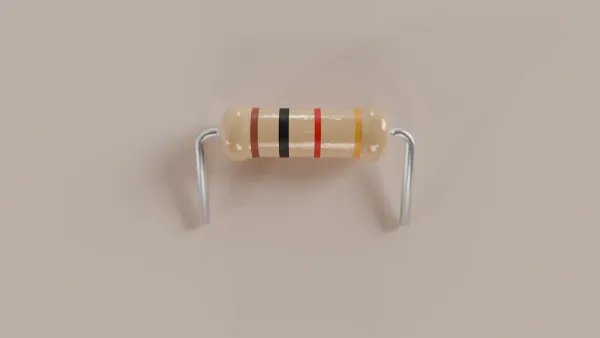
You need to identify the correct resistor value before you add it to your project. The color bands on the resistor help you do this. Each band shows a number, a multiplier, and the tolerance. You can use the table below to read the color codes for a 330 ohm resistor:
| Resistor Type | Color Bands | Digit Representation | Multiplier | Tolerance | Temperature Coefficient |
|---|---|---|---|---|---|
| 4-Band | Orange - Orange - Brown - Gold/Silver | 3, 3 | 10 | ±5% (Gold) or ±10% (Silver) | N/A |
| 5-Band | Orange - Orange - Black - Black - Brown/Red | 3, 3, 0 | 1 | ±1% (Brown) or ±2% (Red) | N/A |
| 6-Band | Orange - Orange - Black - Black - Brown - Brown | 3, 3, 0 | 1 | ±1% (Brown) | 100 ppm/°C (Brown) |
You can also use a multimeter to check the resistor value. This helps you avoid mistakes and makes sure you use the right resistor in your project.
Common Mistakes
You may make mistakes when you select resistor values for your project. If you use a resistor with a value that is too high, you can create voltage errors in your circuit. The table below shows how resistor value affects voltage error:
| Factor / Concept | Explanation / Impact | Example / Numerical Evidence |
|---|---|---|
| Adjust pin current (Iadj) | Approximately 100 µA, largely constant regardless of resistor values. | Causes voltage error proportional to resistor value (Iadj * R2). |
| Effect of resistor value scaling | Increasing resistor values increases voltage error due to Iadj term becoming significant. | Using 330 Ω: Voltage error ~33 mV; Using 3.3 kΩ: Voltage error ~330 mV (10x increase). |
| Output voltage formula | Vout = 1.25 * (1 + R1/R2) + Iadj * R2 | For 330 Ω resistor: 3.3455 V; For 3.3 kΩ resistor: 3.6425 V (showing increased error). |
| Resistor tolerance & load current | Must be considered to maintain regulation and minimize errors. | Minimum load current required; large resistor values can cause output voltage deviations due to Iadj changes. |
| Practical recommendation | Keep resistor values low (e.g., around 330 Ω) to minimize Iadj voltage drop and maintain proper regulation. | Using low resistor values keeps Iadj * R2 negligible, reducing output voltage error to under 0.3%. |
You should keep resistor values low to reduce errors. Always check the tolerance and load current for your project. This helps you keep your circuit stable and accurate.
Power a Project with 330 Ohm Resistor
330 ohm resistors help you power a project safely and reliably. You can use them in many types of circuits, from lighting up LEDs to protecting microcontroller inputs and improving audio signals. These resistors play a multifunctional role in practical circuit design. Let’s look at three common ways you can use a 330 ohm resistor in your next project.
LED Circuit Example
You often start with a simple LED circuit when you learn electronics. A 330 ohm resistor is a safe and popular choice for this type of project. It limits the current flowing through the LED, which protects it from burning out. To build this circuit, gather a breadboard, jumper wires, an LED, a 330 ohm resistor, and a 9V battery. Connect the battery to the breadboard power rails. Place the resistor in series with the LED, making sure the longer lead of the LED connects to the positive side. Complete the circuit by connecting the other end of the LED to the negative rail. When you power the circuit, the LED lights up at a safe brightness. If the resistor gets warm, you may need a higher value. If the LED does not light, check the orientation and connections. This method works well for most LEDs and helps you avoid overcurrent damage.
Microcontroller Input Example
You can use a 330 ohm resistor to protect microcontroller input pins. Microcontroller inputs have high impedance, so they do not need much current. However, a resistor in series with the input line adds extra protection. It limits current during faults or wiring mistakes. In digital logic circuits, you often see 330 ohm resistors in series with input lines. This setup prevents damage from unexpected voltage spikes or shorts. The resistor also helps reduce noise and signal reflections, which keeps your circuit stable. You can use this approach in projects with Arduino, Raspberry Pi, or other microcontrollers.
Audio Signal Example
Audio circuits benefit from 330 ohm resistors as well. You can place a resistor at the output of an audio opamp to protect it from capacitive loads. This resistor limits the output current and reduces the risk of damage if a short occurs. It also helps control power dissipation. A 330 ohm resistor provides stronger current limitation than lower values, which is useful for low-current audio applications. Carbon film resistors with this value offer good temperature stability and low noise, improving audio quality. The chart below compares current limitation and voltage drop for different resistor values in audio circuits:
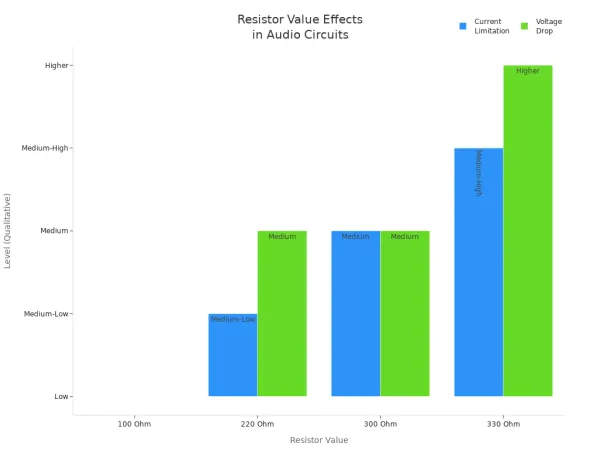
You can see that 330 ohm resistors strike a balance between protection and performance in audio projects.
Tip: 330 ohm resistors are easy to use and fit many types of circuits. You can rely on them to power a project, protect components, and improve signal quality.
You can rely on 330 ohm resistors in almost any electronic project. These resistors offer many benefits:
- Standard value in the E12 series, making them easy to find and use in any project.
- Perfect for driving LEDs and protecting sensitive parts.
- Practical for combining with other resistors to reach new values.
- Metal film types give you better precision and lower noise.
- Affordable and convenient for stocking in your toolkit.
Experimenting with a 330 ohm resistor helps you control current, protect LEDs, and improve circuit reliability. You can adjust resistor values to match different LED colors or stabilize signals in digital circuits. When you use the right resistor, you make your project safer and more reliable. Try different setups to see how a simple resistor can boost your project’s performance.
FAQ
What does a 330 ohm resistor do in an LED circuit?
You use a 330 ohm resistor to limit the current flowing through an LED. This protects the LED from burning out and helps control its brightness.
Can you use a 330 ohm resistor with any microcontroller?
You can use a 330 ohm resistor with most microcontrollers. It helps protect input and output pins from high current and voltage spikes.
How do you read the color code for a 330 ohm resistor?
You look for orange, orange, brown, and gold bands. Orange means 3, brown means a multiplier of 10, and gold shows a tolerance of ±5%.
Tip: Use a multimeter to double-check the resistor value if you feel unsure.
What happens if you use the wrong power rating?
If you use a resistor with a low power rating, it may overheat and fail. You should always pick a rating higher than your calculated need.
Are 330 ohm resistors good for audio circuits?
You can use 330 ohm resistors in audio circuits. They help limit current and reduce noise, which improves sound quality.