Your Complete Handbook for 1k Resistor Color Codes
You can read the 1k resistor color code by looking for bands in this order: brown, black, red, and gold. Knowing how to spot

You can read the 1k resistor color code by looking for bands in this order: brown, black, red, and gold. Knowing how to spot these colors helps you choose the right resistor for your circuit. When you pick the correct value, you keep your project working safely and smoothly.
- You make sure circuits work as planned by identifying resistor values.
- You protect parts from damage by selecting the right components.
- You boost performance and reliability by matching resistors to your needs.
Learning this skill gives you confidence and helps prevent common mistakes in electronics.
Key Takeaways
- Identify a 1k resistor by its color bands: brown, black, red, and gold. This helps you choose the right resistor for your circuit.
- Understanding resistor color codes saves time and prevents mistakes. You can quickly find the value without needing to translate numbers.
- Use a 1k resistor in various applications, like limiting LED current and stabilizing digital signals. This versatility makes it a common choice in electronics.
- Check the tolerance of a resistor before use. A 1k resistor with a 5% tolerance can vary between 950 and 1050 ohms, which matters in sensitive circuits.
- Practice reading color codes and keep a color code chart handy. This skill boosts your confidence and helps you build circuits more effectively.
What Is a 1k Resistor?
1k Resistor Basics
You often see the 1k ohm resistor in electronic circuits. This component controls the flow of electric current. According to electronics standards, a 1k resistor has a resistance value of 1 kilohm, which equals 1,000 ohms. The letter "k" stands for "kilo," meaning one thousand. When you use a 1k ohm resistor, you help manage how much current moves through different parts of your circuit. This control keeps your components safe and your projects working as planned.
A resistor does not store energy. Instead, it slows down the flow of electricity. You can think of it like a narrow section in a water pipe. The 1k ohm resistor is a popular choice because it works well in many situations. You will find it in both simple and complex circuits. Its value makes it easy to use for testing and building new designs.
Common Uses
You will use a 1k ohm resistor in many types of electronic projects. Here are some of the most common ways you might use this part:
- LED current limiting: You place a 1k ohm resistor in series with an LED to prevent too much current from flowing and burning out the light.
- Pull-up and pull-down resistors: You use these in digital circuits to make sure signals stay at the right logic level.
- Voltage dividers: You combine a 1k ohm resistor with other resistors to create a specific voltage for sensors or other parts.
- Sensor interfacing: You connect sensors to control circuits using a 1k ohm resistor to help with signal accuracy.
- Signal conditioning: You use a 1k ohm resistor in filters and attenuators to process signals correctly.
- Basic circuit prototyping: You often choose a 1k ohm resistor when testing new ideas or building simple circuits.
Tip: When you start learning about electronics, keep a few 1k ohm resistors in your kit. You will use them often in many projects.
Why Use a Resistor Color Code?
Purpose of Color Codes
You often see resistors in many shapes and sizes, but most do not have numbers printed on them. Instead, manufacturers use resistor color coding to show the value. This system helps you quickly identify the resistance, tolerance, and sometimes even the reliability of a resistor. The importance of resistor color coding comes from its many advantages:
- The color code system has a long tradition in electronics.
- Applying color bands is easier during manufacturing, especially for small, cylindrical resistors.
- You can read color bands from any angle, while printed numbers might be hard to see.
- The color code is language-independent, so anyone around the world can understand it.
When you work with electronic components, you need to pick the right resistor for your circuit. Understanding resistor color coding helps you avoid mistakes and saves time. You do not need to translate or look up numbers in different languages. You just read the bands and know the value.
How Color Codes Work
Resistor color coding uses colored bands to show numbers and other information. Each band stands for a digit, a multiplier, or a tolerance. You read the bands from one end to the other, usually starting near the edge. The resistor color code system started in the 1920s and became standard in the 1950s. The International Electrotechnical Commission (IEC) created rules for how to mark resistors, making the system reliable for everyone.
Resistor color codes make it easy for you to find the right resistor during manufacturing and repair. You can check the value at a glance, which helps you build and fix circuits faster. The system works for all types of resistors, from basic ones to those used in integrated circuits.
Here is a table that shows how international standards define resistor color coding:
| Aspect | Description |
|---|---|
| Color Code Definition | The color code consists of several colored bands that indicate resistance values and tolerances. |
| Standardization Reference | The coding is defined in the international standard IEC 60062, which describes marking codes. |
| Band Variations | Resistors can have between three to six bands, with specific roles for each band in indicating values. |
| Reliability Band | Some military specification resistors include an extra band for reliability, indicating failure rates. |
| Zero-Ohm Resistor | A single black band indicates a zero-ohm resistor, functioning as a wire link on PCBs. |
| Special Cases | Five band resistors may include gold or silver bands for tolerance and temperature coefficients. |
| High Voltage Resistors | High voltage resistors may use yellow and gray instead of gold and silver to avoid metal particles. |
When you learn resistor color coding, you gain a skill that works in any country and with any electronic device. This knowledge helps you work with integrated circuits and other components with confidence.
1k Resistor Color Code
Standard Color Bands
You can identify a 1k ohm resistor by looking at the colored bands on its body. The most common 1k resistor color code uses four bands: brown, black, red, and gold. Each band has a special meaning:
- The first band (brown) shows the first digit, which is 1.
- The second band (black) shows the second digit, which is 0.
- The third band (red) is the multiplier, which means you multiply by 100.
- The fourth band (gold) tells you the tolerance, which is usually ±5%.
When you read a 1k resistor, start from the end where the bands are closer together. Move from left to right. The brown-black-red-gold pattern tells you the value is 1,000 ohms, or 1k ohm. This 1k resistor color code helps you pick the right part for your circuit and keeps your electronic components safe.
Tip: Always check the direction of the bands. The tolerance band (gold) is usually wider and set apart from the others.
Alternative Color Codes
You might see other ways to show the value of a 1k ohm resistor, especially in modern or compact designs. Some resistors use five bands, such as brown, black, black, brown, and gold. In this case, the first three bands are digits (1, 0, 0), the fourth band is the multiplier (10), and the fifth band is the tolerance.
Surface-mount resistors (SMD) often use numbers or letters instead of color bands. For example, you may see "1K" or "102" printed on the resistor. "1K" stands for 1k ohms, while "102" means 10 followed by two zeros, which is 1,000 ohms. These codes help you quickly spot the value in tight spaces, such as on integrated circuits or small circuit boards.
Here is a table showing some common alternative codes for a 1k ohm resistor:
| Color Code Variation | Description | Contexts Used |
|---|---|---|
| SMD Code | Uses alphanumeric numbers on the resistor's surface. | Voltage dividers, current limiters, signal conditioning, pull-up and pull-down resistors. |
| 1K | Represents 1k ohms directly. | Common in various electronic applications. |
| 102 | Denotes 1k ohms (10^2 ohms). | Used in compact designs where space is limited. |
You will find these alternative codes in many electronic components and integrated circuits. Knowing how to read both color bands and printed codes makes you more confident when working with any 1k resistor.
Resistor Color Code Chart
Color Band Table
You can use a resistor color code chart to quickly find the value of any resistor. This chart shows you what each color means for the digit, multiplier, and tolerance. When you look at a resistor, you match the color bands to the chart to get the right value. Here is the most widely accepted resistor color code chart used in the electronics industry:
| Band Color | Digit Value | Multiplier | Tolerance |
|---|---|---|---|
| Black | 0 | ×1 | |
| Brown | 1 | ×10 | ±1% |
| Red | 2 | ×100 | ±2% |
| Orange | 3 | ×1,000 | |
| Yellow | 4 | ×10,000 | |
| Green | 5 | ×100,000 | ±0.5% |
| Blue | 6 | ×1,000,000 | ±0.25% |
| Violet | 7 | ×10,000,000 | ±0.1% |
| Gray | 8 | ×100,000,000 | ±0.05% |
| White | 9 | ×1,000,000,000 | |
| Gold | ×0.1 | ±5% | |
| Silver | ×0.01 | ±10% | |
| No Color | ±20% |
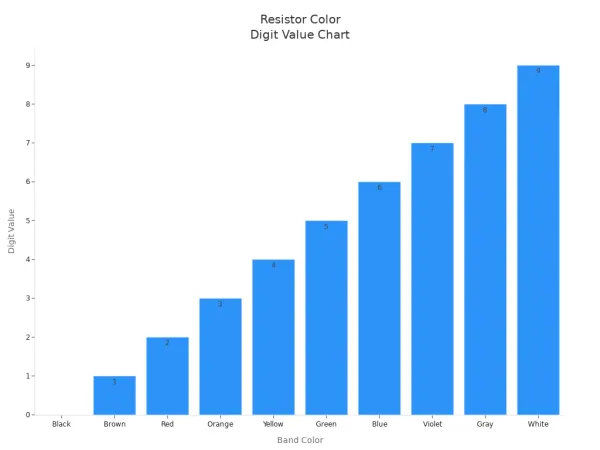
Tip: Keep this chart nearby when you work with electronic components or integrated circuits. It helps you avoid mistakes.
Reading the Chart
You can use the resistor color code chart to identify a 1k resistor in just a few steps. First, look at the color bands on the resistor. For a standard 1k resistor, you will see brown, black, and red bands. Brown stands for 1, black stands for 0, and red means you multiply by 100. This gives you 1,000 ohms. If you see a gold band at the end, it means the resistor has a tolerance of ±5%.
Follow these steps to read the value:
- Find the first band and match it to the digit value in the chart.
- Look at the second band and do the same.
- Check the third band for the multiplier.
- Read the fourth band for the tolerance.
You can use this method for any resistor you find in your electronics projects. The resistor color code chart makes it easy to check values and choose the right resistor for your circuit.
Decoding a 1k Ohm Resistor
Step-by-Step Process
You can master reading resistor color codes by following a clear process. When you pick up a 1k ohm resistor, you will see several colored bands on its body. Each band gives you important information about the resistor’s value and tolerance. Here is how you can decode a 1k resistor step by step:
- Identify the first two bands. These bands show the significant digits of the resistor value. For a 1k ohm resistor, the first band is brown (1), and the second band is black (0).
- Look at the third band. This band tells you the multiplier. On a 1k resistor, the third band is red, which means you multiply by 100.
- Calculate the resistance. Combine the digits from the first two bands (10) and multiply by the value from the third band (100). You get 10 × 100 = 1,000 ohms, which is the value of a 1k ohm resistor.
- Check the fourth band. This band shows the tolerance. Most 1k resistors have a gold band here, which means the resistor can vary by ±5% from its stated value.
Tip: Always start reading resistor color codes from the end where the bands are closer together. The tolerance band is usually set apart or wider.
This process helps you avoid mistakes and makes sure you use the correct 1k resistor in your electronic circuits. You will find this skill useful when working with integrated circuits and other electronic components.
Example: 1k Resistor
Let’s look at a real example of reading resistor color codes for a 1k ohm resistor. Imagine you have a resistor with four bands: brown, black, red, and gold. Here is how you decode it:
- First band (brown): This stands for 1.
- Second band (black): This stands for 0.
- Third band (red): This means you multiply by 100.
- Fourth band (gold): This shows a tolerance of ±5%.
You put the first two digits together to get 10. Then, you multiply by 100. The result is 1,000 ohms, which matches the value of a 1k ohm resistor. The gold band tells you the resistor can be 5% higher or lower than 1,000 ohms.
Here is a quick table to help you remember:
| Band Position | Color | Value |
|---|---|---|
| 1st | Brown | 1 (first digit) |
| 2nd | Black | 0 (second digit) |
| 3rd | Red | ×100 (multiplier) |
| 4th | Gold | ±5% (tolerance) |
When you practice reading resistor color codes, you will get faster and more confident. You will also avoid using the wrong 1k resistor in your projects. This skill is important for anyone who works with electronic components or integrated circuits.
Note: Some 1k ohm resistors may use five bands, especially in precision circuits. In that case, you will see brown, black, black, brown, and gold. The process for decoding is similar, but you use three digits before the multiplier.
You can use this method for any resistor, but it is especially helpful for the 1k ohm resistor because it is so common in electronic circuits. Keep practicing, and soon reading resistor color codes will become second nature.
Common Mistakes
When you read the color code on a resistor, you might make some common mistakes. Knowing these errors helps you avoid problems in your electronics projects. Here are the most frequent issues and how you can prevent them.
Band Order Errors
You may sometimes read the bands in the wrong direction. This mistake leads to the wrong resistor value. Always start from the end where the bands are closer together. The tolerance band, often gold, sits farther apart from the other bands. Follow these steps to avoid band order errors:
- Hold the resistor so the bands are on your left and the tolerance band is on your right.
- Read the first two bands for the main digits.
- Use the third band as the multiplier.
- Check the last band for tolerance.
Tip: If you see the gold band first, flip the resistor and start from the other end.
Color Confusion
Some colors on resistor bands look very similar, such as red and brown. This confusion can cause you to pick the wrong resistor for your circuit. You can use these strategies to tell the colors apart:
- Learn the color code system well.
- Notice the position of the tolerance band to help with orientation.
- Use memory tricks or mnemonics to remember the order of colors.
- Look at the brightness and clarity of each band.
- Try using a color chart or visualization tool if you have trouble seeing the difference.
A table of common mistakes can help you spot problems:
| Issue Identified | Description |
|---|---|
| Misidentifying Color Bands | You might read the bands as red/red/silver/gold, which gives the wrong value. |
| Measurement Inconsistency | Cheap testers or multimeters may show different readings for the same resistor. |
| Component Quality | Low-quality tools can make it hard to get accurate readings. |
Tolerance Band Issues
The tolerance band on a resistor tells you how much the actual value can change from the stated value. For a 1k resistor with a gold band, the real value can range from 950 to 1050 ohms. If you need more accuracy, look for resistors with a tighter tolerance band, such as brown or red. Always check the tolerance band before using the resistor in sensitive circuits.
Note: High-precision circuits need resistors with a 1% or 2% tolerance band. For most basic projects, a 5% tolerance works well.
1k Ohm Resistor Uses
Typical Circuits
You will find the 1k ohm resistor in many types of electronic circuits. This resistor helps you control current, set voltage levels, and protect sensitive parts. The 1k ohm resistor is a favorite in both simple and advanced designs. Here is a table showing where you often use this resistor:
| Circuit Type | Description |
|---|---|
| Voltage Dividers | Creates precise voltage levels for analog sensors and signal conditioning. |
| Current Limiting | Limits current through LEDs, preventing burnout and keeping circuits reliable. |
| Digital Pull-up/Down Configurations | Stabilizes voltage on signal lines, making digital circuits more reliable. |
| Filter Circuits | Shapes signals by working with capacitors to control frequency response. |
| Feedback Networks | Sets feedback ratios to control gain and stabilize amplifiers. |
| Precision Measurement Circuits | Helps get accurate readings in sensor circuits like Wheatstone bridges. |
Tip: If you use the wrong resistor value in a sensitive circuit, you might see inaccurate signals, unstable operation, or even damage from too much current.
Why Choose 1k Resistor
You often pick a 1k ohm resistor because it works well in many situations. This resistor acts as a pull-down resistor, grounding the base of a transistor when no control signal is present. It stops floating signals and leakage currents that could turn on the transistor by mistake. The 1k ohm resistor also balances current use and performance, making it a versatile choice.
- You use a 1k ohm resistor to keep transistor bases grounded when needed.
- It prevents unwanted signals and leakage currents in your circuits.
- The 1k ohm resistor gives you a good mix of low current draw and reliable operation.
If you use the wrong resistor value, your circuit might not work as planned. You could see unexpected behavior, errors in measurements, or even damage to your components. In precision circuits, even a small change in resistor value can cause big problems, like gain errors in amplifiers.
The 1k resistor stands out because it fits many roles in electronic components and integrated circuits. You can rely on it for both testing and final designs.
Choosing the Right 1k Resistor
Tolerance
When you choose a 1k ohm resistor, you need to look at its tolerance. Tolerance tells you how much the actual resistance can differ from the value marked on the resistor. For example, a 1k ohm resistor with a 5% tolerance can have a real value between 950 and 1050 ohms. Tolerance matters most in circuits where accuracy is important, such as in sensor circuits or integrated circuits.
Manufacturers group resistors into series based on their tolerance. The E6 series has a 20% tolerance, E12 has 10%, and E24 has 5%. The table below shows these series and their preferred values:
| Series | Tolerance | Preferred Values |
|---|---|---|
| E6 | 20% | 1.0, 1.5, 2.2, 3.3, 4.7, 6.8 |
| E12 | 10% | 1.0, 1.2, 1.5, 1.8, 2.2, 2.7, 3.3, 3.9, 4.7, 5.6, 6.8, 8.2 |
| E24 | 5% | 1.0, 1.1, 1.2, 1.3, 1.5, 1.6, 1.8, 2.0, 2.2, 2.4, 2.7, 3.0, 3.3, 3.6, 3.9, 4.3, 4.7, 5.1, 5.6, 6.2, 6.8, 7.2, 8.2, 9.1 |
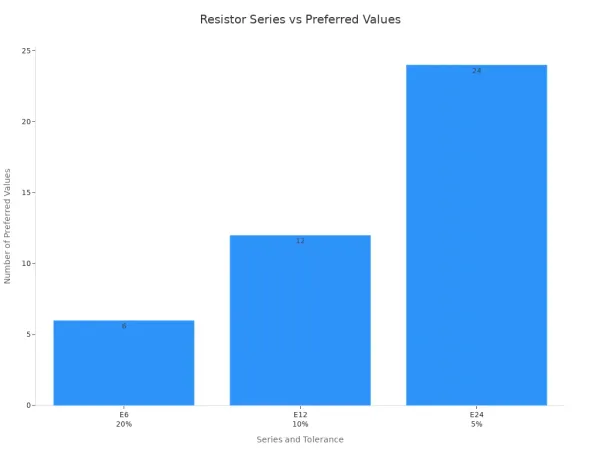
If you work on a project that needs high accuracy, pick a 1k ohm resistor with a lower tolerance, such as 1% or 2%. For general use, a 5% tolerance works well.
Power Rating
Power rating tells you how much energy a resistor can safely handle without overheating. When you use a 1k ohm resistor in a circuit, you must check its power rating to prevent damage. The most common power ratings for through-hole resistors are 1/4 watt and 1/2 watt. Power resistors can handle more, such as 3 watts, 5 watts, or even 25 watts. Surface-mount resistors often have lower ratings, like 1/16 watt or 1/10 watt.
| Resistor Type | Common Power Ratings |
|---|---|
| Standard Through-Hole | 1/4W, 1/2W |
| Power Resistors | > 1W (e.g., 3W, 5W, 25W) |
| Surface Mount | 1/16W (0402), 1/10W (0805) |
To find the right power rating for your 1k ohm resistor, use these formulas:
- P = V × I
- P = I² × R
- P = V² / R
After you calculate the expected power, choose a resistor with a rating at least twice as high. This step keeps your 1k ohm resistor safe and reliable in your circuit.
Tip: When selecting a 1k resistor for integrated circuits or other electronic components, always check both tolerance and power rating. This habit helps you build circuits that last longer and work better.
Buying 1k Resistors
Where to Buy
You can find a 1k resistor at many places, both online and offline. When you shop online, you get access to a wide range of resistor types and brands. Trusted online platforms make it easy to compare options and check reviews. Here are some reputable sources where you can buy resistors for your electronics projects:
- Alibaba: This platform offers many types of resistors, including the CFR-25JR-52-1K model. You can find prices ranging from $0.08 to $0.23 per piece. Alibaba also provides secure payment options, which helps you shop with confidence.
- TRR Semicon: This supplier focuses on quality and customer satisfaction. You can find a variety of resistors for different needs, making it a good choice for both beginners and experienced users.
Local electronics stores also stock resistors. You can visit these stores to see the components in person and ask for advice. Many hobby shops and electronics retailers carry 1k resistors, so you can get what you need quickly.
Tip: Always compare the 1k ohm resistor price across different sellers to get the best deal for your project.
What to Look For
When you choose a resistor, you need to check several important factors. Picking the right resistor helps your circuit work well and last longer. Use this table to guide your selection:
| Factor | Description |
|---|---|
| Power Dissipation Rating | Check how much heat the resistor can handle without damage. |
| Voltage Rating | Make sure the resistor can handle the voltage in your circuit. |
| Resistive Material | Choose the right material for your needs, such as metal film or wire-wound. |
| Temperature Range | Look for resistors that work well in the temperatures your project will face. |
| Noise | Some resistors create less noise, which is important for sensitive circuits. |
| Resistance and Tolerance | Confirm the value and tolerance match your project’s requirements. |
| Package and Mounting Styles | Pick a size and style that fits your circuit board or integrated circuit design. |
You should always match the resistor’s features to your project. For example, if you build a circuit with integrated circuits, you may need a resistor with low noise and tight tolerance. If you work in a high-power application, check the power rating first. Careful selection helps you avoid problems and keeps your electronics safe.
1k Resistor Quick Guide
Fast Reference Table
You can quickly identify a 1k resistor by checking its color bands. Use this table as a handy reference when you work with electronic components or integrated circuits:
| Band | Color | Value |
|---|---|---|
| Digit 1 | Brown (BN) | 1 |
| Digit 2 | Black (BK) | 0 |
| Multiplier | Red (RD) | 100Ω |
| Tolerance | Gold (GD) | ± 5% |
Keep this table nearby when you build or repair circuits. It helps you avoid mistakes and saves time when you need to pick the right resistor.
Memory Tips
Remembering resistor color codes can feel tricky at first. You can use these simple techniques to make it easier:
- Use a mnemonic: Try “Bright Boys Rave Over Young Girls But Veto Getting Wed.” Each word’s first letter matches a color: Black, Brown, Red, Orange, Yellow, Green, Blue, Violet, Grey, White. These colors stand for numbers 0 to 9.
- Try another phrase: “B.B. Roy of Great Britain Veto getting wed.” This phrase works the same way and helps you recall the order.
- Understand the multiplier: The multiplier band uses the same color order. Gold means “divide by 10,” and silver means “divide by 100.”
- Read from the correct end: Place the tolerance band (gold) on the right. Read the resistor from left to right for the value.
- Spot K values: Red in the multiplier band means the resistor is in the 1k range. Orange means 10k.
Practice these tips when you work with resistors in electronic circuits. You will soon read color codes quickly and confidently.
You can identify a 1k resistor by using the color code table below:
| Color | Digit | Multiplier | Tolerance |
|---|---|---|---|
| Brown | 1 | 10^0 | - |
| Black | 0 | 10^1 | - |
| Red | - | 10^2 | - |
| Gold | - | - | 5% |
Mastering this skill helps you quickly find resistor values and build circuits with confidence. You gain speed in troubleshooting and designing projects. To practice, try reading color codes on real parts or build a simple LED circuit. Tutorials and hands-on examples make learning easier.
FAQ
What does the color code on a resistor mean?
The color code shows you the value, multiplier, and tolerance of a resistor. Each color stands for a number. You read the bands from left to right, starting near the edge with the bands close together.
How do I know which end of the resistor to start reading?
Look for the band that is set apart or wider. This is the tolerance band. Start reading from the opposite end, where the bands are closer together.
Can I use a 1k resistor in any circuit?
You can use a 1k resistor in many circuits, but always check the voltage and power needs. Some circuits need different values for safety or performance. Always match the resistor to your project’s requirements.
What happens if I use the wrong resistor value?
If you use the wrong value, your circuit may not work as planned. You could damage parts, get wrong readings, or cause the circuit to fail. Always double-check the color code before use.
Are there special resistors for integrated circuits?
Yes, some integrated circuits need resistors with low noise or tight tolerance. Always check the datasheet for your component. Choose a resistor that matches the needs of your integrated circuit for best results.