How to Determine the Value of Color Coded Resistors
You can determine the value of a resistor by looking at the colored bands on its body. Start with the end closest to a band

You can determine the value of a resistor by looking at the colored bands on its body. Start with the end closest to a band and read each color in order. Use a resistor color code chart to match each color to a number. Multiply the numbers and apply the correct tolerance to get the resistor’s value. This simple process helps you learn how to read color coded resistors. Practice these steps to identify any resistor quickly.
Key Takeaways
- Start reading a resistor from the end with the tolerance band, usually gold or silver. This ensures you read the bands in the correct order.
- Use a resistor color code chart to match each color band to its corresponding number. This helps you accurately determine the resistor's value.
- Practice reading different resistors to improve your skills. The more you practice, the easier it becomes to identify resistance values quickly.
- Good lighting is crucial for reading color bands. Use bright LED lamps or daylight bulbs to avoid misreading similar colors.
- Utilize mnemonics to remember the order of color codes. Phrases like 'BB Roy of Great Britain had a Very Good Wife' can help you recall the colors easily.
How to Read Color Coded Resistors

Learning how to read color coded resistors helps you identify the value of any resistor quickly and accurately. You can follow a simple process to avoid mistakes and get reliable results. Here are the steps for reading resistors:
Identify the Starting End
You must start at the correct end of the resistor. Manufacturers use several methods to help you find the right starting point:
- The tolerance band, often gold or silver, sits at one end and is always read last.
- The band closest to a lead usually marks the starting end.
- A wider gap between the last band and the others can indicate the reading direction.
- The reading direction goes from left to right, with the gold or silver band on the right.
Tip: Always check for a gold or silver band. These colors never represent digits, so they help you avoid reading the resistor backward.
Read the Color Bands
Once you find the starting end, look at each color band in order. Most resistors have four, five, or six bands. Each band tells you something important:
- The first two bands show the significant digits of the resistance value.
- The third band acts as a multiplier.
- The last band gives the tolerance.
Ambient lighting affects your ability to read the colors. Poor lighting can make it hard to tell colors apart, especially similar ones like red and orange. Use a bright LED lamp or daylight bulb for best results. A magnifying glass can help you see small or closely spaced bands.
Use the Resistor Color Code Chart
You need a resistor color code chart to match each color to its value. The chart below shows the standard colors and what they represent:
| Color | Represents |
|---|---|
| Black | 0 |
| Brown | 1 |
| Red | 2 |
| Orange | 3 |
| Yellow | 4 |
| Green | 5 |
| Blue | 6 |
| Violet | 7 |
| Gray | 8 |
| White | 9 |
| Gold | 5% tolerance |
| Silver | 10% tolerance |
| No Color | 20% tolerance |
| Green | 0.5% tolerance |
You can also refer to the official IEC 60062 standard for resistor color codes. This standard defines how to read color coded resistors and what each band means. The chart below shows the numeric values for each color:
| Band Count | Color | Value |
|---|---|---|
| 1 | Black | 0 |
| 2 | Brown | 1 |
| 3 | Red | 2 |
| 4 | Orange | 3 |
| 5 | Yellow | 4 |
| 6 | Green | 5 |
| 7 | Blue | 6 |
| 8 | Violet | 7 |
| 9 | Gray | 8 |
| 10 | White | 9 |
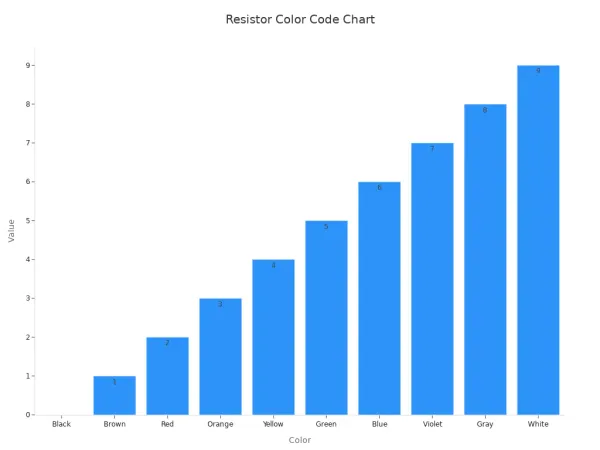
Resistors come in different types. Four-band resistors use two bands for digits, one for the multiplier, and one for tolerance. Five-band resistors use three bands for digits, one for the multiplier, and one for tolerance. The table below shows the differences:
| Feature | 4-Band Resistor | 5-Band Resistor |
|---|---|---|
| Number of Bands | 4 | 5 |
| Significant Digits | 2 | 3 |
| Multiplier Band | 1 | 1 |
| Tolerance Band | 1 | 1 |
| Typical Tolerance | ±5%, ±10%, ±20% | ±1%, ±2%, ±0.5%, ±0.25% |
| Precision | Standard | High |
| Common Use | General electronics | Precision circuits |
Calculate Resistance Value
After you match the colors to their values, you can calculate the resistance. Use the formula:
| Component | Description |
|---|---|
| a | First digit of the resistance value |
| b | Second digit of the resistance value |
| c | Multiplier value |
| d | Tolerance value |
| Formula | R = ab × c ± d |
For example, if you see brown, blue, red, and gold bands, you get:
- Brown = 1 (first digit)
- Blue = 6 (second digit)
- Red = 100 (multiplier)
- Gold = 5% (tolerance)
The calculation is 16 × 100 = 1600 Ohms, with a tolerance of ±5%. You can now read the resistor value with confidence.
Note: Double-check the color order and use good lighting. Misreading colors or band sequence can cause mistakes in your calculations.
By following these steps for reading resistors, you will master how to read color coded resistors and avoid common errors.
Resistor Color Code Chart
Understanding the resistor color code chart helps you read resistor values quickly and accurately. You can use this chart to match each color band to its number, multiplier, and tolerance. This skill is important for both 4-band and 5-band resistors.
Color to Number Table
You will find that each color on a resistor stands for a specific number. The table below shows the color, its digit value, the multiplier, and the tolerance. Use this table as your main reference when reading any resistor color code.
| Band Color | Digit Value | Multiplier | Tolerance (%) |
|---|---|---|---|
| Black | 0 | ×1 (10⁰) | |
| Brown | 1 | ×10 (10¹) | ±1 |
| Red | 2 | ×100 (10²) | ±2 |
| Orange | 3 | ×1,000 (10³) | |
| Yellow | 4 | ×10,000 (10⁴) | |
| Green | 5 | ×100,000 (10⁵) | ±0.5 |
| Blue | 6 | ×1,000,000 (10⁶) | ±0.25 |
| Violet | 7 | ×10,000,000 (10⁷) | ±0.1 |
| Gray | 8 | ×100,000,000 (10⁸) | ±0.05 (rare) |
| White | 9 | ×1,000,000,000 (10⁹) | |
| Gold | ×0.1 (10⁻¹) | ±5 | |
| Silver | ×0.01 (10⁻²) | ±10 | |
| No Color | ±20 |
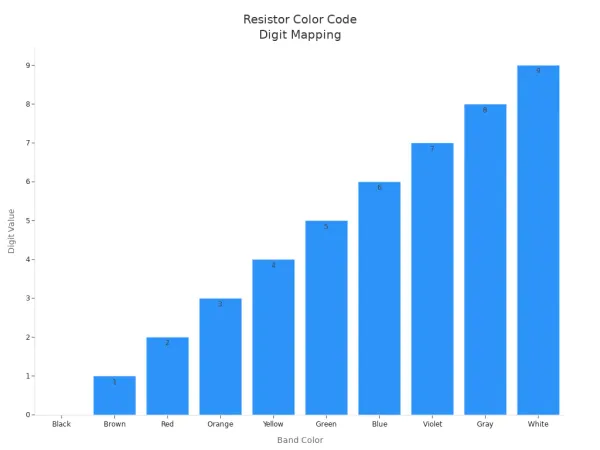
Tip: Keep this resistor color code chart nearby when you work with resistors. It makes reading values much easier.
Multipliers and Tolerances
The multiplier tells you how many zeros to add to the digits you read. The tolerance shows how much the actual resistance can vary from the value you calculate. For example, a 5% tolerance means the real resistance can be 5% higher or lower than the marked value.
| Color | Multiplier | Tolerance (%) |
|---|---|---|
| Black | ×1 (10⁰) | |
| Brown | ×10 (10¹) | ±1 |
| Red | ×100 (10²) | ±2 |
| Orange | ×1,000 (10³) | |
| Yellow | ×10,000 (10⁴) | |
| Green | ×100,000 (10⁵) | ±0.5 |
| Blue | ×1,000,000 (10⁶) | ±0.25 |
| Violet | ×10,000,000 (10⁷) | ±0.1 |
| Gray | ×100,000,000 (10⁸) | ±0.05 (rare) |
| White | ×1,000,000,000 (10⁹) | |
| Gold | ×0.1 (10⁻¹) | ±5 |
| Silver | ×0.01 (10⁻²) | ±10 |
| None | ±20 |
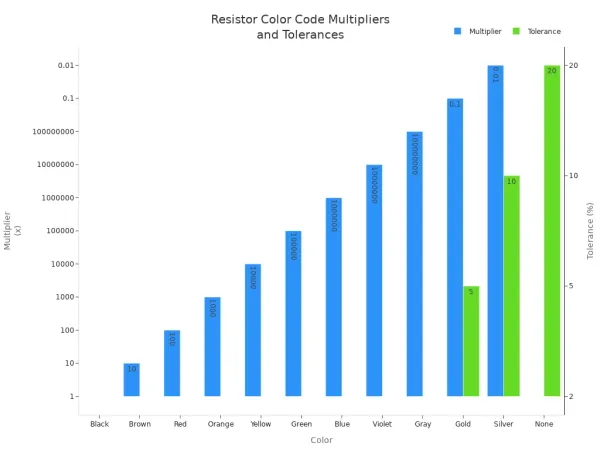
You use the resistor color code chart for both 4-band and 5-band resistors. For a 4-band resistor, the first two bands give you the digits, the third band is the multiplier, and the last band is the tolerance. For a 5-band resistor, the first three bands are digits, the fourth is the multiplier, and the fifth is the tolerance. Always check the tolerance band to know how much the value can change. High-precision circuits need resistors with low tolerance, such as 1%. Less critical circuits can use resistors with 5% or 10% tolerance.
Read Resistors Step by Step

4-Band Example
You can read resistors with four bands by following a simple process. This method helps you avoid mistakes and get the correct value every time. Here is a step-by-step guide for reading resistor color codes on four band resistors:
-
Orient the Resistor Correctly
Hold the resistor so the bands are closest to your left hand. The tolerance band (often gold or silver) should be on the right. -
Read the Significant Digits
Look at the first two color bands. These bands give you the base value. For example, if the first band is red and the second band is violet, you get 2 and 7. -
Apply the Multiplier
The third band shows the multiplier. If the third band is yellow, you multiply the base value by 10,000. -
Check the Tolerance
The last band tells you the tolerance. Gold means ±5%, silver means ±10%.
Tip: Good lighting helps you see the colors clearly. Use a lamp or daylight to avoid misinterpreting colors.
Example Calculation:
Suppose you have a resistor with these bands:
- Red (2)
- Violet (7)
- Yellow (×10,000)
- Gold (±5%)
You multiply 27 by 10,000. The result is 270,000 ohms (270 kΩ) with a tolerance of ±5%. You can use this process for all four band resistors.
5-Band Example
You may need to read resistors with five bands for more precise values. The process is similar, but you use three bands for the digits. This method gives you greater accuracy when reading resistor color codes.
- The first three bands show the significant digits.
- The fourth band is the multiplier.
- The fifth band is the tolerance.
Example Calculation:
Imagine you have a resistor with these bands:
- Brown (1)
- Green (5)
- Black (0)
- Red (×100)
- Brown (±1%)
First, combine the digits: 1, 5, and 0 make 150. Multiply 150 by 100. The result is 15,000 ohms (15 kΩ) with a tolerance of ±1%. You can read resistors with five bands using this method for high-precision circuits.
Note: Five band resistors use an extra digit for more exact values. Always check the number of bands before you start reading.
Applying the Multiplier and Tolerance
When you read resistors, you must apply the multiplier and tolerance to get the final value. The multiplier tells you how many zeros to add. The tolerance shows how much the actual resistance may vary.
| Step | Action |
|---|---|
| Find Digits | Use the first bands for the base value |
| Apply Multiplier | Multiply the base value by the multiplier |
| Check Tolerance | Use the last band for tolerance |
If you misread the multiplier or tolerance band, you may get the wrong resistance value. This mistake can cause problems in your circuit. You might damage components or make the circuit fail. Always double-check the bands and use a chart when reading resistor color codes.
⚡ Quick Tip:
Always compare your result with the resistor color code chart. This step helps you avoid errors and keeps your electronics safe.
You can read resistors with confidence by following these steps. Practice with different resistors to improve your skills. You will find that reading resistor color codes becomes easier with experience.
Common Mistakes with Resistor Color Codes
Reading resistor color codes can seem simple, but you may run into common mistakes that lead to wrong values. If you know what to watch for, you can avoid errors and keep your circuits working as expected.
Wrong Reading Direction
You must always start reading a resistor from the correct end. If you read the bands in the wrong direction, you will mix up the significant digits and the multiplier. The first band gives you the first digit, the second band gives the second digit, and the third band is the multiplier. If you reverse this order, you will get the wrong resistance value. Always look for the tolerance band, usually gold or silver, and make sure it is on the right side.
Tip: Hold the resistor so the band closest to the lead is on your left. The tolerance band should be on your right.
Here is a table showing frequent mistakes:
| Mistake Type | Description |
|---|---|
| Incorrect Order of Reading | Start reading from the correct end to avoid reversing the sequence, which alters resistance values. |
| Misidentification of Colors | Poor lighting or subtle variations can lead to misreading. Use good lighting and magnification. |
| Confusion Between Similar Colors | Colors like red and orange can be confused; practice and use reference tools to ensure accuracy. |
| Impact of Color Blindness | Color vision deficiencies can hinder reading; use apps or multimeters to measure directly. |
Misreading Colors
You may find it hard to tell some colors apart, especially if the lighting is poor. Red, orange, and brown often look similar. Green and blue can also be confusing. If you have trouble seeing colors, you can use a magnifying glass or a bright lamp. Some people have color vision deficiencies, so using a multimeter or a color reading app can help.
- Poor lighting and subtle color variations can lead to misreading resistor color bands.
- Similar colors like red, orange, and brown or green and blue are often confused, especially in inadequate lighting.
- Individuals with color vision deficiencies may find it challenging to accurately read color-coded resistors.
Note: Practice reading resistor color coding with different resistors to improve your accuracy.
Tolerance Band Errors
The tolerance band tells you how much the actual resistance can vary from the stated value. If you misidentify this band, you may choose a resistor that does not meet your circuit’s needs. For example, a 5% tolerance on a 100k ohm resistor means the real value can range from 95k to 105k ohms. In precision circuits, you need exact resistance. If you pick the wrong tolerance, your circuit may not work as planned.
- Tolerance indicates the acceptable variance in a resistor's actual resistance from its stated value.
- For example, a 5% tolerance on a 100k ohm resistor means its resistance can range from 95k to 105k ohms.
- In precision circuits, exact resistance is crucial for proper functionality, and misidentifying tolerance can lead to incorrect resistance values, affecting circuit performance.
⚠️ Always double-check the tolerance band before you install a resistor.
If you pay attention to these common mistakes, you will read resistor color codes more accurately and keep your electronics safe.
Mnemonics for Resistor Color Codes
Popular Memory Aids
You can use mnemonics to remember the order of resistor color codes. These memory aids turn a list of colors into a simple phrase or sentence. Many electronics teachers recommend using mnemonics because they help you recall the color order quickly and accurately.
Here are some of the most popular mnemonics:
- BB Roy of Great Britain had a Very Good Wife
This phrase helps you remember: Black, Brown, Red, Orange, Yellow, Green, Blue, Violet, Gray, White. - Big Boys Race Our Young Girls but Violet Generally Wins
- Bright Boys Rave Over Young Girls But Veto Getting Wed
- Black Bears Raid Our Yellow Green Bins Violently Grabbing Whatever Goodies Smell Nice
- Bachelor Boys Rush Our Young Girls But Veronica Goes Wild for Gold or Silver Necklaces
- Bad Booze Rots Our Young Guts But Vodka Goes Well
Using a mnemonic like "BB Roy of Great Britain had a Very Good Wife" helps you match each color to its number. For example, Black is 0, Brown is 1, Red is 2, and so on.
You can also use the rainbow phrase "ROY G. BIV" for the middle colors: Red, Orange, Yellow, Green, Blue, Violet.
Mnemonics do more than help you memorize. They also make it easier to identify resistors quickly, reduce mistakes, and speed up your work when building or fixing circuits.
Quick Recall Tips
You can use a few simple tricks to remember the resistor color order:
- Pick a mnemonic that is easy for you to say and remember. For example, "Bright Boys Rave Over Young Girls But Veto Getting Wed" covers all ten colors.
- Repeat the mnemonic out loud when you read resistors. This practice helps you remember the order.
- Write the color order on a sticky note or in your notebook. Keep it nearby when you work with resistors.
- Practice with real resistors. The more you use the mnemonic, the faster you will recall the color code.
- Remember that mnemonics help you avoid errors. They let you check your answers without always using a chart or multimeter.
Tip: Using mnemonics not only helps you remember the color order but also makes resistor identification faster and more accurate. With practice, you will rely less on charts and more on your memory.
You can master resistor color code basics by practicing with real resistors. When you read colored bands, you improve your ability to find the correct resistance. Try these steps:
- Check the number of bands on each resistor.
- Read the bands in the right order.
- Match each color to its value.
Repeated practice helps you recognize resistance values faster. You will notice that keeping a color code chart or using mnemonics makes reading resistor value easier. Good lighting lets you see colors clearly. Interactive exercises and helpful articles can support your learning. With time, you will read resistance quickly and accurately. Refer to this guide whenever you need help.
FAQ
How do you know which end of a resistor to start reading the bands?
You look for the tolerance band. This band is usually gold or silver. Place this band on your right. Start reading the bands from the left side. The first band is closest to the lead.
What do the different bands on a resistor mean?
Each band gives you important information. The first bands show the digits of the resistance value. The next band is the multiplier. The last band is the tolerance. You use all bands to find the resistor’s value.
Can you use a chart to help read the bands?
Yes, you can use a resistor color code chart. This chart matches each band color to a number. You check the bands on your resistor and compare them to the chart. The chart helps you avoid mistakes.
Why do some resistors have more bands than others?
Some resistors have more bands for higher accuracy. Four bands are common for basic resistors. Five bands give you more precise values. Six bands add extra information, like reliability. You choose the resistor based on your needs.
What should you do if you cannot see the bands clearly?
You can use a magnifying glass or a bright lamp. Good lighting helps you see the bands. If you still cannot read the bands, you can use a multimeter. This tool measures resistance without reading the color bands.