Why 3 Input NOR Gates Matter in Circuit Design
You often see the nor gate in digital circuit design because of its unique logic. A 3 input nor gate gives you a single outp
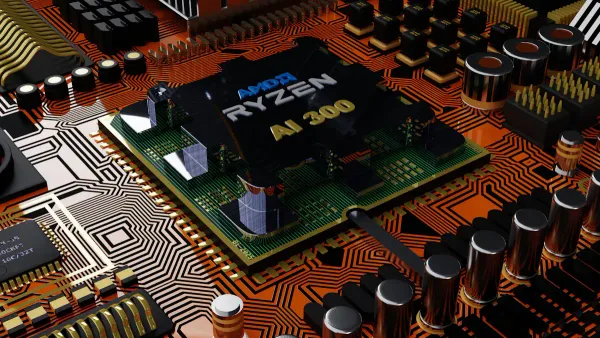
You often see the nor gate in digital circuit design because of its unique logic. A 3 input nor gate gives you a single output that turns on only when all three inputs stay off. This simple rule helps you build complex logic with fewer parts. In consumer electronics, the 3 input nor appears in remote controls, gaming consoles, and even home automation systems. You can find this gate in calculators and keyboards, where it helps capture keystrokes. The nor gate stands out because you can use it to create any other logic gate, making it a powerful tool in any circuit.
Key Takeaways
- A 3-input NOR gate outputs high only when all three inputs are low, making it simple and predictable to use.
- You can build any basic logic function using just 3-input NOR gates, which reduces parts and saves power.
- Using 3-input NOR gates makes circuits smaller, cheaper, and easier to design and maintain.
- These gates appear in many devices like computers, alarms, and control systems, helping make them reliable and safe.
- While NOR gates work well for simple and low-power designs, they may be slower than other gates in high-speed systems.
Importance of 3 Input NOR
Why NOR Gates Matter
You see the 3 input nor gate in almost every area of digital circuit design. This gate plays a key role in modern electronics because it helps you build complex systems with fewer parts. When you use a 3 input nor, you can combine three signals into one gate. This reduces the number of gates you need, which makes your circuits smaller and less expensive. You also save power because the nor gate uses fewer transistors than other gates like AND or OR.
The 3 input nor gate stands out in digital circuit design because it lets you create many different logic functions. You can use it to make NOT, AND, OR, NAND, and even XOR gates. This means you only need one type of gate to build almost any digital system. You find nor gates in microprocessors, memory units, and communication systems. They also help control robots, cars, and even medical devices. Their reliability and flexibility make them a favorite in safety systems, such as airbag deployment and engine control.
You can see how important the nor gate is by looking at history. In the 1960s, engineers created the first commercial integrated circuits using the 3 input nor gate. NASA used this gate in the Apollo Guidance Computer, which helped astronauts land on the moon. This success proved that the nor gate could handle tough jobs and work in critical systems.
Unique Features
The 3 input nor gate has some special features that set it apart from other gates. It gives you a high output only when all three inputs are low. If any input is high, the output drops to low right away. This is different from other multi input gates, like AND or OR, where the output depends on different rules. The unique behavior of the multi input nor gate lets you use it for universal negation and to build complex logic with fewer gates.
You can use the 3 input nor to make your designs more efficient. By combining several signals into one gate, you cut down on the number of parts you need. This makes your circuits easier to design and cheaper to build. The nor gate also helps you save space and power, which is important in devices like smartphones and tablets.
Here is a quick look at what makes the 3 input nor gate so useful:
- You can use it to create any basic logic function.
- It reduces the number of gates in your design.
- It uses fewer transistors, which saves power.
- It works well in many types of digital circuit design, from computers to cars.
When you choose the 3 input nor gate, you get a tool that helps you build smarter, faster, and more reliable circuits.
3 Input NOR Gate Operation

Truth Table
You can understand the operation of a 3 input NOR gate by looking at its logic design and truth table. This table shows every possible combination of the three inputs (A, B, and C) and the output for each case. The output is HIGH (1) only when all inputs are LOW (0). If any input goes HIGH, the output drops to LOW (0). This behavior matches the operation of a 2 input NOR gate, but now you work with three signals instead of two.
| Inputs (A, B, C) | Output (3-input NOR) |
|---|---|
| 0, 0, 0 | 1 |
| 0, 0, 1 | 0 |
| 0, 1, 0 | 0 |
| 0, 1, 1 | 0 |
| 1, 0, 0 | 0 |
| 1, 0, 1 | 0 |
| 1, 1, 0 | 0 |
| 1, 1, 1 | 0 |
You can see from the table that the output stays HIGH only when all three inputs are LOW. This simple rule makes the operation of nor gate easy to predict and use in your projects.
Boolean Logic
The logic behind a 3 input NOR gate follows a clear pattern. You take the OR of all three inputs, then invert the result. In Boolean terms, the operation looks like this:
Y = ¬(A + B + C)
Here, Y is the output, and A, B, and C are the inputs. The plus sign (+) means OR, and the line over the expression means NOT. This Boolean equation tells you that the output will be HIGH only if A, B, and C are all LOW. If any input is HIGH, the output becomes LOW.
You use this logic in many digital circuits. The operation of nor gate helps you create control signals, memory elements, and decision-making parts in your designs. By understanding the truth table and Boolean logic, you can build reliable and efficient circuits.
NOR Gate Universality
Building Logic Functions
You can use a nor gate to build almost any logic function you need. This makes the nor gate a universal building block in digital electronics. When you tie all three inputs of a 3-input nor gate together, it acts as a NOT gate. If you want to create an OR gate, you can connect two nor gates in a row. The first nor gate combines your signals, and the second nor gate inverts the result. This setup works because a nor gate is a combination of or gate and not gate.
Here is a table that shows how you can use 3-input nor gates to make other basic gates:
| Logic Gate | Construction Using 3-Input NOR Gates | Explanation |
|---|---|---|
| NOT | Tie all three inputs together and use the NOR gate output | NOR gate with all inputs tied acts as an inverter |
| OR | Invert the output of a NOR gate (double negation) | OR = ((A + B)')' achieved by cascading NOR gates |
| AND | Invert inputs first, then NOR the results | Using De Morgan's theorem: (A + B)' = A'B', so NOR with inverted inputs yields AND |
| XOR | Combine Ex-NOR gate output with a NOT gate | XOR = A'B + AB', constructed by NOR gates implementing Ex-NOR followed by inversion |
| NAND | Use NOR gates to invert the AND output | NAND is the complement of AND, achievable by adding a NOR gate inverter stage |
You can also use a 3-input nor gate as a 2-input gate by holding one input low. This trick lets you use the same nor gate for many different logic needs in your circuit.
Simplifying Circuits
When you use nor gates, you make your circuit simpler and more efficient. You do not need many different types of gates. Instead, you can use just one type—the nor gate—to build all the logic you need. This reduces the number of parts in your design, which saves space and lowers cost.
In programmable logic devices, you often see nor gates used in tree structures. This setup helps your circuit run faster because it reduces the time signals need to travel. The CD4025 IC is a good example. It gives you three independent 3-input nor gates in one package. You can use this IC to build many logic functions in a small space. When you design with nor gates, you get reliable performance and easy expansion for future needs.
Tip: Using nor gates in your design helps you create flexible and powerful circuits with fewer components.
Applications of NOR Gate

Digital Systems
You find 3 input NOR gates at the heart of many digital systems. These gates help you build memory units, microprocessors, and other important parts of computers. In digital systems, you use NOR gates to create latches and flip-flops. These circuits store data and keep information safe until you need it. Flip-flops made from NOR gates can hold one bit of data. When you connect several flip-flops, you get registers that store multi-bit values. These registers help your system remember numbers, letters, or instructions.
- NOR gates form the building blocks for static RAM, which stores data in computers and other digital systems.
- You use NOR gates to design sequential logic circuits. These circuits keep track of what happened before, so your system can make decisions based on past events.
- Microprocessors rely on NOR gates to perform arithmetic and logic operations. These gates help control how your system processes information.
NOR gates give you the power to build reliable and flexible digital systems. You can use them to create memory, control logic, and data processing units.
Automation and Control
In automation and control systems, you need circuits that work well even in noisy environments. The CD4025 3-input NOR gate IC uses CMOS technology, which gives you high noise immunity. This means your system can ignore unwanted signals and keep working without errors. The inputs of the CD4025 have special diodes that protect against static electricity and electrical noise. These features help your automation systems stay stable and reliable, even in factories or industrial plants.
You often use NOR gates in control panels, motor controllers, and safety systems. When you design with NOR gates, you make sure your system responds only to the right signals. This reduces false alarms and keeps your machines running smoothly.
Real-World Examples
You see the applications of nor gate in many everyday systems. In alarm systems, a 3 input NOR gate lets you set up fail-safe logic. The output goes high only when all safety and security conditions are unmet. This means your alarm triggers only when it should, making your building or home safer. In access control systems, NOR gates help prevent unauthorized entry by checking several conditions at once.
Traffic light control circuits often use logic gates to manage signals. While AND gates are common, you can use NOR gates for special timing or safety features. In some designs, NOR gates help make sure lights do not turn green unless all other signals are safe.
You also find NOR gates in RGB LED color cycling circuits, calculators, and remote controls. These gates help your devices make decisions and respond to your actions.
Here is a table showing two popular ICs that feature 3 input NOR gates:
| Integrated Circuit | Description | Number of Gates | Inputs per Gate | Operating Voltage | Pin Highlights | Notes |
|---|---|---|---|---|---|---|
| CD4025 | CMOS IC with three 3-input NOR gates | 3 | 3 (A, B, C) | 3 to 15V (some versions up to 20V) | VDD (pin 14), GND (pin 7), Inputs A1-A3, B1-B3, C1-C3, Outputs Q1-Q3 | Also available as NTE4025, MC14025, HCF4025, TC4025, HEF4025, CD4025BE |
| 74HC27 | Triple 3-input NOR gate IC alternative | 3 | 3 | Standard 74HC logic levels | Standard 74HC pin configuration | Alternative to CD4025 with 3-input NOR gates |
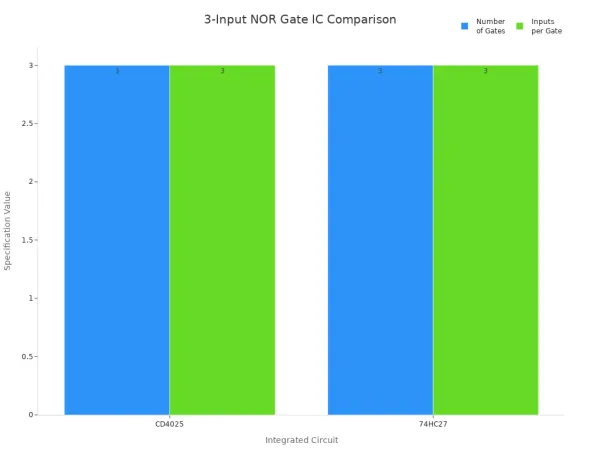
Tip: When you choose ICs like the CD4025 or 74HC27, you get reliable performance and easy integration into your digital systems.
You also need to think about reliability in mission-critical systems. Three-input NOR gates have input pins that you can assign carefully to improve reliability. By choosing which signals go to which pins, you can reduce the chance of errors from electrical noise or radiation. This makes your systems safer and more dependable, especially in space, medical, or safety-critical applications.
The applications of nor gate reach into every part of modern life. You use them in computers, automation, alarms, and many other systems. These gates help you build smarter, safer, and more reliable technology.
Benefits and Drawbacks
Simplicity and Cost
You gain several practical benefits when you use 3-input NOR gates in your circuit designs. These gates help you simplify complex Boolean expressions. You can reduce the number of gates needed, which leads to smaller and more compact circuits. This simplicity makes troubleshooting and maintenance easier for you. You also save money because NOR gates are cost-effective, especially when you build large-scale systems.
- You need fewer gates for the same logic function.
- You spend less time and effort on repairs.
- You lower your overall project costs.
- You make your systems easier to design and expand.
The universal nature of NOR gates means you can create any logic function with just one type of gate. This flexibility adds to their cost efficiency and makes them a smart choice for many digital systems.
Versatility
You find that 3-input NOR gates offer strong versatility in digital electronics. Both NOR and NAND gates are universal, so you can use them to build any logic circuit. NOR gates work well in control and switching systems where reliability and simplicity matter most. You see NOR gates in arithmetic circuits and basic control logic. NAND gates often appear in high-speed and complex systems, but NOR gates shine when you need low power and straightforward design.
| Parameter | NAND Gate Characteristics | NOR Gate Characteristics |
|---|---|---|
| Universality | Can implement all other logic gates (AND, OR, NOT, etc.) | Also universal, can implement all other logic gates |
| Power Requirement | Generally efficient, often lower power consumption | Requires very low power |
| Design Simplicity | Widely used in complex circuits and microprocessors | Simpler design, especially suited for control and switching circuits |
| Speed | Faster response, preferred in high-speed applications | Slower than NAND gates, less used in large complex circuits |
| Usage | Common in complex and high-speed digital circuits | Valued for simplicity and reliability in control systems |
You can rely on NOR gates to build reliable systems that do not need high-speed operation. Their ability to perform all basic logic functions makes them a core part of many digital systems.
Limitations
You should know about some limitations when you choose 3-input NOR gates for your designs. NOR gates respond slower than NAND gates, so they may not suit high-speed or very complex systems. You might see performance issues if you use them in large processors or memory devices. NOR gates work best in simple control systems and basic arithmetic circuits.
- You may face slower response times in fast digital systems.
- You might need to use other gates for advanced or high-speed applications.
- You could see limits in scalability for very large systems.
You get great simplicity and reliability with NOR gates, but you need to consider speed and complexity before using them in every system.
You see 3 input NOR gates as key tools in circuit design. These gates help you build reliable, flexible, and cost-effective systems. Their universality lets you create many logic functions with fewer parts. In new technologies like IoT and AI hardware, you find these gates offer:
- Low power use for energy-saving devices
- Fault tolerance for dependable operation
- High circuit density and fast switching in advanced designs
You can count on 3 input NOR gates to stay important as electronics keep evolving. Their adaptability ensures a strong future in digital innovation.
FAQ
What does a 3-input NOR gate do?
A 3-input NOR gate gives you a high output only when all three inputs are low. If any input goes high, the output drops to low. You can use this gate to combine and control signals in digital circuits.
Can you build other logic gates using only NOR gates?
Yes! You can create NOT, AND, OR, NAND, and XOR gates using just NOR gates. This makes NOR gates universal. You can design almost any digital logic circuit with them.
Where do you find 3-input NOR gates in real life?
You find 3-input NOR gates in computers, calculators, alarm systems, and traffic lights. These gates help control signals, store data, and keep systems safe and reliable.
Why should you use a 3-input NOR gate instead of several 2-input gates?
A 3-input NOR gate lets you combine three signals in one step. You save space and reduce the number of parts in your circuit. This makes your design simpler and more cost-effective.
Are there any drawbacks to using 3-input NOR gates?
You may notice slower response times compared to NAND gates. Large or high-speed systems might not work as well with NOR gates. For simple control circuits, though, NOR gates work great.
Tip: Always check your circuit’s speed and size needs before choosing NOR gates.