Integrated Circuits and How They Drive Modern Electronics
Integrated circuits serve as the building blocks of modern electronics. These tiny chips combine millions, sometimes billions, of components to handle tasks such as data processing, memory storage, and signal control.
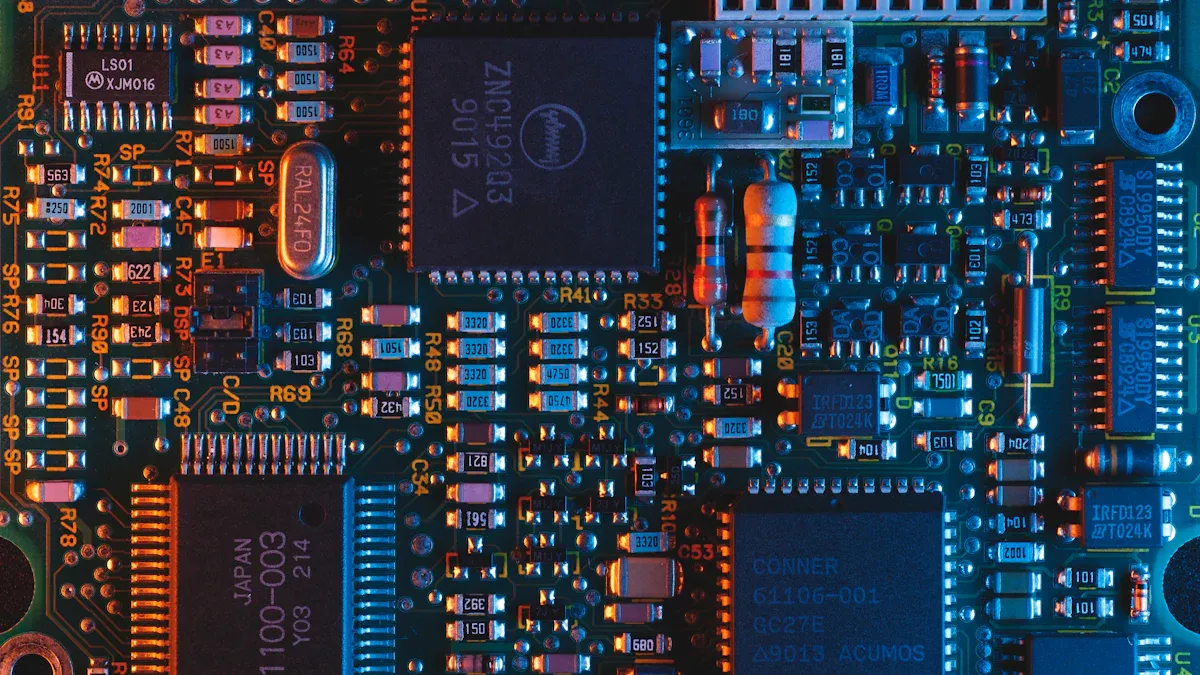
Integrated circuits serve as the building blocks of modern electronics. These tiny chips combine millions, sometimes billions, of components to handle tasks such as data processing, memory storage, and signal control. Over the past fifty years, integrated circuits have allowed devices to become smaller, faster, and more energy efficient. Today, smartphones use advanced integrated circuits for multitasking, graphics, and wireless communication. This technology has transformed large, bulky machines into compact devices that fit in a pocket or on a wrist. The growing complexity and density of integrated circuits continue to push the boundaries of what modern electronics can achieve.
Key Takeaways
-
Integrated circuits combine many tiny electronic parts on a single chip, making devices smaller, faster, and more reliable.
-
Moore’s Law shows that transistor counts double about every two years, driving powerful advances in electronics.
-
Key components like transistors, resistors, capacitors, and diodes work together inside chips to process signals and manage power.
-
Advanced manufacturing techniques, including 3D stacking, help create more complex and efficient integrated circuits.
-
Integrated circuits enable modern devices to handle signal processing, power management, data storage, and communication efficiently.
Integrated Circuits Overview
What Are Integrated Circuits
Integrated circuits are tiny electronic assemblies that combine many components onto a single piece of semiconductor material, usually silicon. These components include transistors, resistors, capacitors, and diodes. By placing all these parts together, integrated circuits can perform complex electronic functions inside a compact chip. This design replaces older setups that used many separate parts, making devices smaller and more reliable.
Formally, integrated circuits are complex three-dimensional structures. They use layers of conductors, dielectrics, and semiconductor films. Engineers build these layers on a very pure silicon wafer. The process uses special techniques like lithography and etching to create detailed patterns. The size of each part inside the chip affects how well it works. Smaller parts usually mean better performance.
Integrated circuits come in several main types.
-
Digital ICs handle binary signals and work in logic gates, microprocessors, and memory devices.
-
Analog ICs process continuous signals and are found in amplifiers, voltage regulators, and sensors.
-
Mixed-signal ICs combine both digital and analog functions, such as in converters.
Engineers also classify integrated circuits by their complexity.
-
Small Scale Integration (SSI) chips have up to 100 transistors.
-
Medium Scale Integration (MSI) chips have up to 1,000 transistors.
-
Large Scale Integration (LSI) chips have up to 10,000 transistors.
-
Very Large Scale Integration (VLSI) chips have up to 1 million transistors.
-
Ultra Large Scale Integration (ULSI) and Giant Scale Integration (GSI) chips can have millions or even billions of transistors.
Tip: Most modern microchips use VLSI or ULSI technology, which allows them to fit billions of transistors into a single chip.
Evolution and Moore’s Law
The story of integrated circuits began in the mid-20th century. Early inventors and engineers made important discoveries that shaped today’s technology. The table below highlights some key milestones:
|
Year |
Milestone Description |
Key Figures |
|---|---|---|
|
1949 |
Patent filed for a semiconductor device with integrated transistors |
Werner Jacobi |
|
1952 |
Concept of the integrated circuit proposed |
Geoffrey Dummer |
|
1958 |
First working integrated circuit demonstrated |
Jack Kilby |
|
1959 |
Silicon-based integrated circuit invented |
Robert Noyce |
|
Early 1960s |
Development of planar integrated circuit |
Jay Last |
|
Mid-1960s |
Development of p-n junction isolation |
Kurt Lehovec |
|
1968 |
Invention of self-aligned gate technology |
Federico Faggin |
|
1971 |
Introduction of the first microprocessor, the Intel 4004 |
Intel Corporation |
|
1980s |
CMOS technology becomes dominant |
Industry-wide |
|
Present |
Continuous advancements in chip density and complexity following Moore’s Law |
Various |
In 1965, Gordon Moore made an important observation. He noticed that the number of transistors on integrated circuits doubled about every two years. This idea became known as Moore’s Law. For over 50 years, engineers confirmed this trend. Transistor counts kept doubling, which made computers and other devices much more powerful.
Modern microprocessors now contain billions of transistors. For example, the Apple M1 Ultra chip has 114 billion transistors. Early integrated circuits only had a few hundred components. This huge increase shows how far technology has come.
Today, companies use advanced manufacturing methods to make even smaller transistors. They have reached process nodes as small as 3 nanometers. IBM has announced a chip with 50 billion transistors using a 2 nm process. However, making transistors this small is very hard and expensive. Engineers now use new designs, like stacking chips in 3D, to keep improving performance.
Moore’s Law still guides the industry, but progress has slowed as physical limits approach. Even so, integrated circuits remain at the heart of modern electronics, driving innovation in everything from smartphones to supercomputers.
Inside Integrated Circuits
Key Components
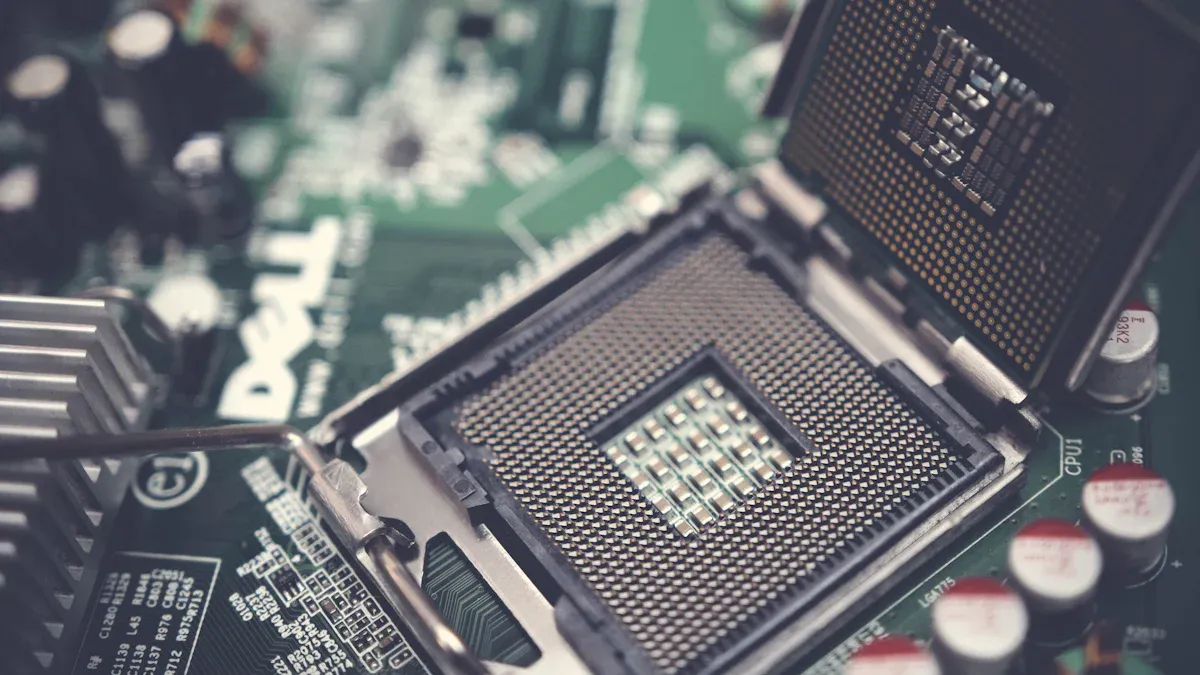
Integrated circuits contain several important parts that work together to perform electronic tasks. Each component has a special job inside the chip. The table below shows the main components and their functions:
|
Component |
Function |
|---|---|
|
Transistors |
Act as tiny switches or amplifiers controlling electrical signals; fundamental for logic gates and signal processing. |
|
Resistors |
Regulate current to stabilize and manage signals within the circuit. |
|
Capacitors |
Store electrical energy and help stabilize signals by managing charge and timing. |
|
Diodes |
Control the direction of current flow, protecting circuits and enabling signal rectification. |
|
Interconnects |
Provide communication pathways connecting all components, enabling signal transmission across the IC. |
Engineers design integrated circuits with these components to handle many types of tasks.
-
Transistors control electrical signals and act as switches or amplifiers.
-
Resistors and capacitors help stabilize and manage signals by regulating current and storing energy.
-
Diodes make sure current flows in the right direction, which protects the circuit.
-
Interconnects link all the parts, allowing signals to move quickly across the chip.
Note: Without these key components, integrated circuits could not perform the complex operations found in modern devices.
How ICs Work
The components inside integrated circuits interact in precise ways to complete both digital and analog functions. Transistors switch on and off to represent the 1s and 0s used in digital logic. In microprocessors, billions of transistors work together to process information at high speeds. Resistors control the amount of current flowing to each part, which keeps the circuit stable and protects sensitive areas. Capacitors store and release energy, smoothing out voltage changes and helping with timing. Diodes guide current in the correct direction, which is important for signal processing and circuit safety.
In digital circuits, these parts create logic gates and memory cells. In analog circuits, they amplify signals and filter out noise. Mixed-signal integrated circuits combine both types of functions. For example, a microcontroller can read sensor data, process it, and send out a signal, all using the same chip. The careful design and interaction of these components allow integrated circuits to power everything from simple toys to advanced computers.
IC Manufacturing
Semiconductor Materials
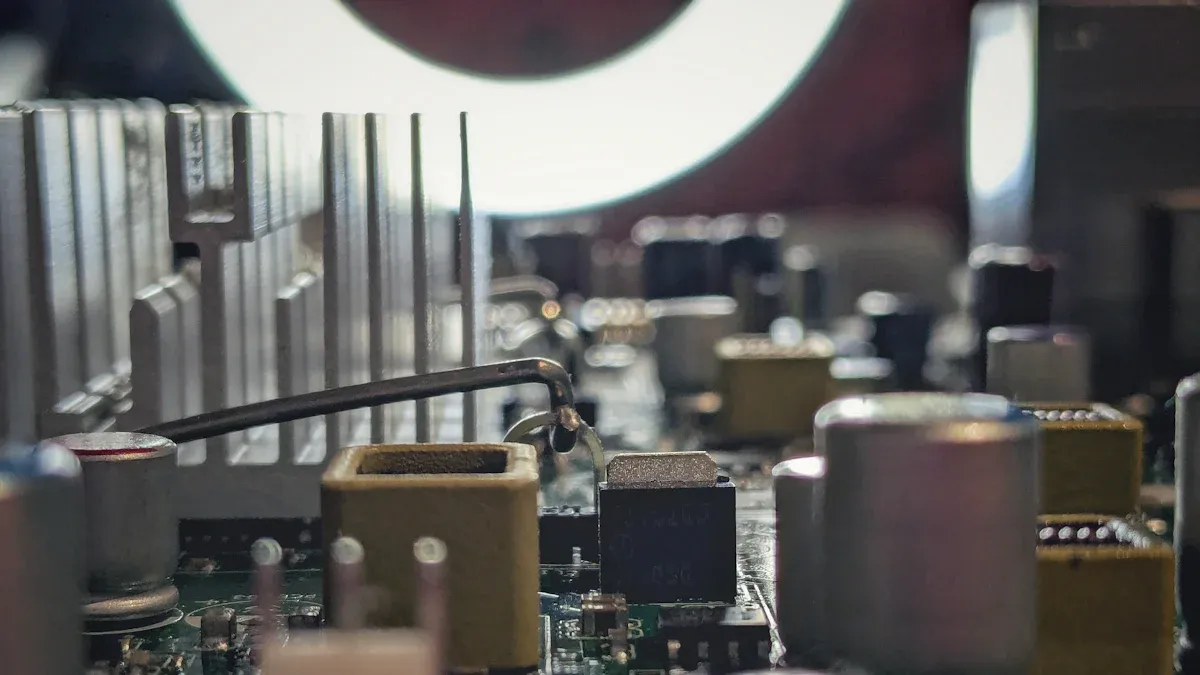
Engineers select semiconductor materials based on their electrical and physical properties. Silicon stands as the most popular choice for integrated circuits. It offers mechanical strength, affordability, and the ability to form high-quality insulating layers. Other materials, such as gallium arsenide and indium phosphide, serve special roles in high-speed or optoelectronic devices. The table below compares common semiconductor materials and their suitability for IC manufacturing:
|
Semiconductor Material |
Key Properties |
Suitability for IC Manufacturing |
|---|---|---|
|
Silicon (Si) |
Indirect band gap, robust, cost-effective, forms high-quality oxide layers |
Most widely used due to strength, affordability, and insulation capability |
|
Gallium Arsenide (GaAs) |
Direct band gap, high electron mobility, operates at high temperatures |
Used for high-speed and optoelectronic applications |
|
Germanium (Ge) |
Indirect band gap, similar lattice to GaAs |
Used in specialized applications like solar cells and detectors |
|
Indium Phosphide (InP) |
Tunable band gap and lattice constants |
Used in high-frequency and optoelectronic devices |
Silicon’s properties make it ideal for cost-effective mass production of integrated circuits.
Fabrication Process
Manufacturing integrated circuits involves many precise steps. Each step uses advanced technology to create tiny features on silicon wafers. The main steps include:
-
Wafer Preparation: Grow pure silicon crystals and slice them into thin wafers.
-
Thin Film Deposition: Add layers of materials using chemical or physical vapor deposition.
-
Photoresist Coating: Apply a light-sensitive layer to the wafer.
-
Photolithography: Use ultraviolet light and masks to transfer circuit patterns onto the wafer.
-
Development: Remove exposed or unexposed photoresist to reveal the pattern.
-
Etching: Remove unwanted material using wet chemicals or plasma.
-
Ion Implantation: Embed ions to change the wafer’s electrical properties.
-
Metallization: Deposit metal layers to form connections.
-
Passivation and Packaging: Add protective layers and package the chip for use.
Manufacturers repeat these steps many times to build complex, multilayer chips. They use simulation tools to predict and prevent failures, which helps improve reliability.
3D ICs
Three-dimensional integrated circuits (3D ICs) represent a major advancement. Engineers stack multiple layers of circuits vertically, which increases density and performance. The table below highlights the advantages and challenges of 3D ICs compared to traditional planar ICs:
|
Aspect |
Advantages |
Challenges |
|---|---|---|
|
Footprint & Density |
Packs more transistors in a smaller area |
Creates thermal management issues |
|
Integration |
Combines different materials and processes |
Increases design complexity |
|
Interconnect & Power |
Shorter connections reduce power use and increase bandwidth |
Adds complexity with vertical vias and layout |
|
Modularity & Design |
Enables modular stacking and new design options |
Makes testing and standardization harder |
|
Cost & Yield |
Smaller dies can improve yield and lower some costs |
Extra steps raise defect risk and overall cost |
|
Reliability |
- |
Complex stacks can cause stress and reliability problems |
|
Supply Chain |
- |
Integration delays and unclear ownership |
3D ICs help extend Moore’s Law, but they require new solutions for heat, testing, and manufacturing standards. Environmental concerns also play a role, as chip production uses large amounts of water, energy, and chemicals. Leading companies now focus on reducing emissions and waste to make manufacturing more sustainable.
Functions in Modern Electronics
Integrated circuits play a vital role in the operation of modern electronics. They allow devices to process signals, manage power, store data, and communicate efficiently. These functions make it possible for smartphones, computers, and wearable devices to perform complex tasks quickly and reliably.
Signal Processing
Signal processing is essential in many electronic devices. Integrated circuits handle this by amplifying, filtering, and converting signals. In smartphones and audio equipment, different types of ICs work together to manage both digital and analog signals. This teamwork allows devices to interpret sensor data, amplify audio, and support wireless communication. The result is clear sound, accurate sensor readings, and smooth operation.
|
Type of IC |
Role in Signal Processing |
|---|---|
|
Audio Integrated Circuits |
Amplify sound, convert signals, control tone and volume, and reduce noise for clear audio in phones and audio devices. |
|
Mixed-Signal Integrated Circuits |
Combine analog and digital functions, handle real-time sensor inputs, and convert voice signals into data. |
|
Analog Integrated Circuits |
Process continuous signals, amplify sound from microphones, and prepare signals for digital processing. |
|
Radio-Frequency Integrated Circuits |
Enable wireless communication by handling Wi-Fi, Bluetooth, and other radio signals. |
Integrated circuits make high-speed processing possible in devices by managing signals efficiently within compact chips. This efficiency supports multitasking and advanced features in modern electronics.
Power Management
Power management integrated circuits (PMICs) help devices use energy wisely. They control how power moves through a device, making sure each part gets the right amount. PMICs perform tasks such as converting voltage, charging batteries, and selecting power sources. These chips are especially important in portable electronics, where saving space and energy matters most.
PMICs come in several types:
-
System power management ICs regulate voltage and current, working closely with the main processor to keep devices stable.
-
Battery management ICs handle charging, monitor battery health, and protect against overcharging.
-
General power management ICs distribute power to different parts of the device, improving efficiency.
Low dropout regulators (LDOs) and chips using pulse-width modulation (PWM) or pulse-frequency modulation (PFM) help devices achieve lower power consumption. These features extend battery life and allow devices to run longer between charges.
Tip: Good power management not only saves energy but also keeps devices cooler and more reliable.
Data Storage
Integrated circuits form the core of modern data storage solutions. Flash memory and solid-state drives (SSDs) rely on ICs to store and manage data quickly and safely. These chips replace the moving parts found in older hard drives, making storage faster and more durable.
-
ICs create the memory cells in NAND and NOR flash, which store data even when the device is off.
-
Controllers inside the chips manage tasks like wear leveling and data transfer.
-
SSDs use ICs to deliver fast data access and low latency.
-
Devices such as smartphones, tablets, and laptops use eMMC storage, which combines flash memory and controllers in a single chip.
-
Integrated circuits enable miniaturization, speed, reliability, and efficiency in data storage, supporting the needs of modern electronics.
Communication
Communication is a key function in today’s devices. Integrated circuits manage both wired and wireless connections, allowing devices to share information quickly and securely. ICs convert data into formats that different hardware components can understand. They support interfaces like UART and SPI for wired communication in computers, sensors, and printers.
For wireless communication, ICs process radio signals for technologies such as Bluetooth, Wi-Fi, and NFC. These chips handle tasks like filtering, modulation, and amplification, which are necessary for clear and reliable connections. Integrated circuits also help with power management during communication, making sure devices stay efficient.
Smartphones, IoT devices, and medical equipment all rely on ICs for communication. These chips support high-speed data transmission, GPS, and multimedia features, making modern electronics more powerful and connected.
Impact and Advantages
Miniaturization
Integrated circuits have changed the way people design and use electronic devices. They replace large, separate parts with thousands or even billions of tiny transistors on a single chip. This change makes it possible to build much smaller devices. Today, people carry smartphones, wearables, and tablets that fit in a pocket or on a wrist. These devices offer more power and features than older, larger machines.
-
ICs combine many functions on one chip, which saves space.
-
Smaller devices use less power and last longer on a single charge.
-
Miniaturization allows for new products like smartwatches and fitness trackers.
-
Higher component density means faster processing and better performance.
-
Compact designs help create real-time connected devices for the Internet of Things.
Miniaturization also reduces the number of parts needed, which lowers material costs and makes design easier.
Efficiency and Cost
Integrated circuits help electronic devices use energy more wisely. They reduce power loss by keeping signals close together and using advanced materials. This leads to longer battery life and cooler devices. ICs also make it easier to build products in large numbers, which lowers the cost for both makers and buyers.
|
Aspect |
Details |
|---|---|
|
Energy Efficiency |
Lower power use, longer battery life, better heat control |
|
Cost Benefits |
Cheaper to make, smaller size, easier assembly, mass production |
|
Market Value (2023) |
|
|
Projected Value (2030) |
USD 1,496.57 billion |
Manufacturers can use automated assembly lines because ICs combine many parts into one chip. This reduces labor and makes products more reliable. Maintenance costs also drop because there are fewer parts that can fail.
Industry Applications
Many industries depend on integrated circuits for their products and services. In consumer electronics, ICs power smartphones, laptops, and gaming consoles. The automotive industry uses ICs in electric vehicles, safety systems, and entertainment features. Telecommunications companies rely on ICs for fast data networks and 5G technology. Healthcare uses ICs in medical devices and diagnostic tools. Aerospace and defense need ICs for flight control, radar, and secure communication. Factories use ICs in robots and automation systems to improve safety and efficiency.
Integrated circuits make devices smaller, faster, and more reliable across many fields. They help people connect, stay safe, and enjoy new technology every day.
Integrated circuits remain the backbone of modern electronics. They help make devices smaller, faster, and more powerful. Industry analysts predict strong growth in this field, with new advances in AI, IoT, and healthcare. The table below shows key trends shaping the next decade:
|
Aspect |
Details |
|---|---|
|
Market Growth |
Expected to reach USD 1,438.42 billion by 2030 |
|
Key Drivers |
AI, IoT, 5G, government support, healthcare expansion |
|
Challenges |
High manufacturing costs |
|
Leading Regions |
Asia-Pacific, North America |
People can look forward to even smarter and more connected technology as innovation continues.
FAQ
What is the main purpose of an integrated circuit?
An integrated circuit combines many electronic parts on a small chip. It helps devices process information, store data, and manage signals. This design makes electronics smaller, faster, and more reliable.
How do integrated circuits affect everyday devices?
Integrated circuits power smartphones, computers, and cars. They allow these devices to run apps, connect to the internet, and save energy. People use products with integrated circuits every day at home, school, and work.
Why is silicon used in most integrated circuits?
Silicon works well as a semiconductor. It is strong, easy to find, and cost-effective. Engineers use silicon to build chips that last a long time and perform well in many types of electronics.
What challenges does the global ic supply chain face?
The global ic supply chain faces issues like material shortages, shipping delays, and high demand. These problems can slow down the production of electronics and raise costs for companies and consumers.
Can integrated circuits be recycled?
Some parts of integrated circuits can be recycled. Specialized facilities recover metals and other materials from old chips. Recycling helps reduce waste and saves resources.