Different Types of Integrated Circuits including Digital and Mixed-Signal Solutions
You probably use things with integrated circuits every day. Integrated circuits, or ICs, are small chips made from semiconductors.
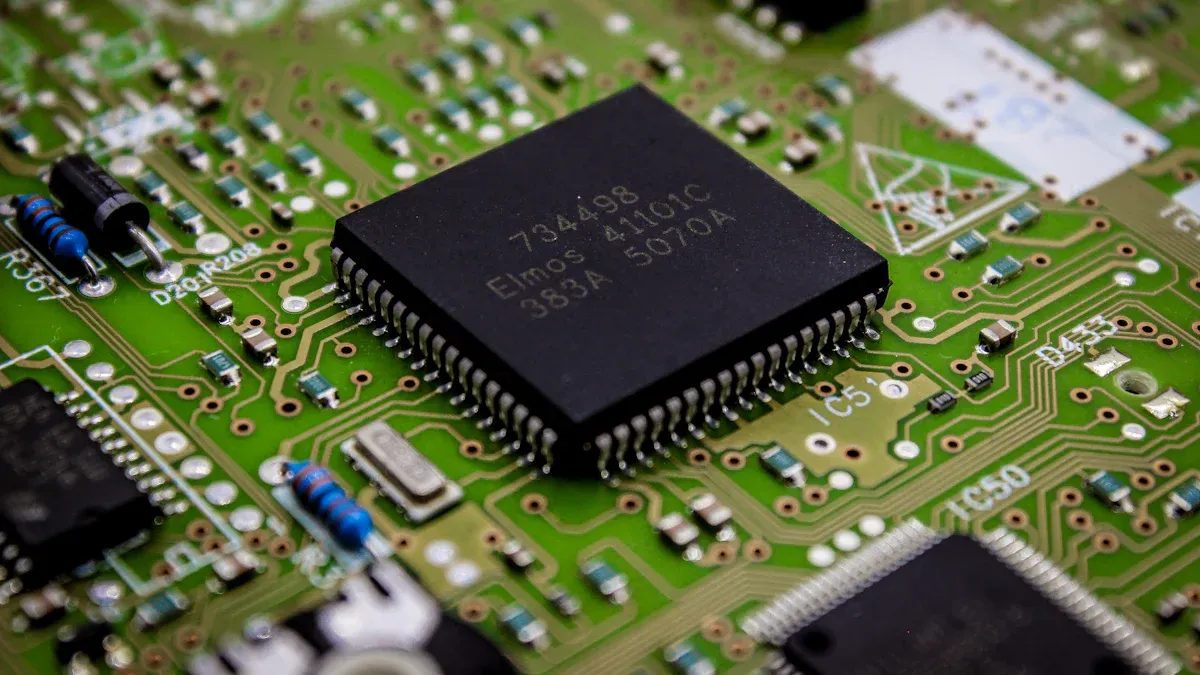
You probably use things with integrated circuits every day. Integrated circuits, or ICs, are small chips made from semiconductors. They have many parts like transistors, resistors, capacitors, and diodes. ICs help electronics do digital and analog jobs. These jobs include data processing, memory storage, and signal control. Knowing the types of integrated circuits helps you pick the right one for your project. The global market for integrated circuits is growing fast, as you can see below:
|
Year |
Market Size (USD Billion) |
CAGR (%) |
Notes |
|---|---|---|---|
|
2024 |
N/A |
Base year |
|
|
2025 |
446.8 |
11.2 |
Short-term forecast |
|
2029 |
661.12 |
10.3 |
Mid-term forecast |
There are three main types of integrated circuits. These are analog, digital, and mixed-signal. Each type uses semiconductor technology in its own way.
Key Takeaways
-
Integrated circuits have three main types: analog, digital, and mixed-signal. Each type works with different signals and jobs. Analog ICs handle smooth signals like sound and temperature. They help make these signals stronger and cleaner. Digital ICs use binary signals, which are 0s and 1s. They process and store data. This makes them good for computers, phones, and memory devices. Mixed-signal ICs have both analog and digital parts on one chip. They let devices like smartphones and IoT sensors link real-world signals to digital systems. To pick the right IC, match its job, speed, power use, and size to your project. Always read datasheets and plan well for the best results.
Types of Integrated Circuits
Integrated circuits, called ICs, have three main types. These are analog, digital, and mixed-signal integrated circuits. You can find them in almost every electronic device. Each type works with analog or digital signals in its own way. Knowing these differences helps you pick the best IC for your project.
Analog Integrated Circuits
Analog integrated circuits work with analog signals. Analog signals are smooth and can have any value in a range. You use these ICs for real-world signals like sound, temperature, or light. Analog signals change slowly and smoothly over time. Analog integrated circuits must handle these changes without losing details. These ICs often have amplifiers, filters, and comparators. You see analog integrated circuits in things like audio equipment, medical tools, and sensors. They help with tasks like making signals stronger, cleaning up signals, and getting signals ready to use.
Note: Analog integrated circuits can be affected by noise. This is because analog signals can pick up small changes from the environment.
Here are some ways people use analog integrated circuits:
-
Making sound louder in radios and speakers
-
Connecting sensors for temperature and pressure
-
Managing power in devices that use batteries
Digital Integrated Circuits
Digital integrated circuits work with digital signals. Digital signals only have two values: 0 and 1. You use a digital integrated circuit when you need to work with data in binary form. Digital signals do not get messed up by noise as much. This makes digital integrated circuits good for storing and processing data. These ICs use logic gates, microcontrollers, and memory blocks. Digital integrated circuits use a clock to keep everything in order.
|
Aspect |
Analog Integrated Circuits (ICs) |
Digital Integrated Circuits (ICs) |
|---|---|---|
|
Continuous, time-varying signals with infinite possible values |
Discrete binary signals represented by 0s and 1s |
|
|
Operation Mode |
Asynchronous, processes signals as they arrive |
Synchronous, coordinated by a reference clock |
|
Susceptibility to Noise |
More susceptible to noise and variations |
Less susceptible due to discrete levels |
You find digital integrated circuits in computers, smartphones, and cameras. They help with things like changing data, saving data, and sending data.
Mixed-Signal Integrated Circuits
Mixed-signal integrated circuits have both analog and digital parts on one chip. You use these ICs to connect the real world to digital systems. Mixed-signal integrated circuits can work with both analog and digital signals. They often change one type of signal into the other. For example, an analog-to-digital converter (ADC) turns analog signals into digital ones. A digital-to-analog converter (DAC) does the opposite job.
|
Signal Processing Characteristics |
Key Components and Functions |
|
|---|---|---|
|
Analog ICs |
Process continuous signals; focus on amplification, filtering, and conditioning of real-world signals |
Operational amplifiers, comparators, analog filters |
|
Digital ICs |
Process discrete binary signals; manipulate data in binary form |
Logic gates, microcontrollers, memory |
|
Combine analog and digital circuitry; enable conversion between analog and digital domains |
ADCs, DACs, support filtering, modulation, SoC integration |
Mixed-signal integrated circuits are used in things like smartphones, smartwatches, and IoT sensors. They help you collect real-world data, change it to digital, and send it back as analog signals to things like speakers or screens. These ICs make signal processing easier and more useful.
Digital Integrated Circuits
Digital integrated circuits are very important in electronics today. You see these ICs in computers, phones, and many other things. They use binary signals, which means only 0 and 1. These ICs help with data processing, memory, and control. Digital integrated circuits are needed for both computers and communication systems.
Logic ICs
Logic ICs are basic parts of digital systems. You use them to do logical work with binary data. These ICs have logic gates like AND, OR, NAND, and XOR. Each gate takes one or more binary numbers and gives an answer. Logic ICs help move data, control information, and make choices in circuits.
Logic ICs let you add, count, decode, and control data. They are needed for computers, microprocessors, and other digital devices.
Some common logic ICs are:
-
Logic gates (AND, OR, NAND, XOR)
-
Flip-flops and latches
-
Counters and shift registers
-
Timer ICs like the 555 timer, which make timing cycles and pulses
You often use logic gate ICs like TTL 7400 series and 4000 series CMOS ICs in projects. These ICs are also in microprocessors and other logic devices. Timer ICs help you make digital clocks and stopwatches.
Memory ICs
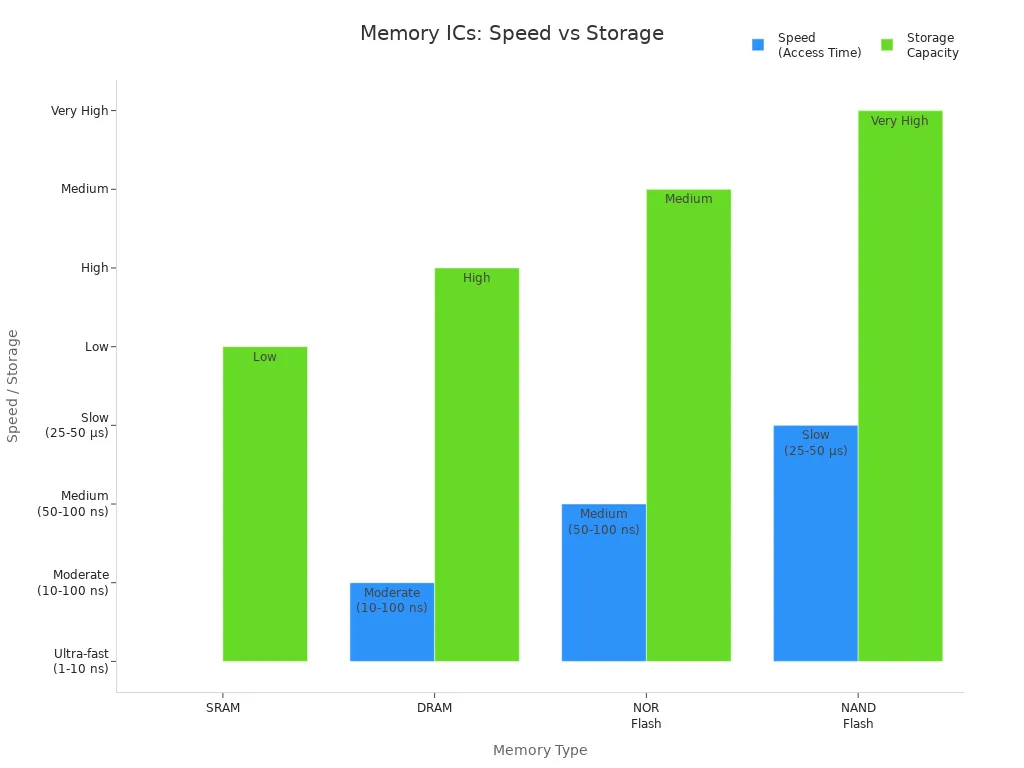
Memory ICs keep data for your devices. You use them in computers, phones, and cameras. There are different types of memory ICs. Each type has its own speed, storage, and price. The table below shows the main memory IC types and how they compare:
|
Memory Type |
Volatility |
Speed (Access Time) |
Storage Capacity (Density) |
Cost per Bit |
Typical Use Case |
|---|---|---|---|---|---|
|
SRAM |
Volatile |
Low |
Highest |
Processor caches, high-speed buffers |
|
|
DRAM |
Volatile |
Moderate (10-100 ns) |
High |
Medium |
Main system memory |
|
NOR Flash |
Non-volatile |
Medium (50-100 ns) |
Medium |
Medium-High |
Boot code, firmware storage |
|
NAND Flash |
Non-volatile |
Slow (25-50 µs) |
Very High |
Lowest |
Mass storage (SSDs, memory cards) |
-
SRAM is the fastest but holds less data and costs more. You find it in processor caches.
-
DRAM is a balance between speed and storage. It is the main memory in computers.
-
NOR Flash and NAND Flash are non-volatile. They keep data when power is off. NAND Flash stores the most data and is used in SSDs and memory cards.
Many companies make memory ICs. Some top makers are:
-
NXP Semiconductors
-
Microchip Technology Inc.
-
Cirrus Logic Inc.
-
Maxim Integrated
-
STMicroelectronics
-
Renesas Electronics Corporation
-
Texas Instruments Incorporated
-
Infineon Technologies AG
-
TOSHIBA ELECTRONIC DEVICES & STORAGE CORPORATION
These companies use new semiconductor technology to make fast and reliable memory ICs for all devices.
Microprocessors
Microprocessors are the "brains" of many systems. You use a microprocessor to run programs and control devices. A microprocessor is a CPU on one chip. It gets, reads, and runs instructions from memory. It does math, logic, manages memory, and handles input and output.
The table below shows how microprocessors are different from other digital ICs:
|
Feature/Aspect |
Microprocessor |
Other Digital Integrated Circuits (ICs) |
|---|---|---|
|
Definition |
Any circuit etched onto a chip with fixed or specific functions |
|
|
Functionality |
Executes instructions, performs arithmetic and logical operations, manages memory and I/O, handles interrupts and real-time events |
Typically fixed-function devices optimized for specific tasks like logic operations, memory storage, or signal conditioning |
|
Architecture Components |
Includes Arithmetic Logic Unit (ALU), control unit, memory and peripheral interfaces |
Usually simpler, may include logic gates, memory elements, or analog paths without complex control units |
|
Programmability |
Yes, designed to be programmable |
Usually fixed-function, not programmable |
|
System Requirements |
Requires external components such as RAM, ROM, and peripherals to form a complete system |
Often functions independently for dedicated roles |
|
Complexity |
High complexity with multiple functional units |
Ranges from simple to complex but generally less than microprocessors |
|
Typical Applications |
Embedded control, computing, real-time control |
Signal processing, power management, logic operations, memory storage |
|
Role in System |
Acts as the 'brain' enabling flexible computation |
Acts as specialized 'organs' performing focused functions |
You find microprocessors in many things:
-
Consumer electronics like MP3 players, mobile phones, and cameras
-
Industrial automation systems
-
Automotive systems
-
Home appliances like microwaves and washing machines
-
Medical devices
-
Telecommunication systems
-
Networking equipment like routers and network bridges
-
Home automation systems
Some well-known microprocessors are ARM Cortex-A and Cortex-M, Intel Atom, ESP32, and RISC-V. These microprocessors use advanced processes for high performance and low power. You see them in smartphones, tablets, IoT devices, and industry machines.
You also find other digital ICs in computers and communication systems. These include:
-
Microcontrollers (like Intel 8051)
-
Digital Signal Processors (DSPs)
-
Field-Programmable Gate Arrays (FPGAs) like Xilinx Spartan
-
System-on-Chip (SoC) devices
-
Communication ICs for wireless and network, like Qualcomm Snapdragon X65 and Texas Instruments CC2650
These ICs help with sending data, signal processing, and network connections. Important technologies like CMOS and VLSI are needed to make these digital ICs.
Tip: When you pick a microprocessor or any IC, always check if it fits your data, speed, and storage needs.
Mixed-Signal Integrated Circuits
Mixed-signal integrated circuits are very important in today’s electronics. You see these chips in things that use both analog and digital signals. A mixed-signal integrated circuit puts analog and digital parts together on one chip. This helps connect real-world signals to digital systems that use binary data. You can find mixed-signal ICs in phones, cars, medical tools, and many other things.
Mixed-Signal Integrated Circuit Functions
A mixed-signal integrated circuit has analog parts like amplifiers, sensors, and ADCs. It also has digital parts such as microcontrollers and DSPs. This lets you work with real-world signals and digital data in one place. You do not need as many extra parts, so you save space and power. This makes mixed-signal ICs great for small things like wearables and IoT sensors.
Here are the main things mixed-signal integrated circuits do:
|
Function |
Description |
|---|---|
|
Analog-to-Digital Conversion (ADC) |
Changes analog signals into digital signals for digital devices. Needed for sensors, audio, video, communication, and medical tools. Makes things more accurate and lowers noise and delay. |
|
Digital-to-Analog Conversion (DAC) |
Changes digital signals back into analog for things like speakers, screens, and motors. Helps lower distortion and save power. |
|
Signal Processing |
Includes making signals stronger, cleaning them up, changing them, and keeping them safe. Can be done in both analog and digital ways to make things faster and more exact. |
|
Clock Generation |
Gives timing signals to keep digital parts working together. |
|
Voltage Regulation |
Keeps voltage steady so the circuit works well. |
|
System on Chip (SoC) Design |
Puts many jobs and parts (analog, digital, memory, logic, communication) on one chip. This makes things smaller, cheaper, and more reliable. |
|
Design Flexibility |
Lets you change how the chip works (like with DSPs or FPGAs) for different needs. |
You use mixed-signal integrated circuits for jobs like cleaning up signals, making them stronger, and changing them. These chips also help with timing and keeping voltage steady, so your devices work well. SoC designs use mixed-signal ICs to put lots of features in one chip, making electronics smaller and better.
Tip: Mixed-signal ICs help you make small, fast devices by using fewer separate chips.
ADCs and DACs
ADCs and DACs are very important in mixed-signal integrated circuits. An ADC takes a real-world signal, like sound or heat, and turns it into digital data. This lets your device use digital logic to work with the signal. A DAC does the opposite. It takes digital data and changes it back into a smooth analog signal for things like speakers or screens.
ADCs measure the analog signal and give it a digital value. This can cause small mistakes called quantization noise, but it lets you use digital tools. DACs try to make the output signal as smooth and correct as possible. You pick the right ADC or DAC based on how fast, detailed, and power-saving you need it to be.
|
Performance Aspect |
ADC Characteristics |
Application Examples |
|---|---|---|
|
Depends on type: Pipeline ADCs are fast; Delta-Sigma ADCs are slower; Integrating ADCs are slowest |
Fast ADCs are used for quick data jobs like in oscilloscopes; Delta-Sigma ADCs are good for careful measuring. |
|
|
Complexity |
Flash ADCs are hard to make; SAR ADCs are easier; Delta-Sigma ADCs are tricky because of extra steps |
Simple ADCs are better for cheap or low-power things; harder ones are for special jobs. |
|
Power Consumption |
Flash ADCs use a lot of power; SAR and Integrating ADCs use less; Pipeline ADCs use medium to high power |
Low-power ADCs are needed for battery things; high-power ADCs are for fast jobs. |
|
Application Needs |
How clear, fast, and quiet the ADC is helps you choose |
High detail is needed for medical tools; medium detail for most things; fast speed for communication. |
You find ADCs and DACs in many mixed-signal integrated circuits. These converters help your device sense things, work with the data, and send out signals. Top makers of ADCs and DACs are Texas Instruments, Analog Devices, Maxim Integrated, Microchip Technology, Cirrus Logic, NXP Semiconductors, STMicroelectronics, ON Semiconductor, Skyworks Solutions, Infineon Technologies, Qorvo, and Renesas Electronics. These companies keep making their products better and faster.
Applications
You use mixed-signal integrated circuits in many places. In electronics for people, you find them in phones, tablets, smart watches, and cameras. These chips help with cleaning up signals, saving power, and changing data. For example, FM radios in music players and digital radios use mixed-signal ICs to work with both analog and digital signals.
In wireless communication, mixed-signal ICs let your device handle sound, radio waves, and digital data at once. This is important for 5G phones and IoT devices. Mixed-signal ICs also help manage power, so your devices last longer on one charge.
In cars and factories, you see mixed-signal ICs in systems that sense, work with, and control signals. Here are some common types of mixed-signal integrated circuits used in these areas:
|
Mixed-Signal IC Type |
Description |
Relevance to Automotive and Industrial Applications |
|---|---|---|
|
Radio Frequency Integrated Circuits (RFICs) |
Mix high-frequency analog and microwave parts like modulators, amplifiers, oscillators, filters, and mixers. |
Power wireless systems in cars and factories. |
|
Memory Chips |
Mixed-signal ICs with capacitors and transistors to store data for a short or long time (RAM, ROM). |
Needed for saving data in car and factory systems. |
|
Voltage Regulators |
ICs that keep voltage steady using parts like transistors, diodes, capacitors, and inductors. |
Make sure power stays steady in car and factory electronics. |
|
Power Management Integrated Circuits (PMICs) |
Have many voltage regulators and control parts for good power use. |
Very important for powering smart devices, IoT, and electric cars. |
You also find mixed-signal ICs in medical tools, where they help collect and work with data from sensors. Software often runs on these chips, letting you gather, use, and send data right away.
New mixed-signal integrated circuits are better at mixing analog and digital parts, use less power, and have new ways to fit more in a small space. Some chips now use artificial intelligence to make sensors smarter. New ways to send data, like Bluetooth Low Energy and Zigbee, also use mixed-signal ICs for fast and easy data sharing.
Note: When you use mixed-signal ICs, you need to think about noise, layout, and power to keep your signals working well.
Mixed-signal integrated circuits, also called analog mixed-signal chips, have changed how you make electronics. They let you build small, strong, and flexible devices. You can use them for working with signals, changing data, and controlling systems. As technology gets better, you will see even more ways to use mixed-signal ICs everywhere.
Choosing Integrated Circuits
Application Needs
You must always start by thinking about what your project needs. Every ic has a job. Some ics help you store data, while others control motors or lights. If you use microcontrollers, you can program them to do many things. You should ask yourself what the ic must do. For example, does it need to measure temperature, run a display, or connect to sensors? You can choose an ic based on application, such as audio, power, or communication. When you know your needs, you can look for ics that match.
Selection Criteria
You have many choices when you pick an ic. Here are the most important things to check:
-
Functionality: Make sure the ic does what you want.
-
Power Consumption: Pick ics that use less power for battery projects.
-
Speed: Some ics work faster than others. Fast ics help in computers and games.
-
Cost: Check your budget. Some ics cost more than others.
-
Availability: Make sure you can buy the ic now and in the future.
You also need to think about the package size and shape. Some ics are small and fit on tiny boards. Others are bigger. Always check the datasheet for voltage, current, and speed. Microcontrollers come in many types based on technology and based on integration level. Some have built-in memory, timers, and communication ports. You can pick microcontrollers based on technology like CMOS or BiCMOS, or based on integration level such as simple or advanced.
Practical Tips
You should always read the ic datasheet before you buy. Look for the voltage range, current, and pin layout. The table below shows what to check:
|
What to Check |
Why It Matters |
|---|---|
|
Package Constraints |
Fits your board and matches your soldering tools |
|
Electrical Specs |
Works with your power supply and other parts |
|
Application Circuits |
Helps you connect the ic the right way |
|
Testing & Evaluation |
Shows if the ic is reliable and safe |
|
Thermal Management |
Keeps the ic cool and working well |
When you use microcontrollers, try to find sample codes and support online. Buy ics from trusted sellers. Always plan for extra ics in case you need repairs. If you use microcontrollers based on technology or based on integration level, check if they have enough memory and speed for your project. Use decoupling capacitors to keep your ic stable. Place your ic away from noisy parts on the board.
Tip: Microcontrollers are great for learning because you can change their program and use them in many projects.
You now know that each ic type has its own job. Analog ic work with smooth signals and help make sounds louder or cleaner. Digital ic use only 0s and 1s, so they are good for computers and saving data. Mixed-signal ic can handle both kinds of signals, so they help connect real things to digital systems.
|
IC Type |
Signal Type |
Main Use |
|---|---|---|
|
Analog IC |
Continuous |
Amplification, filtering |
|
Digital IC |
Binary (0/1) |
Computing, memory |
|
Mixed-Signal IC |
Both |
Interfacing, signal conversion |
Picking the right ic makes your device work better and last longer. Always choose an ic that fits what your project needs. Use these ideas when you design something new to make it smarter and stronger.
FAQ
What are the main types of integrated circuits?
There are three main types of integrated circuits. These are analog, digital, and mixed-signal integrated circuits. Each type works with different signals. They help you fix different problems in electronics.
How do analog signals and digital signals differ in ICs?
Analog signals change smoothly and can be any value. Digital signals are only 0 or 1. Analog integrated circuits work with real-world signals like sound. Digital integrated circuits use binary data for storing and processing.
Where do you use mixed-signal integrated circuits?
Mixed-signal integrated circuits are used in devices needing both signal types. You find them in smartphones, smartwatches, and IoT sensors. These ICs help with changing signals and working with data.
What is the difference between microprocessors and microcontrollers?
Microprocessors are like the brain of a computer. They process data and control things. Microcontrollers have a processor, memory, and input/output on one chip. You use microcontrollers in simple devices for special jobs.
How do you choose the right IC for your project?
First, think about what your project needs. Look at the type of integrated circuit, speed, power, and cost. Make sure the IC fits your board and works with your parts. Always check the datasheet before buying.