Unpacking the Synergy of PAM4 and Integrated Optical Modules
A powerful combination drives today's high-speed data centers: pam4 technology and integrated optical modules. Applications
A powerful combination drives today's high-speed data centers: pam4 technology and integrated optical modules. Applications like AI and high-performance computing create an immense demand for higher bandwidth. The solution is twofold. The PAM4 signal effectively doubles the data rate, while high integration makes the required 400g network architecture physically possible. This synergy fuels a market projected to reach billions in value.
So, how do PAM4 and integration work in concert to solve the 400G puzzle? 🧩
Key Takeaways
- PAM4 technology doubles data speed. It sends two bits of data at once. This helps networks handle more information.
- Integrated optical modules pack many parts into one small device. This makes 400G networks possible. It saves space and power.
- PAM4 and integrated modules work together. They make data centers faster and more efficient. This helps with AI and big data.
- This technology allows more connections in a small space. It also lowers the cost per gigabit. This helps data centers grow.
- These modules prepare networks for the future. They make it easier to upgrade to 800G and faster speeds. This protects network investments.
Core Technologies: PAM4 and Integration
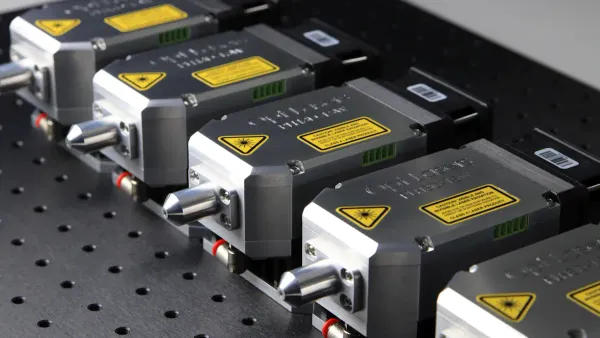
To understand the 400G solution, we must look at its two foundational pillars. The first is an advanced signaling method. The second is a marvel of miniature engineering. Together, they deliver unprecedented speed in a compact and efficient package.
Understanding PAM4 Technology
Traditional networks used a simple method called Non-Return-to-Zero (NRZ). It sends one bit of data (a 0 or 1) per signal cycle. The pam4 technology, or Pulse Amplitude Modulation 4-level, is far more advanced. It uses four distinct signal levels to encode two bits of data (00, 01, 10, or 11) in the same cycle. This instantly doubles the data transmission rate without needing more bandwidth.
However, this speed comes with a challenge. Squeezing four levels into the same voltage space makes the pam4 signal much more sensitive to noise. This results in a lower Signal-to-Noise Ratio (SNR), with a performance penalty of about 9.5 dB compared to NRZ.
You can visualize this difference with an eye diagram. An NRZ signal creates one large, open "eye," showing it is robust against noise. A pam4 signal creates three smaller, stacked "eyes," indicating a much smaller margin for error.
To overcome this, pam4 technology relies on a powerful Digital Signal Processor (DSP) to perform Forward Error Correction (FEC). FEC adds redundant data to the signal, allowing the receiver to detect and correct errors on the fly, ensuring the link remains stable and reliable.
The Role of High-Integration
High-integration is what makes modern 400G modules physically possible. It involves packing all the essential optical and electrical components into a single, tiny transceiver. This process is largely enabled by Silicon Photonics, which uses mature semiconductor manufacturing (CMOS) techniques to build optical parts on a silicon wafer. This method allows for wafer-level testing and drives down costs through economies of scale.
Key components integrated into a single module include:
- Lasers to create the light signal.
- Modulators to encode the data onto the light.
- Ge/Si photodetectors to convert the received light back into an electrical signal.
- A Digital Signal Processor (DSP) to manage the complex signal.
The DSP is the brain of the operation. It performs critical functions like error correction, signal equalization to compensate for distortion, and clock recovery. For these advanced functions, leading solutions are essential. As a HiSilicon-designated solutions partner, Nova Technology Company (HK) Limited) specializes in leveraging these powerful DSP capabilities to deliver robust and reliable networking hardware. This tight integration of components is the key to producing compact, power-efficient, and cost-effective 400G modules.
Key Benefits of the PAM4-Integration Synergy
The partnership between PAM4 signaling and integrated optics delivers more than just a speed bump. It creates a powerful set of advantages that directly address the core challenges of modern data centers. This synergy unlocks higher network capacity, provides a practical balance of key operational metrics, and builds a clear path for future growth.
Higher Density and Network Capacity
The most immediate benefit is a massive increase in network density. Integrated modules pack 400G capabilities into compact form factors like QSFP-DD. This allows switch manufacturers to build hardware with incredible throughput in a small physical space. A single 1RU switch can now deliver tremendous switching capacity.
- A Top-of-Rack (ToR) switch can offer 8.0 Terabits per second (Tbps).
- A larger spine switch can provide a total switching capacity of up to 25.6 Tbps.
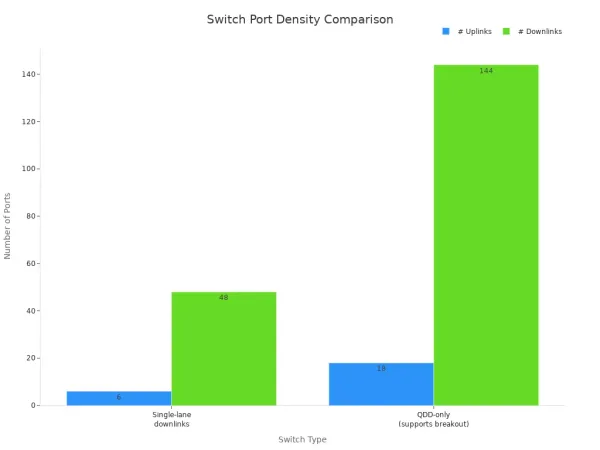
This leap in capacity is further enhanced by the breakout capability of 400G modules. Breakout mode allows a single high-speed 400G port to be divided into multiple lower-speed channels, such as four separate 100G links. This feature is essential for a flexible and efficient network design.
Breakout configurations enable connections between network devices with varying port speeds. A switch with 400G ports can connect to multiple servers with 100G ports. This approach optimizes bandwidth use and increases the number of connections a single switch can support.
The impact on port density is significant. A switch designed for breakout functionality can support far more downlinks compared to a traditional design, enabling a much more efficient high-density deployment.
Ultimately, this technology reduces the total number of required optical fibers, connectors, and patch panels. It simplifies network management and leads to significant cost savings.
Balancing Performance, Power, and Cost
Speed is important, but data center operators must also manage cost and power consumption. The synergy of pam4 technology and integration provides a strong economic case. The cost-per-gigabit for 400G optics is substantially lower than previous generations.
| Technology | Cost per Gigabit |
|---|---|
| 100G NRZ | $6-12 |
| 400G PAM4 | $3-6 |
This cost reduction comes with a trade-off: higher power consumption. A single 400G module can consume up to 15 watts of power. Managing the heat generated by dozens of these modules in a switch is a major engineering challenge. Different form factors offer different solutions. The OSFP form factor, for example, includes an integrated heat sink to better handle thermal loads, making it suitable for the most demanding applications like AI clusters handling low-latency traffic.
The two leading form factors, QSFP-DD and OSFP, present different approaches to this balance.
| Feature | QSFP-DD | OSFP |
|---|---|---|
| Primary Advantage | Backward compatibility, higher port density | Superior thermal performance |
| Power Handling | Lower (up to 14 W) | Higher (≥15 W) |
| Ideal Use Case | General data center spine-leaf networks | New AI/HPC clusters, liquid-cooled systems |
The choice between them depends on the specific needs of the data center, balancing port density against thermal headroom.
Enabling Future-Proof Network Upgrades
Adopting 400G technology is not just a short-term fix. It is a strategic step that prepares networks for the future. One key feature is backward compatibility. The popular QSFP-DD form factor is designed to work with older QSFP28 (100G) modules. This allows network operators to upgrade their core switches to 400G while gradually migrating servers and other endpoints over time.
More importantly, the underlying technology of 400G pam4 modules paves the way for 800G and beyond. These modules often use a 100G-per-lane electrical interface. An 800G module can be built by simply using eight of these 100G lanes. This creates a direct and logical upgrade path, protecting the initial investment.
Industry standards bodies are formalizing this path.
- IEEE 802.3ck defines the standards for 100G electrical lanes.
- The OIF (Optical Internetworking Forum) and various MSAs (Multi-Source Agreements) are developing specifications for 800G and even 1.6T modules.
Looking even further ahead, the industry is preparing for the limits of pluggable optics. As switch bandwidth approaches 51.2 Tbps and higher, a new technology called Co-Packaged Optics (CPO) will become necessary. CPO integrates the optical engine directly onto the same package as the switch chip, solving future power and signal integrity challenges.
| Feature | Pluggable Transceivers | Co-Packaged Optics (CPO) |
|---|---|---|
| Integration | Slots into front panel | Integrated directly with switch ASIC |
| Energy Consumption | Higher (~7W per module) | Lower (~3W per module) |
| Scalability | Limited by front panel space | Indispensable for 1.6T and beyond |
The current generation of pam4 integrated modules provides the foundation today, while CPO represents the next logical step in the evolution of data center networking.
Practical Applications in Data Centers

The synergy between advanced signaling and integration is not just theoretical. It directly enables the powerful and scalable network designs that modern data centers rely on. These technologies are the building blocks for everything from internal server racks to connections between entire data center campuses.
Spine-Leaf Architectures
Most modern data centers use a spine-leaf topology. This design provides high bandwidth and low latency between any two points in the network. The compact QSFP-DD form factor is the primary component for building out the spine and leaf layers of a 400g network architecture.
For short-reach links, such as connecting servers to a Top-of-Rack switch, network engineers often deploy 400G-SR8 modules. These optics are a cost-effective solution for distances up to 100 meters.
- They use eight parallel lanes, each running at 50 Gbps.
- This design requires MPO-16 fiber optic cables.
- They are ideal for new data center builds where cabling can be planned efficiently.
For leaf-to-spine connections, 400G-DR4 modules are a popular choice. These modules use four parallel 100G pam4 lanes and can also operate in a breakout mode to provide four separate 100G links. This flexibility is crucial in high-performance computing (HPC) and AI clusters, where a single GPU server needs a massive high-speed optical interconnect. As a HiSilicon-designated solutions partner, Nova Technology Company (HK) Limited) provides these advanced DR4 optical solutions, enabling robust and scalable AI network fabrics.
Data Center Interconnect (DCI) Links
Data Center Interconnects (DCI) are the links that connect separate data center buildings, often miles apart. For these longer distances, different types of integrated modules are necessary. The choice depends entirely on the required reach.
| Module Type | Maximum Distance | Fiber Type |
|---|---|---|
| 400G-LR4 | 10 km (6.2 miles) | Single-Mode |
| 400G-ER4 | 40 km (25 miles) | Single-Mode |
For even longer DCI links stretching up to 120 km, the industry is rapidly adopting 400ZR and 400ZR+ coherent optics. These modules represent the next-gen data center interconnect, packing sophisticated signal processing into a pluggable form factor. The market for this technology is expanding quickly, preparing the next generation data center for future demands.
The synergy between PAM4 signaling and integrated optics is a fundamental necessity for modern data centers. This powerful partnership delivers the speed, density, and scalability required to handle immense data loads. The technological foundation built for 400G directly paves the way for 800G and 1.6T speeds. This evolution will support the next generation data center and future applications like augmented reality and the Internet of Things (IoT). Industry groups are already developing new standards to overcome future challenges like power consumption and manufacturing complexity.
FAQ
What is the main difference between PAM4 and NRZ?
NRZ technology sends one bit of data (0 or 1) per signal. PAM4 technology is more advanced. It sends two bits of data (00, 01, 10, or 11) in the same signal. This method effectively doubles the data transmission speed without using more bandwidth.
Why is a DSP essential for PAM4 signals?
PAM4 signals are very sensitive to noise. A Digital Signal Processor (DSP) is the brain that fixes this problem. It uses Forward Error Correction (FEC) to find and correct data errors. This ensures the network connection remains stable and reliable despite the signal's sensitivity.
How do data centers choose between QSFP-DD and OSFP?
The choice balances density and cooling needs.
- QSFP-DD offers higher port density and is backward compatible. It is ideal for general-purpose networks.
- OSFP provides better thermal performance for high-power modules. It suits demanding AI and HPC clusters.
What does "breakout" mode do for a 400G port?
Breakout mode allows a single high-speed port to be split into multiple lower-speed channels. For example, one 400G port can become four separate 100G links. This feature provides great flexibility for connecting different network devices and improves switch port utilization.