Integrated Circuit Technology and its Applications in Modern Electronics Manufacturing
Every day, billions of electronic devices use integrated circuit technology to work well. Integrated circuits are also called microchips. They power smartphones, tablets, and smart TVs.
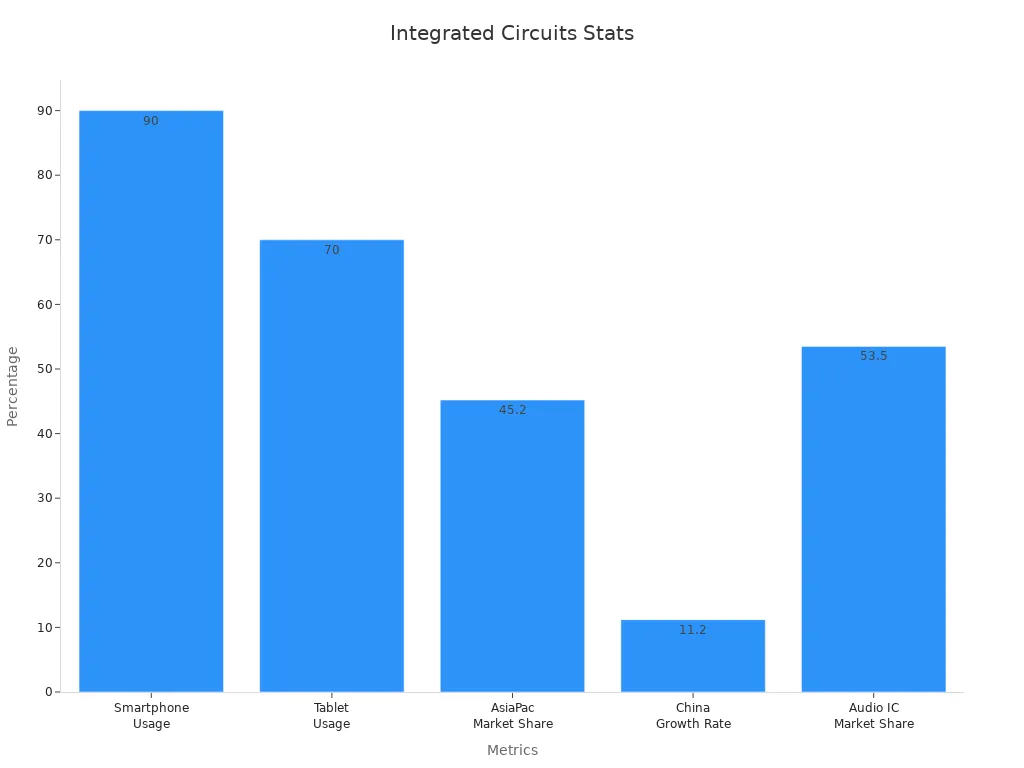
Every day, billions of electronic devices use integrated circuit technology to work well. Integrated circuits are also called microchips. They power smartphones, tablets, and smart TVs. More than 10 billion microchips are made around the world each year. These chips have processors, memory, and input/output systems on one chip. This helps make devices smaller, faster, and use less energy. Integrated circuits help modern electronics get better. They support making things smaller, faster, and using less power. The Asia-Pacific region makes the most chips. China makes over 4 billion chips every year.
Key Takeaways
-
Integrated circuits put lots of electronic parts on a small chip. This makes devices smaller and faster. It also helps them use less energy.
-
Microchips are used in things like phones, cars, and medical tools. They help these things work better and do more.
-
New ideas like 3D stacking and AI integration make chips smarter. These ideas help future devices become more powerful.
-
Good supply chains and smart design choices are important. They help make sure integrated circuits are high-quality and reliable for many industries.
-
People try to reuse and recycle chips to help the environment. These efforts support greener technology and reduce harm to nature.
Integrated Circuit Technology
Definition
Integrated circuit technology is very important for electronics today. This technology lets engineers put many electronic parts on one silicon chip. These parts include transistors, resistors, and capacitors. Microchips use these parts to handle information, save data, and control signals. The main ideas of this technology are to manage power, control current, and stop electrical problems. Engineers use things like p-n junctions and dielectric barriers to keep chip parts apart. The way circuits are placed on a chip matters a lot. Designers must keep noisy and quiet areas apart, spread out heat, and make sure connections work well. These steps help microchips stay accurate and dependable, even as they get smaller and more advanced.
Evolution
Integrated circuits started in 1958 when Jack S. Kilby made the first working microchip. This let people put many electronic parts on one chip. Devices became smaller and stronger. In 1971, Intel made the 4004 microprocessor. This showed that microchips could be tiny computers. Over time, chips got more transistors, following Moore’s Law. This law said the number of transistors would double every two years. Chips became faster and smaller.
The table below shows how integrated circuit technology changed over time:
|
Integration Level |
Approximate Transistor Count |
Time Period |
Key Examples / Notes |
|---|---|---|---|
|
Small-Scale Integration (SSI) |
10-100 transistors |
1960s |
Early ICs enabling basic computational tasks |
|
Medium-Scale Integration (MSI) |
100-1,000 transistors |
Late 1960s to 1970s |
Enabled more complex logic and simple processors |
|
Large-Scale Integration (LSI) |
1,000-10,000 transistors |
1970s |
Introduction of microprocessors like Intel 4004 |
|
Very Large-Scale Integration (VLSI) |
10,000 to 1 million transistors |
1980s |
Marked modern computing growth, integration of complex systems |
|
Ultra-Large-Scale Integration (ULSI) |
Over 1 million to billions of transistors |
1990s to 2000s |
Supported advanced processors and SoCs |
|
System-on-Chip (SoC) |
Billions of transistors |
2000s onwards |
Integration of processors, memory, peripherals on one chip |
|
3D ICs and Advanced Packaging |
Vertical stacking and modular integration |
2020s onwards |
Modern techniques for higher density and efficiency |
As chips got more transistors, they could do more jobs and needed less space. Moving from small-scale to system-on-chip designs let engineers put processors, memory, and sensors on one chip. Today, new ways of making chips use 3D stacking and materials like graphene to make microchips even better.
Importance
Integrated circuit technology is key for making electronics better. Microchips help make devices smaller, faster, and cheaper. Fitting billions of transistors on one chip changed how people use technology every day. Phones, tablets, and smart TVs all need these small circuits to work.
The effects of integrated circuits on device size and speed can be seen in many ways:
-
The first microchip let engineers put parts together, starting smaller devices.
-
The microprocessor made small and flexible computers possible.
-
More transistors on chips made electronics faster and smaller.
-
Special circuits, like analog and digital, added more features in less space.
-
System-on-chip designs put many functions together, making mobile devices stronger.
-
Power-saving ideas helped batteries last longer and made devices greener.
-
New things, like AI accelerators and nanotechnology, will bring even more progress.
Companies keep spending more on research and development in the semiconductor field. They work on new ways to package chips, use better materials, and save energy. These efforts help integrated circuit technology meet the needs of fields like phones, cars, and healthcare. The push to make things smaller and smarter keeps microchips important in electronics.
Note: As technology gets better, integrated circuits will keep making electronics smarter, smaller, and more efficient.
Types of Integrated Circuits
Integrated circuits have many types. Each type does a special job in electronics. Engineers pick the best type for each device. Devices like computers, smartphones, and machines need different circuits. The main types are analog, digital, mixed-signal, ASICs, FPGAs, and electronic integrated circuits.
Analog
Analog integrated circuits work with signals that change smoothly. They help make sounds louder or control voltage. These circuits use signals that move up and down, like ±12V. Analog circuits can be affected by noise. Small changes in voltage can change how they work. People use these circuits in audio gear, sensors, and medical tools.
Digital
Digital integrated circuits use signals with only two levels. These levels are usually 0V and a higher voltage, like 3.3V or 5V. Digital circuits are very important for computers and electronics. They use a clock signal to set the speed for work. Important things to know are how fast they work and what voltages they use. Digital circuits help process and store data quickly and safely.
Mixed-Signal
Mixed-signal integrated circuits have both analog and digital parts. They can turn real signals, like sound or heat, into digital data. These circuits often need two power supplies. They have parts like ADCs and DACs. Mixed-signal circuits are used in phones, cars, and factories.
Note: Datasheets tell about things like supply voltage and current use. They also show input and output voltage levels. This helps engineers pick the right circuit for each job.
ASICs and FPGAs
ASICs and FPGAs do special jobs. ASICs are made for one big use, like in data centers. FPGAs can be changed to do different jobs. These circuits are used in cars, factories, and hospitals. North America sells the most ASICs. Asia Pacific and Europe also sell many. The table below shows some market numbers:
|
Metric/Segment |
Data/Value |
|---|---|
|
ASIC Market Size (2022) |
$29.2 billion |
|
FPGA Market Size (2022) |
$7.2 billion |
|
Market Share by Type (2023) |
Metal ASICs 60%, FPGAs 40% |
|
Application Revenue Shares (2023) |
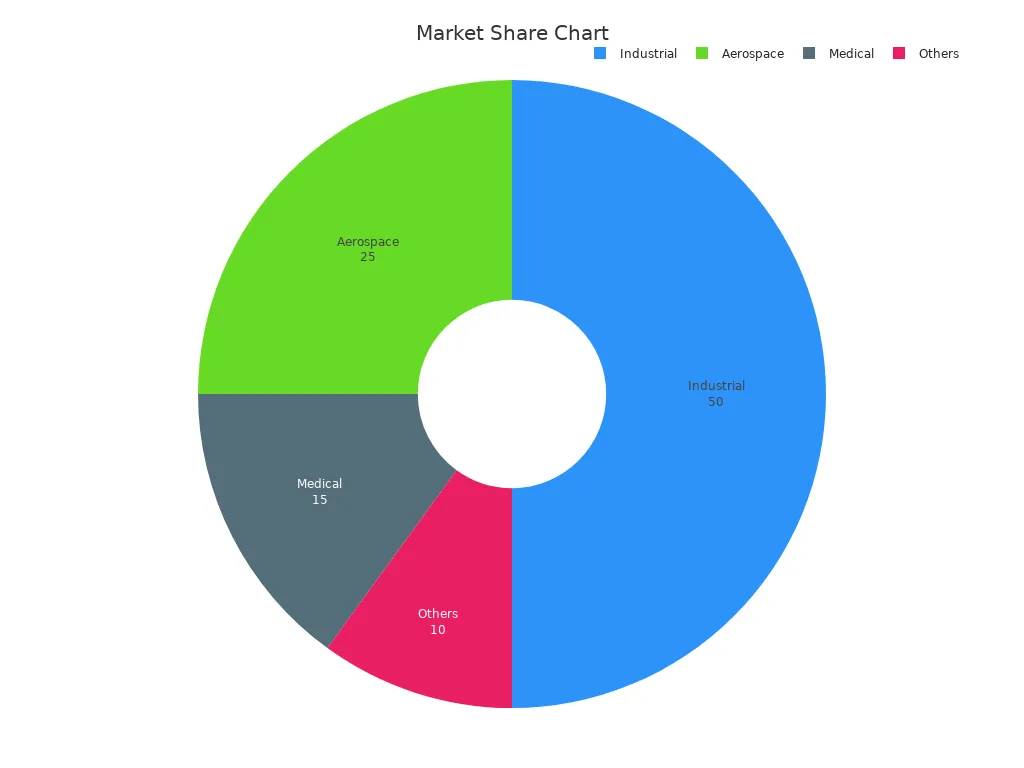
Industrial 50%, Aerospace 25%, Medical 15%, Others 10% |
Electronic Integrated Circuits
Electronic integrated circuits include all these types and more. They use different materials and ways to put parts together. This helps them work in many industries. The table below shows how different they can be:
|
Category |
Types / Examples |
|---|---|
|
Type of Material |
III-V Material, Lithium Niobate, Silica-On-Silicon, Other Raw Materials |
|
Integration Process |
Hybrid, Module, Monolithic |
|
Application |
Biomedical, Data Centers, Telecommunications, Other Applications |
Electronic integrated circuits are found in computers and medical tools. They are small, cost less, and last longer. These circuits help new ideas in phones, factories, and healthcare.
Applications
Consumer Electronics
People want better electronics, so companies use integrated circuits. These circuits help make phones, tablets, and computers work well. They let devices be smaller, faster, and cost less. Makers can add cool features in small spaces. For example, a phone has many integrated circuits. They control the screen, camera, battery, and wireless parts. Tablets use the same technology for good graphics and long battery life. Other things like smart TVs, game consoles, and wearables also need integrated circuits. These circuits help them run smoothly and save energy.
Integrated circuits let brands make easy-to-use and reliable products. This technology helps smart home gadgets and voice assistants grow fast. It makes daily life easier for people.
Makers keep adding more features to each chip. This helps new things like health trackers and virtual reality. Integrated circuits are still very important for new electronics.
Automotive
Cars have changed a lot because of integrated circuits. New cars use these parts for safety and fun features. They help with driving, music, and electric engines. Integrated circuits handle lots of data quickly. This lets cars stay in lanes and avoid crashes. They also help with updates and save power in electric cars.
Car integrated circuits must be safe and last a long time. They read sensor data for self-driving and help cars talk to each other. More cars use these circuits because they work well.
-
Environmental tests make sure they last in tough places.
-
Performance tests look at speed, accuracy, and power use.
-
Standards like ISO 26262 and AEC-Q100 keep cars safe.
-
New testing tools help check circuits better.
These tests show that car integrated circuits are safe and strong. As cars get smarter, integrated circuits will be even more important.
Communications
Integrated circuits help networks go faster and connect better. They power the systems behind phones and the internet. Amplifiers make signals stronger over long distances. Switches help move data and keep it safe. Controllers and processors make networks work well and talk to each other.
|
Aspect |
Evidence Supporting ICs Enhancing Network Speeds and Connectivity |
|---|---|
|
The Communication Integrated Circuit Market will grow a lot. This is because more people use smartphones, 5G, and IoT. |
|
|
Key Components |
Transmitters, receivers, and switches are important. They help signals move and make networks better. |
|
IC Types |
Digital ICs process data fast. RF ICs help with wireless signals. Analog and mixed signal ICs change signals for talking. |
|
Application Sectors |
Phones, cars, and factories all need advanced ICs. This shows how important ICs are for networks. |
|
Technological Trends |
Smaller, smarter, and greener ICs make networks faster and more reliable. |
|
Market Drivers |
More wireless networks and smart devices need better ICs. This keeps connections fast and smooth. |
|
Competitive Landscape |
Big companies spend money to make ICs better. They want faster data and less power use. |
New integrated circuits help networks grow and work better. These changes keep connections strong for everyone.
Industrial and Medical
Factories and hospitals use integrated circuits for accuracy and trust. Factories use them to run machines and watch equipment. These circuits help collect and study data fast. This makes work better and stops problems. In hospitals, integrated circuits power monitors and health tools. They make sure readings are right and quick, which keeps patients safe.
Integrated circuits in factories and hospitals must be very good. Makers test them in hard places to make sure they work.
Factories use these circuits for smart repairs and remote checks. In healthcare, they help with online doctor visits and portable tools. As technology gets better, integrated circuits will do even more in these areas.
Renewable Energy
Renewable energy uses integrated circuits to control power. Solar, wind, and water power need smart circuits to work well. These circuits watch for changes and stop overloads. This keeps the power grid safe in places like hospitals and factories.
-
New power electronics use special materials for better results.
-
Power management integrated circuits help save energy and spread power well.
-
Real-time checks find and fix problems fast.
-
Smart circuit breakers give better reports and can be checked from far away.
Governments and companies spend money on green energy. Asia Pacific makes the most money because of fast growth. Europe will grow the fastest with new technology and more green energy.
Integrated circuits help smart grids and AI-powered repairs. These trends show that integrated circuits are key for clean and smart energy.
Trends and Challenges
Miniaturization
Miniaturization is changing how integrated circuits are made. Smaller chips help engineers build tiny devices. These devices work fast and use less energy. Many fields want these small solutions. Consumer electronics, aerospace, medical, and telecom all need them.
-
Miniaturization makes devices smaller, faster, and use less power.
-
System-on-Chip (SoC) puts CPU, GPU, RAM, and storage together.
-
Making chips at 5nm or 3nm and using 3D stacking saves space.
-
Adaptive voltage scaling and mixed computing help save energy.
-
AI and machine learning cores in SoCs let devices process data on their own.
-
New ways to make chips, like EUV lithography and new materials, help progress.
-
More people want IoT gadgets, wearables, and smartphones.
-
Asia Pacific is best at packaging and making electronics. North America is best at new ideas.
Advanced packaging, like fan-out wafer-level and 3D packaging, makes devices smaller. It also helps them work better. These trends show miniaturization is important for the future of integrated circuits.
AI Integration
AI integration is changing what digital devices can do. Companies now make chips with AI cores inside. This makes processing faster and smarter. For example, AWS Inferentia chips lower costs by 30% compared to old GPUs. Tesla’s AI chips help cars drive safely and cut accidents by 400%. Nvidia’s A100 GPU does AI jobs 20 times faster than before. Google’s TPUs reach 64 teraFLOPS, and TPU v4 Pods reach 275 teraflops. This makes deep learning much faster.
|
AI Accelerator |
Transistor Count |
Core Count |
Key Efficiency Gains |
|---|---|---|---|
|
4 trillion |
900,000 |
Wafer-scale integration for high scalability |
|
|
Tesla Dojo |
1.25 trillion |
8,850 |
High density for large-scale AI training |
Edge AI hardware cuts waiting time by up to 85%. This lets devices do things in real time. These changes show how AI integration is shaping the future of integrated circuits and digital tech.
Supply Chain
The supply chain for integrated circuits has many problems. Disruptions can slow down making and selling digital devices. The car industry saw its IC market share drop from 10.4% to 3.6% between December 2019 and May 2020. Sales dropped by 44% in early 2020. This caused a $60.6 billion loss for car makers. GM sold 111,450 fewer cars. Ford had to cut shifts at big plants. Production dropped by 670,000 cars in Q1 2021 and by 1.3 million for the year. Honda and Nissan sold 250,000 fewer cars together.
|
Aspect |
Statistic / Description |
|---|---|
|
Automotive IC Market Share |
Fell from 10.4% to 3.6% (Dec 2019 - May 2020) |
|
Automotive IC Sales Drop |
44% decrease in first half of 2020 |
|
Revenue Loss (2021) |
$60.6 billion lost across automotive supply chain |
|
GM Vehicle Sales Loss |
111,450 fewer vehicle sales |
|
Ford Production Impact |
Shift reductions at F-150 plants |
|
Production Output Loss |
670,000 fewer vehicles in Q1 2021; 1.3 million fewer for full year |
|
Other Automakers Impact |
Honda and Nissan: 250,000 fewer cars sold |
Natural disasters also cause problems. Taiwan’s drought made TSMC bring in water and build new plants. Over half of semiconductor CEOs now worry about climate and environmental risks. These problems show why strong supply chains are needed for digital technology.
Sustainability
Sustainability is becoming more important for integrated circuits. Life Cycle Assessment (LCA) studies show reusing ICs is better for the environment than recycling. In smartwatches, making ICs hurts the environment the most. For simple devices, the type of base material matters more. Using designs that are easy to recycle and eco-friendly materials helps the planet.
-
Recycling ICs is hard but can help lower carbon emissions.
-
Problems include high costs, tough steps, and unsure quality of reused materials.
-
LCA data helps companies know where to improve.
The semiconductor industry uses LCA to check energy use, emissions, and waste. Companies use this information to save energy and cut pollution. These actions help reach net-zero carbon goals and support a greener future for digital technology.
Practical Considerations
Selection
Engineers pick integrated circuits that fit each project’s needs. They check things like quality, reliability, and price. Industry standards help them make good choices. Teams often look at:
-
The total cost to make the product, including work, materials, and other fees
-
Cost of Goods Sold (COGS) as part of sales, trying for 65% or less
-
Material costs, which are usually half to three-fourths of COGS
-
Yield, with the best companies getting over 95% good products
A high yield means most circuits pass quality checks. Teams also watch operator loading, cycle time, and if schedules are met. These numbers help compare suppliers. They help teams pick the best one for low cost and good quality.
Sourcing
Getting integrated circuits takes careful planning. Companies track how well machines work and how often they stop. They want Overall Equipment Effectiveness (OEE) above 85%. Unplanned stops should be close to 3%. Top makers keep planned maintenance above 80%. Teams use cloud ERP systems to gather and share data. This helps them make smart choices and keep quality high in the supply chain.
Best ways to do this include:
-
Getting support from leaders
-
Sharing info with partners
-
Always trying to get better
These steps help companies get circuits that are reliable and high quality.
Design
Designers look at different integrated circuits to find the best one. The table below shows the main differences:
|
Design Aspect |
Analog IC Design |
Digital IC Design |
Full-Custom IC Design |
Semi-Custom IC Design |
|---|---|---|---|---|
|
Noise Susceptibility |
High |
Low |
N/A |
N/A |
|
Precision |
Low |
High |
N/A |
N/A |
|
Design Difficulty |
High |
Low |
High |
Low |
|
Power Consumption |
Low |
High |
N/A |
N/A |
|
Heat Dissipation |
Low |
High |
N/A |
N/A |
|
10 years |
1-2 years |
N/A |
N/A |
|
|
Cost |
Low |
High |
High |
Low |
Designers use this table to balance quality, price, and how well it works. They also check how fast it runs, how much current it uses, and voltage levels. These steps help make sure the product is good and works well in real life.
Integrated circuit technology is very important for today’s electronics. It helps run things like smartphones and medical devices.
-
The world market for integrated circuits may reach $661.12 billion by 2029. This is because more people use digital tools, IoT, and AI.
-
New ideas like 3D ICs and energy-saving designs help cars and healthcare get better.
-
Top companies and lots of research help the industry grow.
As technology gets better, integrated circuits will help make smarter and more efficient devices.
FAQ
What is an integrated circuit (IC)?
An integrated circuit is a tiny chip with many parts. Engineers use ICs to control, process, and store data. ICs help make electronics smaller, faster, and more dependable.
How do integrated circuits help reduce device size?
ICs put many parts together on one chip. This means devices do not need lots of separate pieces. Devices get lighter and smaller. Makers can add more features in less space.
Where do people use integrated circuits most often?
People use ICs in phones, computers, cars, and medical tools. Factories and power plants also use these chips. ICs help many industries and make products work better.
What is the difference between analog and digital ICs?
|
Analog ICs |
Digital ICs |
|---|---|
|
Work with real signals |
Work with binary data |
|
Used in audio, sensors |
Used in computers |
Analog ICs handle signals that change. Digital ICs use just two levels: 0 and 1.
Why do companies focus on making ICs more energy efficient?
Energy-efficient ICs help devices last longer and use less power. Companies save money and help the planet. Using less energy also means less heat, so devices stay safe and work well.