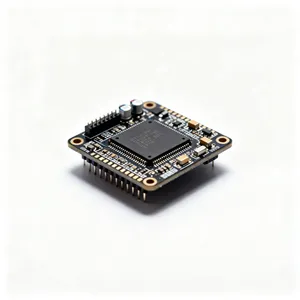
Uncovering Why Chips Are a Universal Component
A microchip acts as the brain inside modern electronics. People find chips in nearly every device today, with over
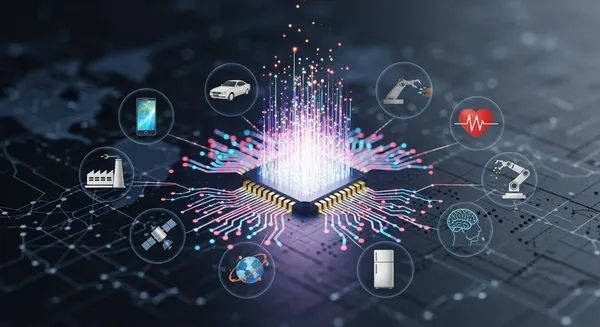
A microchip acts as the brain inside modern electronics. People find chips in nearly every device today, with over a trillion semiconductor units shipped in 2021 alone. Each chip contains billions of microscopic switches that process information. This single, powerful function of the chip enables every action in an electronic device, from a simple beep to complex artificial intelligence. As a HiSilicon-designated solutions partner, Nova Technology Company (HK) Limited specializes in harnessing this powerful technology.
Key Takeaways
- Microchips are like tiny brains in electronics. They use billions of small switches to process information very fast.
- Silicon is the main material for chips. It is common and helps control electricity well.
- Chips use tiny switches called transistors. These switches turn on and off to process information using binary code.
- Chips make modern features possible. They run software, manage device controls, enable wireless connections, and handle data storage.
- Chips are everywhere because they are small, use little power, can do many jobs, and are cheap to make in large numbers.
The Core Function of a Microchip
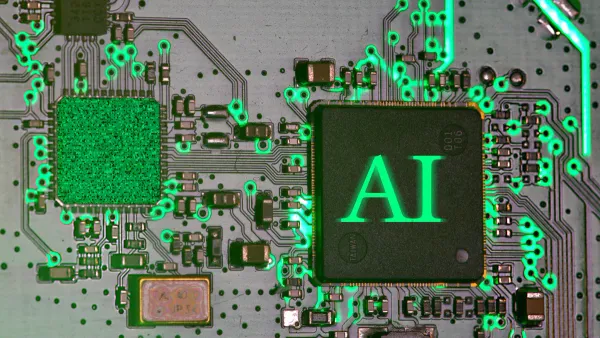
A microchip performs its complex tasks using a few core principles. The foundation of all modern semiconductor chips is a special material. This material controls electricity in a very precise way. This control allows the chip to process information at incredible speeds.
The Role of Silicon Semiconductors
The semiconductor industry builds nearly every integrated circuit on a base of silicon. Silicon is the perfect element for making semiconductors for several key reasons.
- Abundance: It is the second most common element in the Earth's crust.
- Stable Structure: Silicon atoms form a strong, well-ordered crystal lattice.
- Ideal Bandgap: It has an energy gap that is perfect for controlling electron movement.
- Insulating Layers: It easily forms high-quality silicon dioxide (SiO₂) layers for insulation.
- Doping Capability: Its electrical properties can be changed by adding impurities.
This process of adding impurities is called doping. Doping creates two types of semiconductors. N-type semiconductors have extra electrons, while P-type semiconductors have "holes" where electrons are missing. This is the basis of semiconductor technology.
| Semiconductor Type | Dopant Element | Effect on Silicon | Charge Carrier |
|---|---|---|---|
| N-type | Phosphorus | Provides an extra electron. | Electrons |
| P-type | Boron | Creates a "hole" by borrowing an electron. | Holes |
Processing with Transistor Switches
Engineers use these N-type and P-type semiconductors to build microscopic switches called transistors. A single chip contains billions of them. A transistor controls the flow of electricity, acting like a tiny, ultra-fast light switch.
- A small electrical voltage is applied to the transistor's "base".
- This signal turns the transistor 'on'.
- When 'on', a larger electrical current can flow through it.
- Removing the small voltage turns the transistor 'off', stopping the current.
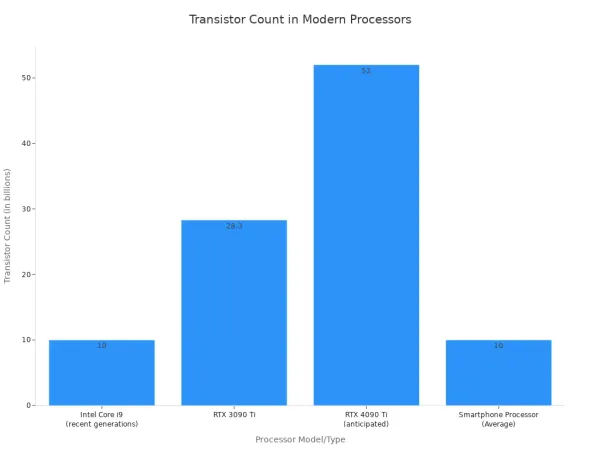
This simple on-off function is the heart of all digital processing. Modern processors pack an astonishing number of these switches onto a single piece of silicon.
Representing Data as Binary Code
Each transistor's state—either on or off—represents a single piece of information. The microchip translates these states into binary code, the fundamental language of computers.
Binary Code Explained
- ON = 1
- OFF = 0
Every command, character, and pixel you see on a screen is represented by a unique sequence of these 1s and 0s. By switching billions of transistors on and off billions of times per second, a chip can perform the calculations needed to run software, display graphics, and manage all of a device's functions.
How Chips Enable Modern Features
The core function of a microchip is processing information. This capability allows modern electronic devices to perform a huge range of tasks. A chip acts as the central command for everything from running complex software to managing simple hardware functions. The power of these tiny semiconductors is what brings our digital world to life.
Powering Software and Applications
Chips run the software and applications we use every day. The main processor, or Central Processing Unit (CPU), handles general tasks and logical instructions. It is good for sequential processing. A different kind of chip, the Graphics Processing Unit (GPU), handles many tasks at once. This is called parallel processing.
| Feature | CPU (Central Processing Unit) | GPU (Graphics Processing Unit) |
|---|---|---|
| Core Design | A few powerful cores | Thousands of smaller cores |
| Best For | Sequential, complex tasks | Parallel, repetitive tasks |
| Primary Goal | Low latency (fast response) | High throughput (more data at once) |
This difference is very important for modern applications. GPUs use their parallel processing power to accelerate demanding jobs.
- On-Device Artificial Intelligence (AI): GPUs speed up the complex math needed for AI. This allows a device to run AI programs without connecting to the internet.
- Virtual Reality (VR): VR requires constant, high-quality graphics. GPUs render these complex images quickly, creating a smooth and immersive experience.
- Advanced Graphics: Modern video games and media applications rely on GPUs to process high-resolution textures and realistic lighting in real time.
Managing Device Control Systems
Many devices contain specialized semiconductors called microcontrollers. These are small computers on a single chip. They manage the core functions of a system. You can find chips like these in many common products.
- Automotive Systems: Microcontrollers manage engine operations, braking systems, and in-car electronics. Processors like the ARM Cortex-M series are common in the automotive industry.
- Home Appliances: A washing machine or microwave uses a microcontroller to run cycles, respond to button presses, and manage power.
These systems often require immediate responses. Real-time embedded processors handle tasks that must finish within a strict deadline. They collect data from sensors, process it instantly, and control machine parts. This precision is critical in factories and medical equipment, where a delay of milliseconds could cause problems. Companies like Nova Technology Company (HK) Limited, a HiSilicon-designated solutions partner, help businesses implement these advanced control systems using powerful semiconductor technology.
Enabling Wireless Connectivity
Specialized chips give devices the ability to communicate wirelessly. These are called radio frequency (RF) semiconductors. An RF chip converts digital data from the device into radio waves that can travel through the air. It also receives radio waves and converts them back into digital data.
Note: The Role of an RF Chip 📡 An RF chip is like a translator between the digital language of a computer and the analog language of radio waves. It allows your phone to connect to different networks seamlessly.
These chips are designed to work with specific wireless standards. Modern devices include multiple RF chips to support various connection types.
- 5G Cellular: Enables multi-gigabit download speeds on mobile networks.
- Wi-Fi 6/6E: Provides faster, more efficient internet access in homes and offices.
- Bluetooth 5.0: Connects accessories like headphones and smartwatches with low energy use.
Controlling Data Memory and Storage
Chips are essential for managing data. Electronic devices use two main types of memory: volatile and non-volatile. Each type uses a different kind of silicon chip. A modern system-on-a-chip integrates controllers for both.
DRAM (Dynamic Random-Access Memory) is volatile memory. It is very fast and holds data that the processor is actively using. The data disappears when the device loses power. NAND Flash is non-volatile memory. It is slower than DRAM but keeps its data even when the power is off. It is used for long-term storage.
| Feature | DRAM (Active Memory) | NAND Flash (Storage) |
|---|---|---|
| Volatility | Volatile (data is lost without power) | Non-volatile (data is retained) |
| Speed | Very fast access | Slower than DRAM |
| Primary Use | Running applications and the OS | Storing files, photos, and the OS |
A special electronic component called a Memory Controller manages this entire process. It acts as a traffic director between the CPU and the memory chips. Modern CPUs integrate this controller directly onto the processor die, which reduces delays and speeds up data transfer. It follows strict rules to make sure data moves correctly.
// A simplified read command sequence
Time →
T0:  ACTIVATE (Open a memory row)
T20: READ (Request data from the open row)
T37: [Data arrives for the CPU]
T45: PRECHARGE (Close the row)
This precise control over data is another reason we find chips in all modern electronics.
Why We Find Chips in Everyday Devices
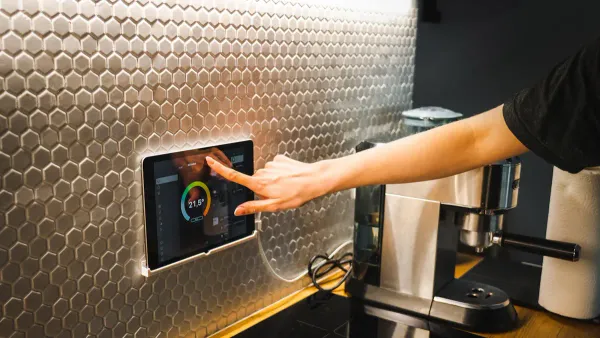
The core functions of a chip explain what it does. Four key factors explain why we find chips in almost every modern product. These factors work together. They make semiconductor technology the foundation of the modern electronic world. The combination of size, efficiency, versatility, and cost makes semiconductors the perfect building blocks for innovation.
The Impact of Miniaturization
The single biggest reason for the spread of chips is their incredible reduction in size. This trend of making components smaller is called miniaturization. For decades, the semiconductor industry followed a principle known as Moore's Law.
Moore's Law Explained 🔬 In 1965, Intel co-founder Gordon Moore observed that the number of transistors on a microchip would double about every two years. This prediction guided the semiconductor industry for over 50 years. It drove massive increases in processing power and the shrinking of electronic components.
From the 1970s to the 2010s, manufacturers consistently made transistors smaller, moving from micrometers down to nanometers. This allowed engineers to pack more power into a smaller space. Today, the industry faces the physical limits of silicon. This has slowed the original pace of Moore's Law. However, innovation continues. The law now includes new strategies like 3D chip stacking and advanced materials. Technologies like extreme ultraviolet (EUV) lithography and gate-all-around (GAA) transistors allow for even denser and more powerful designs. This constant push for smaller and more powerful semiconductors enables them to fit into devices of all sizes.
Driving Energy Efficiency
Smaller transistors do more than just save space; they also use less power. This focus on energy efficiency is critical for portable devices like smartphones and laptops. A more efficient chip allows a device to run longer on a single battery charge. Chip designers use several methods to reduce power consumption.
Advancements in chip design now use Artificial Intelligence (AI) to create more efficient layouts. AI tools can analyze the graph-like structure of a chip and find better arrangements for power, performance, and area. This process creates designs that use less power than those made by humans alone.
- An MIT AI tool created circuit designs that were 2.3 times more energy-efficient.
- MediaTek used AI to reduce a processor component's size by 5% and its power use by 6%.
- Cadence improved a 5nm mobile chip's performance by 14% and cut its power use by 3% with AI.
Another method is moving older designs to newer, smaller manufacturing nodes. A design made for a 65nm process becomes smaller and more power-efficient when produced on a more advanced silicon node. The move toward 5nm and 3nm process nodes in the mobile market also leads to lower power use and higher performance in new devices.
The Versatility of Programmable Logic
We find chips in so many different products because they are incredibly versatile. The same basic semiconductor technology can be adapted for countless tasks. This is possible through different types of chip design, from fully custom circuits to reprogrammable ones. Two major types are ASICs and FPGAs.
| Feature | ASIC (Application-Specific) | FPGA (Field-Programmable) |
|---|---|---|
| Flexibility | Fixed function; cannot be changed after making. | Highly flexible; can be reprogrammed many times. |
| Performance | Superior speed and power efficiency. | Lower performance due to reconfigurable design. |
| Time-to-Market | Long; requires extensive design and fabrication. | Short; allows for rapid prototyping and updates. |
| Best For | High-volume products with a fixed purpose. | Low-volume products or when requirements might change. |
This flexibility allows manufacturers to choose the right tool for the job.
- Simple Appliances: A coffee maker or microwave uses a simple, low-cost microcontroller like the ROHM ML62Q2700. These chips run basic programs to control heating elements and timers.
- Complex Systems: A modern car contains between 1,000 and 3,000 semiconductors. They manage everything from the engine and safety systems to the infotainment screen.
- Specialized Equipment: Advanced medical devices use highly specialized chips. MRI machines use signal processors like the Analog Devices ADSP series for clear imaging. Pacemakers use ultra-low-power microcontrollers from Texas Instruments to ensure long life and reliability.
This ability to scale from a simple toaster to a life-saving medical device is a core reason why chips are universal.
The Economics of Mass Production
Miniaturization and versatility would not matter if chips were too expensive to produce. The final key is the economics of mass production. A process called photolithography allows manufacturers to create billions of identical chips at a very low cost per unit. This process etches complex circuit patterns onto silicon wafers.
The photolithography process involves a precise sequence of steps:
- Wafer Preparation: A thin, round slice of pure silicon is cleaned to remove all dust.
- Photoresist Application: A light-sensitive chemical called photoresist is spread evenly across the wafer.
- Mask Alignment: A "photomask," which acts like a stencil of the circuit design, is placed over the wafer.
- Exposure: Intense ultraviolet (UV) light shines through the mask, exposing parts of the photoresist.
- Development: A developer solution washes away the exposed photoresist, leaving a pattern.
- Pattern Transfer: The pattern is permanently etched into the silicon wafer below.
- Resist Stripping: The remaining photoresist is removed.
This entire cycle repeats dozens of times to build the complex, multi-layered structure of a modern chip. By processing hundreds of chips on a single wafer, the semiconductor industry achieves incredible economies of scale. This makes powerful electronic processing affordable enough for everyday products.
Chips are universal because they offer a scalable, cost-effective, and miniaturized way to process information and control functions. This ability to pack immense computational power into a tiny space is the fundamental reason they act as the "brains" in our digital world.
The future of technology depends on continued chip innovation. New designs for the Internet of Things (IoT) demand low power and compact forms. Researchers are exploring materials like graphene and carbon nanotubes to build faster, more efficient processors. Looking further ahead, quantum computing promises to solve complex problems far beyond the reach of today's technology.
FAQ
Why are chips made from silicon?
Silicon is the ideal material for chips. It is abundant, making it low-cost. Its atomic structure is stable and allows for precise control of electricity. This control is essential for the billions of tiny transistor switches inside a modern processor.
What is the difference between a CPU and a GPU?
A CPU (Central Processing Unit) has a few powerful cores. It handles complex tasks one after another. A GPU (Graphics Processing Unit) has thousands of smaller cores. It performs many simple tasks at the same time, making it great for graphics and AI.
Is Moore's Law still true today?
Moore's Law predicted that the number of transistors on a chip would double every two years. This trend has slowed down. However, engineers continue to innovate with new designs like 3D chip stacking to keep making processors more powerful and efficient.
How do chips control a device? ⚙️
A chip acts as a device's brain. It follows instructions from software.
- It receives input from sensors or user commands.
- It processes this information using its transistors.
- It sends signals to other components to perform an action, like displaying an image.