Resistor standard values everyone can understand
Resistor standard values make choosing the right resistor much easier for you. You see these values everywhere in electronic
Resistor standard values make choosing the right resistor much easier for you. You see these values everywhere in electronics, like 1.0, 2.2, or 4.7 ohms. Manufacturers use resistor standard values to keep things simple and reliable. When you pick a resistor, you find these values in organized groups. For example, the E12 and E24 series help you select from the most common resistor standard values. Here is a table showing how many resistor types you get in each series:
| E-Series | Number of Values | Total Resistor Types |
|---|---|---|
| E12 | 12 | 84 |
| E24 | 12 | 168 |
Resistor standard values let you build and repair circuits with confidence.
Key Takeaways
- Standard resistor values simplify the process of selecting the right resistor for your electronic projects.
- Using E-series values helps you avoid confusion and saves time during design and repairs.
- Tighter tolerance resistors provide more accurate results, making your circuits more reliable.
- Color coding on resistors allows for quick identification of values and tolerances, speeding up troubleshooting.
- Always use standard resistor values to ensure compatibility and ease of replacement in your circuits.
Why standard resistor values exist
Purpose and benefits
You often see standard resistor values in electronics because they make your life easier. Industry groups like the IEC set these values so you can pick resistors that work well in almost any circuit. When you use standard resistor values, you avoid confusion and save time during design and repair. You do not need to guess which resistor to use or worry about finding rare parts.
Standard resistor values help you focus on building circuits instead of searching for hard-to-find components.
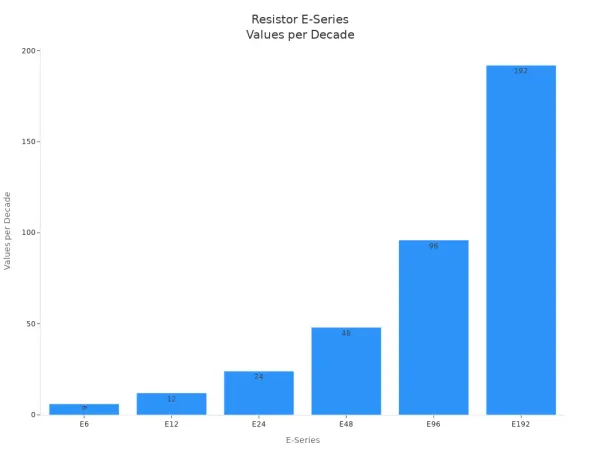
Here is a table showing how the E-series organizes resistor values by tolerance. This system lets you choose the right resistor for your needs, whether you want basic or ultra-precise performance.
| E-Series | Values per Decade | Tolerance |
|---|---|---|
| E6 | 6 | ±20% |
| E12 | 12 | ±10% |
| E24 | 24 | ±5% |
| E48 | 48 | ±2% |
| E96 | 96 | ±1% |
| E192 | 192 | ±0.5%, ±0.25%, ±0.1% |
You benefit from standard resistor values in many ways:
- You get predictable resistance values.
- You can easily find compatible resistors for your project.
- You save money because manufacturers stock these common values.
- You spend less time on calculations and adjustments.
Error minimization
Standard resistor values also help you avoid mistakes. When you use resistors from the same series, you reduce the chance of errors in your circuit. You can match resistors with similar values to get more precise results. For example, if you need a resistance close to 940 ohms, you can combine resistors within a tight range to achieve this.
- Using several resistors together helps average out small errors.
- You can select resistors with close values for better accuracy.
- Tighter tolerance resistors give you more reliable circuit performance.
Color coding on resistors makes identification quick and easy. You can spot the value and tolerance at a glance, which speeds up troubleshooting and repair. This system keeps your electronic devices running smoothly and helps you fix problems faster.
| Aspect | Explanation |
|---|---|
| Standardization | IEC defined standard resistor values to ensure compatibility across manufacturers. |
| Procurement Efficiency | Simplifies the procurement process by providing a consistent set of values for sourcing. |
| Supply Chain Efficiency | Enhances supply chain efficiency by allowing manufacturers to stock standardized values. |
Organizing resistor standard values

E-series overview
You see resistor values organized into groups called E-series. These groups help you choose the right resistor for your electronic project. The E-series system comes from the IEC 60063:1963 standard. This standard started after World War II, when the need for common resistor values became clear. Military production required reliable electronic components for radar and communication equipment. After the war, consumer electronics grew quickly, so manufacturers needed a way to make and sell resistors with predictable values.
The IEC began working on this system in 1948. The first version appeared in 1952. By 1963, the E-series became the main way to organize resistor values. You use these series today to pick resistors for everything from simple circuits to advanced integrated circuits.
- E3, E6, E12, E24, E48, E96, and E192 are the main E-series.
- Each series gives you a set number of resistor values per decade.
- You find these values in tables and charts, making selection easy.
Here is a table showing how many resistor values you get in each E-series and their tolerance:
| E Series | Tolerance (SIG FIGS) | # of Values in Each Decade |
|---|---|---|
| E3 | 36%* | 3 |
| E6 | 20% | 6 |
| E12 | 10% | 12 |
| E24 | 5% | 24 |
| E48 | 2% | 48 |
| E96 | 1% | 96 |
| E192 | 0.5%, 0.25% and higher tolerances | N/A |
You can see how the number of resistor values increases as the tolerance gets tighter. This means you have more choices for precise circuits.

You often use the E6, E12, and E24 series for most electronics work. For high-precision jobs, you might need E48, E96, or E192. Manufacturers list these resistor values in catalogs and online stores, so you can find what you need quickly.
Tip: When you design a circuit, start by checking which E-series fits your needs. This saves you time and helps you avoid mistakes.
Tolerances and categories
Resistor values are grouped by tolerance. Tolerance tells you how much a resistor's actual value can differ from its labeled value. You see this as a percentage, like ±5% or ±10%. The tolerance band on a resistor shows this information using colour coding. For example, a gold band means ±5%, and a silver band means ±10%.
Here is a table showing common tolerance categories and example resistor values:
| Tolerance Category | Example Preferred Values |
|---|---|
| 20% (E6 series) | 1.0, 1.5, 2.2, 3.3, 4.7, 6.8 |
| 10% | Various values |
| 5% | Various values |
| 2% | Precision resistors |
| 0.1% | Precision resistors |
You use tighter tolerance bands when you need more accuracy. For everyday circuits, a 5% or 10% tolerance works well. For sensitive equipment, you pick resistors with a 1% or even 0.1% tolerance.
Manufacturers make sure resistors match these standard values and tolerances. They test each batch and use simulation tools to check performance. For example, a resistor labeled 100 ohms with a 5% tolerance can measure anywhere from 95 ohms to 105 ohms. This balance between precision and cost helps you build reliable circuits without spending too much.
How decade tables work
Resistor values follow a pattern called the decade table. You see base values like 1.0, 1.2, 1.5, 1.8, 2.2, and so on. You multiply these base values by powers of ten to get more options. For example, if you need a resistor for a higher voltage, you might use 10, 12, 15, 18, 22, 33, 47, 68, or 100 ohms. You can also find 1K, 10K, or 100K ohms by multiplying the base values.
This system makes it easy to find resistor values for any part of your circuit. You do not need to guess or calculate odd numbers. You just look up the value in a table and pick the closest match.
Note: Colour coding helps you read resistor values and tolerance bands quickly. You do not need special tools—just learn the color chart and you can identify resistors by sight.
Resistor values are grouped by the EIA preferred value system. For example, with a 10% tolerance, you start with 100 ohms, then move to 120 ohms, 150 ohms, 180 ohms, and 220 ohms. This pattern continues across decades, so you always have a logical set of choices.
You use these standard resistor values in all kinds of electronic components and integrated circuits. Whether you build a simple LED circuit or a complex microcontroller board, you rely on these values to make your design work.
Using resistor values

Common values
You see standard resistor values everywhere in electronics. These values help you build circuits that work reliably. Manufacturers use the standard resistor values system to make sure you can find the right resistor for your project. You often use resistor values like 1.0, 1.5, 2.2, 3.3, 4.7, 6.8, 10, 100, 1K, 10K, 100K, and 1M ohms. These numbers come from the E-series, which groups resistor values by tolerance and makes selection easy.
Resistor values such as 4.7kΩ and 5.1kΩ appear often in consumer electronics. The International Electrotechnical Commission (IEC) created the standard resistor values system to reduce manufacturing costs and cover a wide range of tolerances. This approach lets you use a limited set of resistor values for many different circuits.
You use standard resistor values in many real-world circuits. Here are some examples:
- Timing circuits: You use 1K, 10K, or 100K ohm resistors in 555 timer circuits to control how long the timer runs.
- Voltage regulation: You use standard resistor values to set the output voltage in regulators like the LM317.
- Current sensing: You use a fixed resistor to measure current in battery management systems.
- Temperature sensing: You use resistor values in voltage divider circuits with thermistors to measure temperature.
- Signal filtering: You use standard resistor values to remove noise in audio and data circuits.
- Voltage dividers: You use preferred resistor values to step down voltages for microcontrollers and sensors.
You can find these resistor values in almost every electronic device, from radios to computers.
Here is a table showing some common standard resistor values and where you might use them:
| Resistor Value | Typical Use Case |
|---|---|
| 1.0 Ω | Current limiting in power supplies |
| 2.2 Ω | LED protection |
| 4.7 Ω | Audio circuits |
| 10 Ω | Signal filtering |
| 100 Ω | Pull-down resistors |
| 1K Ω | Timing circuits |
| 10K Ω | Voltage dividers |
| 100K Ω | Sensor circuits |
| 1M Ω | High-impedance inputs |
You see these standard resistor values in both simple and complex electronic components. Integrated circuits often use these values to set operating points and control signals.
Selection tips
When you choose a resistor for your project, you need to think about several factors. You want your circuit to work safely and reliably. Here are some tips to help you select the right resistor value:
- Check the resistance value you need for your circuit. Use standard resistor values from the E-series to make your choice easier.
- Look at the power rating. Make sure your resistor can handle the amount of power in your circuit. If the resistor gets too hot, it can fail.
- Pay attention to tolerance. Tighter tolerance means your resistor value will be closer to what you expect. For most projects, a 5% or 10% tolerance works well.
- Think about the temperature coefficient. If your circuit will get hot or cold, choose a resistor that stays stable in those conditions.
- Pick the right physical size and package type. Small resistors fit in compact circuits, while larger ones handle more power.
- Use fixed resistor types for most projects. Fixed resistors give you a set value and are easy to use.
Tip: Always use standard resistor values when you design or repair circuits. This makes it easier to find replacements and keeps your project reliable.
Engineers follow a simple process to choose resistor values:
- Calculate the resistance you need for your circuit.
- Calculate the power rating required.
- Select a resistor with the right value and rating from the standard resistor values list.
You should also check the nominal resistance, allowable error, rated power, and withstand voltage. These details help you pick a resistor that fits your project and lasts a long time.
When you use standard resistor values, you save time and avoid mistakes. You can find these values in tables, charts, and online catalogs. You do not need to guess or use non-standard values. This makes your work with electronic components and integrated circuits much easier.
Note: If you use preferred resistor values, you can build circuits that are easy to repair and upgrade.
Mistakes to avoid
Common errors
When you work with electronic components, you can make mistakes if you do not pay attention to resistor values. Many beginners choose the wrong resistor and cause problems in their circuits. Here are some common errors you should watch out for:
- You might burn out LED circuits by picking the wrong current-limiting resistor.
- You can create unstable power supplies if you use incorrect values in voltage dividers.
- Signal distortion happens when you mismatch impedance with the wrong resistor.
- You may forget to keep common resistor values like 1k, 10k, and 100k handy for quick repairs.
- You might not stock enough resistor types with different power ratings for prototyping.
- You can overlook power dissipation and cause a resistor to overheat.
- You should always check resistors first when debugging a circuit.
If you use non-standard resistor values, you can make your design more complicated. Sometimes, engineers use non-standard values for special timing needs, but this can confuse others who work on the same project. Some people copy old designs without checking if the resistor values are correct for their new application.
Tip: Always use standard resistor values unless you have a strong reason to choose something different.
Best practices
You can avoid mistakes by following some simple best practices. First, understand what your circuit needs before you select a resistor. Talk to experts if you are unsure about which resistor type fits your application. Consider the characteristics of each resistor, such as tolerance and power rating.
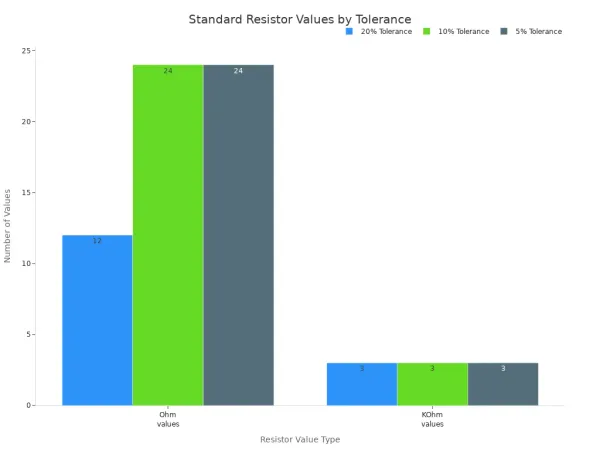
Here is a table that shows standard resistor values for different tolerance levels. You can use this as a quick reference when you build or repair circuits.
| Tolerance | Resistor Values (Ohm) | Resistor Values (KOhm) |
|---|---|---|
| 20% | 10, 12, 15, 18, 22, 27, 33, 39, 47, 56, 68, 82 | 1, 10, 100 |
| 10% | 10, 11, 12, 13, 15, 16, 18, 20, 22, 24, 27, 30, 33, 36, 39, 43, 47, 51, 56, 62, 68, 75, 82, 91 | 1, 10, 100 |
| 5% | 10, 11, 12, 13, 15, 16, 18, 20, 22, 24, 27, 30, 33, 36, 39, 43, 47, 51, 56, 62, 68, 75, 82, 91 | 1, 10, 100 |
You should always calculate power dissipation before you choose a resistor. Keep a variety of resistor values and power ratings in your toolbox. Use tables and charts to help you pick the right resistor quickly. If you follow these steps, you will build circuits that work well and last longer.
You can choose resistor values with confidence when you understand the basics. Here are key points to remember:
- Learn about different resistor types and their uses.
- Practice reading color codes to find resistor values.
- Pick resistors with the right power rating and tolerance for your project.
Knowing standard values like those in the E6 and E12 series helps you build reliable circuits. Educational resources and hands-on practice make learning easier. 😊 Keep exploring and enjoy creating with electronic components!
FAQ
What does "E-series" mean in resistor values?
You see "E-series" as a way to group resistor values by tolerance. Each series, like E12 or E24, gives you a set of preferred values. You use these groups to pick resistors for electronic circuits.
How do you read resistor color codes?
You read color bands from left to right. Each color stands for a number. The first two bands show the value, the third is a multiplier, and the last band shows tolerance. Use a color code chart for quick reference.
Tip: Practice with real resistors to learn color codes faster!
Why do you need different resistor tolerances?
You choose tighter tolerances for circuits that need accuracy, like integrated circuits. Wider tolerances work for simple projects. Tolerance tells you how close the resistor value is to its label.
Can you use non-standard resistor values in your project?
You can use non-standard values, but you may have trouble finding replacements. Standard values make repairs and upgrades easier. Stick to E-series values for most electronic components.
What happens if you pick the wrong resistor value?
You risk damaging your circuit or causing it to work incorrectly. For example, using a low-value resistor with an LED can burn it out. Always check your calculations and use standard values for safety.