Is the plate area of a capacitor constant in 2025's designs?
The direct answer to the question, "is the plate area of a capacitor constant?" is effectively no. A capacitor's p
The direct answer to the question, "is the plate area of a capacitor constant?" is effectively no. A capacitor's physical electrode surface area is fixed, but its performance changes dramatically.
At high frequencies, current crowds into a smaller path. This phenomenon shrinks the area participating in charge storage. This reduction causes a loss of effective capacitance. The capacitor's rated capacitance is not the true capacitance you get. This lost capacitance impacts circuit integrity. The available capacitance, usable capacitance, and total capacitance all decrease. A capacitor's job is providing stable capacitance, but this capacitance is not constant.
This effect is critical as the high-frequency market, valued at over $1.8 billion in 2025, is projected to grow at a 12% CAGR.
Key Takeaways
- A capacitor's effective plate area changes at high frequencies. Current crowding makes the active area smaller, which reduces the available capacitance.
- High-frequency circuits need special capacitor designs. Engineers must choose capacitors with low ESL and use smart PCB layouts to keep capacitance stable.
- Smaller capacitors often work better at high frequencies than larger ones. This is because smaller capacitors have less internal inductance.
- Reverse geometry capacitors improve performance. Their design shortens the current path, which lowers inductance and provides better high-frequency capacitance.
- Using multiple identical capacitors in parallel helps. This method lowers total inductance and provides a more stable power supply for high-frequency circuits.
So, is the plate area of a capacitor constant?
Engineers often ask, is the plate area of a capacitor constant in modern designs? The physical area is fixed, but the electrically active area is not. At high frequencies, the path of least impedance dictates current flow. This path is not across the entire plate but the shortest route between terminals. This phenomenon, known as current crowding, shrinks the effective area, reducing the available capacitance for the circuit. A capacitor with reduced capacitance cannot properly stabilize a circuit.
Current crowding at high frequencies
Current crowding directly impacts a capacitor's performance. Imagine current as water seeking the easiest path to ground. In a high-frequency circuit, this path is the one with the lowest total impedance. The capacitor's internal structure creates inductance. This inductance forces current to concentrate in a narrow channel. This effect renders large portions of the capacitor plates useless. The result is a significant drop in effective capacitance. The rated capacitance of the component no longer reflects the actual capacitance the circuit receives. This loss of capacitance can destabilize the entire circuit.
The role of ESL and current loops
The primary cause of this behavior is Equivalent Series Inductance (ESL). ESL is a parasitic inductance that exists in series with the ideal capacitance of a capacitor. Its value depends heavily on the geometry of the current loop. A longer or narrower current path inside the capacitor increases ESL. This is why ESL is often called "connection inductance," as it relates more to the current's journey than the capacitor's internal build.
A capacitor and its ESL form a series resonant circuit. Below its self-resonant frequency, the component acts as a capacitor, providing necessary capacitance. Above this frequency, ESL dominates. The capacitor then behaves like an inductor, and its impedance rises, making it ineffective for decoupling a high-frequency circuit.
This shift means the capacitor fails to provide stable capacitance. The circuit loses a critical source of charge. A well-designed circuit must account for the ESL of every capacitor to ensure proper function. The total capacitance available to the circuit is therefore frequency-dependent.
Geometry, ESR, and capacitor performance
A capacitor's physical geometry directly dictates its high-frequency performance. The shape and size of a capacitor influence its internal current paths. These paths, in turn, determine the parasitic inductance and resistance that limit the component's effectiveness. Understanding this relationship is crucial for modern electronic design.
Physical size vs. effective capacitance
Engineers often assume a larger capacitor package offers better capacitance. This is a dangerous oversimplification at high frequencies. While a larger package size, like a 1206, has a greater physical plate area, it also has a longer current path between its terminals. This increased length raises the capacitor's ESL, making it perform poorly for high-frequency decoupling. The larger size becomes a liability.
- Miniaturization in MLCCs generally leads to a higher resonance frequency.
- Larger capacitors exhibit higher ESL due to longer internal connection distances. Every millimeter contributes to unwanted inductance.
Therefore, a smaller capacitor often provides more usable capacitance at the target frequency than a physically larger one. The effective capacitance, not the physical size, is the metric that matters.
The reverse geometry capacitor advantage
Designers can overcome the limitations of standard packages by selecting a different component geometry. The reverse geometry capacitor is an excellent example. This type of capacitor alters the standard aspect ratio. For instance, instead of a standard 0402 package (0.4mm x 0.2mm), an engineer might choose a reverse geometry 0204 capacitor (0.2mm x 0.4mm).
| Capacitor Type | Dimensions | Current Path | ESL Performance |
|---|---|---|---|
| Standard 0402 | Long and narrow | Longer | Higher ESL |
| Reverse 0204 | Short and wide | Shorter | Lower ESL |
This change in geometry shortens the distance current travels between the terminals, significantly lowering ESL. Performance graphs show that reverse geometry capacitors maintain lower impedance at higher frequencies compared to standard capacitors of the same capacitance value. This superior performance allows engineers to achieve design goals with fewer components, saving both cost and board space. Expert partners like Nova Technology Company (HK) Limited, a HiSilicon-designated solutions partner, help engineering teams select the optimal capacitor geometry for demanding high-speed applications.
Connecting ESR to effective area
The concept of shrinking effective area also directly impacts a capacitor's equivalent series resistance (ESR). Equivalent series resistance represents the total resistive losses within the capacitor. In an MLCC, this resistance comes from the metal electrodes and termination materials.
When current crowding occurs at high frequencies, the current is forced through a much smaller cross-section of the capacitor's internal plates. This constriction increases the resistance of the current path, causing the equivalent series resistance to rise. The capacitor essentially behaves as if it has a smaller, more resistive conductor inside it.
Minimizing this rise in resistance is critical for maintaining power integrity. A capacitor with low and stable equivalent series resistance can deliver charge more efficiently, ensuring the circuit receives the stable voltage it needs to operate correctly. The total available capacitance is therefore a function of both frequency and the component's resistive losses.
High-frequency layout and design strategies
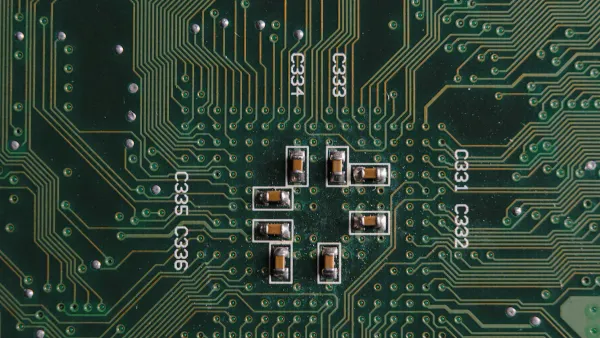
Choosing the right capacitor is only half the battle. The component's performance is deeply tied to the PCB layout. Engineers use specific design strategies to preserve the available capacitance and ensure the circuit functions correctly. A poor layout can undermine even the best capacitor selection, impacting the entire circuit.
Minimizing PCB loop inductance
The PCB itself introduces parasitic inductance into a circuit. This loop inductance comes from the path current travels from the capacitor, through a via to the power plane, to the IC, and back through the ground plane and another via. A larger loop area creates higher inductance, which chokes off high-frequency current and reduces the effective capacitance delivered to the circuit. Minimizing this loop is a primary goal for any high-speed circuit design.
Designers follow strict rules for via placement to reduce this inductance.
- Place power and ground vias very close to the capacitor pads.
- Avoid sharing vias between different capacitor components.
- Use short, wide traces if a direct via-in-pad connection is not possible.
- Mount the capacitor as close as possible to the power and ground planes.
Following these guidelines ensures the capacitor can deliver its charge efficiently, providing the stable capacitance a high-frequency circuit demands.
Using parallel capacitors effectively
Engineers often place multiple capacitors in parallel to lower the total impedance of the power delivery network. Using several smaller, identical capacitors is more effective than using a single large capacitor. This approach reduces the total ESL because the inductances combine in parallel. This strategy helps maintain low impedance at higher frequencies, which is critical for the circuit. The total impedance of a parallel capacitor bank is found with the following formula:
$$Z_{total} = \frac{1}{\frac{1}{Z_1} + \frac{1}{Z_2} + \dots + \frac{1}{Z_N}}$$
An outdated strategy involved using multiple capacitors with different capacitance values (e.g., 10nF, 100nF, 1µF). This method can create parallel resonance peaks, increasing impedance at certain frequencies and destabilizing the circuit. Modern design requires a system-level analysis to select the right capacitance values. This analysis ensures a flat, low impedance profile for the circuit. Expert partners like Nova Technology Company (HK) Limited, a HiSilicon-designated solutions partner, help engineering teams perform this complex analysis to select the optimal capacitance for a demanding circuit. This ensures the final design provides the necessary capacitance without creating performance issues.
The question of whether the plate area of a capacitor is constant has a clear answer in high-frequency design: no. The physical area is a misleading metric. Engineers must instead focus on the dynamic, effective area that shrinks as frequency rises, which reduces the available capacitance. The key solutions involve choosing the right capacitor geometry, like reverse geometry, and implementing smart PCB layout techniques to preserve the needed capacitance.
Looking toward 2025, this focus is essential. Future designs for GaN and SiC semiconductors will demand advanced capacitor designs with superior capacitance. Ultra-low ESL capacitors are critical for next-generation applications. This trend shows the industry's shift toward treating the capacitor as a complex structure to achieve target capacitance and performance. The total capacitance, usable capacitance, and available capacitance all depend on this approach.
FAQ
Why does a larger capacitor sometimes have less effective capacitance?
A larger capacitor package often has higher internal inductance (ESL). This inductance limits the capacitor's performance at high frequencies. The circuit receives less usable capacitance. A smaller capacitor can provide better high-frequency capacitance because its lower ESL allows it to respond faster to the circuit's needs.
Is the plate area of a capacitor constant for a circuit?
No, the effective plate area is not constant. The question, is the plate area of a capacitor constant, has a clear answer in high-frequency design. Current takes the shortest path, shrinking the active area. This reduces the available capacitance and impacts the performance of the entire circuit.
What is the main benefit of a reverse geometry capacitor?
A reverse geometry capacitor has a shorter, wider shape. This design reduces the current's travel distance inside the capacitor. The shorter path lowers the capacitor's ESL. This provides better high-frequency capacitance, making the capacitor more effective for a demanding circuit that requires stable capacitance.
How do parallel capacitors improve a circuit?
Placing multiple capacitors in parallel lowers the total inductance. This strategy provides a low-impedance path for high-frequency currents. The circuit sees a more stable source of capacitance. Using several identical small capacitors is often better than one large capacitor for maintaining the required capacitance.