How AC DC Switching Power Supplies Are Evolving in 2025
AC & dc switching power supplies are undergoing rapid transformation in 2025, driven by higher power density, wide-bandg
AC & dc switching power supplies are undergoing rapid transformation in 2025, driven by higher power density, wide-bandgap semiconductors, digital control, and AI/IoT integration. Companies now focus on hybrid architectures to boost efficiency and sustainability across industries. The global ac dc switching power supply market is projected to hit USD 32.1 billion in 2025, reflecting strong demand from electric vehicles, renewable energy, and smart devices.
| Dimension | 2023 Value | 2025 Projected Value | Key Drivers and Trends |
|---|---|---|---|
| Market Size | USD 25.4 billion | USD 32.1 billion | Growth driven by electric vehicles (EVs), renewable energy, and demand for energy-efficient solutions |
| Annual Growth Rate | 5.2% | 6.8% | Increasing due to IoT expansion, sustainability trends, and smart device proliferation |
| Regional Focus | North America | Asia-Pacific | Shift due to market saturation in developed regions and emerging opportunities in Asia-Pacific |
| Key Applications | Consumer Electronics | EV Charging Infra. | Rising demand for compact, efficient power supplies in EV infrastructure and smart grids |
| Emerging Technologies | Smart Grids | Wireless Power Transfer | Innovations in power conversion efficiency, AI integration, and smart controls |
| Challenges | Pricing pressure, regulatory changes, supply chain disruptions | Addressed by innovation, compliance, and resilient supply chains |
These emerging trends set new standards for ac & dc switching power supplies, impacting efficiency, reliability, and sustainability in real-world applications.
Key Takeaways
- Wide-bandgap semiconductors like silicon carbide and gallium nitride boost power supply efficiency and shrink their size.
- Digital control and AI/IoT integration make power supplies smarter, safer, and easier to monitor and maintain.
- The market grows fast due to demand from electric vehicles, renewable energy, and smart devices worldwide.
- Modular and hybrid designs improve power density, flexibility, and reliability in many industries.
- Strong focus on energy efficiency, thermal management, and safety helps meet strict standards and sustainability goals.
ac dc switching power supply innovations
Wide-bandgap semiconductors
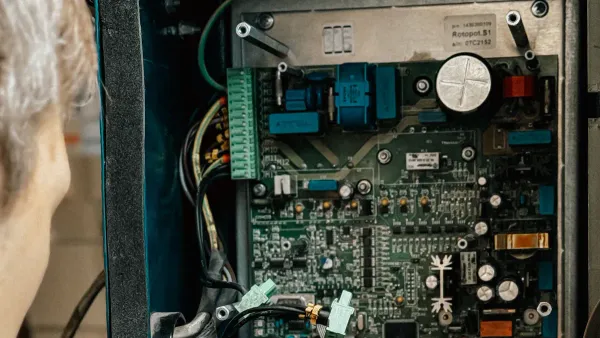
Wide-bandgap semiconductors, such as silicon carbide (SiC) and gallium nitride (GaN), have become the foundation for the latest ac/dc switching power supplies. These materials enable smps to operate at higher voltages, frequencies, and temperatures. As a result, ac-dc power supply designs now achieve high efficiency and greater power density. For example, GaN technology allows ac-dc switching power supplies to reach efficiencies up to 99%. SiC-based solutions, like COSEL’s 3.5kW ac-dc power supply units, deliver up to 94% efficiency and maintain stable operation in harsh industrial environments.
The adoption of SiC and GaN has led to smaller, lighter, and more reliable switching mode power supply units. These devices require less cooling and support compact form factors, which are essential for modern automation, aerospace, and renewable energy applications. The table below highlights some of the most recent advancements in SiC and GaN for ac & dc switching power supplies:
| Technology / Company | Advancement / Feature | Performance / Benefit | Application / Notes |
|---|---|---|---|
| Alpha & Omega Semiconductor (AOS) | 1200 V Gen-3 SiC MOSFETs with up to 30% lower switching losses | High ruggedness, TO-247 4-lead package | EV traction inverters, industrial drives |
| Pulsiv | GaN-based USB-C PD modules delivering 65 W at 97.3% efficiency | Ultra-compact, thermally optimized | AC/DC power supplies, multi-device breaker support |
| Cambridge GaN Devices | Combo ICeGaN hybrid inverter combining GaN with IGBTs | 25 kW/L power density, 99.1% efficiency | 800 V EV drivetrains, scalable 1 kW to 100 kW |
| Microchip | mSiC isolated gate driver for 3.3 kV SiC modules | Integrated Augmented Switching control | High-voltage SiC MOSFETs |
SiC dominates high-voltage ac-dc applications, while GaN leads in low- to mid-voltage smps. The complementary use of both materials drives innovation and supports the latest trends in ac-dc switching power supplies.
Digital and smart control
Digital and smart control have transformed ac-dc switching power supplies. Fully digital control architectures now cover both input and output stages, providing real-time communication, diagnostics, and optimization. This approach gives engineers deeper insights into the power supply and its environment, improving safety, efficiency, and reducing operating costs.
- Digital control algorithms deliver precise voltage regulation and current management, which boosts efficiency and reliability.
- Adaptive voltage scaling optimizes power delivery for each device, reducing energy waste.
- Enhanced transient response ensures system stability during load changes.
- Real-time monitoring and diagnostics enable proactive maintenance, minimizing downtime.
- Programmable and adaptable control allows smps to respond to varying load conditions.
- Advanced control techniques, including machine learning, support dynamic adaptation and extend device lifespan.
These innovative approaches help ac & dc switching power supplies achieve higher power density and better system understanding. The integration of advanced control techniques also supports compliance with the latest efficiency standards, making ac-dc power supply solutions more sustainable and reliable.
AI and IoT integration
AI and IoT integration represent the most cutting-edge technologies in ac/dc switching power supplies. These features transform smps into smart, responsive systems that support predictive maintenance and adaptive power management.
- AI-driven diagnostics use machine learning to monitor power supply data and predict failures before they occur.
- IoT connectivity enables remote monitoring, cloud-based firmware updates, and real-time anomaly detection.
- Adaptive power distribution powered by AI and IoT dynamically adjusts to device demands, optimizing energy efficiency.
- Automation and robotics, enhanced by AI, improve precision in manufacturing and maintenance.
- These technologies reduce downtime and improve reliability in critical sectors, such as medical devices and industrial automation.
By leveraging AI and IoT, ac-dc power supply manufacturers deliver smarter, more efficient, and more reliable solutions. These trends support the shift toward proactive maintenance, lower energy consumption, and improved operational efficiency.
Note: The combination of wide-bandgap semiconductors, digital control, and AI/IoT integration sets new standards for ac & dc switching power supplies. These innovations drive high efficiency, reliability, and sustainability, meeting the demands of modern industry.
ac/dc switching power supplies market trends
Power density and miniaturization
ac/dc switching power supplies continue to evolve as manufacturers push for higher power density and smaller form factors. The adoption of wide-bandgap semiconductors, such as silicon carbide and gallium nitride, allows smps to operate at higher voltages and switching frequencies. This shift increases efficiency and enables the use of smaller passive components. Advanced packaging, including 3D integration and additive manufacturing, reduces the size of ac-dc power supply units. Planar transformer designs and flat isolated power supplies, like those developed by Tesla, demonstrate how integration and component reduction lead to compact, high-density solutions. Higher switching frequencies, especially in the MHz range, further shrink inductors and capacitors, supporting the trend toward lighter and smaller ac-dc switching power supplies. These developments meet the growing demand for compact systems in electric vehicles and portable electronics.
Hybrid and modular designs
Hybrid and modular designs have become a defining feature of the switching mode power supply market. Intermediate Bus Converters (IBCs) and hybrid regulated ratio (HRR) IBCs blend unregulated and regulated approaches, optimizing voltage regulation and efficiency. These designs address challenges such as start-up dynamics and reverse energy management. Modular architectures, especially in automotive 48V systems, distribute smaller ac-dc power supply modules close to loads. This approach reduces current and power losses, enabling smaller cables and connectors. Modular smps enhance thermal management and system redundancy, simplifying development and qualification. Companies like Flex Power Modules and Vicor achieve efficiencies over 98% and high power densities, proving the scalability and practicality of modular ac & dc switching power supplies in data centers and automotive applications. However, these designs require careful management of control complexity and safety.
Wireless charging advances
Wireless charging represents one of the most significant emerging trends in ac/dc switching power supplies. Recent advances in high-frequency inductive charging now deliver speeds up to 22 kW, making contactless charging practical for medical devices, portable electronics, and electric vehicles. New ac-ac converter designs eliminate traditional ac-dc and dc-ac stages, reducing energy losses and operating costs. These systems use multilevel diode clamp inverters and high-frequency LCC compensators to improve efficiency and lower voltage stress. Integration of wireless charging into linear power supplies, especially for medical and portable devices, enhances convenience and system integration. Materials like SiC and GaN, along with self-rectifying designs, contribute to more compact and efficient ac-dc power supply solutions. The switching mode power supply market sees wireless charging as a future-ready solution, supporting safer operation and streamlined installation.
The ac-dc power supply market is projected to grow from USD 20.86 billion in 2024 to USD 22.43 billion in 2025, with an approximate growth rate of 7.5%. The compound annual growth rate is expected to reach 8% from 2025 to 2032, reflecting strong demand for advanced ac & dc switching power supplies.
| Attribute | Value |
|---|---|
| Market Value in 2024 | USD 20.86 billion |
| Market Value in 2025 | USD 22.43 billion |
| Approximate Growth Rate (2024-25) | ~7.5% |
| CAGR (2025-2030) | 7.3% |
ac-dc power supply industry drivers
Consumer electronics
ac/dc switching power supplies drive innovation in consumer electronics. Manufacturers respond to the rising demand for portable devices, smart appliances, personal computers, televisions, and gaming consoles. Users expect consistent, efficient, and clean power delivery. The trend toward miniaturization and enhanced performance pushes for small footprint ac-dc designs. Engineers focus on advanced thermal performance and wide input voltage ranges for global compatibility. Programmable outputs, standby modes, and compliance with strict regulatory standards such as RoHS and FCC are now standard. Wireless charging and fast-charging capabilities in smartphones and tablets rely on efficient smps. The adoption of energy-efficient, space-saving power conversion systems grows. Advanced semiconductor materials like gallium nitride and silicon carbide improve efficiency and reduce size.
- Increasing demand for portable and smart devices
- Need for efficient, clean, and reliable ac-dc switching power supplies
- Miniaturization and enhanced performance requirements
- Advanced thermal management and global compatibility
- Compliance with regulatory standards
- Wireless and fast-charging support
- Use of GaN and SiC for higher efficiency
ac/dc switching power supplies support digitalization trends, enabling remote monitoring and IoT integration. Modular and scalable smps designs offer flexibility and faster deployment. These factors enhance reliability, efficiency, and adaptability in consumer electronics.
Automotive and e-mobility
The automotive and e-mobility sector shapes the evolution of ac/dc switching power supplies. Electric vehicles require highly efficient, reliable, and compact ac-dc solutions. High-frequency switching techniques reduce energy loss and improve power management. Key applications include Battery Management Systems, On-Board Chargers, and auxiliary power distribution. These ac-dc switching power supplies ensure stable power delivery, enhancing battery life, vehicle safety, and charging efficiency. Advanced thermal management reduces heat generation, protecting electronics and extending component longevity. Compact and versatile smps designs fit into space-constrained EV architectures. Continuous innovation addresses design complexity and cost, keeping solutions cost-effective and high-performance. Modular and redundant electrical architectures improve reliability. Advanced control algorithms manage efficient power flow. The use of wide bandgap semiconductors like SiC and GaN improves efficiency and thermal performance. These developments enable faster charging and better battery health management.
Medical and military sectors
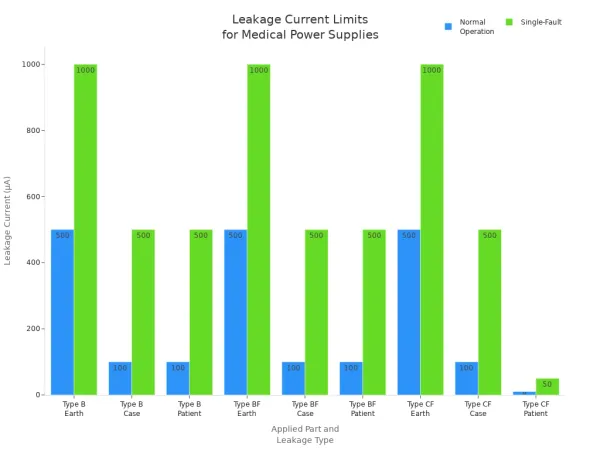
Medical and military sectors demand ac/dc switching power supplies with strict safety and reliability standards. Medical smps must comply with IEC 60601-1, which sets limits for leakage currents and requires high isolation. These ac-dc power supply solutions protect both operators and patients. The following table summarizes leakage current limits for different applied part types:
| Applied Part Type | Leakage Current Type | Normal Operation Max | Single-Fault Max |
|---|---|---|---|
| Type B (Body) | Earth Leakage | 500 µA | 1 mA |
| Case Leakage | 100 µA | 500 µA | |
| Patient Leakage | 100 µA | 500 µA | |
| Type BF (Body Floating) | Earth Leakage | 500 µA | 1 mA |
| Case Leakage | 100 µA | 500 µA | |
| Patient Leakage | 100 µA | 500 µA | |
| Type CF (Cardiac Floating) | Earth Leakage | 500 µA | 1 mA |
| Case Leakage | 100 µA | 500 µA | |
| Patient Leakage | 10 µA | 50 µA |
Medical ac/dc switching power supplies require high Mean Time Between Failures, efficient power conversion, and robust isolation. Military smps must withstand harsh environments and electromagnetic interference. Both sectors rely on ac-dc power supply solutions that deliver reliability, safety, and compliance.
Renewable energy
Renewable energy initiatives drive the development of ac/dc switching power supplies that are efficient, scalable, and compatible with smart grids. Solar and wind power systems need converters that handle variable inputs and maintain stable outputs. Engineers use adaptive control algorithms and modular smps designs to meet these needs. Regulatory agencies enforce strict energy efficiency standards, pushing manufacturers to adopt advanced semiconductor materials like GaN and SiC. Sustainable manufacturing and integration of energy storage systems require bidirectional power flow capabilities. These trends foster a dynamic market where ac-dc switching power supplies evolve to optimize efficiency, interoperability, and sustainability. Regional growth in Asia Pacific, North America, and Europe accelerates as renewable energy adoption and energy efficiency policies expand.
Sustainability and energy efficiency

Eco-friendly designs
Manufacturers now prioritize eco-friendly designs in ac & dc switching power supplies. They use advanced power management techniques, such as maximum power point tracking and DC link voltage regulation, to support energy-efficient power conversion. Many companies adopt bidirectional power converters, which allow flexible voltage adjustments and efficient power transfer between multiple voltage buses. Adaptable layouts support various loads, including EV fast charging, by optimizing energy distribution. Coordinated control techniques regulate current and power flow, improving overall efficiency. Integration of energy management systems with user-friendly algorithms helps optimize energy usage and set points.
Other strategies include the use of wide-bandgap semiconductors like GaN and SiC, which improve energy conversion efficiency and reduce heat. Digital control systems and intelligent management reduce standby losses. Modular and scalable architectures allow flexible configuration for dynamic loads. AI and IoT integration enable self-regulation and remote configuration, supporting energy efficiency goals. EcoSmart technology and high integration in ICs reduce e-waste and conserve raw materials, helping ac-dc power supplies meet strict regulation and sustainability targets.
Efficiency standards
Efficiency standards play a major role in shaping ac & dc switching power supplies. Regulations such as Levels IV, V, and VI set minimum efficiency thresholds and no-load power consumption limits. These rules require power supplies to maintain high power efficiency at different load points, including 25%, 50%, 75%, and 100% of rated power. Designers use advanced semiconductors like SiC and GaN to achieve these targets. They also implement control algorithms that optimize efficiency at low loads, including green-mode operation and switching between driver circuits for different load ranges.
| Standard Level | Minimum Efficiency | No-Load Power Limit | Impact on Design |
|---|---|---|---|
| IV | 80-85% | ≤ 0.5W | Improved topologies, better components |
| V | 85-87% | ≤ 0.3W | Advanced control, lower losses |
| VI | 87-90% | ≤ 0.1W | Wide-bandgap semiconductors, multi-mode operation |
Regulation also expands to cover more products, including multi-voltage and higher power supplies. Compliance with these standards ensures reduced energy consumption, lower heat, and better environmental outcomes. Programs like 80 PLUS encourage designs that maintain efficiency across a wide load range, supporting energy efficiency goals and global regulation.
EMI and noise reduction
EMI and noise reduction remain critical for ac & dc switching power supplies. Engineers use filtering strategies to target both common mode and differential mode noise. Careful PCB layout, with clear return paths and strong grounding, helps reduce emissions. Advanced semiconductors like SiC and GaN allow higher switching speeds but require careful EMI design from the start. Multiphasing switching techniques and damping parasitic oscillations improve noise suppression. Snubber circuits reduce spike noise from switching elements.
Designers also use shielding and grounding to limit radiated EMI. Input and output line filtering with LC filters, common mode chokes, and capacitors reduce conducted noise. Four main EMC strategies—reflection, absorption, bypassing, and shielding—work together to control EMI throughout the power supply. Surface-mounted components and metal enclosures further reduce noise. These techniques help ac-dc power supplies meet strict EMI regulation and deliver energy-efficient solutions for sensitive applications.
ac-dc challenges and solutions
Thermal management
ac & dc switching power supplies in 2025 face major thermal management challenges. As engineers push for higher power density and smaller smps, heat becomes a bigger problem. Power losses turn into heat, which can damage sensitive components if not managed well. Advanced features like programmable outputs and active power factor correction add to the complexity. Designers must use effective cooling methods, such as forced-air or conduction cooling, to keep temperatures within safe limits. They consider airflow, fan size, and the orientation of the ac-dc unit to improve heat removal. Even with wide bandgap semiconductors and higher switching frequencies boosting efficiency, thermal management remains a top concern. If heat is not controlled, reliability drops and failures increase. Engineers use heatsinks, cooling fans, and compact high-voltage SiC MOSFETs to help manage heat. They also use advanced control techniques to monitor temperature and adjust operation as needed. Good thermal management supports long-term performance and meets strict industry standards.
Reliability and safety
Reliability and safety are critical for ac & dc switching power supplies. Standards from groups like IEC, ANSI, and OSHA set strict rules for electrical safety, electromagnetic compatibility, and environmental impact. These standards keep getting tougher, with new rules for energy efficiency and limits on hazardous materials. Manufacturers must follow best practices, such as regular audits, detailed documentation, and real-time monitoring. They use advanced control techniques to optimize electrical parameters and reduce electromagnetic noise. Simulation and prototype testing help ensure that smps meet all safety and noise standards. Energy efficiency rules now require low no-load power use and high efficiency at different loads. This holistic approach improves reliability, safety, and environmental responsibility. Engineers also add protection functions for input, output, and temperature to prevent failures. These steps help ac-dc power supply units stay safe and reliable in demanding environments.
- International standards cover electrical safety and electromagnetic compatibility.
- Energy efficiency rules set strict limits for power use.
- Environmental laws restrict hazardous substances and promote recycling.
- Best practices include audits, documentation, and compliance software.
Supply chain and cost
Supply chain and cost issues shape the ac & dc switching power supplies market in 2025. New tariffs on key raw materials, like advanced semiconductor substrates, have raised import costs. Manufacturers with local or vertically integrated production gain a pricing edge. Many suppliers now use nearshoring to cut lead times and reduce risk. Long-term supplier agreements often include backup plans and inventory buffers. Companies also work together to qualify domestic components. Cost engineering has become more important, with design for manufacturability and module reuse helping to lower expenses. Digital supply chain platforms allow real-time price adjustments and margin control. Agile supply chain management and strong supplier partnerships help companies stay profitable. Engineers use standardized modules and advanced simulation tools to reduce waste and speed up development. These strategies help ac & dc switching power supplies remain competitive despite rising costs and supply chain disruptions.
| Challenge | Description | How It Is Addressed |
|---|---|---|
| Efficiency | Demand for higher efficiency, including low standby power. | Integrated control ICs and optimized switching systems. |
| Heat Generation | Heat loss can damage components and reduce reliability. | Heatsinks, cooling fans, and advanced switching systems. |
| Downsizing | Reducing size is hard with added cooling needs. | Multi-function ICs and compact high-voltage SiC MOSFETs. |
| Protection Functions | Need for input, output, and temperature protections. | Integrated protection functions in control ICs. |
| Obsolescence | Component lifecycle issues force redesigns. | Components with lifecycle support and integrated ICs. |
Tip: Companies that invest in agile supply chains and advanced control techniques can better manage costs and keep ac & dc switching power supplies reliable and efficient.
future of ac-dc switching power supplies
Emerging applications
The future of ac/dc switching power supplies centers on a wave of new applications. Engineers see advanced 5G technology, software-defined power architectures, and smart grids as major growth drivers. The rise of microgrids, telecommunications, and IT infrastructure increases demand for efficient ac & dc switching power supplies. Industrial automation, aerospace, and defense sectors require smps with digital management and precise control. Medical devices and renewable energy systems also depend on reliable ac/dc switching power supplies for safe operation.
- 5G devices need digital control and new material designs for lower power use.
- Software-defined power architectures use advanced control and monitoring for flexible power delivery.
- Smart grids and microgrids rely on digital ac & dc switching power supplies for stable energy flow.
- Electric vehicles and consumer electronics push for miniaturized, high-efficiency smps.
- Industrial automation and aerospace require robust control and fast response from ac/dc switching power supplies.
The switching mode power supply market grows as these sectors adopt smarter, more efficient solutions. Manufacturers address challenges like thermal management and electromagnetic interference with innovative cooling and integrated circuit designs. Regional growth in emerging markets creates new opportunities for ac & dc switching power supplies.
Five-year outlook
The next five years will bring rapid change to the ac/dc switching power supplies landscape. Wide-bandgap semiconductors, such as SiC and GaN, will transform smps by improving efficiency, reducing size, and enhancing thermal control. The power supply market will expand as renewable energy and electric vehicles become more common. Data centers and AI workloads will require high-density, modular ac & dc switching power supplies with advanced control features.
Manufacturers will focus on integrating IoT capabilities and digital control for smarter, communicative ac/dc switching power supplies. Miniaturization will support smaller devices, while energy-efficient designs will meet strict environmental standards. The switching mode power supply market will see steady growth, with projections showing the modular segment rising from USD 5.2 billion in 2024 to USD 7.9 billion by 2033. Key trends include digital power management, modular designs, and smart power supply solutions.
Challenges such as supply chain disruptions and regulatory compliance will remain. However, ongoing innovation in control, cooling, and manufacturing will help the ac/dc switching power supplies industry adapt. Manufacturers will invest in research, strategic partnerships, and sustainability to stay ahead. The future of ac & dc switching power supplies promises smarter, safer, and more efficient next-generation power supplies for every sector.
ac & dc switching power supplies in 2025 show remarkable progress. Wide-bandgap semiconductors, digital control, and IoT integration drive higher efficiency, miniaturization, and smarter smps. Real-time monitoring and adaptive algorithms support stable output and proactive maintenance. These trends help industries meet strict standards and sustainability goals. End-users benefit from compact, reliable ac/dc switching power supplies across sectors. Manufacturers can adapt by leveraging supplier expertise and tracking market trends. The future of ac dc switching power supply technology promises even greater efficiency, reliability, and innovation.
FAQ
What are wide-bandgap semiconductors, and why do they matter?
Wide-bandgap semiconductors, such as SiC and GaN, allow power supplies to work at higher voltages and temperatures. They improve efficiency and reduce size. Engineers use these materials to create smaller, faster, and more reliable power supplies.
How does digital control improve ac-dc switching power supplies?
Digital control gives engineers real-time data and precise adjustments. It helps maintain stable output and reduces energy waste. Smart algorithms also support faster troubleshooting and easier updates.
Tip: Digital control systems make power supplies safer and more efficient.
Can ac-dc switching power supplies support wireless charging?
Yes, modern ac-dc switching power supplies support wireless charging. They use high-frequency circuits and advanced materials. Devices charge faster and safer without cables.
| Feature | Benefit |
|---|---|
| High-frequency | Faster charging |
| Advanced materials | Safer operation |
What industries benefit most from new ac-dc switching power supply technology?
Consumer electronics, automotive, medical, and renewable energy sectors see the biggest gains. These industries need compact, efficient, and reliable power supplies for new devices and systems.
- Consumer electronics
- Automotive and e-mobility
- Medical devices
- Renewable energy