FPGA Engineering Trends Shaping Tomorrow
The world of fpga engineering is undergoing a rapid transformation, driven by powerful trends. Key innovations include the d

The world of fpga engineering is undergoing a rapid transformation, driven by powerful trends. Key innovations include the deep integration of Artificial Intelligence and the shift towards High-Level Synthesis, expanding what is possible with programmable logic. The growing role of field-programmable gate arrays and other programmable logic devices in automotive and 5G sectors showcases this technology's impact. This flexible design approach is critical for modern systems.
The global FPGA market reflects this momentum. It is projected to grow from USD 11.73 billion in 2025 to USD 19.34 billion by 2030, a testament to the rising adoption of FPGA technology.
Key Takeaways
- FPGAs are changing fast. They combine with AI and use new design methods.
- FPGAs help AI work better. They use less power for tasks like smart cameras and self-driving cars.
- New FPGAs mix different computer parts. This makes them powerful for many tasks.
- FPGAs are key for 5G internet. They can change to fit new network rules.
- New tools make FPGAs easier to use. These include cloud tools and open-source software.
Core Technological Trends in FPGA Engineering
The core technological trends in FPGA engineering are pushing the boundaries of what is possible. These developments are not just incremental; they represent fundamental shifts in how we approach system design and computation. The future of fpga market depends on these powerful innovations.
AI and FPGA Convergence
The fusion of Artificial Intelligence (AI) and FPGA technology is a dominant trend. An FPGA serves as a powerful, energy-efficient accelerator for real-time data processing. This is especially true for edge AI workloads where low latency and power efficiency are critical. The future of fpga market is closely tied to this convergence. FPGAs provide a unique energy-efficient architecture for AI inference. Their ability to perform custom parallel processing makes them ideal for running complex models like Convolutional Neural Networks (CNNs). While transformer models present challenges due to their complexity, fpga design tools are enabling their acceleration with far less power than traditional GPUs.
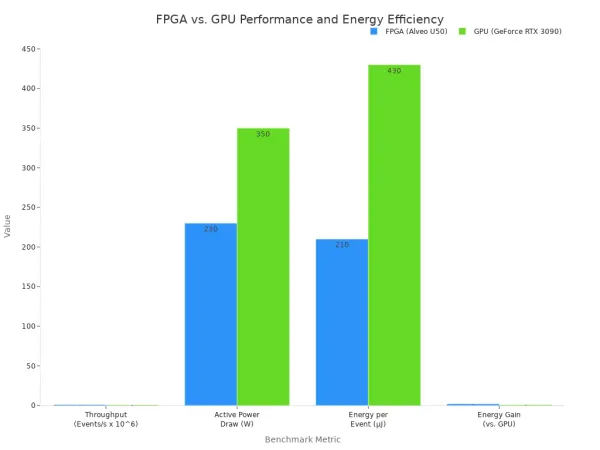
The performance benefits are clear. An FPGA offers a distinct advantage in energy efficiency for real-time tasks. The future of fpga market will be shaped by this efficiency.
| Metric | FPGA (Alveo U50) | GPU (GeForce RTX 3090) |
|---|---|---|
| Throughput (Events/s x 10^6) | 1.10 | 0.82 |
| Active Power Draw (W) | 230 | 350 |
| Energy per Event (µJ) | 210 | 430 |
| Energy Gain (vs. GPU) | 2.0x | 1.0x |
This data shows an FPGA can be twice as energy-efficient per event. The growth in AI applications directly fuels the growth of the future of fpga market. Modern fpga design tools help engineers optimize these devices for specific AI workloads.
This high efficiency makes the FPGA essential in many commercial applications.
- Smart Surveillance: Systems use an FPGA to process video streams for real-time object detection.
- Autonomous Vehicles: An FPGA offloads intensive sensor fusion and path planning tasks.
- Industrial Automation: Programmable logic devices handle motion control and predictive maintenance analysis.
- Medical Devices: An FPGA provides low-power processing for wearable health monitors.
Specialized fpga design tools are crucial for implementing these advanced digital systems. The future of fpga market relies on this expanding ecosystem.
The Rise of Heterogeneous SoCs
The industry is moving beyond single-processor solutions. Heterogeneous Systems-on-Chip (SoCs) integrate different types of processors, such as CPUs, GPUs, and FPGA logic, onto a single chip. This architecture creates powerful and versatile systems for high-performance computing. The limits of traditional scaling laws like Moore's Law make this approach necessary. No single processor can handle every task optimally. The future of fpga market is increasingly about this integrated approach.
Leading commercial examples include the AMD/Xilinx Zynq series, which combines ARM CPUs with FPGA fabric. This integration allows for a powerful combination of software programmability and hardware customization. The development of such advanced solutions often involves specialized partners. For instance, Nova Technology Company (HK) Limited serves as a HiSilicon-designated (authorized) solutions partner, helping companies implement complex SoC solutions. The versatility of these devices is a key driver of their adoption, and fpga design tools are evolving to support this complex design environment.
Heterogeneous SoCs offer significant architectural benefits. They enable efficient data sharing through unified memory and ensure data consistency with hardware-level cache coherency. This tight integration reduces power consumption and improves system reliability.
This integrated design provides enhanced performance and high efficiency. The CPU handles general tasks while the FPGA accelerates specific, computationally intensive workloads like genomics sequencing or financial computing. This division of labor is managed by sophisticated fpga design tools. The growth of high-performance computing ensures the continued growth of the future of fpga market. The use of fpga design tools is essential for unlocking the full potential of this technology.
5G and High-Speed Connectivity
The rollout of 5G and future wireless networks demands unprecedented levels of performance and flexibility. The reconfigurable nature of an FPGA is essential for developing this next-generation telecommunications infrastructure. Standards for 5G are constantly evolving. An FPGA allows engineers to update hardware logic to adapt to new protocols and spectrum allocations without costly hardware redesigns. This adaptability is a major factor in the future of fpga market.
FPGAs are used as function accelerators in 5G base stations for high-speed signal processing and network slicing. Their inherent parallelism and re-programmability offer a balance between the flexibility of CPUs and the performance of ASICs. This makes them a key technology for 5G innovations. The programmable logic allows for custom intelligence, such as embedding AI for advanced beamforming. The future of fpga market will see more of this customization.
The performance metrics confirm these advantages. FPGA-based implementations for 5G functions show lower processing times and reduced power consumption compared to CPU-only systems. This is critical for meeting the low-latency and high-throughput requirements of 5G. The use of advanced fpga design tools enables rapid prototyping of key 5G components, accelerating deployment. The entire field of fpga engineering benefits from these trends, which require advanced fpga design tools. The logic and architecture of these systems are becoming more complex, and fpga design tools are keeping pace. The development of high-speed signal processing capabilities is supported by modern fpga design tools.
Emerging Trends in FPGA Technology
Beyond core hardware advancements, a second wave of innovation is reshaping the development landscape. These emerging trends in fpga technology are not about the silicon itself but about the tools, languages, and platforms engineers use. This evolution is making FPGA technology more accessible, efficient, and integrated into modern software workflows. These trends in fpga development are lowering the barrier to entry and expanding the community of developers who can leverage programmable logic. The future of fpga market depends heavily on this democratization of design.
HLS: Future Trends in FPGA Design
High-Level Synthesis (HLS) represents a fundamental shift in how engineers create logic for an FPGA. Traditionally, this required expertise in Hardware Description Languages (HDLs) like Verilog or VHDL. HLS allows developers to write algorithms in high-level languages like C, C++, or SystemC. The HLS compiler then automatically converts this code into a hardware implementation. This is one of the most important future trends in fpga design.
Modern languages and frameworks are elevating this abstraction even further. Chisel, an open-source language from UC Berkeley, is a prime example. Embedded in the Scala programming language, Chisel brings powerful software concepts like object orientation and functional programming directly into hardware design. This allows engineers to build sophisticated hardware generators using a single, unified language. The approach is more scalable and productive than mixing older HDLs with scripting languages. Advanced fpga design tools are central to this process, enabling a new level of customization and efficiency. This growth in accessibility directly impacts the future of fpga market.
Cloud-Based Tools: New Trends in FPGA Development
The cloud is revolutionizing advanced fpga development workflows. Instead of investing in expensive on-premise servers for synthesis and verification, engineering teams can now leverage powerful cloud infrastructure on a pay-as-you-go basis. This is one of the key trends in fpga development. Major cloud providers offer dedicated FPGA instances:
- Amazon Web Services (AWS): Offers EC2 F1 instances with Xilinx FPGAs.
- Microsoft Azure: Provides FPGA acceleration through services like Project Brainwave.
- Google Cloud: Continues to expand its FPGA offerings for AI and analytics.
This model offers significant financial flexibility. It minimizes large upfront capital expenditures and converts them into predictable operational costs. While on-premise solutions offer greater control and potentially lower long-term costs for high-utilization workloads, the cloud provides unmatched scalability. Teams can spin up hundreds of machines for a complex verification task and shut them down when finished. This agility accelerates development cycles and is a major driver for the future of fpga market.
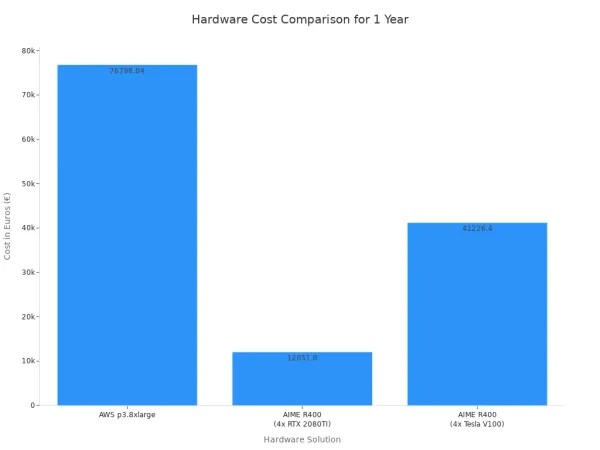
The cost-benefit analysis often favors cloud adoption for projects with variable computational needs. On-premise hardware can become profitable over time but requires a significant initial investment.
| Cost for 1 Year | AWS p3.8xlarge (Reserved Instance, All Upfront) | AIME R400 (4x RTX 2080TI, incl. electricity) | AIME R400 (4x Tesla V100, incl. electricity) |
|---|---|---|---|
| Cost | €76,798.04 | €12,051.80 | €41,226.40 |
| Savings vs. AWS | N/A | 84.3% | 46.3% |
| Profitability (from month) | N/A | 2nd month | 5th month |
Specialized cloud services from EDA vendors like the Synopsys Cloud and S2C Verification Prototyping Cloud Service further enhance this ecosystem. These platforms provide on-demand access to a full suite of fpga design tools for emulation and verification, enabling robust CI/CD (Continuous Integration/Continuous Deployment) pipelines for hardware. This trend is vital for the future of fpga market.
Growth of Open-Source Platforms
The growth of open-source software has finally reached the world of fpga engineering. A vibrant community is building a complete, end-to-end toolchain that offers an alternative to proprietary fpga design tools from vendors. This movement is fostering collaboration, reducing costs, and providing innovative design options. The future of fpga market will be influenced by these open developments.
Key open-source fpga design tools include:
- Yosys: A powerful framework for Verilog RTL synthesis.
- nextpnr: A vendor-neutral, timing-driven place-and-route tool.
- Amaranth: A Python-based toolbox for building complex digital hardware.
- Project IceStorm & Trellis: Tools for documenting and working with Lattice FPGA bitstreams.
These tools are not just academic projects; they are gaining industry support. The CHIPS Alliance, a Linux Foundation project, hosts the F4PGA workgroup to accelerate open FPGA innovation.
“FPGAs are essential for a wide variety of low-latency compute use cases, from telecoms to space applications and beyond. This new F4PGA toolchain will enable a software-driven approach to building FPGA gateware, making code integration easier than ever.” — Rob Mains, General Manager at CHIPS Alliance
Frameworks like the FPGA Interchange Format are being developed to ensure interoperability between open-source and closed-source fpga design tools. This lowers the barrier to entry for the entire supply chain. The availability of open-source IP cores on platforms like OpenCores further accelerates design and experimentation. This growth is a positive signal for the future of fpga market.
Challenges and Limitations
Despite this progress, open-source fpga design tools face challenges. The proprietary nature of FPGA architectures makes it difficult for third-party tools to match the performance of vendor-supplied fpga design tools, which are co-designed with the silicon. The complex knowledge required for tool development—a mix of software, algorithms, and hardware engineering—is rare. As a result, the core implementation tools for the newest and largest FPGA devices largely remain closed-source. However, the rapid bug fixes and community-driven improvements in open-source fpga design tools present a compelling advantage over the slower pace of proprietary tool updates. This dynamic continues to shape the future of fpga market, pushing all fpga design tools toward greater quality and responsiveness. The growth of this ecosystem is a key part of the emerging trends in fpga technology. The future of fpga market is tied to the evolution of these powerful fpga design tools.
Key Industries Reshaped by FPGA Advancements
The latest developments in FPGA technology are transforming critical industries. The unique combination of performance, flexibility, and efficiency is driving significant growth in automotive, data center, and medical applications. The future of fpga market depends on this widespread adoption.
Automotive: ADAS and Infotainment
The automotive industry uses the FPGA for Advanced Driver-Assistance Systems (ADAS) and infotainment. An FPGA provides the low-latency processing needed for safety-critical functions. This technology is essential for the future of fpga market. These functions include:
- Sensor Fusion: An FPGA processes data from cameras, radar, and lidar to understand the vehicle's surroundings.
- Real-time Processing: The device handles high-bandwidth sensor data for rapid environmental perception.
- AI Acceleration: An FPGA optimizes neural networks for object recognition with low power consumption.
This parallel processing capability enables split-second decisions, which is critical for safety. The deterministic behavior of FPGA logic helps systems meet functional safety standards like ISO 26262. In the cabin, an FPGA manages high-resolution displays and video processing for next-generation infotainment systems. This customization supports the growth of advanced digital systems in vehicles.
Data Centers and HPC
Data centers and high-performance computing (HPC) environments leverage the FPGA to accelerate workloads. An FPGA acts as a Smart Network Interface Card (SmartNIC), offloading networking tasks from the main CPU. This design improves overall system efficiency. The future of fpga market is tied to this high-performance role. An FPGA can manage encryption, packet filtering, and quality-of-service tasks at hardware speed. This acceleration has a measurable impact on database performance. The future of fpga market will see more of this integration.
| Metric | Without Swarm64 (MariaDB Default) | With Swarm64 (FPGA Accelerated) | Improvement Factor |
|---|---|---|---|
| Response Time | N/A | 10x faster | 10x |
| Database Size | 640 TB | 64 TB | 10x reduction |
| Data Ingestion/Query Rate | 100,000 packets/sec | 1.14 million packets/sec | 11.4x |
| Data Compression | N/A | 10x (640TB to 64TB) | 10x |
Major cloud providers like AWS and Microsoft Azure offer FPGA-accelerated instances, making this powerful technology accessible for various HPC tasks. This trend supports the continued growth of the future of fpga market.
Aerospace, Defense, and Medical
Aerospace, defense, and medical fields rely on FPGA technology for its reliability and performance. In defense, an FPGA processes signals in real-time for advanced radar and electronic warfare systems. The programmable nature of an FPGA allows for secure communication systems that can be updated with new encryption algorithms after deployment. This adaptability is a key driver for the future of fpga market.
In the medical sector, fpga engineering enhances imaging devices like MRI and CT scanners. The parallel processing power of an FPGA accelerates complex image reconstruction and analysis. This allows for real-time, high-resolution image rendering, which helps doctors make faster and more accurate diagnoses. The future of fpga market benefits from these life-saving applications. The flexible logic of an FPGA is ideal for these demanding environments. The future of fpga market is bright because of this versatility.
Recent developments in fpga engineering show a clear path forward. Key trends like AI integration and HLS accessibility are powerful innovations. This innovation drives the future of fpga market. This technology growth supports the future of fpga market. The future of fpga market depends on this design customization. The future of fpga market is bright. The future of fpga market will see continued growth. The future of fpga market is secure. An fpga is now more essential than ever, pushing engineers from hardware specialists to versatile system architects.
FAQ
What is an FPGA?
A Field-Programmable Gate Array (FPGA) is an integrated circuit. Engineers can configure its internal hardware logic after manufacturing. This re-programmable nature provides great flexibility for custom computing tasks, unlike fixed-function chips like CPUs.
Why are FPGAs important for AI?
FPGAs offer powerful and energy-efficient acceleration for AI workloads. Their parallel architecture processes data with very low latency. This makes them ideal for real-time AI inference, especially in edge devices where power is limited.
What is High-Level Synthesis (HLS)?
High-Level Synthesis (HLS) is a design process. It automatically translates high-level programming languages, such as C++, into hardware logic for an FPGA. HLS makes FPGA development faster and more accessible to software engineers.
How do FPGAs help with 5G technology?
FPGAs are essential for 5G infrastructure. Their reconfigurable logic allows engineers to update hardware for evolving standards without replacing physical chips. They accelerate high-speed signal processing tasks, meeting the low-latency demands of 5G networks.