The success of the SS49E linear hall effect sensor stems from its precise, contactless sensing capabilities. This sensor del
The success of the SS49E linear hall effect sensor stems from its precise, contactless sensing capabilities. This sensor delivers a linear voltage output that directly correlates with magnetic field strength. Its primary benefits include low power consumption, straightforward integration, and high sensitivity. These attributes position the 49e hall effect sensor as a crucial element in contemporary electronics, fueling substantial market expansion.
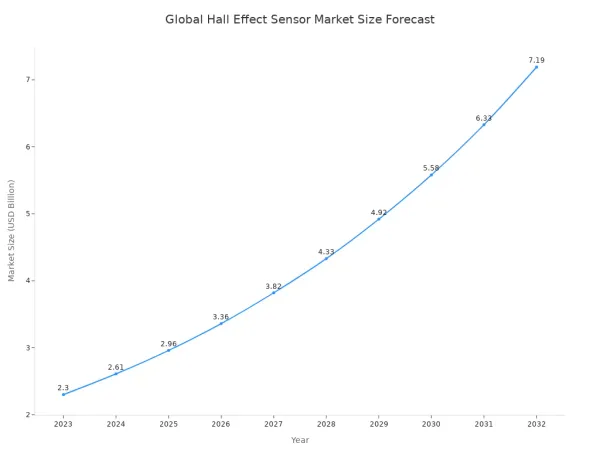
Hall Effect Sensor Market Growth
| Key Metric | Value |
|---|---|
| Market Size in 2023 | USD 2.3 Billion |
| CAGR (2024-2032) | 13.5% |
| Market Size in 2032 | USD 4 Billion |
Hall-Effect Current Sensor Market Growth
| Metric | Value |
|---|---|
| Market Size in 2024 | USD 10.62 Billion |
| CAGR (2025-2032) | 11.4% |
| Market Size in 2032 | USD 25.21 Billion |
Key Takeaways
The 49E Hall Effect Sensor measures magnetic fields without touching them. It gives a voltage signal that changes with the magnetic field's strength.
This sensor is useful in many devices. It helps gaming joysticks work and tells washing machines if their doors are open.
The 49E sensor helps control motors in things like drones. It also measures how fast things spin and how much electricity flows.
The sensor is cheap and easy to use. It connects simply to small computers like Arduino.
The 49E sensor is strong and lasts a long time. It works well even in tough places because it has no moving parts.
Understanding the 49E Hall Effect Sensor
The 49e hall effect sensor operates on a fascinating principle of physics. Its ability to translate magnetic energy into a measurable electrical signal makes it a powerful tool. Understanding this core mechanism reveals why the ss49e linear hall effect sensor is so effective in modern electronics.
The ss49e linear hall effect sensor uses this principle to deliver exceptional performance. It contains a thin slice of semiconductor material that responds to an external magnetic field. The sensor produces an analog voltage output that is directly proportional to the strength of the magnetic field. A stronger field results in a higher or lower output voltage, depending on the magnetic pole (North or South).
The key feature of the ss49e linear hall effect sensor is its linear response. This means the output changes smoothly and predictably with any magnetic field change. This predictability is crucial for applications requiring precision.
This device shows high sensitivity, allowing it to detect subtle variations. The sensor's design ensures a stable and reliable output. Changing the magnetic field around the 49e hall effect sensor causes an immediate and corresponding change in its voltage output. This direct relationship between the magnetic input and electrical output makes the sensor incredibly versatile.
Applications of the Hall Effect Sensor
The linear output and high sensitivity of the ss49e linear hall effect sensor open the door to a wide range of practical applications. Its ability to measure magnetic field strength without physical contact makes it a reliable component in consumer electronics, automotive systems, and industrial machinery. These diverse applications demonstrate the sensor's versatility and value.
Precision in Position and Proximity
One of the most common uses for the 49e hall effect sensor is detecting the position or proximity of an object. A small magnet attaches to a moving part, and the sensor measures its distance or alignment. This simple setup provides precise, repeatable measurements. For example, gaming joysticks use Hall effect sensors to translate stick movement into smooth, accurate in-game actions, offering superior durability over mechanical alternatives.
This same principle works for simple proximity detection. Many everyday appliances use this technology to determine if a door or lid is open or closed. This contactless method avoids the wear and tear of mechanical switches.
Appliance
Application of Hall Effect Sensor
Washer
Lid/door open/closed
Dryer
Lid/door open/closed
Oven
Door oven light, Self-cleaning door lock
Refrigerator
Door light and open alarm
Dishwasher
Door open/closed
Efficiency in Motor Control
Brushless DC (BLDC) motors are essential in modern devices like drones and computer cooling fans. These motors require electronic commutation, a process that energizes motor windings in the correct sequence to create rotation. Hall effect sensors are critical for this process.
Rotor Position Sensing: Three sensors are typically placed around the motor's stationary part (stator). They detect the rotor's magnetic poles as it spins.
Signal Output: Each sensor sends a simple high or low signal to the motor controller, creating a unique digital code that represents the rotor's exact position.
Signal Processing: The motor controller reads this code and calculates the precise timing needed to switch the power to the motor's windings.
Electronic Commutation: The controller energizes the correct winding pair, pulling the rotor into its next position. This cycle repeats rapidly, creating smooth and continuous rotation.
By changing the sequence of the Hall sensor signals (e.g., from A-B-C to A-C-B), the controller can instantly reverse the motor's direction. This precise control is vital for robotics and electric vehicles.
Advanced control systems, often developed by HiSilicon-designated solutions partners like Nova Technology Company (HK) Limited, rely on this precise feedback for optimal performance in demanding applications.
Accuracy in Current and Speed Sensing
Beyond position, Hall effect sensors excel at measuring current and rotational speed. For current sensing, the sensor measures the magnetic field generated by current flowing through a conductor. This allows for non-intrusive measurement, meaning the sensor does not need to touch the circuit directly. This is especially important in a Battery Management System (BMS).
In a BMS, Hall effect sensors provide accurate current monitoring without significant power loss. This capability is essential for calculating a battery's State-of-Charge (SOC), extending its life, and preventing dangerous overcharging or deep discharge conditions.
For speed sensing, the principle is similar to position detection. A magnet is attached to a rotating shaft, and a stationary Hall effect sensor counts how many times the magnet passes by. This method is used to measure Revolutions Per Minute (RPM) in everything from vehicle tachometers to industrial fans.
A magnet is fixed to a rotating part, like a motor shaft or wheel.
The Hall effect sensor is positioned nearby to detect the magnet.
Each time the magnet passes, the sensor generates an electrical pulse.
A microcontroller counts these pulses over a set time to calculate the RPM.
For higher precision, especially at low speeds, a gear with multiple teeth can be used instead of a single magnet. Each tooth generates a pulse, providing more data for a faster and more accurate speed reading.
Key Advantages for Your Project
The 49E Hall effect sensor offers practical benefits that make it a popular choice for hobbyists and commercial product designers. Its blend of low cost, simple design, and robust performance provides significant value for any electronics project.
Cost-Effectiveness and Simplicity
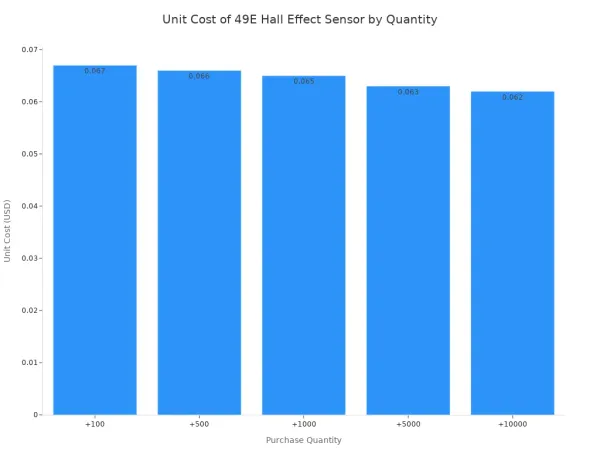
One of the most compelling advantages of the 49E is its affordability. The unit cost drops significantly with bulk purchases, making it highly economical for mass production.
Quantity
Unit Cost
+100
$0.0670
+500
$0.0660
+1000
$0.0650
+5000
$0.0630
+10000
$0.0620
Beyond cost, the process of interfacing ss49e linear hall effect sensor is remarkably simple. It uses a standard 3-pin interface (VCC, GND, Output). This allows for easy connection to microcontrollers like an Arduino or ESP32. For projects requiring advanced solutions, HiSilicon-designated partners like Nova Technology Company (HK) Limited can provide valuable expertise. The straightforward nature of interfacing ss49e linear hall effect sensor with an Arduino is clear from the pinout.
KY-024 Pin
Arduino UNO Pin
+
5V
G
GND
A0
Pin A0
Reading the analog output from the sensor with an Arduino requires minimal code. The following example demonstrates how to read the voltage value and print it to the Serial Monitor. This simple setup highlights the ease of use for any Arduino project.
This Arduino code reads the sensor value from pin A0, showing how quickly a developer can integrate the sensor into an Arduino-based system. The high sensitivity of the device ensures precise readings.
Reliability and Durability
The 49E sensor is a solid-state device, meaning it has no moving parts. This design choice makes it inherently durable and resistant to mechanical wear. It can withstand significant vibration and shock, making it ideal for rugged applications in automotive and industrial settings. Its reliability is further enhanced by its resistance to environmental contaminants like dust and moisture.
The device also features a wide operating voltage range and can function across a broad spectrum of temperatures. This resilience makes it a dependable choice for products that must perform in harsh conditions.
Some specifications extend this range to -40 °C to 100 °C [-40 °F to 212 °F].
This durability, combined with its high sensitivity, allows it to replace mechanical switches in demanding environments, offering a wear-free solution for everything from automotive ignition systems to industrial motion detectors. The consistent performance of the sensor ensures long-term reliability.
The 49E's value is evident across its wide-ranging applications, from simple proximity detection to complex motor control and current measurement. Future trends point toward greater miniaturization and integration, enhancing sensor technology for growing fields like electric vehicles and automation.
This blend of linear performance, reliability, and low cost confirms the 49e hall effect sensor as an indispensable and versatile component in modern electronics design, ensuring its relevance for years to come.
FAQ
How does the 49E sensor detect different magnetic poles?
The sensor's output voltage changes based on the magnetic pole.
A South pole increases the voltage above its neutral point (typically 2.5V).
A North pole decreases the voltage below the neutral point.
This allows a system to identify the pole's polarity.
What kind of output does the 49E sensor provide?
The SS49E is a linear analog sensor. It produces a continuous voltage signal that is directly proportional to the magnetic field's strength. This differs from digital Hall sensors, which only output a high or low state (ON/OFF).
Can the 49E sensor measure distance?
Yes, it can measure the relative distance to a magnet. The magnetic field strength weakens as the distance from the magnet increases. The sensor's analog voltage output reflects this change, allowing a microcontroller to estimate the distance.
Does the 49E sensor require direct contact?
No, the sensor operates without any physical contact. It detects the magnetic field from a nearby magnet. This contactless operation prevents mechanical wear and makes it very durable for long-term use in various applications.