Never underestimate the mighty inverting amplifier in tech
An inverting amplifier is a fundamental component in electronics. It provides stable, predictable, and easily cont
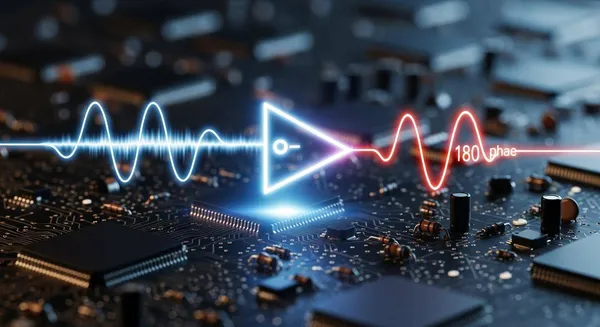
An inverting amplifier is a fundamental component in electronics. It provides stable, predictable, and easily controllable signal conditioning. This simple design makes it a hidden hero in many gadgets. Think of inverting op-amps like a universal adapter, making different technologies work together seamlessly. The design is crucial for modern devices. The market for these components shows significant growth.
| Metric | Value |
|---|---|
| Market Size (2024) | USD 4.5 billion |
| Projected Market Size (2033) | USD 7.8 billion |
| Compound Annual Growth Rate | 6.5% |
| Production Volume CAGR (5 yrs) | 4-6% |
The simple design of inverting op-amps enables complex functions inside your favorite technology.
Key Takeaways
- Inverting amplifiers are important parts in electronics. They help make many devices work well.
- These amplifiers offer stable and predictable performance. This is because of their simple design with two resistors and negative feedback.
- Inverting amplifiers can do many tasks. They can combine signals, filter sounds, and convert digital signals to analog ones.
- You can find inverting amplifiers in everyday tech. They are in audio mixers, sensors, and power supplies.
- The simple design of inverting amplifiers makes them very useful. They are a key part of modern technology.
Why the Inverting Amplifier Offers Stable Gain
The inverting amplifier is a cornerstone of analog electronics because it delivers exceptionally stable and predictable performance. This reliability is not an accident. It is the direct result of a clever and elegant circuit design. The magic lies in how a few simple components work together. Let's explore the three core principles that give this circuit its power.
Predictable Gain with a 2-Resistor Network
The primary job of an amplifier is to increase a signal's strength. The inverting amplifier achieves this with remarkable precision. Its amplification factor, or gain, depends on just two components: an input resistor (Rin) and a feedback resistor (RF). The closed-loop gain is determined by the ratio of the feedback resistor to the input resistor. This simple relationship gives engineers a straightforward method for managing amplification.
The gain formula for an ideal inverting amplifier is Vout/Vin = -RF/Rin. The negative sign indicates that the output signal is an inverted version of the input signal. By carefully selecting the values for these two resistors, an engineer can set a precise, predictable gain. This is a key feature of the inverting amplifier design.
💡 Did You Know? Different operational amplifier configurations have distinct gain formulas. This table shows the fundamental difference between inverting op-amps and non-inverting op-amps.
| Op-amplifier Type | Gain Formula |
|---|---|
| Inverting | -RF/Rin |
| Non-Inverting | 1 + RF/Rin |
This simple resistor-based design makes inverting op-amps incredibly versatile for scaling signals. In contrast, non-inverting op-amps always have a gain greater than or equal to one.
Phase Inversion and Virtual Ground
A unique characteristic of inverting op-amps is the concept of a "virtual ground." An operational amplifier has an extremely high open-loop gain. When used in this circuit design, the op-amp works to keep the voltage difference between its two inputs at zero. Since the non-inverting input is connected to the actual ground (0V), the op-amp forces the inverting input to also remain at 0V.
This point is not physically connected to ground, but it behaves like it is. This is the "virtual ground."
- It acts as a stable reference point.
- It simplifies the analysis of the circuit's behavior.
- It is the reason the output is an inverted copy of the input.
Because the inverting input is held at 0V, the input current flows through Rin and then through RF, bypassing the op-amp's input. The output voltage must swing to a negative value to pull this current through RF, resulting in the 180-degree phase shift. This predictable inversion is a crucial feature of the design. While non-inverting op-amps keep the signal in phase, the virtual ground of inverting op-amps provides unique advantages in other applications.
Superior Stability via Negative Feedback
Stability is arguably the most important benefit of the inverting amplifier design. This stability comes from a principle called negative feedback. The feedback resistor (RF) creates a path from the output back to the inverting input. This connection "feeds back" a portion of the output signal.
Negative feedback forces the output to closely track the input. The system constantly corrects any deviations or errors. This process provides several major benefits:
- Reduces Distortion: Negative feedback helps maintain the op-amp's inputs near zero volts, which minimizes non-linearities and reduces signal distortion.
- Increases Bandwidth: It significantly expands the range of frequencies the amplifier can handle effectively.
- Stabilizes Gain: The gain becomes dependent on the external resistors, not the op-amp's internal characteristics, which can vary with temperature or from part to part.
This feedback mechanism is what separates simple operational amplifier configurations from unstable, high-gain circuits. It trades raw, unusable gain for controlled, stable performance. The design of non-inverting op-amps also uses negative feedback, but the virtual ground in inverting op-amps offers a different set of advantages for signal processing.
For an amplifier, applying negative feedback increases its effective bandwidth. The new high-frequency cutoff point (
Whf) becomes the original cutoff (Wh) multiplied by a factor related to the feedback loop.Af = (Ao/(1+AoB)) * (1/(1+(s/(Wh*(1+AoB)))))This equation shows the new bandwidth is
Wh * (1+AoB), demonstrating a significant increase.
Versatile Signal Processing with Inverting Op-Amps
The true power of the inverting amplifier lies in its incredible versatility. The basic two-resistor design is just a starting point. Engineers can modify this fundamental circuit to perform a wide range of signal processing tasks. This adaptability makes inverting op-amps a go-to solution for everything from simple audio mixing to complex digital-to-analog conversion. Let's explore how this simple circuit transforms into powerful processing tools.
The Summing Amplifier
One of the most elegant applications of the inverting amplifier is its use as a summing amplifier. This circuit combines multiple input signals into a single output. The virtual ground at the inverting input is the key to this function. It acts as a perfect current summing node. Each input source connects to this virtual ground through its own resistor. This design keeps the input signals from interfering with each other, preventing crosstalk. In contrast, other amplifier types without this virtual ground can suffer from inter-channel interference. This makes summing amplifiers a form of simple analog computer, perfect for tasks like audio mixing.
The output voltage is a weighted sum of the input voltages. The formula for a three-input circuit shows this relationship clearly.
Vout = - (Rf/R1 * V1 + Rf/R2 * V2 + Rf/R3 * V3)
💡 A Closer Look at the Math In this equation,
Rfis the feedback resistor, whileR1,R2, andR3are the input resistors for voltagesV1,V2, andV3. By choosing different resistor values, an engineer can give each input a different "weight" in the final output.
Active Filters and Oscillators
The inverting amplifier design can be transformed by replacing resistors with other components, like capacitors. This simple change creates powerful new functions.
- Replacing the feedback resistor with a capacitor turns the circuit into an integrator. The output voltage becomes the integral of the input voltage over time.
- Replacing the input resistor with a capacitor creates a differentiator. The output becomes the rate of change (derivative) of the input signal.
These integrator and differentiator circuits are the fundamental building blocks of active filters. Active filters use inverting op-amps to shape signals by amplifying or attenuating specific frequencies. They are essential for cleaning up noise, isolating desired frequency bands in communication systems, and creating audio equalizers. Furthermore, this flexible design is also used in oscillators, which generate stable, repeating waveforms. These are crucial for creating the clock signals that synchronize operations in nearly all digital devices.
Digital-to-Analog Conversion
In our digital world, we constantly need to convert digital bits into real-world analog signals. The inverting amplifier is a hero in this process, especially in a common design called an R-2R ladder Digital-to-Analog Converter (DAC). Here, the inverting op-amp functions as a precise current-to-voltage converter.
The R-2R ladder network produces a current (Iout1) that is proportional to the digital input value. The inverting op-amp then converts this current into a stable output voltage. The process works as follows:
- The R-2R ladder's output current connects to the op-amp's inverting input.
- The op-amp's virtual ground ensures this input point remains at 0V.
- It forces the current through the feedback resistor to equal the input current.
- The final output voltage is simply the input current multiplied by the feedback resistance (
Vout = -Iin * Rfb).
This op-amp based design offers significant advantages over simpler methods like resistive voltage dividers. Companies like Nova Technology Company (HK) Limited, a HiSilicon-designated solutions partner, often leverage this precise design for advanced applications. Op-amps provide a low output impedance, which is necessary to drive other components effectively. They also offer great flexibility for modifying voltage ranges without a complete hardware redesign.
| Attribute | Voltage Divider | Op-Amp Based DAC |
|---|---|---|
| Flexibility | Low; requires redesign for changes. | High; adjust gain by swapping resistors. |
| Linearity | Not constant across the range. | Maintains excellent linearity. |
| Output | High output impedance; can be problematic. | Low output impedance; drives loads easily. |
The use of inverting op-amps in DACs showcases a sophisticated and reliable design that bridges the digital and analog domains.
Real-World Applications in Everyday Tech

The principles of the inverting amplifier extend far beyond theory. They are the foundation for countless features in the technology we use daily. From the music we hear to the data our devices collect, inverting op-amps perform critical tasks quietly and efficiently. This versatile design makes modern electronics possible.
Audio Preamps and Mixers
Inverting op-amps are essential in audio equipment. Audio preamplifiers use this circuit to boost weak signals from microphones or instruments. The amplifier's 180-degree phase inversion is a key feature for noise cancellation. For example, a system can capture ambient noise, and the inverting amplifier creates an inverted copy. Playing this inverted wave alongside the original sound effectively cancels out the unwanted noise.
Audio mixing consoles also rely heavily on inverting op-amps, specifically in a summing amplifier configuration. This design allows engineers to combine many audio signals into one output.
- The virtual ground at the op-amp's input isolates each audio source. This prevents signals from bleeding into other channels.
- Each channel's volume can be adjusted with a potentiometer before the signal reaches the summing point.
- A second op-amp often re-inverts the combined signal to correct the initial phase inversion.
This clever use of inverting op-amps ensures a clean, controllable mix.
Sensor Signal Conditioning
Many sensors produce a very small electrical current, not a voltage. An inverting amplifier circuit is perfect for converting this current into a usable voltage signal. This application is common in light-sensing devices that use photodiodes.
A photodiode generates a current that is proportional to the light hitting it. An inverting op-amp configuration, acting as a transimpedance amplifier, converts this tiny current into a measurable voltage. This simple and effective design is crucial for devices like automatic streetlights, camera light meters, and optical data readers.
Power Supply Voltage Regulation
Stable power is critical for any electronic device. Inverting op-amps play a vital role in modern power supplies by helping to regulate voltage. In this role, the op-amp acts as an error amplifier within a feedback loop. It compares a fraction of the output voltage to a stable reference voltage. If the output voltage drifts too high or too low, the inverting amplifier produces a corrective signal. This signal adjusts the power supply's output, keeping the voltage constant. This feedback design ensures that sensitive electronic components receive a steady and reliable power source.
The inverting amplifier remains a vital component in electronics. Its power comes from a few key principles.
- The simple resistor network provides predictable gain.
- Negative feedback ensures superior stability.
- The versatile design allows for summing, filtering, and converting signals.
This elegant design is why inverting op-amps are a cornerstone of modern technology. The ability of inverting op-amps to reliably perform these tasks makes them indispensable.
The next time you use a gadget, remember the clever engineering inside. A simple circuit design often powers the most complex functions.
FAQ
What is the main difference between inverting and non-inverting op-amps?
The main difference is the input connection. An inverting amplifier connects the signal to the inverting (-) input. This creates an inverted output. In contrast, non-inverting op-amps connect the signal to the non-inverting (+) input, keeping the output signal in phase with the input.
Why is the gain formula negative for inverting amplifiers?
The negative sign shows the output signal is 180 degrees out of phase with the input. The op-amp's virtual ground forces the output to a negative voltage to pull current through the feedback resistor. This action inverts the signal. Many non-inverting op-amps lack this specific characteristic.
Can an inverting amplifier have a gain less than one?
Yes, it can. The gain is the ratio -RF/Rin. An engineer can make the feedback resistor (RF) smaller than the input resistor (Rin). This design attenuates, or reduces, the signal. This differs from standard non-inverting op-amps, which always have a gain of one or greater.
💡 Quick Tip The ability to attenuate signals makes inverting amplifiers very flexible. This is useful for matching signal levels between different electronic stages. While non-inverting op-amps are great for boosting signals, they cannot perform this function.
Are non-inverting op-amps more stable?
Both amplifier types use negative feedback for stability. The choice depends on the application's needs. Inverting amplifiers offer a stable virtual ground reference point. This is ideal for summing applications. The stability of non-inverting op-amps is also excellent, but they serve different circuit design purposes.