How Do Electronic Integrated Circuits Enable Smarter Sensing in 2025
Imagine a home where lights turn on when someone walks in. The air changes to make people comfortable. Appliances learn what you do every day.
Imagine a home where lights turn on when someone walks in. The air changes to make people comfortable. Appliances learn what you do every day. This smart home is possible because of electronic integrated circuits. These circuits help smart sensors work fast and correctly. With 3D IC technology, wires get shorter by up to half. Power use also goes down by about one third. Because of this, smart devices get even smarter. Sensing things becomes easier and better. Top semiconductor companies keep making smarter technology. They help bring smart sensing into our daily lives.
Key Takeaways
-
Electronic integrated circuits help sensors work faster and better. They also help sensors use less energy. This lets devices in homes, hospitals, and cities get smarter.
-
Advanced circuits help sensors handle signals and power better. Sensors use less energy and give good data, even in hard places.
-
AI-powered integrated circuits let sensors handle data right away. They can change when things around them change. This makes systems safer and quicker to react.
-
Making circuits smaller and adding wireless connections helps. Devices get smaller and smarter. They connect easily and batteries last longer.
-
Privacy, energy use, and system integration are still problems. But new changes try to make smart sensing safer and better. People will trust these systems more.
Electronic Integrated Circuits in Sensing
Signal Processing
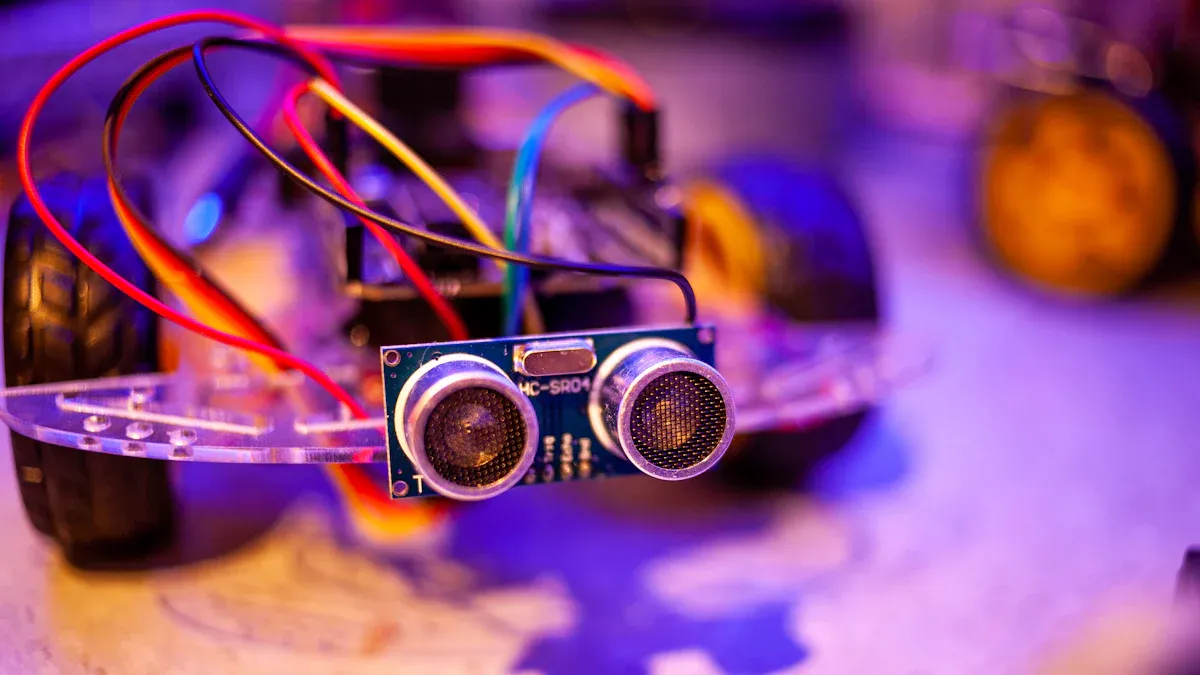
Electronic integrated circuits are very important for sensors. They help sensors get, clean, and use data fast. When a sensor finds a signal, the circuit turns it into digital data. Devices can then use this data. Sensors can work with many kinds of data. These include temperature, light, and sound.
New technology makes signal processing faster and more stable. CMOS scaling cuts power use by about half. More devices fit on a chip, so sensors handle more data at once. Gate delay is now shorter, so sensors answer faster. Better memory helps with size, power, and speed. This is good for smart sensors.
Today’s sensors use advanced circuits to manage lots of data right away. This helps smart devices work better and faster.
Here is a table that shows some signal processing improvements:
|
Benchmark Aspect |
Quantitative Result |
Description |
|---|---|---|
|
Throughput Improvement |
40% increase in TOPS/W |
Compared to existing IMC SRAM architectures, measured via CIFAR-10 dataset using NeuroSim. |
|
Stability Validation |
1000-sample Monte Carlo simulations |
Tested under worst-case process, voltage, and temperature (PVT) conditions. |
|
Stability Robustness |
Stability confirmed up to 6σ variations |
High reliability of the 10T bit-cell architecture under manufacturing and operational variations. |
|
Architectural Advantage |
Single-cycle bit-wise operations |
Enables parallelism leading to enhanced throughput. |
|
Read-disturb Failure Elimination |
Achieved |
Simplifies sensing circuitry and improves performance reliability. |
Data Accuracy
Sensors need to give correct data. Electronic integrated circuits help sensors measure things better. For example, a special circuit for bioimpedance made accuracy 30% better. It also made settling time almost 88% faster than old ways. The biggest error was only 0.3% in size and 2.1° in phase. This means sensors now give much better data.
A temperature system used a Class B 3-wire PT-1000 RTD sensor. Electronic parts kept temperature changes under 0.5 °C, even with strong interference. The total error stayed within ±0.4 °C for many temperatures. TVS diodes and good resistors helped keep data right, even in hard places.
Smart technology uses deep neural networks to make data from cheap sensors better. A model trained on sensor data had a mean squared error of only 1.22x10^-4. This means data from sensors got much more correct after circuits and algorithms worked on it.
Sensors in smart devices now give good data for many jobs. These sensors help collect and use data, making sure it is fast and right.
Power Management
Power management is very important for sensors. Electronic integrated circuits help sensors use less power and last longer. Most car sensors work at 5V to 24V. Power use is measured in milliwatts or watts. Efficiency shows how much power is used well. High efficiency means less wasted energy.
-
Power Consumption: Using less power helps sensors run longer on batteries.
-
Power Efficiency: Higher efficiency means more power is used for sensing.
-
Energy Efficiency: Using less energy over time is good for battery sensors.
-
Power Density: Lower power per area keeps sensors cool and working longer.
-
Power Quality: Good power supply keeps sensors working without mistakes.
-
Sleep Power: Low power in sleep mode helps sensors last longer in smart devices.
Power management units in circuits keep voltage steady with over 99% accuracy. This protects sensors and helps them work well in all places. Devices with sensors now last longer and work better. This is good for smart homes, factories, and cities.
Smarter Sensing with AI
Real-Time Processing
AI makes sensors much smarter. Integrated circuits with AI can look at data right away. This means devices can sense and decide fast. In hospitals, AI sensors watch patient data every second. Doctors can find problems early and help quickly. In smart homes, AI chips let lights and machines react fast to changes.
AI in these circuits also helps things work better and more safely. These chips can handle lots of data very quickly. This is important for cars and smart city systems. The market for new integrated circuits was $1,296.2 million in 2024. It may grow to $3,718.4 million by 2033. This shows AI is very important for fast data and automation.
Here is a table that shows how AI-powered sensing helps:
|
Application Area |
Quantitative Impact |
|---|---|
|
Traffic Management |
25% reduction in average travel times during peak hours |
|
Pollution Control |
85–90% predictive accuracy; preventive actions 2 days earlier |
|
Resource Management |
30% increase in efficiency; 20% reduction in waste |
AI chips help sensors make decisions faster and more correctly. This lets people and machines react to changes right away.
Adaptive Response
AI lets sensors learn and change how they work. These smart circuits use new data to adjust their actions. For example, in communication, AI watches signals and changes settings to keep things working well. Deep learning in sensors can find problems by spotting strange data. When something is wrong, the system acts fast.
AI uses analytics to mix data from many places. This helps the system know more and make better choices. Reinforcement learning lets the system change its own rules and get smarter. In factories, AI uses these tools to find and fix problems before they get worse.
AI-powered sensing means devices can change what they do based on what they sense. This makes systems safer, more efficient, and more reliable in daily life.
Ambient Intelligence and Applications
Ambient intelligence is changing how we live and work. It uses sensors and smart devices to help people every day. Advanced circuits make spaces safer and more helpful. These systems collect data and learn from it. They make choices based on what is happening around them. People use them in homes, hospitals, factories, and cities.
Smart Homes
Smart homes use ambient intelligence to help people. Sensors watch for movement, temperature, and light. Integrated circuits let devices talk and react quickly. For example, smart lights and HVAC change for people and time. Power management ICs help save energy. Real-time energy checks show how much power is used. This helps people save money. AI and edge processing ICs allow voice commands and face checks. This makes homes safer. System-on-Chip technology puts many features together. Devices work better and last longer.
Healthcare
Ambient intelligence helps doctors care for patients. Sensors in wearables track heart rate, stress, and movement. Integrated circuits send this data to doctors right away. Hospitals use ambient intelligence to watch patients and automate care. Smart monitors keep rooms clean and safe. The Intelligent Connectivity Framework lets devices share data fast. This helps doctors make better choices. Pharmacies use smart dispensers to track medicine. They help patients take the right dose.
Industry
Factories use ambient intelligence to work better and safer. Sensors check machines for problems before they break. Predictive maintenance helps factories work up to 15% better. Mixed-signal ICs make sensors more accurate and faster. This cuts waste and saves energy. Robots and AI find items in warehouses faster. Cold chain companies use ambient intelligence to watch temperature and humidity. This keeps products safe.
|
Metric |
Value/Impact |
|---|---|
|
Productivity improvement |
Up to 15% with predictive maintenance |
|
Mixed-signal IC accuracy |
|
|
Mixed-signal IC latency |
Reduced to 0.75 ms |
|
Power management efficiency |
Energy waste cut by 30% |
Cities
Cities use ambient intelligence to fix big problems. Sensors in traffic lights and cameras help control traffic. AI systems lower jams and pollution. The MyAQI system uses smart monitors to predict air quality. It gives warnings to help people pick safer routes. It looks at pollution, health, and location. Smart grid systems use ambient intelligence to balance energy use. These choices make cities cleaner, safer, and more efficient.
Ambient intelligence brings sensors, devices, and AI together. Spaces can learn and change to help people. This technology helps people live better in homes, hospitals, factories, and cities.
IC Advancements for 2025
Miniaturization
Miniaturization is making smart sensing better. Smaller integrated circuits can fit more features in tiny places. This helps make smart devices lighter and easier to carry. The TrackPad Integrated Circuit Module market was worth USD 1.2 billion in 2024. Experts think it will reach USD 2.5 billion by 2033. The growth rate from 2026 to 2033 is 9.1%. People want electronics that are small but do more things. New technology lets devices use capacitive sensing and multi-touch gestures. This makes devices smarter and more fun to use.
|
Metric |
Value |
Explanation |
|---|---|---|
|
Market Size (2025) |
The market for consumer Integrated Circuits is growing because of miniaturization. |
|
|
Market Size (2034) |
USD 798.66 Billion |
The need for small circuits keeps rising. |
|
CAGR (2025-2034) |
4.42% |
Smart and energy-saving ICs help the market grow. |
|
Key Drivers |
Portable electronics, IoT, 5G |
These things make people want smaller and smarter circuits. |
|
Trends |
Miniaturization, integration |
Now, one chip can do many jobs. |
|
Technological Focus |
Energy efficiency, AI, sustainability |
These help make ICs smaller and smarter. |
Miniaturization also helps devices get power from their surroundings using energy harvesting.
Wireless and Connectivity
Wireless and connectivity changes help smart sensing work everywhere. New integrated circuits like the SX9320 can use two sensor channels. They also make RF performance better. These circuits use very little power, so batteries last longer. High-resolution sensing helps find things more exactly. Built-in regulators and temperature controls keep devices working well. Automatic calibration lets sensors stay accurate over time.
-
Two sensor channels help find things better.
-
Very low power use means batteries last longer.
-
High-resolution sensing gives smarter results.
-
400kHz I2C interface lets devices talk fast.
-
Many devices now use 5G, 4G, and Wi-Fi.
Phones, tablets, and laptops use these circuits to connect fast and safely. Wireless ICs help people stay connected at home, work, or school.
Security
Security is very important for smart sensing. New integrated circuits use special security designs to keep sensor data safe. Secure temperature sensors have strong transducer units and can spot strange signals. These features can find attacks 97.73% of the time. Circuits use current checks and signal tests to find problems fast. Good power supply rejection and fault checks keep sensors working even if things change.
Modern protection modules use backup systems, careful sensing, and quick action. They watch current, voltage, and temperature to find faults or attacks. Important parts like sensor elements, control ICs, and feedback links work together to check for problems right away. These new ideas make smart technology safer and help people trust it more.
Challenges in Ambient Sensing
Privacy
Privacy is a big problem for ambient intelligence. Many people worry about sensors taking their personal information. Studies show privacy worries make people less likely to use these systems. For example, a survey showed privacy fears affect if people use them. There is a strong link between privacy worries and using the technology (R-squared value of 0.260, p ≤ 0.001). People try to balance privacy with health benefits from these systems. When cameras or microphones are used, people worry more about privacy. Mobile sensing apps also have privacy risks, so fewer people use them. Developers need to add privacy features to build trust. This helps people feel safe using ambient intelligence every day.
Energy Efficiency
Energy efficiency is very important for ambient intelligence. Many sensors use batteries or get power from the environment. If sensors use too much energy, they stop working fast. Harder algorithms use more energy. For example, Ant Colony Optimization uses a lot of energy as networks get bigger. Deep Reinforcement Learning also needs lots of power because of its deep neural networks. The Modified Ant Colony Optimization Algorithm helps save 6–15% more energy in sensor nodes. When more sensors join, energy use goes up. This makes it hard to keep systems working for a long time. Wireless Body Area Networks show that hardware, network design, and software all matter for energy use. New ideas like energy-saving electronics and energy harvesting help. Designers must keep finding better ways to save energy.
|
Algorithm / Metric |
Complexity / Value |
Energy Efficiency Impact |
|---|---|---|
|
Ant Colony Optimization |
O(N³) |
Uses lots of energy, hard to grow bigger |
|
Deep Reinforcement Learning |
O(N² t_max) |
Uses lots of energy, hard to adapt |
|
Modified Ant Colony (MACOA) |
O(m t_max N log N), 6–15% more energy retained |
Saves more energy, sensors last longer |
Integration
Bringing ambient intelligence systems together is hard. There are technical and ethical problems. Different homes and buildings use sensors in different ways. This causes gaps in data and makes results hard to compare. Ambient sensors often track big actions like movement or doors. They can miss small actions or things outside. Older adults worry about privacy, cost, and safety. They want systems that help with their health needs. It is hard to keep sensors working well all the time. Many older adults live alone and cannot check sensors themselves. Caregivers have many jobs, so they cannot check sensors often. Some projects use friends and caregivers to check sensors during visits. Feedback from users and caregivers helps build trust. It also shows how technology changes care. Real-world projects like the Ubismart platform show that setup takes a long time. It can take over a year to set up, get approvals, and watch systems. Designers must think about ethics, what users need, and technical limits. This helps make ambient intelligence work for everyone.
Electronic integrated circuits help people use intelligence every day. These circuits make smart sensing better and more useful. Devices can now use intelligence to handle data fast. They can also react right away. More smart homes, cities, and healthcare are showing up everywhere. The table below shows how the market for smart sensing is growing quickly.
|
Aspect |
Statistic / Forecast |
|---|---|
|
Market Size 2025 |
$446.8 billion |
|
IoT Connected Devices 2025 |
27 billion (estimated) |
|
Smartphone Penetration UK 2025 |
95% ownership expected |
People will see even more smart solutions in the future. Intelligence will keep getting better. This will help make life safer and easier for everyone.
FAQ
What is an electronic integrated circuit?
An electronic integrated circuit, or IC, is a tiny chip. It has many electronic parts inside. These parts work together in one place. They help process signals and store data. ICs also control how devices work. Smart sensors use ICs to work faster and better.
How do ICs improve sensor accuracy?
ICs use special designs to lower mistakes and noise in data. They help sensors measure things more correctly. Some circuits keep temperature readings steady. This works even when the environment changes a lot.
Why is power management important in smart sensors?
Power management helps sensors use less energy. This lets devices last longer and work better. Good power control keeps sensors safe from harm. Many smart sensors use ICs to manage power well.
Where can people find smarter sensing in daily life?
People see smarter sensing in homes, hospitals, and cities. For example, smart lights turn on when someone walks in. Hospitals use sensors to watch patient health. Cities use sensors to control traffic and air quality.
Are smart sensors safe from hackers?
Many new ICs have strong security features. They check for strange signals and stop attacks. Security helps keep personal data safe. This builds trust in smart technology.