Digital Integrated Circuits and how they power computing and modern electronics
Digital Integrated Circuits put many digital logic gates on one chip. They use special voltage levels to show a 0 or a 1. These circuits handle binary signals.
Digital Integrated Circuits put many digital logic gates on one chip. They use special voltage levels to show a 0 or a 1. These circuits handle binary signals. This lets them work fast and without mistakes. Almost every smartphone and computer needs them to work.
|
Device Type |
Reliance on Digital ICs |
|---|---|
|
Smartphones |
|
|
Computers |
Near Universal |
You can think of Digital Integrated Circuits as the brain of your gadgets. They help your phone open apps, save pictures, and go online. They do this by using patterns made from 0s and 1s.
Key Takeaways
-
Digital integrated circuits use tiny switches called transistors. They process data quickly and correctly by working with binary signals (0s and 1s).
-
These circuits power almost all modern devices. They are in smartphones, computers, and smart home gadgets. They run instructions, store data, and help devices talk to each other.
-
Making digital ICs means putting layers of materials on silicon wafers. The parts get smaller so more can fit on one chip. This makes chips faster and saves energy.
-
System-on-Chip (SoC) technology puts many functions on one chip. This makes devices smaller, faster, and saves more energy. It also adds smart features.
-
Future chip designs will use new materials and support AI. They will use 3D stacking and save more energy. This will make electronics stronger, smarter, and last longer.
Digital Integrated Circuits
What They Are
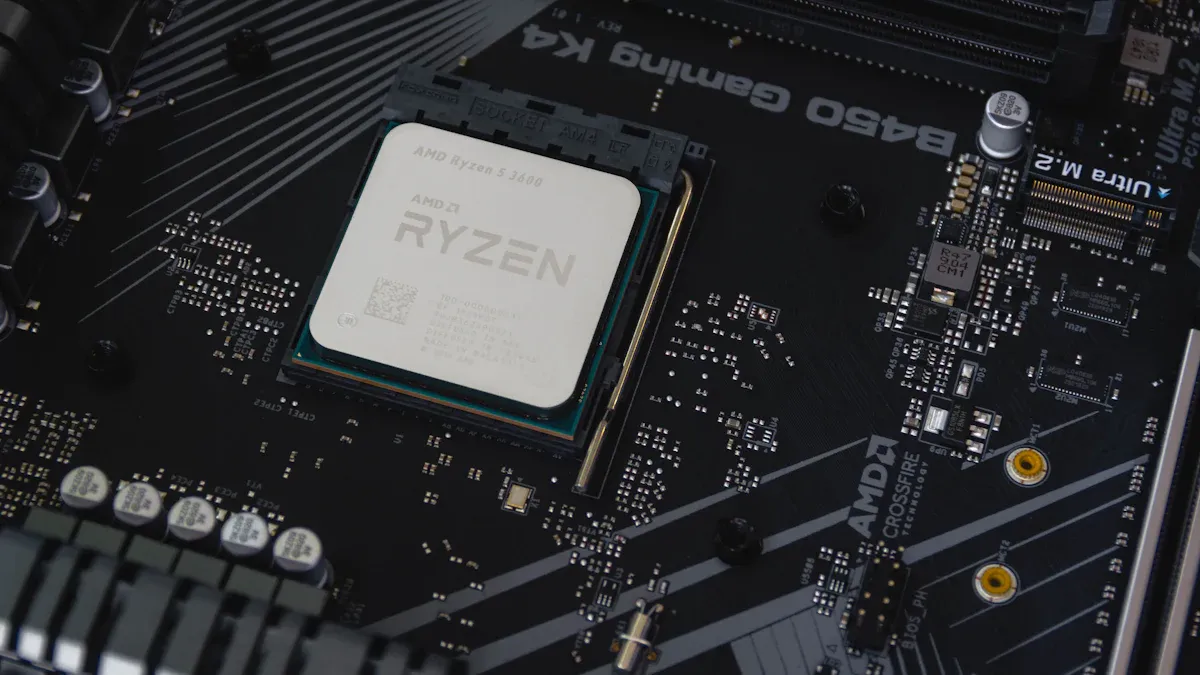
Digital Integrated Circuits are small chips that use binary signals. These chips show a 0 or a 1 with two voltage levels. This helps them process data fast and without mistakes. There are many types of Digital Integrated Circuits. Each type does a different job.
-
Logic gate circuits
-
Memory devices like RAM and ROM
-
Digital Signal Processors (DSPs)
-
Application-Specific Integrated Circuits (ASICs)
-
Programmable logic devices such as FPGAs
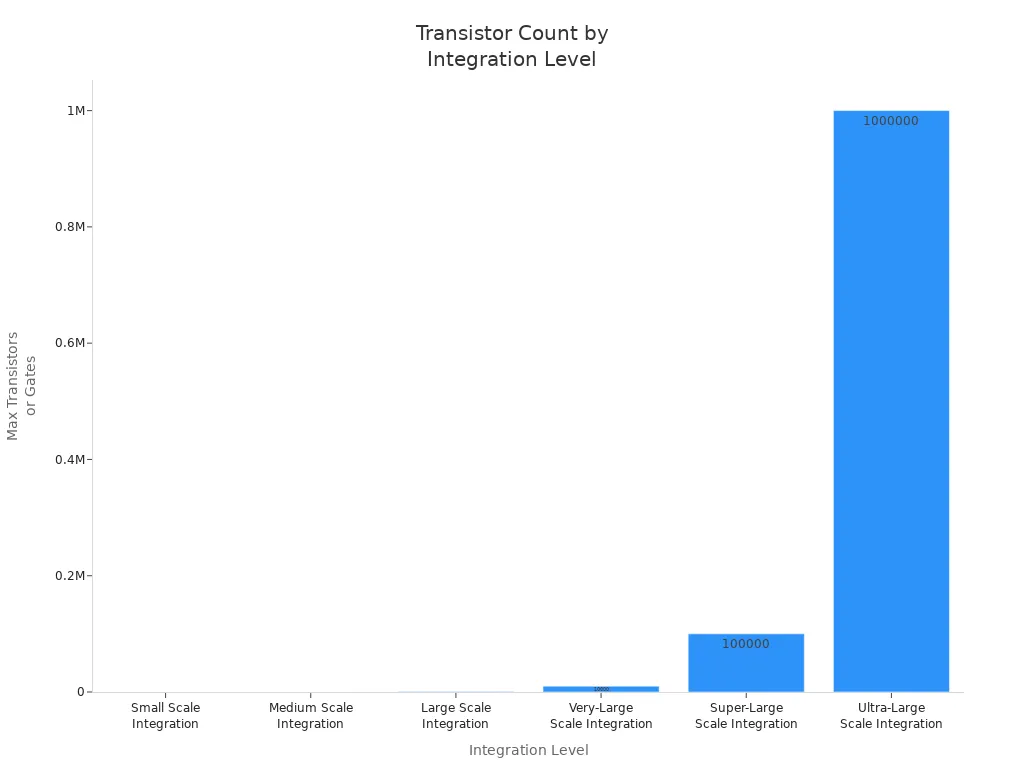
Engineers sort these circuits by technology, like bipolar (TTL, ECL) and unipolar (CMOS). They also group them by how many parts fit on a chip, from Small Scale Integration (SSI) to Ultra Large Scale Integration (ULSI).
Core Components
All digital integrated circuits have important parts. Each part has a job to help the circuit work.
|
Component |
Function |
|---|---|
|
Transistors |
Work as tiny switches to control signals and store binary data. |
|
Control how much current flows and keep parts safe. |
|
|
Hold and release energy, help with timing, and smooth voltage changes. |
|
|
Make current flow in one direction, keeping signals safe and correct. |
|
|
Logic Gates and Memory Cells |
Do math and store information. |
These parts work together to make logic gates, flip-flops, and multiplexers. When more parts fit on a chip, circuits can have millions of these pieces.
Binary Logic
Digital Integrated Circuits use binary logic to handle information. They turn all data into 0s and 1s. Logic gates like AND, OR, and NOT do simple jobs with these signals. Combinational circuits use only what is happening now to decide outputs. Sequential circuits use memory to remember what happened before. This lets devices work fast and store or move data easily. Binary logic is why these circuits are so important in electronics. They help run things like smartphones and cars.
How They Power Devices
Processing Functions
Digital Integrated Circuits help devices work fast and correctly. Microprocessors are a kind of Digital Integrated Circuit. They are the main part in computers, smartphones, and other gadgets. They follow steps, do math, and make choices using data. In cars and smart home devices, these circuits control sensors and check for safety.
-
They do math and logic jobs.
-
They handle memory and input or output.
-
They deal with interrupts and real-time things.
-
They guide how the system works.
A microprocessor gets instructions from memory. It works on them and sends results to other parts. This lets devices run apps, play games, and control robots. Putting many jobs, like arithmetic logic units and control logic, on one chip makes devices faster and saves power.
Note: Microprocessors and embedded systems use Digital Integrated Circuits to do hard jobs very fast. This makes them the "brains" of modern electronics.
Storage and Memory
Devices need to keep things like photos, music, and apps. Digital Integrated Circuits do this with memory chips like RAM, ROM, and Flash memory. These chips keep data safe and easy to get. RAM holds what a device needs right now. ROM keeps important instructions that do not change. Flash memory lets people save files and apps, even when the device is off.
Memory chips work with microprocessors to move data in and out. This teamwork helps smartphones open apps fast and computers load programs quickly. Memory ICs also help devices remember settings and what users like.
|
Device Category |
Real-World Examples and Applications |
Representative Chips / Technologies |
|---|---|---|
|
Memory ICs |
Computers, mobile devices, embedded systems |
RAM, ROM, Flash memory ICs |
Communication
Electronic devices must share information between their parts to work well. Digital Integrated Circuits help by handling binary signals and moving data. Logic gates, flip-flops, and multiplexers inside these circuits control how information flows. Microprocessors and microcontrollers act as managers. They make sure each part gets the right data at the right time.
-
Logic gate circuits (AND, OR, NOT) are the base for digital communication.
-
Combinational and sequential logic circuits handle and sync signals.
-
Memory ICs store and get data for sharing.
-
Microprocessors and microcontrollers manage data flow and control signals.
-
Interface ICs help connect electronics, making things more reliable and easier to design.
Communication ICs, like those for Wi-Fi, Bluetooth, and cellular networks, let devices go online and talk to each other. For example, a smartphone uses these circuits to send messages, stream videos, and make calls. Interface ICs also help connect different parts inside a device so everything works together.
|
Device Category |
Real-World Examples and Applications |
Representative Chips / Technologies |
|---|---|---|
|
Communication ICs |
Wireless communication, telecommunication equipment, data networking |
Qualcomm Snapdragon X65, TI CC2650, Broadcom BCM54616S |
Manufacturing and Evolution
IC Fabrication
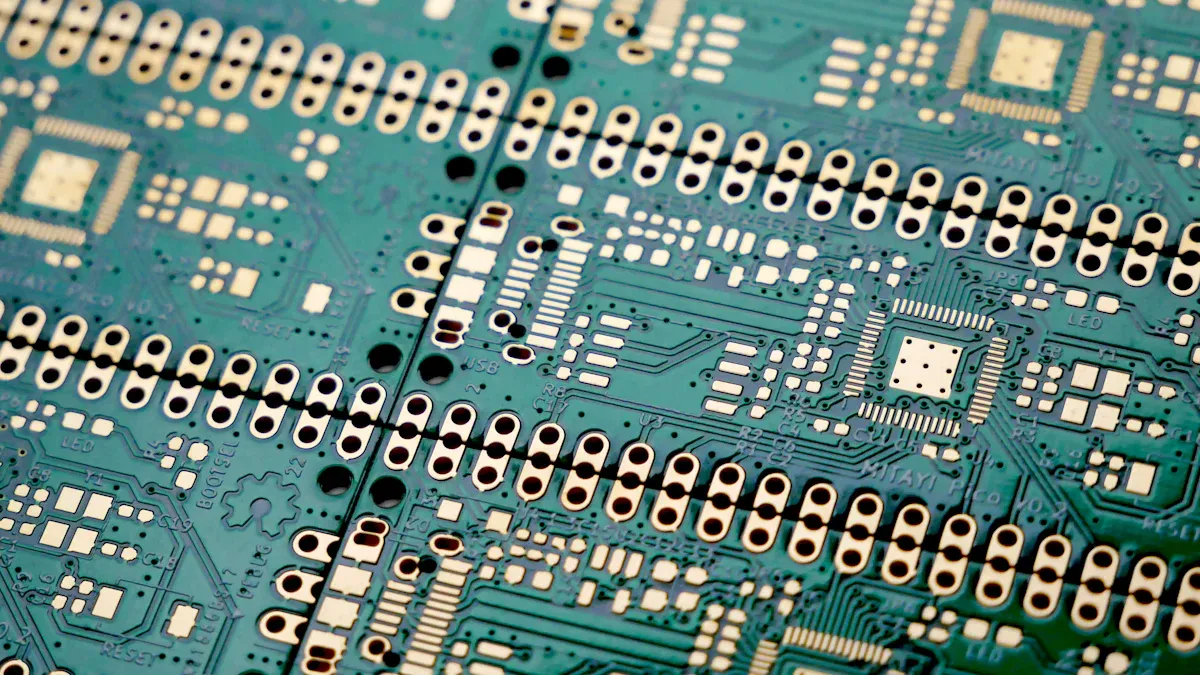
Engineers make digital integrated circuits by following many steps. They begin with a thin piece of silicon called a wafer. This wafer is the base for the chip. First, experts design and plan how the circuit will look. Then, they use photolithography to put a special coating called photoresist on the wafer. Ultraviolet light shines through a mask to make patterns on the wafer. After that, etching removes parts they do not need. Next, doping adds things like boron or phosphorus to change how the silicon works. Thin film deposition puts layers of metals and insulators on the chip. Metallization makes tiny wires that link the chip’s parts. At the end, each chip is tested and packed to keep it safe and working.
Main materials used include:
-
Silicon wafers for the base
-
Photoresist for patterning
-
Silicon dioxide for insulation
-
Metals like aluminum and copper for connections
Miniaturization
Miniaturization means making chip parts smaller and putting more together. Over time, engineers have made transistors much tinier. Transistors are the main parts inside chips. Smaller transistors let more fit on one chip. This makes chips faster and saves energy. Because of this, smartphones and computers are now much stronger.
Packaging has also gotten better. For example:
|
Packaging Technology |
Key Features |
Impact on Density and Performance |
|---|---|---|
|
PQFP |
Leads on four sides, reduced spacing |
More connections, but reached limits |
|
BGA |
Pins under the chip, supports layers |
Higher pin counts, smaller size |
|
CSP |
Tiny solder balls, thin package |
Fits more pins, supports miniaturization |
These new ways help chips do more in less space.
Moore’s Law
Moore’s Law says the number of transistors on a chip doubles every two years. This has happened for over 50 years. Chips have become faster, smaller, and cheaper. Computers and phones now have more power and use less energy.
Moore’s Law has helped technology change a lot. Devices are smaller and cost less. Engineers have made new ways to build chips to keep up. Now, it is harder as parts get very tiny. Still, Moore’s Law has shaped electronics and gives people new ideas.
Applications and Impact
Consumer Electronics
Digital Integrated Circuits are very important in many gadgets. These chips help phones, tablets, and computers work well. They let you use apps, save photos, and go online. Microcontrollers run smart home things like lights and cameras. Microprocessors make gaming consoles and computers fast. Memory chips keep data safe in cameras, TVs, and tablets. System-on-Chip (SoC) technology puts many parts on one chip. This makes gadgets smaller and helps them use less power.
-
Microcontrollers: Used in smart home devices and appliances
-
Microprocessors: Found in smartphones, computers, and gaming consoles
-
Memory ICs: Store data in cameras, TVs, and tablets
-
SoCs: Power smartphones and embedded devices
Many gadgets need these chips for speed, storage, and sharing data.
Industry and Automation
Factories use Digital Integrated Circuits to control machines. These chips help automate jobs and make work safer. Programmable Logic Controllers (PLCs) use them to manage sensors. Programmable Automation Controllers (PACs) run hard programs and link systems. Remote Terminal Units (RTUs) gather data and send out commands. Intelligent Electronic Devices (IEDs) use microprocessors for power and talking to other devices. These circuits help factories work in real time and be more flexible.
|
Device Type |
Role in Automation |
|---|---|
|
PLC |
Controls machines and sensors |
|
PAC |
Runs complex programs and connects systems |
|
RTU |
Collects data and sends commands remotely |
|
IED |
Manages power systems and communication |
System-on-Chip
System-on-Chip (SoC) technology puts many things on one chip. It has processors, memory, and input/output parts together. This makes gadgets smaller and cheaper to make. SoCs use less power, so batteries last longer. They let devices get to memory faster and do many jobs at once. SoCs help new products get made quickly. They can be changed for different uses. Some new SoCs even have AI and machine learning. This helps gadgets get smarter and do more.
-
Smaller size and lower cost
-
Lower power use and longer battery life
-
Faster performance and more functions
-
Easier and faster product development
-
Support for AI and smart features
Benefits and Future Trends
Efficiency and Cost
Digital chips help modern electronics in many ways.
-
Miniaturization lets devices be small and light. This is good for phones and wearables.
-
Fewer connections inside the chip mean fewer things break. Devices last longer.
-
Fast data processing and special circuits make gadgets work quickly.
-
Using less power means batteries last longer. Devices also stay cooler.
-
High system integration makes design and building easier.
-
These chips work in many things, from toys to computers.
-
Good heat control keeps devices working well.
-
Built-in modules like Wi-Fi and Bluetooth help devices talk to each other.
Putting many parts on one chip saves money. Making lots of chips lowers the price for each one. Quick and cheap testing helps companies make new products faster. Devices last longer, so people do not need to buy new ones often.
Challenges
Designers face new problems as chips get smaller and more complex. Security risks grow with new technology like quantum computing and AI. Factories must handle new defects and stress from stacking layers. Testing gets harder as chips become more advanced. Mixing analog and digital parts makes design harder. Power use and heat must be watched closely. Teams need to work together and use new tools to keep up.
|
Challenge |
Description |
|---|---|
|
New Defects |
Problems from new ways of making chips |
|
Heat and Stress |
Damage from heat in stacked chips |
|
Testing |
Harder to find and fix problems |
|
Design Complexity |
Mixing analog and digital parts |
|
Power and Heat |
Need to save energy and control temperature |
|
Teamwork |
More people and tools needed for success |
Future Directions
The future for chips looks bright and full of new ideas.
-
Quantum computing will help chips solve hard problems faster.
-
Special hardware for AI will make smart devices even smarter.
-
Chips that use light instead of electricity will send data faster.
-
New materials like carbon nanotubes will make chips smaller and better.
-
Flexible and wearable chips will help with health and smart clothes.
-
Chiplets will make upgrades easier and boost performance.
-
Energy-saving designs will help the planet and make batteries last longer.
The market for these chips should grow fast, with new uses in cars, smart homes, and medical devices.
Digital integrated circuits give power and smarts to today’s electronics. Engineers made devices smaller and quicker by making transistors tiny. They also put many parts together on one chip. System-on-Chip designs and 3D stacking make gadgets small and work well. New materials and better chip designs will bring more speed and smart features. As technology gets better, electronics will be stronger, last longer, and use less energy. Every smartphone, car, and smart device shows how these changes help us.
FAQ
What is a digital integrated circuit?
A digital integrated circuit is a tiny chip. It uses electronic parts to work with 0s and 1s. These chips help phones and computers run fast. They also help them work the right way.
Why do devices need so many transistors?
Transistors are like small switches. They control signals in the chip. More transistors let the chip do more things at once. This makes devices faster and able to do more jobs.
How do digital ICs save energy?
Digital ICs use very small parts and smart designs. Smaller transistors use less electricity. This helps batteries last longer in things you carry.
Can digital ICs break or wear out?
Yes, digital ICs can stop working from heat or age. They can also break if damaged. Most chips last a long time. Engineers make them strong to handle stress and problems.
What is the difference between RAM and ROM?
RAM holds data a device needs right now. It loses data when power goes off. ROM keeps important instructions safe. These stay even when the device turns off.