AC DC Power Source Evolution and Its Impact on Today’s Technology
Electricity changed the world and shaped daily life. The history of power shows how inventors improved ac dc power source th
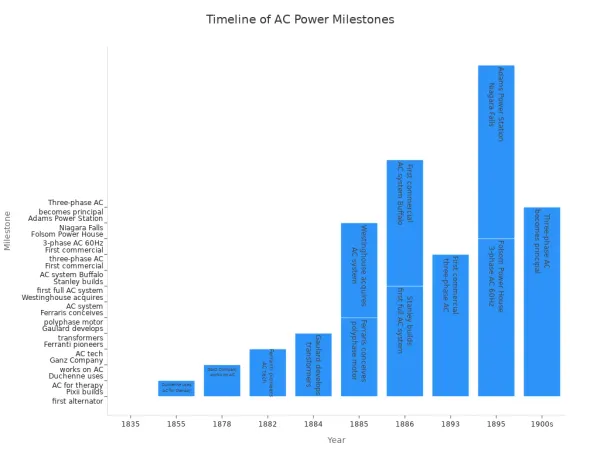
Electricity changed the world and shaped daily life. The history of power shows how inventors improved ac dc power source through many discoveries. People saw new ways to create energy and use electric machines. Electrification reached homes and cities, making life easier. The story of electric innovation includes famous names and big achievements. The table below shows key moments in the history of power and electricity:
| Year | Milestone Description |
|---|---|
| 1835 | Hippolyte Pixii builds the first alternator with a rotating magnet, an early AC device though not yet practical. |
| 1855 | Guillaume Duchenne uses AC for electrotherapeutic muscle stimulation, an early application of AC. |
| 1878 | Ganz Company begins work on single-phase AC power systems in Budapest. |
| 1882 | Sebastian Ferranti pioneers early AC power technology including transformers in London. |
| 1884 | Lucien Gaulard develops transformers and power transmission system in Turin, Italy. |
| 1885 | Galileo Ferraris conceives the polyphase AC motor using rotating magnetic fields without commutators. |
| 1885 | George Westinghouse acquires rights to Gaulard and Gibbs AC system and orders Siemens alternator and transformers. |
| 1886 | William Stanley builds the first full AC power system in Great Barrington, Massachusetts, funded by Westinghouse. |
| 1886 | First commercial AC power system installed in Buffalo, New York, designed by Westinghouse, Stanley, and Shallenberger. |
| 1893 | First commercial installation of three-phase AC power at Redlands Power House (40 Hz). |
| 1895 | Folsom Power House installs modern 3-phase AC power at 60 Hz in the USA. |
| 1895 | Westinghouse builds the Adams Power Station at Niagara Falls, enabling long-distance AC transmission. |
| 1900s | Three-phase AC power becomes the principal source of electrical power worldwide. |
Key Takeaways
- AC power allows electricity to travel long distances efficiently using transformers, making it ideal for powering cities and industries.
- DC power flows in one direction and is essential for running electronic devices, electric vehicles, and renewable energy systems like solar panels.
- The historic rivalry between Edison’s DC and Tesla’s AC shaped modern electricity, with AC becoming the main method for power transmission.
- Modern power supplies use advanced technologies like switching power supplies and wide-bandgap semiconductors to improve efficiency and reduce size.
- Combining AC and DC power in grids, vehicles, and renewable systems supports smarter energy use, better reliability, and environmental benefits.
Origins of AC DC Power Source
Edison’s DC Beginnings
The history of power generation started with Thomas Edison’s work on direct current. Edison built the first electric power grid in New York City in 1882. His system used direct current to supply electricity to homes and businesses. Edison’s DC power source focused on small-scale grids that served local areas. He installed many generating stations throughout cities because direct current could not travel far. Each station needed to be close to users, usually within a mile.
Edison’s DC system had several key features and limitations:
- Direct current provided a constant flow of electricity.
- The system required multiple generators for different voltages.
- DC voltage could not be easily changed, which limited power transmission distance.
- Many generating stations increased complexity and cost.
- DC distribution worked well for short distances but struggled with large-scale energy needs.
Despite these challenges, Edison’s DC microgrids played an important role in the early history of electric power. The system powered lights and machines in cities, but the need for many stations made it hard to expand. DC electricity also faced safety issues, such as electrical arcing, which made distribution harder.
Tesla and AC Power
Nikola Tesla changed the history of power generation with his work on alternating current. Tesla’s AC power system used electricity that changed direction many times per second. This allowed for efficient power transmission over long distances. Tesla’s patents helped George Westinghouse build AC power grids using transformers. These devices could step voltage up or down, making it possible to send electricity far from the power generation site.
AC power had several advantages over direct current:
- Alternating current could travel long distances with less energy loss.
- Transformers made it easy to change voltage levels for safe and efficient distribution.
- Fewer power stations were needed, reducing cost and complexity.
- AC power transmission allowed large power plants to serve many people.
Tesla’s AC power innovations solved many problems that Edison’s DC system faced. AC grids became the standard for electric power generation and distribution. The ability to transmit energy over long distances changed the way people used electricity. The history of power transmission shows how AC power replaced DC in most applications. The famous “Edison vs. Tesla” rivalry shaped the future of electric energy and technology.
War of the Currents

AC vs DC
The war of the currents shaped the history of electricity. Thomas Edison supported direct current. He believed direct current was safer for homes and businesses. Edison argued that alternating current was dangerous because it used high voltage. He showed public demonstrations where animals were electrocuted with ac power to warn people about its risks. Edison also pushed for laws to limit ac voltage.
George Westinghouse and Nikola Tesla supported ac power. They explained that alternating current could travel long distances with less energy loss. AC power used transformers to change voltage levels, making it more efficient for cities and factories. Westinghouse sold ac systems at low prices to compete with direct current. Tesla’s inventions, like the polyphase ac system, made ac power even more practical.
The war of the currents included many public and legal battles. Edison tried to protect his patents and market share. Westinghouse and Tesla focused on showing the benefits of ac power. The 1893 Chicago World’s Fair used ac power to light up the event, proving its reliability. The Niagara Falls project sent ac electricity over 26 miles, showing that ac power could serve large areas. These events marked a turning point in the history of electric power.
Note: AC power became the standard for electricity transmission because it was more efficient and cost-effective than direct current.
Key Figures
Several inventors and engineers played key roles in the war of the currents. Thomas Edison created the first direct current power station in 1882. His work started the spread of electric power in cities. Nikola Tesla invented the ac induction motor and developed the polyphase alternating current system. His ideas made ac power possible for long-distance transmission.
George Westinghouse saw the value of Tesla’s inventions. He bought Tesla’s patents and built ac power systems across the country. Westinghouse used business skills and engineering knowledge to challenge Edison’s direct current monopoly. The rivalry between these men changed the history of electricity. The current war ended with ac power becoming the main way to deliver electricity to homes and industries.
Today, both ac and direct current play important roles in technology. AC power runs the electric grid, while direct current powers many electronic devices. The war of the currents shows how competition and innovation can shape the future of power and electricity.
Power Supply Advances
Mercury Arc Rectifiers
Mercury arc rectifiers marked a major step forward in the power supply industry. These devices converted ac into direct current for electric railways, industrial motors, and communication systems. Engineers used a liquid mercury cathode that renewed itself, which did not wear out over time. This feature allowed the rectifier to conduct high current with low arc voltage, boosting efficiency. The ionization of mercury vapor and the positive ion bombardment kept the cathode emission spot at the right temperature. This process made operation stable and reliable.
Mercury arc rectifiers improved ac to dc conversion in several ways:
- They used multiple anodes per phase for full-wave rectification, which allowed both halves of the ac waveform to be used. This produced smoother dc output and increased transformer efficiency.
- Control grids between the cathode and anode regulated conduction timing. This feature enabled adjustable output voltage and more reliable operation.
- Compared to rotary converters or motor-generator sets, mercury arc rectifiers offered a more efficient, lower-maintenance, and reliable solution for ac to dc conversion.
These advances helped the power supply industry meet growing demand for electric power in factories and transportation. Mercury arc rectifiers set the stage for modern power supply technology.
Switching Power Supplies
Switching power supplies changed the way people designed and used electric devices. These supplies use high-frequency switching to convert ac to dc with much greater efficiency. The power supply industry saw rapid growth as switching power supplies became standard in computers, televisions, and mobile devices.
Innovations in switching power supplies include:
- Microcontrollers and digital control algorithms monitor and manage power in real time, improving efficiency and reliability.
- Zero-voltage and zero-current switching techniques reduce losses, making energy use more efficient.
- Wide-bandgap semiconductors like gallium nitride (GaN) and silicon carbide (SiC) allow higher switching frequencies and temperatures. This leads to smaller passive components and higher power density.
- Advanced thermal management, such as phase change materials and heat pipes, improves heat dissipation and supports miniaturization.
| Aspect | Explanation |
|---|---|
| Integrated Circuit Design | Highly integrated ICs combine many functions into one chip, reducing size and complexity in power supply systems. |
| High-Frequency Switching | Operating at tens of kHz to MHz allows smaller transformers and capacitors, shrinking the physical size while keeping efficiency high. |
| Advanced Semiconductor Devices | MOSFETs and IGBTs with low resistance and fast switching enable compact, efficient power supplies with higher density. |
| Thermal Management Techniques | Multilayer PCBs and heat sinks help manage heat in small packages, ensuring reliability. |
| Space Optimization | Miniaturized power supplies make better use of limited space, which is important in automotive and aerospace electronics. |
| Energy Efficiency | Smaller components use less power, lowering operational costs. |
| Enhanced Performance | Miniaturization improves voltage regulation, reduces noise, and increases power density. |
| Cost Reduction | Smaller supplies need fewer materials and lower manufacturing costs, helping both manufacturers and consumers. |
Switching power supplies have made electric devices smaller, lighter, and more efficient. The power supply industry continues to develop new technologies that improve ac to dc conversion and meet the needs of modern electronics.
Modern AC DC Power Source Applications
AC Power in Grids
AC power forms the backbone of the electric grid in most countries. Engineers use ac power for long-distance transmission because it allows easy voltage changes with transformers. Modern ac power grids connect cities, industries, and homes, supporting daily life and economic growth. Microgrids have become important in recent years. These localized systems operate independently or alongside national and regional grids. Microgrids use ac power from renewables, traditional generators, and energy storage. They provide backup power during outages and reduce strain on the main grid.
- Microgrids offer autonomy, flexibility, and smart management. Advanced control systems monitor energy flow and switch sources in real time.
- Microgrids improve reliability in remote areas, military bases, campuses, and urban settings.
- Integration of renewables like solar and wind supports environmental goals and helps balance energy supply and demand.
Smart grids build on the foundation of ac power. Power routers convert between ac and dc, manage energy flow, and support two-way communication. These systems allow real-time monitoring and automated adjustments. The grid can now handle diverse energy sources and respond quickly to changes in demand. The evolution of ac dc power source technology has made smart grids possible, improving reliability and efficiency.
Note: The electric grid relies on ac power for transmission, but modern systems use both ac and dc to meet new energy needs.
DC Power in Technology
DC power plays a vital role in many modern applications. Engineers prefer dc power for its stable, unidirectional current, which ensures continuous and reliable operation. Telecommunications use dc power for cell towers and network hubs. Backup batteries activate during outages, keeping communication lines open. Aviation and battery storage systems also rely on dc power for efficiency and scalability.
- Power supply for consumer electronics: Devices like smartphones, laptops, and smartwatches need dc power for charging and operation.
- Electric vehicles: Charging stations convert ac power from the grid to dc power for batteries. Onboard chargers manage conversion and communication with the vehicle control unit.
- Renewable energy systems: Solar panels and wind turbines generate dc power. Inverters convert dc to ac for grid compatibility. Hybrid inverters combine multiple sources and enable energy storage integration.
| Aspect | Description |
|---|---|
| Role of DC Power | Solar PV and wind turbines generate dc power that must be converted to ac for grid compatibility using inverters. |
| String Inverters | Connect multiple solar panels; convert dc from the string to ac; popular for reliability and cost-effectiveness. |
| Microinverters | Installed on individual panels; convert dc to ac at panel level; improve efficiency and reduce single points of failure. |
| Central Inverters | Used in large-scale solar and wind farms; convert dc from many strings; known for high efficiency and cost savings. |
| Hybrid Inverters | Convert power from multiple sources (solar, batteries, grid); enable seamless integration of energy storage with renewables. |
| Advanced Features | MPPT maximizes power extraction; reactive power support helps maintain grid voltage; grid support functions improve stability and power quality. |
| Impact on System Design | Adoption of dc power has driven innovations in inverter technology, hybrid system design, and energy storage integration, shaping modern renewable energy architectures. |
- Data centers: DC power supplies critical infrastructure such as UPS, servers, and cooling systems. Direct dc distribution reduces conversion losses and increases rack power capacity.
- Telecommunications infrastructure: DC power supports base stations, routers, and switches, ensuring reliable data transmission.
- Industrial automation: DC power drives sensors, motors, and robotics, providing precise control in manufacturing.
- Healthcare devices: Patient monitors and diagnostic machines depend on stable dc power for safety and accuracy.
- Home appliances: Modern appliances use dc power for electronic controls and variable speed motors.
- Lighting systems: LED lighting relies on dc power for energy efficiency and smart control.
- Audio and video equipment: DC power supports stable operation and high-quality sound and image reproduction.
AC DC Power Source in Electric Vehicles
Electric vehicles use both ac and dc power sources. The electric grid supplies ac power, which onboard chargers convert to dc for battery charging. DC charging stations deliver dc power directly to the battery, enabling faster charging. DC-DC converters step down high-voltage dc from the battery to lower-voltage dc for auxiliary systems. Innovations like the Coil Driver™ integrate charger functions into the traction inverter, improving charging speed and efficiency.
- AC and dc power sources are essential for testing EV components, using emulators and simulators to replicate real-world conditions.
- DC fast charging bypasses the onboard charger, supplying dc power directly to the battery.
- Safety and cybersecurity features protect power delivery and data exchange.
AC DC Power Source in Data Centers
Data centers use staged power conversion, integrating ac and dc sources to minimize losses and improve efficiency. Utility-connected ac/dc converters and intermediate dc buses reduce voltage drops. Voltage levels like 48 VDC and 800 VDC balance efficiency, safety, and cost. Hybrid regulation schemes offer flexibility. Advanced solutions integrate dc/dc converters with processors, optimizing power delivery.
DC power systems in data centers lower cooling demands and support high-density workloads. Hybrid ac/dc architectures enable incremental adoption, balancing capital costs with operational savings. Pilot projects show reduced conversion losses and increased rack space utilization. Collaborations aim to support 1 MW racks, highlighting the trend toward dc power integration.
AC DC Power Source in Renewable Energy
Renewable energy sources like solar and wind generate dc power. Inverters convert dc to ac for grid compatibility. Hybrid inverters combine solar, batteries, and grid power, enabling seamless energy storage integration. MPPT maximizes power extraction, while reactive power support maintains grid voltage. The adoption of dc power has driven innovations in inverter technology and system design.
AC DC Power Source in Off-Grid Systems
Off-grid systems use solar panels to generate dc electricity. Charge controllers regulate energy flow to batteries, preventing overcharge. Battery banks store dc energy for use when generation is low. Inverters convert dc power from batteries into ac power for household appliances. Proper system sizing ensures reliable supply tailored to energy consumption.
- Solar panels generate dc electricity from sunlight.
- MPPT charge controllers optimize dc power for battery charging.
- Battery banks provide power when solar generation is insufficient.
- Stand-alone inverters convert stored dc power into ac power for appliances.
- Backup generators and monitoring systems enhance reliability.
Energy Efficiency and Environmental Impact
Modern ac dc power source technology improves energy efficiency in consumer electronics. Switch-mode power supplies minimize energy loss during ac to dc conversion. Efficient adapters reduce heat generation, improving device longevity and lowering environmental impact. DC power provides stable voltage, reducing energy loss and improving efficiency. Integration with renewable energy sources supports energy-efficient electronics.
- AC-DC converters operate at 80-90% efficiency; dc-dc converters reach about 95%.
- Improving conversion efficiency reduces energy consumption and environmental load.
- Regulations require energy conservation and reduced standby power consumption.
- Engineering efforts focus on increasing efficiency and reducing the number of power supplies.
Power Electronics and Future Trends
Advancements in power electronics enable efficient ac dc conversion. Wide-bandgap semiconductors like silicon carbide and gallium nitride allow faster switching, higher efficiency, and reduced cooling needs. Digital control systems optimize conversion parameters, improving performance under variable loads. These innovations result in compact, reliable, and high-performance ac-dc power supplies.
| Advancement Type | Key Benefits | Applications and Impact |
|---|---|---|
| Wide-bandgap Semiconductors | Lower switching and conduction losses, higher thermal conductivity, operation at higher frequencies and temperatures | Electric vehicle inverters, renewable energy inverters, industrial motor drives, high-frequency dc-dc converters |
| Silicon Carbide (SiC) | Higher efficiency, compact designs, better thermal management, smaller passive components | High voltage power supplies, EV inverters, solar inverters, industrial drives |
| Gallium Nitride (GaN) | Ultra-fast switching, high power density, improved thermal management | High-frequency dc-dc converters, wireless power transfer, high-efficiency adapters and chargers, RF amplifiers |
| Advanced Converter Designs | Active rectifiers, bridgeless PFC converters, soft-switching (ZVS, ZCS) | Efficient ac-dc conversion in consumer electronics, renewable energy, automotive sectors |
| Digital Control Integration | Adaptive optimization, enhanced performance under variable loads | Smart power management in aerospace, defense, consumer electronics |
Projected trends for ac dc power source technology include higher efficiency, compact designs, and smart conversion systems with real-time monitoring. The adoption of wide-bandgap semiconductors will enable higher switching frequencies and improved thermal management. Energy storage solutions will grow, especially in renewable energy and electric vehicle applications. Programmable power supplies and AI-enabled diagnostics will become more common.
- The global ac dc power supply market was valued at USD 37.9 billion in 2023 and is projected to reach USD 54.9 billion by 2032, growing at a CAGR of 4.2%.
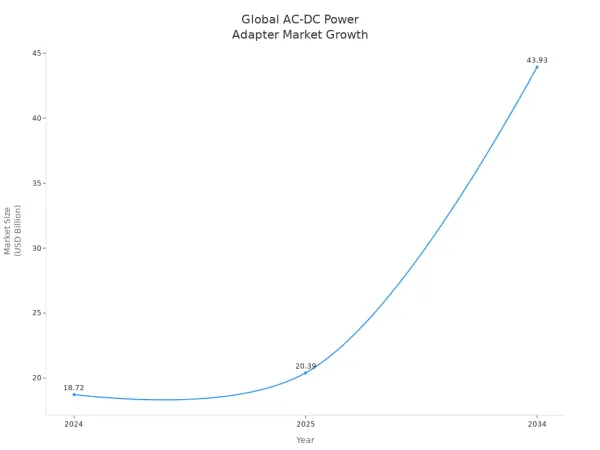
- The AC-DC power supply adapter market is expected to grow from USD 18.72 billion in 2024 to USD 43.93 billion by 2034.
Government policies and regulations influence the development of ac dc power source technologies. Energy regulations, supply chain policies, and consumer preferences drive demand for efficient, compact, and innovative power supplies. Agencies promote market competition and innovation, fostering growth in consumer electronics, automotive, industrial equipment, telecommunications, and medical devices.
Promising research areas include medical ac-dc power supplies for AI and machine learning, sophisticated control systems, wireless power transfer, and energy storage integration. Hybrid ac/dc systems enhance grid stability and cybersecurity. DC power grids reduce energy losses and integrate seamlessly with renewable energy sources.
Tip: The evolution of ac dc power source technology supports smart grids, renewable energy integration, and efficient energy management in modern society.
The evolution of ac and dc power continues to shape modern technology. Early breakthroughs in rotary converters and transformers allowed ac and dc systems to work together, laying the groundwork for today’s hybrid power networks. The shift from Edison’s dc to Tesla’s ac showed how technical advances in power transmission changed the way people use electricity. Modern grids now combine ac and dc to improve efficiency and reliability.
- Future innovations will include wide-bandgap semiconductors, smart features, and digital control for better power management.
Ongoing research in ac dc power supports energy savings, smaller devices, and new uses in electric vehicles and aviation.
FAQ
What is the main difference between AC and DC power?
AC power changes direction many times each second. DC power flows in one direction only. Engineers use AC power for grids and DC power for electronics. Each type supports different devices and systems.
Why do modern devices need both AC and DC power sources?
Many devices use AC power from the grid. They convert it to DC power for operation. Computers, phones, and LED lights need DC power for their circuits. This conversion helps devices work safely and efficiently.
How does renewable energy use AC and DC power?
Solar panels and wind turbines generate DC power. Inverters change DC power into AC power for grid use. Hybrid systems combine both types to store energy and supply homes or businesses. This process improves energy management.
What role does power electronics play in today’s technology?
Power electronics control and convert electrical energy. They help manage AC and DC power in vehicles, data centers, and renewable energy systems. These devices improve efficiency, reliability, and safety in many applications.
Can DC power improve energy efficiency in homes?
DC power reduces energy loss in some devices. LED lighting and electronics work better with DC power. Using DC power in homes can lower electricity bills and support smart energy systems.