22uF capacitor is the Swiss Army knife for circuits
You often reach for a 22uF capacitor when you need a quick fix in your electronic circuits. This small component, with its 2
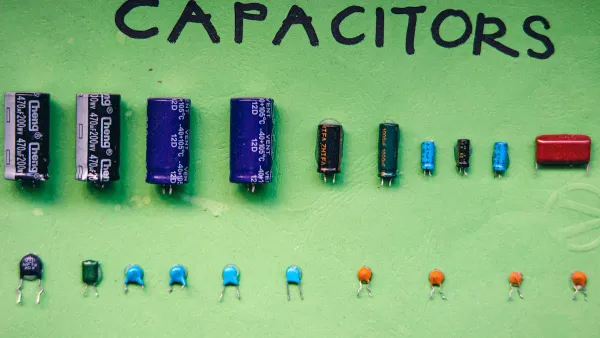
You often reach for a 22uF capacitor when you need a quick fix in your electronic circuits. This small component, with its 22 microfarads of capacitance, fits almost anywhere yet delivers impressive performance. Whether you work on Arduino projects or build measuring instruments, you see the 22uF capacitor shine in many real-world applications:
- Power supply circuits need a 22uF capacitor for voltage smoothing.
- Arduino and Raspberry Pi projects use a 22uF capacitor for signal conditioning.
- High-voltage circuits rely on a 22uF capacitor for stability.
- DIY electronics depend on a 22uF capacitor for noise filtering.
- 3D printers and CNC machines enhance performance with a 22uF capacitor.
- Measuring instruments use a 22uF capacitor to reduce noise.
You discover the 22uF capacitor’s adaptability in power supply, audio, timing, and filtering applications. Its popularity comes from a perfect balance of capacitance, compact size, and unmatched versatility.
Key Takeaways
- The 22uF capacitor offers a perfect balance of size and performance, making it ideal for smoothing voltage, filtering noise, and timing in many circuits.
- Using multiple 22uF capacitors in parallel improves circuit stability by increasing capacitance and reducing resistance, but requires careful PCB layout.
- Different types of 22uF capacitors—electrolytic, tantalum, and ceramic—fit various needs; choose based on your circuit's voltage, size, and stability requirements.
- The 22uF capacitor plays key roles in power supply filtering, audio signal coupling, noise reduction, and timing, making it a versatile tool for both beginners and experts.
- Selecting the right 22uF capacitor involves checking voltage rating and type to match your application, ensuring reliable and efficient circuit performance.
Why 22uF Capacitor

Capacitance Sweet Spot
You often see the 22uF capacitor in many electronic circuits because it sits at a sweet spot for capacitance. With 22 microfarads, this value gives you enough storage to smooth voltage, filter noise, and support timing functions. The 22uF capacitor is not too large or too small, so it fits well in both compact and high-power circuits. You can use it in real-world applications like power supplies, amplifiers, and control systems.
The 22uF capacitor balances size and performance. It stores enough energy to handle sudden changes in current, which helps keep your circuit stable. You get reliable performance even when the temperature changes or the voltage goes up and down. Many 22uF capacitors use X7R dielectric, which keeps the capacitance steady over a wide temperature range. This stability means your circuits work well in different environments.
Tip: The 22uF capacitor is a favorite for both beginners and experts because it offers stable performance, compact size, and versatility for many applications.
Here is a table showing some key characteristics of a typical 22uF capacitor:
| Characteristic | Description |
|---|---|
| Capacitance | 22µF |
| Voltage Rating | 16V |
| Tolerance | ±20% |
| Package Size | Compact 1206 (3216 metric) package |
| Dielectric Type | X7R dielectric providing stable capacitance over a wide temperature range |
| Features | Stable capacitance, suitable for decoupling, filtering, timing applications, RoHS compliant |
| Applications | Power supplies (decoupling/filtering), signal coupling, timing circuits |
| Benefits | Compact size, stable performance, versatility for low to medium voltage circuits |
When you compare the 22uF capacitor to other values, you notice it costs more than a 10uF but less than a 100uF. This makes it a good choice when you want quality and performance without spending too much. The 22uF capacitor also comes in many package sizes, from tiny 0603 to larger 1206, so you can pick the right one for your project.
| Capacitance (µF) | Voltage (V) | Price (USD) |
|---|---|---|
| 10 | 100 | 0.33 |
| 22 | 100 | 0.44 |
| 100 | 100 | 0.92 |
Parallel 22uF Capacitors
You can use more than one 22uF capacitor in parallel to increase total capacitance or improve circuit performance. When you connect capacitors in parallel, you lower the equivalent series resistance (ESR) and impedance. This helps your circuit handle ripple currents better and respond faster to sudden changes. For example, in power supply circuits, using two or more 22uF capacitors in parallel can reduce noise and improve voltage stability.
Paralleling capacitors also lets you place them closer to important parts of your circuit, like microcontroller pins. This reduces inductance and helps filter out high-frequency noise. However, using several 22uF capacitors takes up more space and can cost more. You must also make sure your PCB layout is good, with short and direct traces, to get the best results.
Note: Using multiple 22uF capacitors in parallel can improve reliability by lowering ESR and impedance, but always check your layout to avoid unwanted resonances.
Capacitor Types
You find 22uF capacitors in several types, each with unique characteristics. The three most common are electrolytic, tantalum, and ceramic.
- Electrolytic capacitors give you high capacitance in a small size. They are polarized, so you must connect them the right way. They work well for energy storage and filtering in low-frequency applications, but they have a limited lifespan and less stability.
- Tantalum capacitors offer higher capacitance in even smaller packages. They are reliable and stable, with consistent capacitance under different voltages and temperatures. Like electrolytic types, they are polarized and need careful handling to avoid failure.
- Ceramic capacitors are non-polarized and very reliable. They have low ESR and inductance, making them great for high-frequency filtering. Ceramic 22uF capacitors are cheap and work well in many circuits, but their capacitance can change with voltage and temperature.
Here is a table comparing tantalum and ceramic 22uF capacitors:
| Parameter | Tantalum Capacitors | Ceramic Capacitors |
|---|---|---|
| Aging | Stable over time | Capacitance decreases with age |
| Polarization | Polarized (DC only) | Non-polarized (AC or DC) |
| Temperature Response | Linear | Non-linear |
| Voltage Response | Stable | Capacitance drops at high voltage |
| ESR | Higher | Lower |
| Inductance | Higher | Lower |
| Reliability & Stability | Very good | Good, but can age |
| Size and Capacitance Density | High in small size | Lower than tantalum |
You can find 22uF capacitors with many voltage ratings, such as 16V, 25V, 35V, 50V, and even 100V. Most consumer electronics use 16V, 25V, or 35V ratings. Always pick a voltage rating higher than your circuit voltage for safety.
- Voltage ratings show the maximum safe voltage for a capacitor.
- For a 5V circuit, a 16V or 25V 22uF capacitor is common.
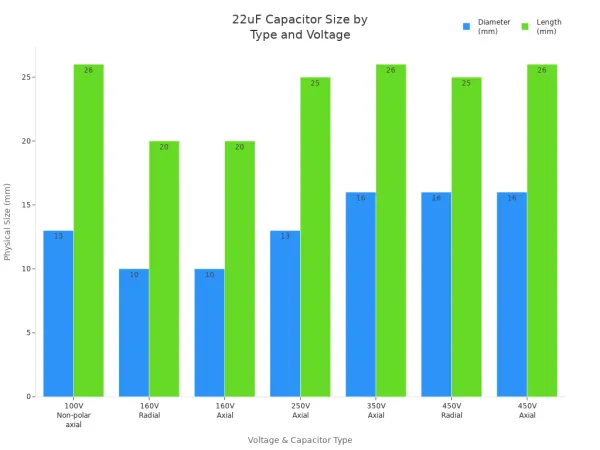
- Higher voltage ratings mean larger physical size.
- You can find 22uF capacitors in both radial and axial shapes.
The physical size of a 22uF capacitor changes with type and voltage rating. Here is a chart that shows how size increases with voltage:
You should also think about reliability. Ceramic 22uF capacitors are tough and handle stress well, but can crack if the board bends. Tantalum capacitors are stable but need careful voltage derating to avoid failure. Electrolytic capacitors can dry out over time, so they may not last as long in hot environments.
Remember: The 22uF capacitor gives you a mix of quality, performance, and flexibility. You can use it in many electronic circuits, from power supplies to audio and timing applications. Its characteristics make it a true Swiss Army knife for circuit design.
Power Supply Filtering
22uF for Smoothing
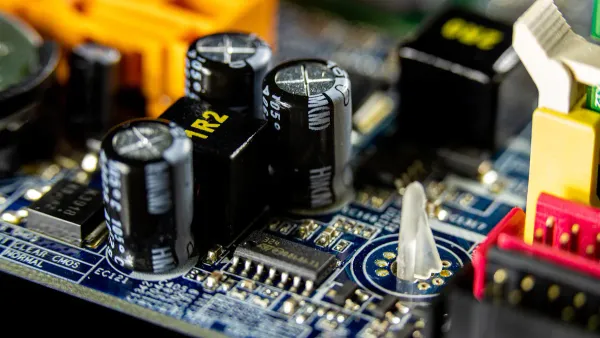
You often use a 22uf capacitor for power supply filtering in electronic circuits. This capacitor helps smooth voltage by charging during peaks and discharging when the voltage drops. You see this effect in full-wave rectifier circuits. The 22uf capacitor reduces voltage fluctuations, but larger capacitors like 100uf or 470uf provide better smoothing. The ripple voltage in these circuits depends on the capacitance. When you use a 22uf capacitor, you get some smoothing, but the ripple voltage stays higher compared to bigger values. You must balance the capacitor size with cost, weight, and space in your applications.
A smoothing capacitor works best when its time constant is much longer than the interval between waveform peaks. You notice that the 22uf capacitor can help maintain a steady DC output, but it may not be enough for high current loads. You choose the 22uf capacitor for small circuits or when you need a compact solution. In many electronic applications, you find the 22uf capacitor used for basic smoothing and power supply filtering.
Tip: If you want better circuit performance, use a larger capacitor for heavy loads, but the 22uf capacitor gives you a good balance for small devices.
High Performance Capacitor in Power Rails
You rely on the 22uf capacitor as a high performance capacitor in power supply filtering for microcontroller power rails and household appliances. You place bulk electrolytic capacitors, such as the 22uf, between inductors and ceramic capacitors in switching converters. This setup helps damp high-Q resonances and improves phase margin. You see the 22uf capacitor stabilize voltage spikes at the output of power controllers. This action is critical for keeping your power rails steady.
In household appliances, you use the 22uf capacitor to reduce noise and voltage fluctuations. You add decoupling capacitors to provide a low-impedance path for AC signals, isolating parts of the circuit and stabilizing local power supplies. You also use bypass capacitors to filter out high-frequency noise, shunting it to ground and protecting circuit performance. The 22uf capacitor shows its quality and characteristics by improving impedance and circuit performance in many electronic applications.
Here is a table showing how the 22uf capacitor supports power supply filtering in different applications:
| Application | Role of 22uf Capacitor | Benefit |
|---|---|---|
| Microcontroller Power Rails | Damps resonance, stabilizes voltage | Reliable operation |
| Household Appliances | Reduces noise, filters voltage spikes | Smooth power, less interference |
| Switching Converters | Improves phase margin, lowers impedance | Better circuit performance |
You see the 22uf capacitor as a high performance capacitor in power supply filtering for many electronic circuits. You get stable voltage, reduced noise, and improved impedance, making your applications work better.
Coupling and Decoupling
22uF in Audio Circuits
You often use a 22uf capacitor as a coupling capacitor in audio circuits. This capacitor lets the AC audio signal pass from one stage to another while blocking any DC voltage. By doing this, you protect sensitive parts of your circuit from unwanted DC and keep your audio signal clean. The 22uf capacitor helps you connect different parts of your audio system, such as amplifiers and speakers, without letting DC offset cause problems.
The type and material of the 22uf capacitor can change how your audio sounds. Some capacitors give you a brighter sound with more treble, while others boost the bass. You may notice that swapping out a 22uf capacitor in your signal path changes the tonal balance. Many users report that changing the capacitor can make the highs more aggressive or the bass more present. You might need to adjust your equalizer to get the sound you want. For the best performance, choose a 22uf capacitor with low leakage and the right dielectric for your audio applications. This choice helps you keep your signal pure and your music sounding great.
Tip: Always test different 22uf capacitors in your audio circuits to find the sound characteristics you like best.
Noise Filtering Capacitor
You rely on the 22uf capacitor for decoupling and noise filtering in both analog and digital circuits. In electronic applications, this capacitor acts as a bulk decoupling device. It stores energy and smooths out voltage changes, which helps your circuit run smoothly. The 22uf capacitor works well for filtering low to mid-frequency noise, usually up to around 1 MHz. Its low impedance at these frequencies makes it a strong choice for many electronic circuits.
However, the 22uf capacitor alone cannot filter out very high-frequency noise. You often pair it with smaller capacitors, such as 100nF or 1nF, to cover a wider frequency range. This combination gives you better noise suppression and stable performance. The table below shows how different capacitors work together for decoupling and noise filtering:
| Capacitor Value | Role in Decoupling/Noise Filtering | Frequency Range Covered | Notes |
|---|---|---|---|
| 22uF ceramic | Bulk decoupling, energy storage | ~10 kHz to 10 MHz | Best for lower frequency noise; value can change with voltage and temperature |
| 100nF ceramic | High-frequency decoupling near IC power pins | 1 MHz to 40 MHz | Handles fast transients; place close to IC pins |
| 1nF ceramic | Very high-frequency noise filtering | 80 MHz to 400 MHz | Used in parallel with larger capacitors |
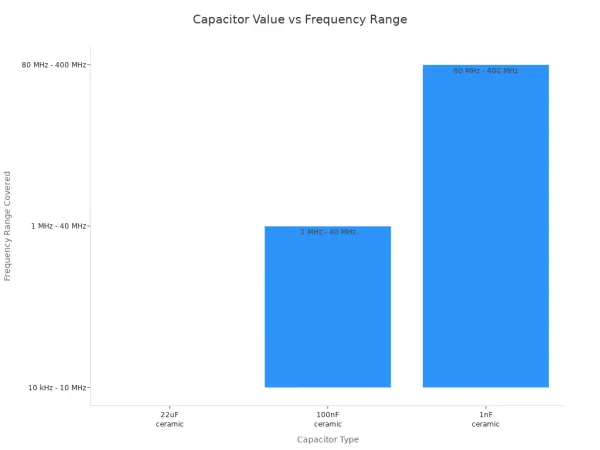
You see the 22uf capacitor used in power supply circuits, voltage regulator modules, and many other electronic applications. It helps you filter out low-frequency noise and stabilize your circuit. For high-speed digital circuits, always place smaller capacitors close to the IC pins for the best noise filtering. The 22uf capacitor gives you strong performance for bulk decoupling, but you need a mix of capacitors to cover all frequencies.
Note: Good PCB layout and proper placement of your 22uf capacitor and other capacitors are key to getting the best results in your circuits.
Timing and DIY Uses
22uF in Timing Circuits
You often see a 22uf capacitor in timing circuits because it helps set how long a circuit stays active. In a simple RC timing circuit, the capacitor charges through a resistor. The time it takes to charge or discharge controls the delay. For example, you can use a 22uf capacitor with a 555 timer IC to create a pulse that lasts from a fraction of a second to several seconds. This setup is perfect for making light blinkers, buzzers, or delay switches.
Here is a table showing how different types of capacitors compare in timing circuits:
| Capacitor Type | Typical Capacitance Range | Stability & Accuracy Characteristics | Application Notes |
|---|---|---|---|
| Mica/PTFE | 1pF to 15nF | Excellent stability, very low loss, wide temperature range | Used in precision timing circuits and RF applications |
| Ceramic Class 1 (C0G) | 0.1pF to 0.1uF | Stable over temperature, voltage, frequency; good linearity | Used in precision timing and signal applications |
| Class 2 Ceramics (X5R, X7R) | 10pF to 100uF | Capacitance shifts with time, voltage, temperature; lower accuracy | Used in low-precision filtering and bulk decoupling |
| Aluminum Electrolytic | 0.1uF to 2.2F | High ESR, parameter shifts with temperature and time; lower stability | Used in bulk filtering and less precision-critical applications |
| Polymer Electrolytic | 22nF to 4.7mF | Improved ESR and longevity; less stable than ceramic Class 1 or mica | Used in bulk filtering and general signal applications |
| Other Film Types | 470pF to 22uF | Variable performance; not common for precision timing | Used in variable applications, not often for precision timing |
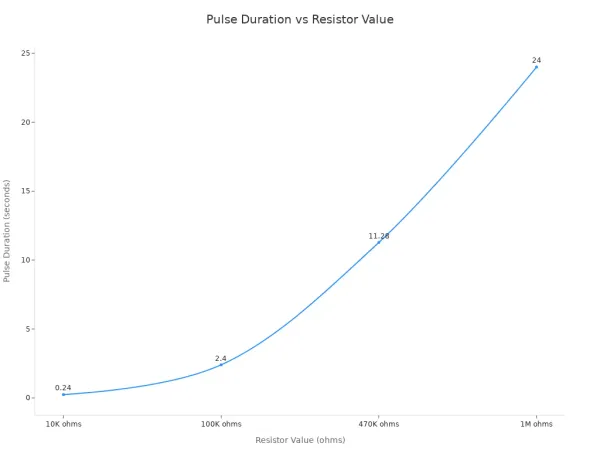
You trade some accuracy for higher capacitance when you use a 22uf capacitor. Smaller values like 0.1uF give better timing precision, but a 22uf capacitor lets you create longer delays. In a 555 timer circuit, pairing a 22uf capacitor with a resistor between 10K and 1M ohms gives you pulse durations from about 0.24 seconds to 24 seconds. This makes the 22uf capacitor a flexible choice for many timing applications.
You also find the 22uf capacitor in oscillator circuits. Here, the capacitor charges and discharges, causing transistors to switch on and off. This action creates a repeating signal, which you can use for sound effects or flashing lights. The size of the 22uf capacitor sets how fast the circuit oscillates. A larger capacitor means a slower frequency, so you can control the timing and pitch in your projects.
Tip: Use a 22uf capacitor in RC timing circuits when you want longer delays or slower oscillations. For more precise timing, choose smaller, more stable capacitors.
DIY and Integrated Devices
You use the 22uf capacitor in many DIY electronics projects. It works as a filter, a timing element, and a stabilizer. In Arduino and Raspberry Pi projects, a 22uf capacitor helps smooth power and condition signals. You see it in power supply circuits, where it stores energy and reduces voltage drops. In measuring instruments, the 22uf capacitor cuts down on noise, giving you more accurate readings.
Here are some popular DIY applications for the 22uf capacitor:
| Application Area | Role of 22uF Capacitor |
|---|---|
| Power Supply Circuits | Energy storage and smoothing voltage fluctuations |
| Arduino and Raspberry Pi | Stable signal conditioning |
| High-Voltage Applications | Reliable high-voltage component |
| DIY Electronics | Noise filtering and performance enhancement |
| 3D Printers and CNC Machines | Electrical stability in complex systems |
| Measuring Instruments | Reducing power supply noise for precise readings |
You benefit from the 22uf capacitor’s small size. Advances in surface-mount technology let you fit these capacitors into tiny spaces. This helps you build compact and integrated electronic devices. The 22uf capacitor supports miniaturization without losing performance. You can rely on it for stable operation in space-limited designs.
The 22uf capacitor also plays many roles in modern DIY kits. You use it for audio coupling, power smoothing, timing, filtering, and even LED driver circuits. Its non-polar design in some types makes it easy to install and reduces mistakes. You get a reliable, cost-effective part that fits many applications in circuit design.
Note: The 22uf capacitor is a true multitasker in your DIY toolbox. You can use it in almost any electronic project, from simple timers to advanced integrated devices.
You see the 22uf capacitor as a true Swiss Army knife for electronics. This capacitor fits many circuits, from power supply filtering to audio and timing applications. You benefit from its practical size, reliability, and ability to reduce noise. Designers often choose the 22uf capacitor for its balanced performance in a wide range of applications. Many professionals and beginners keep 22uf capacitors ready for quick fixes or upgrades.
Share your favorite uses or tips for the 22uf capacitor in your own circuits below!
FAQ
What makes a 22uf capacitor so popular in electronics?
You often choose a 22uf capacitor because it fits many needs. This capacitor works well in power supply filtering, audio coupling, and timing circuits. You find it in both small and large projects. Its size and performance make it a favorite for many circuits.
Can you use a 22uf capacitor for both AC and DC circuits?
You can use a 22uf capacitor in both AC and DC circuits. For AC, pick a non-polarized type. For DC, you often use electrolytic or tantalum capacitors. Always check the voltage rating before adding the capacitor to your circuit.
How do you select the right 22uf capacitor for your circuit?
You should check the voltage rating, type, and size. For power supply circuits, use a 22uf electrolytic capacitor. For audio or timing, ceramic or tantalum types work well. Always pick a capacitor with a voltage rating higher than your circuit voltage.
Tip: Always match the capacitor type to your circuit needs for best results.
What happens if you use more than one 22uf capacitor in parallel?
You increase total capacitance when you connect 22uf capacitors in parallel. This setup helps your circuit handle ripple and noise better. Many circuits use several 22uf capacitors together for improved stability and performance.
| Number of 22uf Capacitors | Total Capacitance |
|---|---|
| 1 | 22uf |
| 2 | 44uf |
| 3 | 66uf |