Mastering Power Factor for Maximum Efficiency
Your business is likely overpaying for electric power. A low power factor is a common cause of higher energy costs, impactin

Your business is likely overpaying for electric power. A low power factor is a common cause of higher energy costs, impacting your power budget. This power inefficiency can increase your bill by 5-15%. The importance of power factor is clear when you see the potential for savings.
Imagine paying for a full tank of gas but only being able to use three-quarters. That's the impact a poor power factor has on your usable power.
Power factor measures how effectively your equipment converts grid power into useful power. Understanding the power triangle and power factor is key to achieving better energy efficiency. Improving power factor through correction enhances system performance and unlocks significant cost savings by optimizing your power usage.
Key Takeaways
- A low power factor means your business wastes electricity and pays more on utility bills.
- Inductive loads like motors cause a low power factor by using power that does no useful work.
- Check your utility bill or use special tools to find your current power factor.
- Install capacitor banks or other devices to fix a low power factor and save money.
- Improving your power factor stops penalties, increases system capacity, and makes equipment last longer.
Understanding the Power Triangle and Power Factor

To cut costs, you first need to understand the relationship between the different types of power your facility consumes. The power triangle and power factor are the core concepts that explain your electrical efficiency. The importance of power factor lies in this direct relationship to your bill.
Visualizing the Power Triangle
You can think of the power triangle using a simple analogy. Imagine you are pushing a heavy box across the floor:
- Pushing Horizontally: All your effort moves the box forward. This is like a perfect power factor (1.0), where all electrical power becomes useful work (active power).
- Pushing Down at an Angle: Part of your effort moves the box forward (useful work, or active power), but part of it just presses the box into the floor (wasted effort, or reactive power). The total effort you feel is the combination of both. This is how most electrical systems work.
- Pushing Straight Down: You use a lot of energy, but the box doesn't move. All your effort is wasted. This is like a power factor of zero, where no useful work is done.
Real, Reactive, and Apparent Power Explained
Your electrical system deals with three types of power. The relationship between them determines your power factor. Understanding this relationship is key to grasping the power triangle and power factor.
| Power Type | Definition | Unit |
|---|---|---|
| Active Power | The "useful" power that performs actual work, like running a motor or lighting a bulb. | Kilowatts (kW) |
| Reactive Power | The "wasted" power required by inductive equipment (like motors) to create magnetic fields. It does no useful work. | Kilovolt-Amperes Reactive (kVAR) |
| Apparent Power | The total power your utility must supply to you. It is the vector sum of Active Power and Reactive Power. | Kilovolt-Amperes (kVA) |
The impact of reactive power is that it increases the total Apparent Power your utility has to deliver, even though it performs no work. A leading power factor is rare in industrial settings; a lagging power factor is the common issue.
Calculating Power Factor: The kW to kVA Ratio
You can calculate your power factor with a simple formula that shows the relationship between active power and apparent power.
Power Factor (PF) = Active Power (kW) / Apparent Power (kVA)
For example, if your facility uses 80 kW of active power but draws 100 kVA of apparent power, your calculation is 80 kW / 100 kVA = 0.80. Your power factor is 0.80, or 80%.
The Financial Impact of a Low Power Factor
Utility companies penalize you for a low power factor because it forces them to generate more energy than you actually use. This inefficiency strains the grid.
A low power factor can increase your commercial electricity bill by 10-20% due to utility penalties.
Most utilities in the United States begin to apply penalty charges when a facility's power factor drops below 0.95. The financial impact grows as the power factor worsens. This is the primary financial impact of reactive power.
How Inductive Loads Reduce Efficiency
The main cause of a low, lagging power factor is inductive loads. These are common in most facilities and include:
- Electric motors
- Transformers
- Fluorescent lighting ballasts
These devices use magnetic fields to operate. This process causes the electrical current to fall behind the voltage, creating a delay or "phase shift." This poor relationship reduces your operational efficiency and is what defines a low power factor in electrical systems. The power triangle and power factor model helps visualize this inefficiency in electrical systems. A leading power factor, caused by capacitive loads, is the opposite phenomenon.
Identifying and Measuring Your Power Factor

You must first find your current power factor to start saving money. This measurement shows you how efficiently your facility uses power. You can find this information in a few key places. The first step to improving power factor is knowing where you stand.
How to Read Your Utility Bill for Clues
Your monthly utility bill is the easiest place to check your power factor. Commercial and industrial electricity invoices often show charges for kW, kWh, kVA, and kVArh. Look for a section labeled 'Load/Power Factor Terms and Charges'. Here, you will see your recorded power factor and any penalty fees. Utilities apply these charges when your power factor drops below a set threshold, often 0.95.
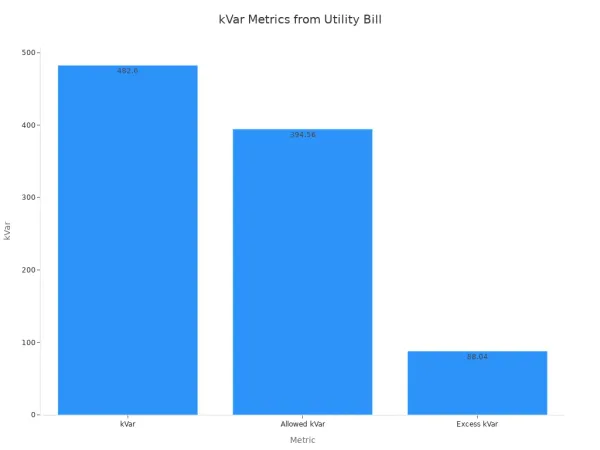
This data shows the financial impact of low power factor. For example, a bill might show these details:
| Metric | Value |
|---|---|
| kVar | 482.60 |
| Allowed kVar | 394.56 |
| Excess kVar | 88.04 |
| Power Factor | 89.83% |
| kVar Penalty | $228.47 |
The penalty directly relates to the excess reactive power your system draws.
Using Power Quality Analyzers
For a deeper look, you can use a power quality analyzer. This is a more advanced step. An electrician or engineer usually performs this analysis. The device connects to your electrical systems to get real-time data. It measures voltage, current, and the phase relationship between them. This information gives a precise power factor reading and helps diagnose complex issues with your power. A professional analysis service provides a detailed report on your power quality. This data is crucial for designing an effective correction strategy.
Common Culprits of a Low Power Factor
Inductive loads are the main cause of a poor power factor. These devices need reactive power to create magnetic fields. This process reduces the efficiency of your electrical systems. Common culprits include:
- Induction motors (especially when lightly loaded)
- Transformers
- Welding equipment
- Industrial heating furnaces
- Fluorescent and mercury vapor lighting
An oversized or lightly loaded motor is a major problem. It draws a consistent amount of reactive power regardless of its workload. However, its active power usage drops with a lighter load. This imbalance worsens your power factor. Understanding the power triangle and power factor helps you see how this wasted energy affects your total power consumption.
Implementing Power Factor Correction
After identifying a low power factor, your next step is implementing a solution. This active process is called power factor correction. It involves installing equipment that counteracts the effects of inductive loads. Proper power factor correction will boost your system's efficiency and deliver significant financial returns.
The Goal of Power Factor Correction
Your primary goal with power factor correction is to raise your power factor as close to unity (1.0) as possible. While no single national standard exists in the U.S., utilities often set their own rules. Many apply penalties for a power factor below a certain level, which can range from 0.80 to 0.95. Therefore, most businesses aim for a power factor of 0.95 or higher. Reaching this target maximizes your electrical efficiency and stops you from paying for power you cannot use. This improvement is key to optimizing your energy consumption.
Choosing the Right Correction Method
You have several techniques for improving power factor. The most common solution involves installing capacitor banks. These devices act as reactive power generators, producing the leading reactive power that offsets the lagging reactive power from inductive loads. Choosing the right method depends on your facility's specific needs.
The primary techniques for improving power factor include:
- Capacitor Banks: The most common and cost-effective solution for most facilities. They are ideal for offsetting the reactive power created by motors and transformers.
- Synchronous Condensers: These are large, rotating machines used in major industrial or utility-scale applications. They can be finely controlled to either generate or absorb reactive power, helping to stabilize grid voltage.
- Active Power Filters (APF): These are modern electronic devices. They provide a more dynamic solution for power factor correction by injecting a compensating current to correct the power factor and filter out harmonic distortions. For advanced electronic solutions like these, you might work with specialized partners. For example, Nova Technology Company (HK) Limited is a HiSilicon-designated solutions partner that can help implement such sophisticated systems.
The following table compares these key correction technologies:
| Characteristic | Capacitor Bank | Synchronous Condenser | Active Power Filter |
|---|---|---|---|
| Primary Function | Supplies capacitive reactive power | Provides/absorbs reactive power | Corrects power factor and harmonics |
| Control | Switched in steps | Fine control via field current | Dynamic electronic control |
| Harmonic Impact | Can be affected by harmonics | Unaffected by harmonics | Actively cancels harmonics |
| Cost | Lower initial cost | Higher initial cost | Higher cost due to electronics |
| Maintenance | Very low maintenance | Requires regular maintenance | Maintenance for electronic parts |
You must also decide where to install your correction equipment. The choice depends on your load characteristics.
The selection of a power factor correction method depends on your electrical load's working cycle, power, and existing power factor.
- Distributed Correction: You can connect individual capacitors directly to large motors that run for long periods. This is often the most effective approach for heavy, constant loads.
- Group Correction: If you have many small motors with similar operating cycles, you can use a single capacitor bank to provide correction for the entire group.
- Centralized Correction: You can install a large, automatic capacitor bank at the main service entrance. This system adjusts the amount of correction as your facility's total load changes throughout the day.
Key Benefits of a High Power Factor
Improving power factor delivers more than just cost savings on your utility bill. A high power factor creates a more robust, efficient, and reliable electrical system. The main benefits include eliminating penalties, increasing your system's capacity, and extending the life of your equipment. This improvement in efficiency has a positive long-term impact.
Eliminating Utility Penalties
The most immediate benefit of power factor correction is the elimination of utility penalty fees. Utilities bill for the extra strain a low power factor puts on the grid, often by charging for kVA demand or applying a penalty factor.
A packaging company saved almost $7,000 annually after implementing power factor correction. The investment paid for itself in just 15 months by eliminating reactive power charges and reducing demand charges.
For facilities with a power factor below 0.85, the investment in capacitor banks often pays for itself within 12 to 18 months. The payback period for a power factor correction project can range from one to four years, depending on your facility's size and energy use. These savings make improving power factor a smart financial decision.
Increasing System Capacity
Improving your power factor reduces the total current flowing through your electrical systems. Your transformers, switchgear, and cables are rated in kVA (apparent power). By reducing reactive power, you lower the kVA demand, which frees up capacity.
This released capacity allows you to:
- Add more loads and equipment to your existing circuits without needing expensive upgrades.
- Reduce the thermal stress on transformers and cables, preventing overloads.
- Improve voltage stability across your facility, leading to better equipment performance.
Essentially, power factor correction lets you get more useful power from your current infrastructure. This boost in available power is a major advantage for growing facilities.
Enhancing Equipment Lifespan
A low power factor forces more current through your electrical system to deliver the same amount of useful power. This excess current generates heat. Heat is a primary enemy of electrical equipment, causing insulation to break down and components to fail prematurely.
By implementing power factor correction, you lower the overall current. This reduction leads to:
- Less energy wasted as heat.
- Lower operating temperatures for motors, transformers, and wiring.
- Reduced wear and tear on all electrical components.
A cooler, more efficient system is a more reliable one. This enhanced performance extends equipment lifespan and lowers long-term maintenance and replacement costs. The overall efficiency of your electrical systems is greatly enhanced.
Your power factor is a critical measure of your power and energy efficiency. A low power factor wastes money and strains your power system's power delivery. Proven power factor correction methods offer strong returns through energy savings. This improvement boosts your power capacity, enhances equipment performance, and improves overall power efficiency.
Take Action Now:
- Review your utility bill for power factor charges.
- Audit large motors to find opportunities for power improvement.
- Consult an engineer to analyze your power needs and implement the right power factor correction strategy to unlock more usable power.
FAQ
What is a good power factor?
You should aim for a power factor of 0.95 or higher. Most utilities do not charge penalties for power at this level. A higher number means your system uses power more efficiently. This efficient power usage saves you money and improves your system's overall power delivery.
Can a low power factor damage my equipment?
Yes, it can. A low power factor increases the current your system needs to deliver the same amount of useful power. This extra current creates excess heat. The heat can shorten the lifespan of your motors, transformers, and other equipment that uses power.
Will power factor correction lower my total power use?
No, it does not reduce your active power (kW) consumption. Instead, it reduces your apparent power (kVA) demand. This change eliminates penalties and frees up capacity in your electrical system. Your equipment will still use the same amount of active power to do its job.
How often should I check my power factor?
You should review your utility bill every month for power factor charges. If you make significant changes to your equipment or facility layout, you should perform a new power analysis. This check ensures your power correction strategy remains effective and your power usage is optimized.