Mastering Resistor Reading for Beginners
Wondering how to read resistors? Start by looking for the colored bands on your resistor. Read from the end closest to a ban

Wondering how to read resistors? Start by looking for the colored bands on your resistor. Read from the end closest to a band. The color code system helps you quickly spot resistance values, making your projects easier and reducing mistakes. Through-hole resistors use bands, while SMD resistors use numbers. With practice, you’ll get it!
Key Takeaways
- Start reading resistors from the end with tightly packed color bands. The last band indicates tolerance and should be on your right.
- Use a resistor color code chart to decode the colors. This chart helps you match colors to their corresponding numbers for accurate readings.
- Practice reading different types of resistors, including SMD and through-hole. Familiarity will boost your confidence and reduce mistakes.
How to Read Resistors
Learning how to read resistors is easier than you might think. You just need to know where to start and what each color band means. Let’s break it down step by step so you can read resistors with confidence.
Reading Direction
Before you start reading resistor color codes, you need to figure out which end to begin with. This step is super important because reading from the wrong side will give you the wrong value.
- Look for the Band Spacing: The color bands are usually grouped together on one side of the resistor. The last band, which shows tolerance, sits a little farther apart from the others. Hold the resistor so the tightly packed bands are on your left and the single band with a bigger gap is on your right.
- Spot the Tolerance Band: The tolerance band is often gold or silver. This band never comes first. Always keep it on the right side when you read resistors.
- Check the First Band’s Position: The first color band sits closest to the edge of the resistor. That’s your starting point.
Tip: If you see a metallic band (gold or silver), that’s your clue to start reading from the opposite end.
Many beginners make mistakes here. You might misread the direction if you don’t pay attention to the spacing or the metallic band. Poor lighting can also make it hard to tell colors apart. Try to read resistors in good light and double-check the band positions.
Band Identification
Now that you know where to start, let’s talk about what each band means. Most resistors you’ll see are four band resistors, but sometimes you’ll find five-band types too.
Here’s a simple way to read resistors:
- Count the Bands: Check if your resistor has four or five color bands.
- Read the First Bands: For four band resistors, the first two bands give you the main numbers (the significant digits). For five-band resistors, the first three bands are the significant digits.
- Find the Multiplier: The next band (third for four band resistors, fourth for five-band) tells you how many zeros to add or what to multiply by.
- Spot the Tolerance: The last band, usually gold or silver, shows how much the actual value might vary from the labeled value.
Here’s a quick table to help you remember:
| Band Position | Four Band Resistors | Five Band Resistors |
|---|---|---|
| 1st Band | 1st digit | 1st digit |
| 2nd Band | 2nd digit | 2nd digit |
| 3rd Band | Multiplier | 3rd digit |
| 4th Band | Tolerance | Multiplier |
| 5th Band | — | Tolerance |
Note: Always use a resistor color code chart to match each color to its number. This chart is your best friend when you’re learning how to read resistors.
Common Mistakes to Avoid
- Reading from the wrong end, especially if you miss the tolerance band.
- Confusing similar colors, like red and orange, especially in dim light.
- Misidentifying the tolerance band, which can mess up your calculations and cause your circuit to fail.
- Not using a resistor color code chart, which can lead to wrong values.
- If you have color blindness, ask for help or use a multimeter for double-checking.
Tip: If you’re ever unsure, double-check with a resistor color code chart or use a multimeter to verify the value.
Once you get the hang of how to read resistors, you’ll find it much easier to build and troubleshoot circuits. Practice with different resistors and keep your resistor color code chart handy. You’ll be reading resistor color codes like a pro in no time!
Resistor Color Code

Understanding the resistor color code makes reading resistors much easier. This system uses colored bands to show you the value and tolerance of a resistor. The international standard IEC 60062 defines this system, so you can use it anywhere in the world. You just need to match the colors to numbers and symbols.
Color-to-Number Chart
You will see different colors on resistors, and each color stands for a number or a value. Here’s a handy table to help you decode the resistor color code:
| Color | 1st | 2nd | 3rd | Multiplier | Tolerance |
|---|---|---|---|---|---|
| Black | 0 | x100 | |||
| Brown | 1 | 1 | 1 | x101 | ±1% |
| Red | 2 | 2 | 2 | x102 | ±2% |
| Orange | 3 | 3 | 3 | x103 | ±0.05% |
| Yellow | 4 | 4 | 4 | x104 | ±0.02% |
| Green | 5 | 5 | 5 | x105 | ±0.5% |
| Blue | 6 | 6 | 6 | x106 | ±0.25% |
| Violet | 7 | 7 | 7 | x107 | ±0.1% |
| Grey | 8 | 8 | 8 | x108 | ±0.01% |
| White | 9 | 9 | 9 | x109 | |
| Gold | x10-1 | ±5% | |||
| Silver | x10-2 | ±10% |
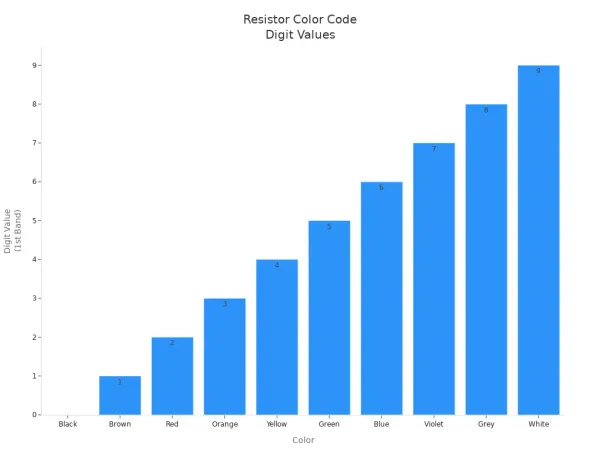
Gold and silver bands are special. Gold means a tolerance of ±5%, and silver means ±10%. These bands help you know how much the actual resistance might change from the labeled value.
Tip: If you want to check your answer fast, you can use an online resistor color code calculator. These tools work for 4-band, 5-band, and even 6-band resistors. They save you time and help you avoid mistakes.
4-Band, 5-Band, 6-Band Types
Resistors come in different types, and each type uses the resistor color coding system a little differently.
| Resistor Type | Number of Significant Digits | Multiplier | Tolerance | Temperature Coefficient |
|---|---|---|---|---|
| 4-band | 2 | Yes | Yes | No |
| 5-band | 3 | Yes | Yes | No |
| 6-band | 3 | Yes | Yes | Yes |
- A 4-band resistor has two digits, a multiplier, and a tolerance band.
- A 5-band resistor adds a third digit for more accuracy.
- A 6-band resistor includes a temperature coefficient band, which tells you how much the resistance changes with temperature.
You will see 5-band and 6-band resistors more often in high-precision electronics. These types give you tighter tolerances and extra information, which is important for advanced projects.
Read SMD Resistors

Reading SMD resistors feels different from reading through-hole types. You won’t see color bands here. Instead, you’ll find numbers or letters printed right on the resistor. These codes tell you the resistance value.
SMD Code Formats
You’ll see a few common formats when you look at SMD resistor codes:
- Three-digit codes: The first two digits show the value, and the last digit is the multiplier. For example, “273” means 27 × 1,000, which gives you 27 kΩ.
- Four-digit codes: The first three digits are the value, and the last digit is the multiplier. “7992” means 799 × 100, so you get 79.9 kΩ.
- Codes with “R”: The letter “R” stands for a decimal point. “5R1” means 5.1 Ω.
- SMD size codes: These codes, like “01005,” tell you the physical size of the resistor. They help you pick the right part for your circuit.
Here’s a quick table to compare SMD codes with through-hole resistor color codes:
| Feature | SMD Resistor Codes | Through-Hole Color Codes |
|---|---|---|
| Coding System | Numbers and letters | Color bands |
| Example | 103 = 10 × 1,000 = 10 kΩ | Bands show resistance |
| Low Resistance | “R” for decimal (8R2) | Not used |
| Precision | EIA-96 for 1% tolerance | Standard color coding |
Tip: If you’re stuck, use an online SMD code calculator. It saves time and helps you avoid mistakes.
Troubleshooting
Sometimes, SMD resistor markings fade or get hard to read. Here’s what you can do:
- Use a magnifying glass or your phone’s camera to zoom in on the code.
- Figure out if it’s a three-digit, four-digit, or EIA-96 code.
- Enter the code into an online tool or check a reference chart.
- Double-check the result with your expected value.
If you still can’t read the code, grab a digital multimeter. Make sure the circuit is off. Remove the resistor from the board if you can. Touch the probes to each end and read the value. If the reading is way off or shows “open,” the resistor might be faulty.
Zero-ohm resistors look like regular SMD resistors but act as jumpers. They usually have a single “0” or “000” marking. You’ll find them in places where a wire would go.
Handling SMD resistors can be tricky. They’re tiny, so you need steady hands and sometimes special tools. Soldering can cause problems like solder bridging. Practice helps you get better at working with these small parts.
You can read any resistor with confidence if you follow these steps:
- Learn the color codes and check each band’s meaning.
- Practice reading resistor values often to boost your skills.
- Use a color code chart or online tools when measuring resistance.
- Try both physical resistors and apps for better results.
Mistakes happen, but every try helps you get better!
FAQ
How do you figure out the resistance value of a resistor?
You look at the color bands or printed code. Each color or number stands for a digit. Add them up to get the resistance value.
Why does resistor tolerance matter when picking a resistor?
Resistor tolerance tells you how much the resistance value can change. If you need accuracy, pick a resistor with a low resistor tolerance.
Can you use a multimeter to check the resistance value of any resistor?
Yes! You can use a multimeter to measure the resistance value. This works for any resistor, even if the bands or codes are hard to read.
Tip: Always double-check the resistance value with a multimeter if you feel unsure about the resistor markings.
| Resistor Type | How to Read Resistance Value |
|---|---|
| Through-hole | Color bands |
| SMD | Printed code |
| Any type | Multimeter |