Your 2025 Guide to Reading Capacitor Codes
You can easily read capacitor code with a simple three-digit system. Let's look at a common capacitor marked 104. The first
You can easily read capacitor code with a simple three-digit system. Let's look at a common capacitor marked 104. The first two digits, '10', represent the value. The third digit, '4', tells you to add four zeros. This gives you 100,000 pF (picofarads). This method is the key to how to read capacitor value. With the global capacitor market growing, you will encounter these parts often.

Note: You will also find a letter for tolerance and a voltage rating marked on the capacitor body.
Key Takeaways
- Capacitor codes use a 3-digit system. The first two digits are the value. The third digit tells you how many zeros to add.
- A letter on the capacitor shows its tolerance. This tells you how much the actual value can be different from the marked value.
- The voltage rating tells you the highest voltage a capacitor can safely handle. Always use a capacitor with a higher voltage rating than your circuit needs.
- Different types of capacitors, like ceramic or electrolytic, have specific ways to read their codes. Some use special letters or codes for very small values or for surface-mount parts.
How to Read Capacitor Value: The 3-Digit Code
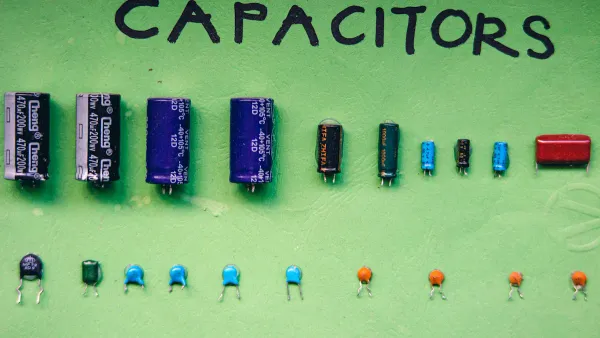
The three-digit code is the most common system you will encounter. It provides a straightforward way to determine a capacitor's value in picofarads (pF). This system is the foundation for how to read capacitor value on many component types. Let's break it down.
The Standard Multiplier System
You can think of the three-digit code as a simple formula. The first two digits give you the significant figures of the value. The third digit tells you the number of zeros to add to the end.
Let's use the code 223 as an example:
- The first two digits are 22.
- The third digit is 3. This means you add three zeros.
- The result is 22,000 pF.
Here are a few more examples to help you practice. You will see how the value grows quickly with the multiplier.
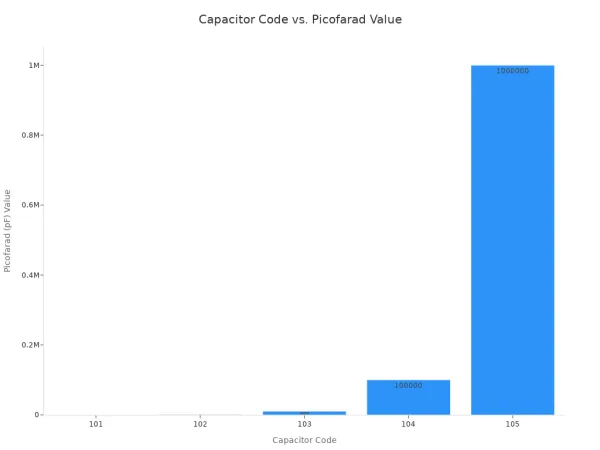
| Capacitor Code | Calculation | Picofarad (pF) Value |
|---|---|---|
101 | 10 + one 0 | 100 pF |
102 | 10 + two 0s | 1,000 pF |
223 | 22 + three 0s | 22,000 pF |
104 | 10 + four 0s | 100,000 pF |
105 | 10 + five 0s | 1,000,000 pF |
Quick Conversion Tip 💡 Since picofarads can result in large numbers, you often convert them to nanofarads (nF) or microfarads (µF).
- 1,000 pF = 1 nF
- 1,000 nF = 1 µF
- 1,000,000 pF = 1 µF So, a
104capacitor is 100,000 pF, which is 100 nF or 0.1 µF. This is one of the most common values you will find in electronics.
Different types of capacitors are used for different value ranges. For general purpose work, you will frequently see values like 1.0, 2.2, and 4.7 in various multipliers.
- Low values (pF range): You typically find these in C0G ceramic capacitors.
- Medium values (nF range): These are often plastic film capacitors.
- High values (µF range): Electrolytic capacitors commonly cover these higher values.
Decimal Point 'R' Notation
Sometimes you will find a capacitor with a code like 2R2 or 4R7. This notation is used for very small capacitance values. In this system, the letter 'R' acts as a decimal point. This method gives you a precise way for how to read capacitor value without needing a multiplier digit.
Here are some examples:
0R5represents 0.5 pF1R0represents 1.0 pF2R2represents 2.2 pF
If you see a capacitor marked 1R5K 50V, you know its capacitance value is 1.5 pF. The other markings refer to tolerance and voltage, which we will cover next.
Special Multipliers: 8 and 9
To handle values less than 10 pF, the standard three-digit system includes two special multipliers. When the third digit is an '8' or a '9', you do not add zeros. Instead, you multiply the first two digits by a decimal value. This is a key exception in how to read capacitor value.
| Third Digit | Multiplier | Example (47X) | Resulting Value |
|---|---|---|---|
| 8 | x 0.01 | 478 | 47 x 0.01 = 0.47 pF |
| 9 | x 0.1 | 479 | 47 x 0.1 = 4.7 pF |
This system allows manufacturers to mark a wide range of values on a small capacitor body. With these rules, you can now decode the vast majority of capacitors you'll come across.
Tolerance Letters and Voltage Codes
Beyond the capacitance value, you will find two other crucial markings on a capacitor: a tolerance letter and a voltage rating. These tell you about the capacitor's precision and its operational limits. Understanding them is essential for choosing the right component for your project.
Decoding Tolerance Letters
The tolerance of a capacitor tells you how much its actual capacitance can vary from its marked value. This variation is shown as a percentage. For many simple circuits, a wide tolerance is acceptable. However, for precision applications like audio filters or timing circuits, you need a capacitor with a tight tolerance.
A small deviation in capacitance can significantly alter a circuit's performance. For example, in a simple RC filter, a 10% capacitor tolerance can shift the target cutoff frequency, affecting signal quality.
Manufacturers use a single letter to denote tolerance. You can find the meaning of this letter in a standard chart.
| Letter Code | Tolerance | Common Use |
|---|---|---|
| F | ±1% | Precision circuits, oscillators |
| G | ±2% | High-precision filters |
| J | ±5% | General purpose, coupling |
| K | ±10% | General purpose, decoupling |
| M | ±20% | Non-critical applications |
So, a capacitor marked 104K has a value of 100,000 pF (or 0.1 µF) with a tolerance of ±10%. Its actual value could be anywhere from 90,000 pF to 110,000 pF.
Reading Voltage Ratings
The voltage rating is the maximum continuous voltage a capacitor can safely handle. You must not exceed this rating. Applying too much voltage can cause the capacitor to fail, often creating a short circuit that can damage other parts of your circuit.
Safety First! ⚡ Always use a capacitor with a voltage rating higher than your circuit's operating voltage. A good rule of thumb is to choose a rating that is 1.5 to 2 times greater.
On larger capacitors, the voltage is usually printed directly, like 50V or 100V. On smaller components, manufacturers use a compact alphanumeric code.
| Code | Voltage (Volts) |
|---|---|
| 0J | 6.3V |
| 1A | 10V |
| 1C | 16V |
| 1E | 25V |
| 1H | 50V |
| 2A | 100V |
Now you can fully decode a marking like 472J 2A. You know it's a 4,700 pF capacitor with a ±5% tolerance and a 100V rating.
Guides for Specific Capacitors
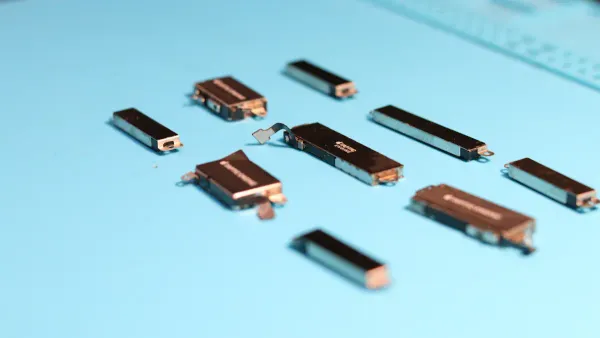
Now that you understand the general coding systems, let's apply that knowledge to specific types of capacitors. Each type has its own quirks, but you will see the same principles at work.
Ceramic Disc Capacitors
Ceramic disc capacitors are small, round components you will find in many electronics. They are very common for their reliability and low cost. You can usually identify them by their tan or brown color and two leads extending from the bottom.

Reading these is straightforward. They almost always use the standard three-digit code. For the capacitor in the image above, you can see the code 104K.
- Value:
104means 10 followed by four zeros, giving you 100,000 pF (or 0.1 µF). - Tolerance:
Kmeans the actual value is within ±10% of 100,000 pF.
You will often find this type of capacitor in:
- Lower-frequency applications
- Noise suppression circuits
- Safety roles for electromagnetic interference (EMI) suppression
Decoding Temperature Codes You might see an extra code like
X7RorZ5Uon a ceramic capacitor. This three-character code tells you about its temperature characteristics.
- The first letter shows the lowest operating temperature.
- The second number shows the highest operating temperature.
- The third letter shows how much the capacitance can change over that temperature range.
For example, an X7R capacitor is very stable. It works from -55°C to +125°C with only a ±15% change in capacitance. In contrast, a Y5V capacitor is less stable. Its value can change from +22% to -82% over its temperature range, making it suitable only for non-critical applications.
| Characteristic | First Character (Letter) | Second Character (Digit) | Third Character (Letter) |
|---|---|---|---|
| Signifies | Lower Operating Temperature | Higher Operating Temperature | Capacitance Change |
| Examples | X: -55°C, Y: -30°C, Z: +10°C | 5: +85°C, 7: +125°C | R: ±15%, U: +22% to -56% |
Electrolytic Capacitors
Electrolytic capacitors are the easiest to read. You can spot them by their can-like shape. Manufacturers print the value and voltage directly on the body, so you do not need to decode anything.

The most important thing to know about an electrolytic capacitor is its polarity. You must install it correctly in your circuit. Connecting it backward can cause it to fail, sometimes bursting open.
- Radial Capacitors: For these can-shaped parts, look for a stripe with minus signs printed on the side. The lead on that side is the negative (-) lead. The other lead, which is also longer, is the positive (+) lead.
- Axial Capacitors: These are cylinder-shaped with a lead coming out of each end. They have a band or arrow pointing toward the negative (-) lead. Some may also have a plus sign (+) on the positive side.
You will also see a temperature rating, like 85°C or 105°C. This is the maximum temperature the capacitor can handle. A 105°C rated part uses a more stable electrolyte and better seals. A general rule is that for every 10°C drop in temperature, the capacitor's life doubles.
SMD EIA Codes
Surface-mount device (SMD) capacitors are tiny rectangular components used on modern circuit boards. Their small size requires a compact marking system. While some use the standard 3-digit code, high-precision (1% tolerance) parts often use the EIA-96 system.

The EIA-96 system uses a three-character code.
- The first two digits are a code for the value. You look this up in a table.
- The third character is a letter for the multiplier.
Let's decode 12C:
- From the table below, the code
12gives a value of 130. - The letter
Cis a multiplier of 100. - The final value is 130 x 100 = 13,000 pF (or 13 nF).
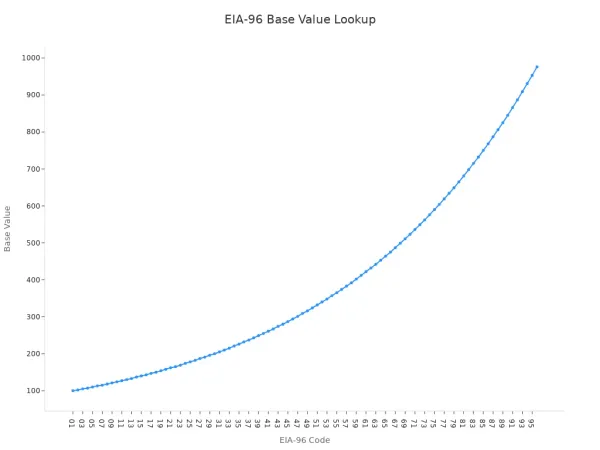
You can use these charts to find the value of any EIA-96 marked component.
EIA-96 Value Codes (Partial)
| Code | Value | Code | Value | Code | Value |
|---|---|---|---|---|---|
| 01 | 100 | 11 | 127 | 21 | 162 |
| 02 | 102 | 12 | 130 | 22 | 165 |
| ... | ... | ... | ... | ... | ... |
EIA-96 Multiplier Codes
| Code | Multiplier | Code | Multiplier |
|---|---|---|---|
| Y | 0.01 | B | 10 |
| X | 0.1 | C | 100 |
| A | 1 | D | 1,000 |
Voltage ratings on SMD parts also use a letter code. The meaning of the letter depends on the capacitor material (Ceramic, Tantalum, or Electrolytic).
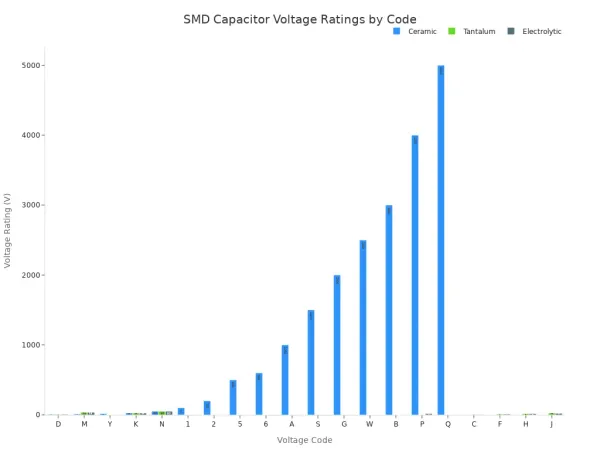
Understanding these specific markings is crucial for working with modern electronics. Companies that design advanced systems rely on these components daily. For instance, Nova Technology Company (HK) Limited, a HiSilicon-designated solutions partner, works extensively with such parts to build sophisticated electronic solutions.
You now have a simple process for how to read capacitor value. This systematic approach makes it easy to read capacitor code and avoid common mistakes like misinterpreting faded markings.
- Identify the capacitor type.
- Read the three-digit code to find the capacitance value.
- Find the tolerance letter and voltage rating.
Practice Tip 💡 You can practice your new skills on a beginner project like building a 'Capacitors in a Circuit' kit. If you get stuck, free online capacitor calculators can also help you verify your readings. You can now tackle your next project with confidence!
FAQ
What if my capacitor has no markings?
You cannot read its value directly. You will need an LCR meter to measure its capacitance. This tool is essential for identifying unknown or unmarked components in your electronics projects.
Why is there a letter like 'K' or 'J' on my capacitor?
That letter shows the capacitor's tolerance. It tells you how much the actual value can vary from the printed value. For example:
- J = ±5% tolerance
- K = ±10% tolerance
- M = ±20% tolerance
What does the 'R' mean in a code like '4R7'?
The letter 'R' acts as a decimal point for small values. A code like 4R7 means 4.7 pF. You will see this notation on components where precision is important.
How do I choose the correct voltage rating?
You should always pick a capacitor with a voltage rating higher than your circuit's voltage. A good practice is to choose a rating 1.5 to 2 times greater. This simple step ensures safety and reliability for your circuit.