Why You Should Always Understand the Capacitance Formula
What if one simple physics formula explained your favorite gadgets? A tiny component called a capacitor stores and releases
What if one simple physics formula explained your favorite gadgets? A tiny component called a capacitor stores and releases energy, powering everything from your phone’s screen tap to your camera’s flash.
In a consumer electronics market projected to reach nearly USD 865 billion, this concept is everywhere. Understanding the capacitance formula demystifies the technology you use daily. This knowledge of capacitance and the capacitor gives you a new appreciation for the energy powering your world.
Key Takeaways
- A capacitor stores and releases electrical energy, like a small, fast battery. It powers many gadgets you use daily.
- The capacitance formula (Q = C x V) shows how much charge a capacitor holds. 'C' is its storage size, 'Q' is the stored electricity, and 'V' is the electrical pressure.
- Capacitors are important for three main things: giving quick power bursts (like a camera flash), cleaning up electrical signals (for clear sound), and helping circuits keep time.
- The physical parts of a capacitor, like its size and the material inside, decide how much energy it can store. Engineers design these parts carefully.
- Capacitors are in your phone's touchscreen, camera flash, speakers, and chargers. They make these devices work correctly and efficiently.
Understanding the Capacitance Formula

The relationship between a capacitor's storage ability, the electricity it holds, and the electrical pressure is described by the simple yet powerful capacitance formula. Let's break down its three key parts using a simple analogy: a water tank.
C for Capacitance: The Energy Storage Capacity
You can think of capacitance (C) as the size of your water tank. A bigger tank holds more water, just as a capacitor with higher capacitance holds more energy. In physics, the formal capacitance formula defines capacitance as the amount of charge stored for each volt of electrical pressure. This gives us the fundamental relationship: charge = capacitance x voltage, or symbolically, q = c x v. This answers the question of how much energy can a capacitor store. The unit for capacitance is the farad (F). However, a farad is a very large unit, so you will more commonly see a capacitor rated in smaller units like microfarads (μF).
Q for Charge: The Stored Electricity
If capacitance is the tank's size, then charge (Q) is the actual amount of water inside it. Charge is the fundamental electrical energy of electrons. We measure this stored energy in units called coulombs (C). When you power up a circuit, you are essentially filling the capacitor with charge, just like filling the tank with water. A capacitor stores this energy until the circuit needs it.
V for Voltage: The Electrical Pressure
Voltage (V) is the water pressure in our tank analogy. The more water (charge) you push into the tank (capacitor), the higher the pressure (voltage) becomes. Voltage is the electrical potential difference that pushes the charge through a circuit. It represents the work required to move a unit of charge from one point to another. A higher voltage means the stored energy in a capacitor can be released with greater force.
The Physical Capacitor: Area, Distance, and Material
A capacitor's capacitance isn't a random value; engineers design it. The physical properties of a capacitor determine its ability to store energy. The capacitance equation for a simple parallel-plate capacitor shows how:
- A is Area: The larger the surface area of a capacitor's internal plates, the more charge it can hold. Think of it as making the base of your water tank wider to increase its volume.
- d is Distance: The smaller the distance between the plates, the higher the capacitance. Closer plates allow the positive and negative charges to attract each other more strongly, packing more energy into a smaller space.
- ε is the Dielectric: This is the insulating material between the plates, like air, ceramic, or mica. A better dielectric material helps the capacitor store more energy, effectively increasing its capacitance.
What Does a Capacitor Do in Electronics?
Now that you understand the formula, you might ask, what does a capacitor do inside your gadgets? A capacitor is not a one-trick pony. It performs three critical jobs that make modern electronics possible. These functions are storing and releasing energy, filtering signals, and creating timing circuits. These applications are fundamental to the devices you use every day.
Storing and Releasing Energy
The most basic job of a capacitor is to act like a tiny, rechargeable battery. It excels at storing energy and then releasing it in a powerful, instantaneous burst. Your phone contains up to 500 of these components, and a laptop can have around 800, all managing energy in different ways.
The perfect example is a camera flash. Your camera's battery slowly charges a capacitor. When you take a picture, the capacitor dumps all its stored energy into the flashbulb in less than a second. Some professional flashes can store around 90 Joules of energy for this exact purpose.
This rapid release is something a regular battery cannot do. You see the same principle in other devices:
- Audio Amplifiers: When you listen to music with heavy bass, the amplifier needs sudden jolts of power. A large capacitor provides these bursts, preventing the sound from distorting and keeping the bass clean and powerful.
- Defibrillators: In the medical field, a defibrillator uses a very large capacitor to store a life-saving electrical charge. The formula for energy stored in a capacitor (
E = CV²/2) is critical here, as it determines the precise amount of energy delivered to a patient's heart.
Filtering and Smoothing Signals
A capacitor also works like a gatekeeper for electrical signals. Its ability to block or pass signals depends on their frequency. This makes it essential for cleaning up electricity and sound. This is one of the most important practical applications for a capacitor.
First, let's see what does a capacitor do for filtering. In an audio speaker system, you have different speakers for high and low sounds (tweeters and woofers). A capacitor helps direct the right signals to the right speaker.
- High-Pass Filter: A capacitor placed in the signal's path will block low-frequency signals but allow high-frequency signals to pass through to the tweeter.
- Low-Pass Filter: A capacitor connected to the ground will divert high-frequency signals away from the main path, allowing only low-frequency signals to reach the woofer.
Second, a capacitor is crucial for smoothing power. The power from your wall outlet is AC (Alternating Current), but your electronics need smooth DC (Direct Current). Your power adapter uses a capacitor to solve this. After converting AC to DC, the power is still bumpy or "pulsating." The capacitor acts as a small reservoir.
- It charges up when the voltage is high.
- It releases its energy when the voltage drops.
This action smooths out the bumps, providing a stable stream of energy to charge your device safely. Increasing the capacitance results in a smoother output.
Timing and Oscillation
The predictable charging and discharging rate of a capacitor allows engineers to use it as a clock or timer. This is another key answer to the question, "what does a capacitor do?"
When you pair a capacitor with a resistor, you create an RC circuit. The time it takes for the capacitor to charge or discharge through the resistor is a precise, calculable value. This time constant allows engineers to create delays. For example, a simple circuit can delay a speaker from turning on for a few seconds to prevent a "pop" sound. This is a simple but effective way of storing energy for a timed release.
What does a capacitor do for creating a "heartbeat" in a circuit? When used in an oscillator circuit, a capacitor helps generate a continuous, repeating signal.
- LC Oscillators: Used in radios, these combine a capacitor and an inductor to create a resonant "tank" circuit that oscillates at a specific radio frequency.
- RC Oscillators: These are used for lower frequencies, like those in audio equipment.
- DRAM: Your computer's memory (DRAM) uses billions of tiny capacitors. Each capacitor stores a small charge to represent a "1" or a "0," forming the basis of digital information. The system must constantly refresh this charge, highlighting the role of capacitance in timing and data storage.
From a camera's flash to the memory in your computer, the ability of a capacitor to manage energy is truly fundamental. Understanding how much energy can a capacitor store and release is the key to its diverse roles.
The Capacitance Equation in Everyday Gadgets
You have seen the theory. Now, let's connect the capacitance formula to the devices you use every single day. The principles of storing energy, filtering signals, and timing are not just for textbooks. They are the practical applications that make your favorite gadgets work. From your phone to your speakers, the capacitor is an unsung hero.
Smartphone Touchscreens: Sensing with Capacitance
Every time you tap, swipe, or pinch to zoom on your phone, you are interacting with a grid of capacitors. Your finger becomes part of the circuit. This is how a modern capacitive touchscreen works.
How Your Touch Becomes a Command 👆
A projected capacitive touchscreen uses a grid of transparent electrodes. An electrostatic field is applied to this grid. Your body is also conductive and holds an electrical charge.
- You touch the screen's protective glass.
- Your finger disturbs the screen's electromagnetic field at that exact point.
- This disturbance changes the local capacitance. A touch controller detects this change.
- The controller projects the touch position within the X and Y layers of the grid.
- Finally, the controller sends these X-Y coordinates to the phone's processor.
This entire process happens almost instantly. The sensitivity of these tiny capacitors allows for the precise and responsive control you expect from modern touchscreens.
Camera Flashes: Instant Power Release
A camera flash needs a massive burst of energy in a fraction of a second. Your camera's battery cannot release energy that quickly. This is the perfect job for a capacitor.
The camera's battery slowly charges a high-voltage capacitor. For a typical DSLR flash, this capacitor might be rated for 330V and have a capacitance between 100µF and 300µF. Once you press the shutter button, the capacitor unleashes all its stored energy. The formula for energy stored in a capacitor (E = CV²/2) is critical here. It ensures the flash gets the powerful jolt it needs.
This rapid discharge creates the brilliant flash of light through a fascinating process:
- A trigger pulse ionizes the xenon gas inside the flash tube.
- This allows the main capacitor to discharge its energy through the gas.
- The sudden surge of current heats the xenon into a plasma state.
- The superheated plasma emits an intense, bright burst of light.
This is a perfect example of a capacitor delivering a huge amount of energy far faster than a battery ever could.
Audio Speakers: Filtering for Clear Sound
A capacitor also acts as a smart gatekeeper for audio signals. In a multi-speaker system, you have different drivers for different sounds: tweeters for high notes and woofers for low bass notes. A capacitor helps direct the right frequencies to the right speaker. This is one of its most important practical applications.
A crossover capacitor is a key component in a speaker crossover network. Its primary role is to allow only high frequencies to pass through to the tweeter speaker. It effectively blocks low- and mid-range frequencies. This filtering is crucial for clear audio.
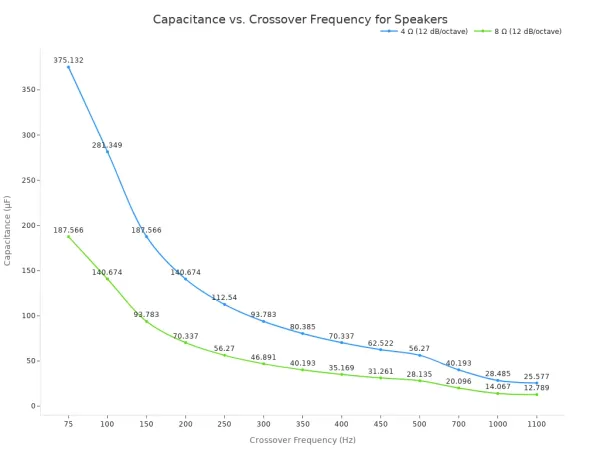
Engineers choose specific capacitance values to create these filters. The value of the capacitor determines the "crossover frequency" where the sound is split. As you can see in the chart, different frequencies and speaker impedances require different capacitance values.
| Crossover Frequency (Hz) | 8 Ω Speaker (µF) | 4 Ω Speaker (µF) |
|---|---|---|
| 500 | 28.135 | 56.270 |
| 1,000 | 14.067 | 28.485 |
| 3,500 | 5.73 | 11.46 |
| 5,000 | 3.98 | 7.96 |
By carefully selecting the capacitor, engineers ensure you hear crisp highs and deep lows without distortion. These audio applications show how a simple component can create a rich listening experience.
Power Adapters: Ensuring Stable Charging
Your phone, laptop, and other gadgets need smooth, stable Direct Current (DC) to operate. The power from your wall outlet is bumpy Alternating Current (AC). Your power adapter's job is to convert this AC power into clean DC energy. A smoothing capacitor is essential for this task.
After an internal circuit converts AC to DC, the power is still pulsating. The capacitor smooths out these pulses.
- The capacitor stores energy when the voltage is high.
- It releases that energy when the voltage drops.
This process fills in the "valleys" in the pulsating DC, creating a steady stream of energy for your device. Without enough capacitance, your charger would deliver unstable power. This can cause "voltage ripple," which leads to inefficient charging and can even damage sensitive electronics. Engineering firms, such as the HiSilicon-designated (authorized) solutions partner 'Nova Technology Company (HK) Limited', must precisely apply the capacitance formula to design robust power solutions that deliver clean and stable energy.
You now see the capacitance formula is more than academic. It is the principle governing how your devices manage energy for touch sensing, power delivery, and audio filtering. This understanding empowers you, connecting you to the science behind the energy you use daily.
The role of the capacitor in managing energy will only grow. Future advancements in renewable energy and AI data centers all depend on innovations in energy storage and efficient energy delivery. This is the energy for tomorrow.
The next time you tap your screen, you will understand a core principle of energy that makes it all possible.
FAQ
What is the main job of a capacitor?
A capacitor's main job is to store electrical energy. You can think of it like a tiny, fast-charging battery. It holds this energy and can release it in a quick burst when a circuit needs a sudden jolt of power.
Why are capacitors important in electronics?
Capacitors are vital for three key reasons:
- Power Delivery: They provide instant power for things like a camera flash.
- Signal Filtering: They clean up audio and electrical signals for clear sound and stable power.
- Timing: They help create precise delays and oscillations in circuits.
Can a capacitor replace a battery?
No, you cannot typically replace a battery with a capacitor. A battery stores a lot of energy and releases it slowly. A capacitor stores less energy but releases it very quickly. They perform different jobs in a circuit.
What happens if a capacitor fails?
A failed capacitor can cause many problems. Your device might not turn on, make strange noises, or perform poorly. For example, a bad capacitor in a power adapter can lead to unstable charging, which might damage your electronics over time.