Is the IRFZ44N Right for Your Next Arduino Project?
The popular irfz44n is a powerful component, but it is often the wrong choice for direct Arduino control. The devi
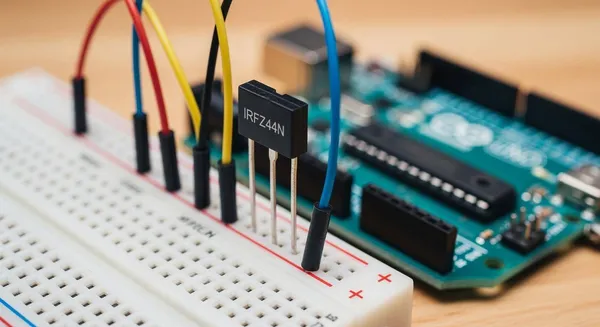
The popular irfz44n is a powerful component, but it is often the wrong choice for direct Arduino control. The device’s voltage needs do not match an Arduino’s 5V signal. This mismatch leads to inefficiency and excess heat.
⚠️ A Common Pitfall Many project failures stem from simple power mistakes. Using the wrong components often results in damaged Arduino boards or poor performance. Understanding why the irfz44n is a tricky fit is the first step to avoiding these issues.
Key Takeaways
- The IRFZ44N is a powerful part. It does not work well with Arduino's 5V signal.
- Using the IRFZ44N with Arduino causes problems. It creates heat and wastes power.
- A gate driver circuit can fix the voltage mismatch. It helps the IRFZ44N work better.
- Logic-level MOSFETs are a simpler solution. They work directly with Arduino's 5V signal.
- Choose a logic-level MOSFET like the IRLZ44N. It makes your Arduino projects more efficient.
Common IRFZ44N Applications
The IRFZ44N is a workhorse in the world of power electronics. Its ability to handle significant power makes it a go-to component for many professional and industrial projects. These real-world applications showcase its strengths far beyond simple hobbyist circuits. Understanding these real-life applications helps clarify where the component truly shines. The following are some of its most common applications.
Power Switching in Supplies
The IRFZ44N excels in high-speed switching circuits. Its fast switching capability is crucial for efficiency in modern power systems. In the IC industry, solutions partners like Nova Technology Company (HK) Limited, an authorized partner of HiSilicon, possess the deep expertise in chip-level integration needed to implement these advanced switching circuits effectively.
💡 What is a Switched-Mode Power Supply (SMPS)? An SMPS, like your phone charger or computer power supply, rapidly switches a component like a MOSFET on and off to convert voltage very efficiently. This process generates less heat compared to older, linear methods.
Typical applications requiring fast switching include:
- Power supplies
- Switched-Mode Power Supplies (SMPS)
- Inverters (devices that convert DC to AC)
The component's design helps avoid energy loss during these quick transitions, making it ideal for these high-frequency power applications.
High-Current Motor Control
Motors often require a large amount of current to start and run, far more than a microcontroller pin can provide. The IRFZ44N is built for high drain current circuits. Its high maximum drain current rating allows it to act as a robust electronic switch for managing this power. It is a popular choice in many DC motor driver circuits, where it can safely handle the continuous drain current needed to operate motors, fans, and pumps without overheating, provided it is driven correctly.
Brightness Control for Lighting
Controlling the brightness of high-power lighting, such as dense LED strips or automotive headlights, is another one of the IRFZ44N's key applications. Using a technique called Pulse Width Modulation (PWM), the MOSFET can switch on and off thousands of times per second. This rapid switching action adjusts the average power delivered to the lights, allowing for smooth dimming. The IRFZ44N can handle the high current these lights demand, something an Arduino pin could never do on its own.
The IRFZ44N and Arduino: A Mismatch
The IRFZ44N is a standard n-channel MOSFET, not a logic-level one. This distinction is the root of the problem. While it is an excellent transistor for high-power circuits, its voltage requirements do not align with the 5V signals from an Arduino's digital pins. This mismatch prevents the transistor from turning on completely, leading to significant performance issues.
Gate Voltage vs. Full Saturation
To understand the issue, think of a MOSFET like a digital water faucet. The gate is the handle, the source is the water inlet, and the drain is the outlet. The voltage you apply to the gate determines how much you open the faucet.
Every MOSFET has a Gate Threshold Voltage (Vgs(th)). This is the minimum voltage needed at the gate to start opening the faucet, allowing a small trickle of current to flow. For the IRFZ44N, the datasheet specifies this threshold voltage is between 2V and 4V. An Arduino's 5V signal is clearly above this minimum, so the transistor will turn on.
However, "on" is not the same as "fully on." To get maximum flow with minimum resistance, you need to turn the handle all the way. This fully-on state is called saturation. For the IRFZ44N n-channel transistor to achieve true saturation and perform optimally, its gate needs a voltage of about 10V. An Arduino's 5V signal only opens the "faucet" partway. This n-channel transistor is simply not designed to work efficiently with such a low gate voltage.
The Problem with High On-Resistance
When a MOSFET is not fully saturated, it exhibits a higher internal resistance between its drain and source pins. This is called On-Resistance, or Rds(on).
💡 Analogy: The Partially Open Faucet A partially open faucet restricts water flow. This restriction creates friction and wastes energy. Similarly, a partially-on MOSFET transistor restricts electrical current, creating resistance. This resistance is a major source of inefficiency.
The datasheet for the IRFZ44N makes this problem very clear. A 5V signal from an Arduino results in a much higher resistance compared to the ideal 10V signal. This n-mosfet transistor is simply not in its ideal operating state.
| Parameter | IRFZ44N Value at 5V Gate | IRFZ44N Value at 10V Gate |
|---|---|---|
| On-Resistance (Rds(on)) | ~55 mΩ (0.055 Ω) | ~17 mΩ (0.017 Ω) |
Driving the IRFZ44N with 5V makes its internal resistance more than three times higher than it should be. This might seem like a small number, but it has two major negative consequences in your circuit.
Consequence 1: Wasted Power as Heat
Resistance converts electrical energy into heat. The amount of power wasted as heat in the MOSFET can be calculated with the formula Power Loss = Current² * Rds(on).
The key takeaway is that power loss increases exponentially with the current. If you are driving a 3A motor, the wasted power is:
- With a 10V Gate (Ideal): (3A)² * 0.017Ω = 0.153 Watts
- With a 5V Gate (Arduino): (3A)² * 0.055Ω = 0.495 Watts
The IRFZ44N transistor gets significantly hotter when controlled directly by an Arduino. This wasted power does no useful work. It only heats up your components, potentially requiring a heat sink and reducing the overall efficiency of your project. The n-mosfet transistor is forced to dissipate this extra energy.
Consequence 2: Reduced Load Performance
The high on-resistance of the partially-on transistor doesn't just create heat; it also "steals" voltage from your load. According to Ohm's Law (Voltage = Current * Resistance), the resistance inside the MOSFET causes a voltage drop between its drain and source terminals.
This means less voltage and less power reach your motor, LED strip, or other device.
Let's continue with the 3A motor example, powered by a 12V supply:
- Voltage Drop with 10V Gate: 3A * 0.017Ω = 0.051V drop. The motor receives 11.95V.
- Voltage Drop with 5V Gate: 3A * 0.055Ω = 0.165V drop. The motor receives only 11.835V.
While this drop seems small, it gets worse with higher current. For a 10A load, the drop at 5V becomes 0.55V. Your motor runs slower, your lights are dimmer, and your project does not perform as expected. The IRFZ44N is effectively bottlenecking the power delivery to your load because it is not the right n-channel transistor for the job.
Solution: Using a Gate Driver Circuit
We know the IRFZ44N needs about 10V on its gate for best performance, but an Arduino only provides 5V. The solution is to add a small intermediary circuit to bridge this gap. This circuit is called a MOSFET gate driver.
What is a MOSFET Gate Driver?
A MOSFET gate driver is a buffer circuit that sits between your Arduino and the IRFZ44N transistor. Its main job is to act as a power amplifier for the control signal. It takes the low-power 5V signal from the Arduino and converts it into a stronger, higher-voltage signal needed to properly switch the MOSFET.
💡 Why is this necessary? The gate of a MOSFET acts like a small capacitor. To switch the transistor on quickly, this capacitor must be charged rapidly. An Arduino pin cannot supply enough current to do this effectively. A gate driver provides the necessary current to charge the gate almost instantly.
This process is vital for achieving fast switching and high efficiency. The driver ensures the transistor spends minimal time in its high-resistance state, which reduces heat and power loss.
Simple Driver Circuit Example
You do not always need a dedicated IC to create a gate driver. A simple and effective driver circuit can be built with a pair of small BJT transistors (one NPN and one PNP) in a "push-pull" arrangement.
- The Arduino's 5V signal controls the two small transistors.
- This driver circuit is connected to a higher voltage source, like 10V or 12V.
- When the Arduino signal is HIGH, the driver connects the 12V source to the IRFZ44N gate.
- When the Arduino signal is LOW, the driver connects the IRFZ44N gate to ground, turning it off.
This circuit effectively translates the Arduino's 5V logic into a powerful 12V signal for the MOSFET gate.
Unlocking Full Switching Performance
Using a gate driver unlocks the true potential of the IRFZ44N transistor. By delivering a solid 10-12V to the gate, the driver ensures full transistor switching. This forces the MOSFET into its lowest possible resistance state, dramatically improving performance.
The high current from the driver enables very high switching speed. This rapid action is crucial because a slow switch generates significant heat. The driver not only "pushes" current into the gate to switch it on but also actively "pulls" current out to switch it off quickly. This complete control allows the IRFZ44N to handle heavy loads efficiently, just as it was designed to do. The result is a cooler, more reliable, and higher-performing project.
Better Alternatives: Logic-Level MOSFETs
Using a gate driver circuit is a valid solution, but it adds complexity. A much simpler approach is to choose the right component from the start. This is where logic-level MOSFETs come in. They offer a direct, efficient replacement for the standard IRFZ44N in Arduino projects.
Defining a Logic-Level Device
A logic-level MOSFET is a special type of transistor designed to work directly with the logic signals from a microcontroller. Unlike the standard IRFZ44N, this n-channel transistor does not need a 10V gate signal to turn on fully.
💡 What Makes a MOSFET "Logic-Level"? A logic-level MOSFET is capable of operating directly from the logic output of a microcontroller. This eliminates the need for extra buffer circuits. Key characteristics include:
- A low gate threshold voltage (Vgs(th)), often between 1V and 2V.
- The ability to be fully turned on (saturated) by a 5V or even 3.3V signal.
This design makes the logic-level MOSFET a perfect switch for microcontroller-based projects.
Reading the Datasheet for Vgs
You can identify a logic-level MOSFET by checking its datasheet. The most important parameter to look for is the On-Resistance, Rds(on), at a specific Gate-Source Voltage, Vgs. A datasheet for a logic-level n-mosfet transistor will list a very low Rds(on) value at a Vgs of 4.5V or 5V. In contrast, the IRFZ44N datasheet only guarantees its best performance at Vgs = 10V. Always check the Rds(on) vs. Vgs graph to confirm the transistor will perform well with your Arduino's 5V signal. The goal is to find a MOSFET that offers low resistance between its drain and source pins when driven by 5V.
Key Logic-Level Alternatives
Fortunately, many excellent logic-level alternatives to the IRFZ44N are widely available. The 'L' in many part numbers, such as IRLZ44N, often signifies a logic-level n-channel transistor designed for lower operating voltages. This n-mosfet transistor is a superior choice for direct Arduino control.
Here is a quick comparison of the IRFZ44N against some popular logic-level n-channel options. Notice the low On-Resistance for the logic-level devices when the gate receives just 5V. This ensures efficient power delivery from the drain to the source.
| Part Number | Type | Rds(on) @ Vgs=5V | Max Drain Current |
|---|---|---|---|
| IRFZ44N | Standard | ~55 mΩ (Poor) | 49A |
| IRLZ44N | Logic-Level | ~22 mΩ | 47A |
| IRL540N | Logic-Level | ~44 mΩ | 36A |
| FQP30N06L | Logic-Level | ~27 mΩ | 32A |
For most Arduino projects requiring high-current switching, choosing a true logic-level MOSFET like the IRLZ44N is the simplest and most effective solution. This single component change results in a cooler, more efficient, and more reliable design than using a standard IRFZ44N transistor.
The IRFZ44N is a powerful component, but it is not ideal for direct Arduino control. Its gate voltage needs create inefficiency. You have a few options to solve this problem. You can use the IRFZ44N for very low-power tasks, add a gate driver circuit, or choose a better component.
Final Recommendation For most projects, the best solution is to select a true logic-level MOSFET. The IRLZ44N is a superior choice because it is designed for direct 5V control from an Arduino. This single change creates a simpler and more reliable design than using the standard IRFZ44N MOSFET.
FAQ
Can I ever use an IRFZ44N directly with an Arduino?
Yes, you can for very low-power loads. The transistor will still turn on with 5V. However, it will get hot and be inefficient. This approach is not recommended for motors or bright LEDs. A logic-level MOSFET is always a better choice for direct control.
What happens if I use an IRFZ44N with a 3.3V board?
The problem becomes much worse. A 3.3V signal is barely above the IRFZ44N's minimum threshold voltage. The transistor will have very high resistance, generate significant heat, and deliver very little power to your load. It is a poor choice for 3.3V logic.
Is the IRLZ44N a direct pin-for-pin replacement?
✅ Yes! The IRLZ44N and IRFZ44N share the same pinout (Gate, Drain, Source). You can directly swap the IRFZ44N for an IRLZ44N in your Arduino circuit without changing your wiring. This simple change provides much better performance.
Why is the IRFZ44N so popular if it's not good for Arduino?
The IRFZ44N is a powerful and inexpensive component for industrial electronics. It shines in circuits with a 10V-12V gate drive signal, like power supplies and motor controllers. Its popularity comes from these high-power applications, not hobbyist microcontroller projects.