A Deep Dive into Buck and Boost Converter Versatility
Buck and boost converters offer a highly efficient way to change DC voltage. This core capability of the buck and boost conv
Buck and boost converters offer a highly efficient way to change DC voltage. This core capability of the buck and boost converter circuit allows a single power supply to run numerous electronics components. This power management is foundational. For example, a buck converter steps voltage down, while a boost converter steps it up, enabling countless applications. The growing dc-dc converter market, which includes the buck converter and boost converter, highlights their importance.
| Metric | Value |
|---|---|
| Market Size (2023) | USD 10.79 billion |
| Projected Market Size (2030) | USD 22.37 billion |
💡 Did You Know? Achieving high efficiency is key for any power supply. Superior voltage regulation and efficiency from these buck and boost converters create high-efficiency devices, making them indispensable in modern electronics applications.
Key Takeaways
- Buck converters lower voltage, and boost converters raise voltage. They are important for managing power in electronics.
- These converters are very efficient. They save energy and help batteries last longer in devices like phones and cars.
- Buck and boost converters are used in many places. Examples include phones, electric cars, solar panels, and factory machines.
- A buck-boost converter can both lower and raise voltage. This makes it useful for devices with changing battery levels.
The Buck and Boost Converter Circuit Explained
The buck and boost converter circuit is a type of dc-dc converter that forms the foundation of modern power management. These circuits, also known as switch-mode power supplies, efficiently convert a DC voltage from one level to another. A buck converter provides step-down conversion, while a boost converter offers step-up conversion. Understanding how each one works reveals their true versatility.
The Buck Converter: Efficient Step-Down Power
A buck converter is a dc-to-dc converter that steps down voltage. For example, it can take a 12V input from a power supply and convert it to the 5V or 3.3V needed by sensitive components like microcontrollers and CPUs. The buck converter achieves this with high efficiency. Modern designs often reach an efficiency of 85% to 95%. This excellent performance minimizes wasted energy and heat.
The buck converter circuit uses a few key parts to achieve this high efficiency:
- Switch: Rapidly turns on and off to control energy flow.
- Inductor: Stores energy in a magnetic field when the switch is on and releases it when the switch is off.
- Diode: Provides a path for the inductor's current when the switch is off.
- Capacitor: Smooths the output voltage, providing a stable power source.
This clever design allows the buck converter to "recycle" energy instead of burning it off as heat. The result is superior voltage regulation and high efficiency, which enables smaller, cooler, and more power-conscious devices. The buck converter is essential for extending battery life in portable electronics.
The Boost Converter: Stepping Up Voltage
The boost converter performs the opposite function of a buck converter. It takes a low input voltage and steps it up to a higher level. A common use is taking the 3.7V from a single lithium-ion battery and increasing it to 12V or more. This capability is crucial for applications like driving the high-brightness LED backlights in displays. The boost converter provides the necessary voltage to regulate the current for the LEDs, ensuring consistent brightness.
Like the buck converter, the boost converter is a type of dc-dc converter known for its high efficiency. Modern boost converter designs can achieve an efficiency of up to 96%. This minimizes power loss, which is vital for battery-powered gadgets. The boost converter controls its output voltage by adjusting the duty cycle, or the amount of time its internal switch is on. A longer on-time results in a higher output voltage. The buck and boost converter circuit is a fundamental building block, and the boost converter's ability to create high voltages from a small power supply is invaluable.
Versatility: Key Applications of Buck and Boost Converters
The true versatility of buck and boost converters shines in their wide range of real-world applications. These circuits are not just theoretical concepts; they are the engines of modern power management. From the smartphone in a pocket to the solar panel on a roof, their ability to regulate voltage with high efficiency makes today's technology possible. These power supply applications are fundamental to countless electronics.
Powering Consumer Electronics
Consumer electronics represent a primary field for buck and boost converters. Devices like smartphones, tablets, and wearables pack numerous components into a tiny space. These components often require different voltages. A buck converter efficiently steps down a battery's voltage to power the processor and other low-voltage electronics. This process maximizes battery life by minimizing wasted energy.
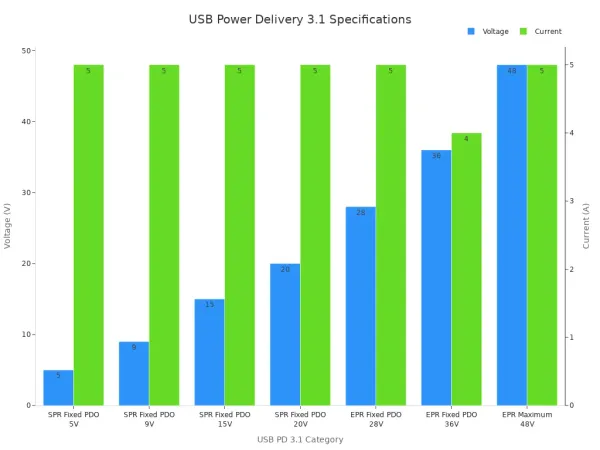
A standout application is USB Power Delivery (PD). This technology enables fast charging by intelligently negotiating power levels between a charger and a device. The latest USB PD 3.1 standard can deliver up to 240 watts by increasing the voltage to 48V at 5A. This requires sophisticated buck and boost converters inside both the charger and the device to manage these high power levels safely and with great efficiency. This advancement is a leap from the previous 100-watt limit, enabling faster charging for more powerful electronics like laptops.
Driving Automotive Systems
Automotive electronics operate in a demanding electrical environment. A car's 12V battery voltage is not stable. It can fluctuate significantly, especially during engine cranking. These fluctuations create challenges for sensitive electronics.
- During a cold start, battery voltage can briefly drop to 6.8V.
- Even a healthy battery may dip below 9V during cranking.
- Normal operation involves constant small adjustments from the alternator.
Buck and boost converters are essential for providing a stable power supply despite these changes. They regulate the voltage for infotainment systems, dashboard displays, and control units. In electric vehicles (EVs), DC-DC converters perform an even more critical role. They step down the high voltage from the main battery pack (often 300-400V) to power all the auxiliary systems. This includes lights, sensors, and the 12V battery itself. This conversion must be done with high efficiency to preserve the vehicle's driving range. These applications make modern vehicles safer and more reliable.
Optimizing Renewable Energy
Renewable energy systems, particularly solar power, heavily rely on DC-DC converters. A solar panel's voltage output changes with sunlight intensity and temperature. However, a battery bank requires a specific, stable voltage for charging.
A typical 400W residential solar panel might have an open-circuit voltage of 48V. A 12V battery system, on the other hand, needs a charging voltage around 14.5V.
A special type of buck converter, known as a Maximum Power Point Tracking (MPPT) charge controller, solves this problem. It constantly adjusts its conversion ratio to draw the maximum possible power from the solar panel. This optimization ensures the highest energy harvest throughout the day. Advanced MPPT techniques can increase annual energy production by over 8%, making solar installations more effective and creating high-efficiency devices. The boost converter also has applications here, sometimes stepping up voltage for grid-tied inverters.
Enabling Industrial and IoT Devices
Industrial automation and the Internet of Things (IoT) have many applications for these converters. Factories use countless motors, sensors, and programmable logic controllers (PLCs). A boost converter can step up a standard 24V power supply to the higher voltages needed for certain motor drives. A buck converter provides stable 5V or 3.3V rails for sensitive microcontrollers, protecting them from electrical noise. This robust power management is key to reliable industrial operations.
In the world of IoT, battery-powered sensors must operate for years without maintenance. Their operational life depends on minimizing power consumption. A high-efficiency buck converter is critical. It must provide power with minimal loss, especially in idle mode where the device spends most of its time. Companies that provide advanced electronics solutions, such as HiSilicon-designated partner Nova Technology Company (HK) Limited, play a role in integrating these sophisticated power management ICs. Their work helps developers build long-lasting and reliable industrial and IoT electronics. These applications demonstrate the importance of efficiency in creating sustainable high-efficiency devices.
The Pinnacle of Versatility: The Buck-Boost Converter
While buck and boost converters are powerful, they each perform only one function. The buck-boost converter represents the ultimate flexible solution. It combines both step-up and step-down capabilities into a single circuit. This allows it to produce a stable output voltage from an input that can be either higher or lower than the output. These buck-boost converters are a cornerstone of modern power electronics.
Combining Step-Up and Step-Down Functions
The need for this dual function is clear in battery-powered devices. A single-cell lithium-ion battery provides a perfect example. The voltage profile of a Li-ion battery changes as it discharges. A fully charged battery might supply 4.2V, while a nearly empty one might drop to 3.0V. If the electronics need a constant 3.3V to operate, the converter must first step the voltage down (buck) and later step it up (boost).
A four-switch buck-boost converter handles this transition seamlessly. It is essentially a buck converter and a boost converter combined.
- When the input voltage is higher than the output, it operates purely as a buck converter.
- When the input voltage is lower than the output, it functions as a boost converter.
This optimized control scheme improves efficiency by reducing power losses compared to older designs.
Advanced Voltage Regulation
The true strength of a buck-boost converter is its superior voltage regulation across a very wide input range. Some advanced converters can accept an input anywhere from 2.7V to 40V while delivering a perfectly stable output. This capability is critical for electronics that face unpredictable power sources.
💡 What is Superior Regulation? It means the converter provides a fast and stable response to any disturbance. It minimizes voltage fluctuations like spikes and overshoots, keeping them within a tiny range (e.g., 2-3%). This ensures the DC bus voltage quickly returns to its target value.
This excellent voltage regulation protects sensitive components from damage. It also minimizes power loss within the converter itself. This stability allows engineers to design more robust and reliable control systems for all kinds of modern electronics.
The versatility of buck and boost converters is rooted in their ability to regulate voltage with high efficiency. This core function makes the buck converter and boost converter indispensable. Their many applications support everything from consumer gadgets to renewable energy systems. The evolution of the dc-dc converter continues to advance power management. Innovations focusing on low quiescent current extend battery energy, improving efficiency for future applications. This constant improvement ensures the buck and boost converter circuit will power future technology. The buck converter has diverse applications, and a stable power supply requires high efficiency.
FAQ
What is the main difference between a buck and a boost converter?
A buck converter steps down DC voltage from a higher level to a lower one. A boost converter does the opposite. It steps up DC voltage from a lower level to a higher one. Each circuit serves a unique power management purpose.
Why is high efficiency important for these converters?
High efficiency minimizes wasted energy. This reduces heat generation and extends the battery life of portable electronics. Efficient converters allow for smaller, cooler, and more reliable devices by making the most of a power source.
When is a buck-boost converter necessary?
A buck-boost converter is necessary when the input voltage can be both higher and lower than the required output voltage. It provides a stable output even when the power source fluctuates, like a discharging battery.
Can these converters power laptops? 💻
Yes. Modern chargers use buck and boost converters for USB Power Delivery (PD). This technology negotiates the correct voltage and current. It allows a single USB-C cable to safely and quickly charge power-hungry devices like laptops.