Understanding TL072 Operational Amplifier IC Pinout and Key Features
You can find the TL072 operational amplifier in many audio circuits. It has two amplifiers inside one chip. The TL072 uses a JFET input to keep input currents very low. This helps your signals stay clear and correct.
You can find the TL072 operational amplifier in many audio circuits. It has two amplifiers inside one chip. The TL072 uses a JFET input to keep input currents very low. This helps your signals stay clear and correct. This amplifier makes very little noise, so it is good for sensitive audio projects. It keeps distortion low, so your sound stays clean. The high slew rate lets it handle fast signal changes. It works with many power supply options because of its wide voltage range. If you know the TL072 pinout, you can connect each pin the right way. This helps your circuit work its best.
Here are some key advantages of the TL072 operational amplifier:
|
Feature |
Description |
|---|---|
|
Low-noise |
Cuts down on unwanted signal problems |
|
Dual op-amp configuration |
Has two amplifiers in one chip |
|
High slew rate |
Changes quickly when the input changes |
|
Wide supply voltage range |
Can use many different power supplies |
|
Output short-circuit protection |
Stops damage if there is a short circuit |
Key Takeaways
-
The TL072 has two amplifiers in one chip. This saves space and gives more options for audio and signal projects. Its JFET input keeps input currents very low. This helps keep signals clear and lowers noise. Knowing the TL072 pinout is important to connect the chip right. This helps you avoid wiring mistakes. The TL072 works well with many power supplies. It can handle fast signal changes because it has a high slew rate. Use neat circuit layouts and good power supplies for the best performance. This helps you avoid common problems.
TL072 Pinout
Pin Diagram
The TL072 operational amplifier comes in an 8-pin DIP package. Each pin has its own job in the circuit. The TL072 pinout helps you connect the chip the right way. This stops you from making mistakes. Here is a table that shows the usual pin setup for the TL072:
|
Pin Number |
Pin Name |
Function Description |
|---|---|---|
|
1 |
1OUT |
Output of the first operational amplifier |
|
2 |
1IN- |
Inverting input of the first operational amplifier |
|
3 |
1IN+ |
Non-inverting input of the first operational amplifier |
|
4 |
Vcc- |
Negative power supply (Ground) |
|
5 |
2IN+ |
Non-inverting input of the second operational amplifier |
|
6 |
2IN- |
Inverting input of the second operational amplifier |
|
7 |
2OUT |
Output of the second operational amplifier |
|
8 |
Vcc+ |
Positive power supply voltage |
Tip: Always check the TL072 pinout before putting the IC on your breadboard or PCB. This helps you avoid wiring mistakes and keeps your parts safe.
Pin Functions
The TL072 has two amplifiers inside one chip. Each amplifier uses three pins. One pin is for the non-inverting input. Another pin is for the inverting input. The last pin is for the output. There are also two pins for power.
-
Pin 1 (1OUT): This pin gives the output from the first amplifier. You connect it to the next part of your circuit.
-
Pin 2 (1IN-): This is the inverting input for the first amplifier. You use it to set gain or feedback.
-
Pin 3 (1IN+): This pin is the non-inverting input for the first amplifier. You send your main signal here.
-
Pin 4 (Vcc-): This pin connects to the negative power or ground.
-
Pin 5 (2IN+): This is the non-inverting input for the second amplifier. You use it for the second signal.
-
Pin 6 (2IN-): This pin is the inverting input for the second amplifier.
-
Pin 7 (2OUT): This pin gives the output from the second amplifier.
-
Pin 8 (Vcc+): This pin connects to the positive power.
The TL072 pinout lets you use both amplifiers in one chip. You can make stereo audio circuits or work with two signals at once. You do not need two separate ICs. The dual op-amp setup gives you both flexibility and easy use. If you look at the TL072 and compare it to the TL071, you see the TL072 has two amplifiers in one 8-pin chip. A quad op-amp like the LM324 needs more pins and more space. The TL072 pin setup keeps your design simple and neat.
Note: The TL072 pinout lets you use both amplifiers alone or together. This helps in many projects, like audio pre-amps or sensor circuits.
TL072 Operational Amplifier Features
Main Features
The TL072 operational amplifier works well in many circuits. It is a high-performance chip. The JFET input stage gives it very high input impedance. It also has very low input bias current. This helps keep your signal clean and accurate.
Here are the main features of the TL072:
-
The high slew rate (13–20 V/μs) lets the amplifier react fast. It can handle quick changes in signals. This means you get less distortion. Your audio sounds better.
-
The JFET input stage gives high input impedance. You can connect high-impedance sources. You will not lose signal strength.
-
The TL072 has low noise (15–18 nV/√Hz at 1 kHz). This keeps unwanted noise out of your signal.
-
The wide voltage range lets you use many power supplies. You can use the TL072 in lots of different circuits.
-
Internal frequency compensation keeps the amplifier stable. It works well even with high gain.
-
Output short-circuit protection keeps the amplifier safe. If you connect the output to ground or supply by mistake, it will not break.
-
Low harmonic distortion (about 0.01%) keeps your signal true. The output stays close to the original.
-
Latch-up free operation means the amplifier works reliably. It does not get stuck or fail in tough conditions.
-
The dual operational amplifier setup saves space. You get two amplifiers in one chip.
Note: The TL072 uses less power than many amplifiers. Some chips like the JRC4558 use even less. The TL072 gives you a good mix of power use and performance.
The TL072 is fast, quiet, and precise. These features make it great for audio, sensors, and signal processing.
Input Impedance Comparison
The JFET input stage gives the TL072 much higher input impedance. This is better than bipolar input amplifiers. High input impedance is important for weak or high-impedance signals.
|
Parameter |
JRC4558 (Bipolar) |
TL072 (JFET) |
|---|---|---|
|
Input Impedance |
Around 5 MΩ |
Much higher (often over 10^12 Ω) |
|
Input Bias Current |
Around 200 nA |
Very low (typically under 10 pA) |
If you need to boost weak signals, the TL072 is a good choice. It works better than many other amplifiers for these jobs.
Electrical Specs
You should check the main specs before using any amplifier. The TL072 has electrical features that help you design for accuracy and performance.
|
Specification |
Typical Value / Range |
|---|---|
|
Input Offset Voltage |
|
|
Input Offset Voltage Drift |
2 μV/°C |
|
Supply Voltage Range |
±2.25 V to ±20 V (dual supply) |
|
4.5 V to 40 V (single supply) |
|
|
Noise Performance (Voltage Noise) |
18 nV/√Hz at 1 kHz (typical) |
|
Slew Rate |
20 V/μs (typical) |
|
Input Bias Current |
Very low (under 10 pA typical) |
|
Power Consumption |
940 μA per channel (typical) |
The TL072 can use a wide range of supply voltages. You can use it with single or dual supplies. This makes it easy to fit into many projects.
The high slew rate lets the amplifier handle big, fast signals. For example, it can drive signals up to 40 V peak-to-peak at 100 kHz. It can also handle 5 V peak-to-peak at 1 MHz. If you go past these limits, the signal may distort or get weaker.
The TL072 is low-noise, but some chips like the LF353 are even quieter. Still, the TL072 is good for most audio and signal jobs.
Tip: Always check if the amplifier’s specs match your needs. If you need very low noise or super high precision, compare the TL072 to other chips first.
The TL072 gives you good gain, output, and clear signals. You can trust it for many analog projects, like audio preamps or sensor circuits.
TL072 Datasheet
Key Parameters
When you check the TL072 datasheet, you find helpful facts. These facts help you use the chip the right way. Always look at the main parameters before using the TL072 in your circuit. These numbers tell you how the chip will work in real life.
Here is a table with the most important datasheet parameters:
|
Parameter |
Typical Value |
|---|---|
|
Supply Voltage (Vcc) |
±3V to ±18V (dual supply) |
|
Input Offset Voltage |
3mV (typical) |
|
Input Bias Current |
65pA (typical) |
|
Slew Rate |
13V/µs (typical) |
|
Gain Bandwidth Product |
3MHz (typical) |
|
Input Impedance |
10⁹Ω (high impedance) |
|
Output Voltage Swing |
±12V (with ±15V supply) |
|
Noise Voltage Density |
18nV/√Hz (at 1kHz) |
|
Operating Temperature |
0°C to 70°C |
The TL072 can use many different supply voltages. This means you can use it in lots of circuits. It has high input impedance and low input bias current. These help keep your signals strong and clean. The datasheet shows the TL072 uses little power and makes little noise. This is good for audio and sensor projects.
Tip: Always read the datasheet for the newest specs before you start. This helps you avoid mistakes and get the best results.
Performance Highlights
The TL072 is special because it is fast, quiet, and flexible. You can use it for audio, sensors, or signal jobs. The JFET input stage gives you very low input bias current and high input impedance. This helps you work with weak signals and not lose quality.
If you compare the TL072 to other op-amps like the NE5532, you see some differences:
|
Performance Aspect |
TL072 |
NE5532 |
|---|---|---|
|
Input Noise Voltage |
5 nV/√Hz (at 1 kHz) |
|
|
Total Harmonic Distortion |
0.003% (typical) |
Lower than TL072 |
|
Slew Rate |
13 V/µs |
9 V/µs |
|
Gain Bandwidth |
3 MHz |
10 MHz |
|
Input Bias Current |
65 pA |
Higher than TL072 |
|
Supply Voltage Range |
±3V to ±18V |
±5V to ±12V |
The TL072 gives you a wider supply voltage range and lower input bias current. This makes it a good pick for many analog circuits, even if you do not need the lowest noise. The datasheet also shows it has short circuit protection and latch-up free operation. These features help you build safe and strong circuits.
Note: When you read the datasheet, look at the key parameters and main features. This helps you choose the TL072 for your project.
TL072 Applications
The TL072 operational amplifier works in many different projects. You can use it for audio, signal processing, and other important jobs. It is popular with hobbyists and professionals because it is quiet and fast. It also keeps sound quality high.
Audio Circuits
The TL072 is used a lot in audio mixers and sound equipment. This amplifier gives you clear sound with almost no noise or distortion. The JFET input keeps the input bias current low and the input impedance high. These features help your audio signals stay strong and clean. The dual op-amp setup lets you make stereo systems or use two channels in one chip. You get high sound quality, which is important for music and recording. Many professional mixers and accurate audio tools use the TL072 because it keeps your sound true.
The TL072 is great for audio because it reacts quickly, has low offset voltage, and very low distortion. You can trust it for high-quality sound at home or in the studio.
Signal Processing
You can use the TL072 for many signal processing jobs. It works well in active filters, preamplifiers, and buffer amplifiers. The high slew rate and low noise help you handle fast signals without losing quality. You can use it to boost signals and prepare them in sensor circuits. The TL072 also works in instrumentation amplifiers, giving you accuracy in measurement tools. Its high input impedance and low output impedance make it good for voltage followers and isolation amplifiers. You get steady, accurate signals in your circuit.
-
Common signal processing uses:
-
Active filters to shape sound or data
-
Buffer amplifiers to drive long cables
-
Instrumentation amplifiers for medical and industrial tools
-
Other Uses
The TL072 is also used in many other circuits. You find it in solar power systems, motor drives, and UPS systems. Its low power use and good efficiency help in battery testers and power control. You can use it in sensor interfaces where fast response and low noise are important. The TL072 is a smart choice because it balances cost, power, and performance.
Here are some other TL072 uses:
-
Solar inverters and power systems
-
Motor control and servo drives
-
Battery testing and monitoring
You can count on the TL072 for simple or complex circuits. Its features give you the quality and accuracy you need in many projects.
Usage and Substitutes
Circuit Tips
You can get good results from the TL072 if you follow some easy tips:
-
Use a bipolar power supply like ±15V for best results. The TL072 does not work well with low single-supply voltages, such as 3.3V.
-
The TL072 is not a rail-to-rail device. The output will not reach the highest or lowest supply voltage. It stays about 1.5V away from both the positive and negative supply.
-
Never connect the circuit ground to pin 4, which is the negative supply pin. Always use the correct pinout.
-
Put a resistor (between 10k and 1M ohm) from the non-inverting input to ground. This stops unwanted current from building up because of the high input impedance.
-
Do not leave any input pins unconnected. Connect all inputs to a set voltage to stop noise or strange signals.
-
Do not use the TL072 as a comparator. If the input voltage gets too close to the negative supply, the output may act oddly.
-
When using AC coupling, make sure there is a DC path to ground. This keeps the input from drifting and helps your signal stay steady.
-
Keep your circuit layout neat and short. Put decoupling capacitors close to the power pins to cut down on noise.
Tip: A neat layout and the right power supply help you avoid most problems with the TL072.
Equivalent ICs
Sometimes you need a different IC instead of the TL072. Here is a table that compares some popular choices:
|
Substitute IC |
Technology |
Input Impedance |
Noise Performance |
Bandwidth |
Slew Rate (V/µs) |
Input Bias Current |
Input Offset Voltage |
Voltage Range |
Key Application/Notes |
|---|---|---|---|---|---|---|---|---|---|
|
TL072 |
JFET |
Very High |
Low (18 nV/√Hz) |
~4 MHz |
~13-20 |
~10 pA |
~1 mV |
±3V to ±18V |
Audio, precision circuits |
|
NE5532 |
Bipolar |
Moderate |
Lower than TL072 |
~10 MHz |
~9 |
~8 nA |
~1 mV |
±5V to ±22V |
High-performance audio |
|
LM358 |
Bipolar |
Moderate |
Higher noise |
~1.1 MHz |
~0.3 |
~45 nA |
~2 mV |
3V to 32V |
Single supply, cost-effective |
|
JRC4558 |
Bipolar |
~5 MΩ |
Moderate |
~3 MHz |
~1 |
~200 nA |
~1 mV |
±4V to ±18V |
Audio, guitar pedals |
|
OPA827 |
JFET |
High |
Very Low |
High |
High |
Low |
Low |
N/A |
Precision, low noise |
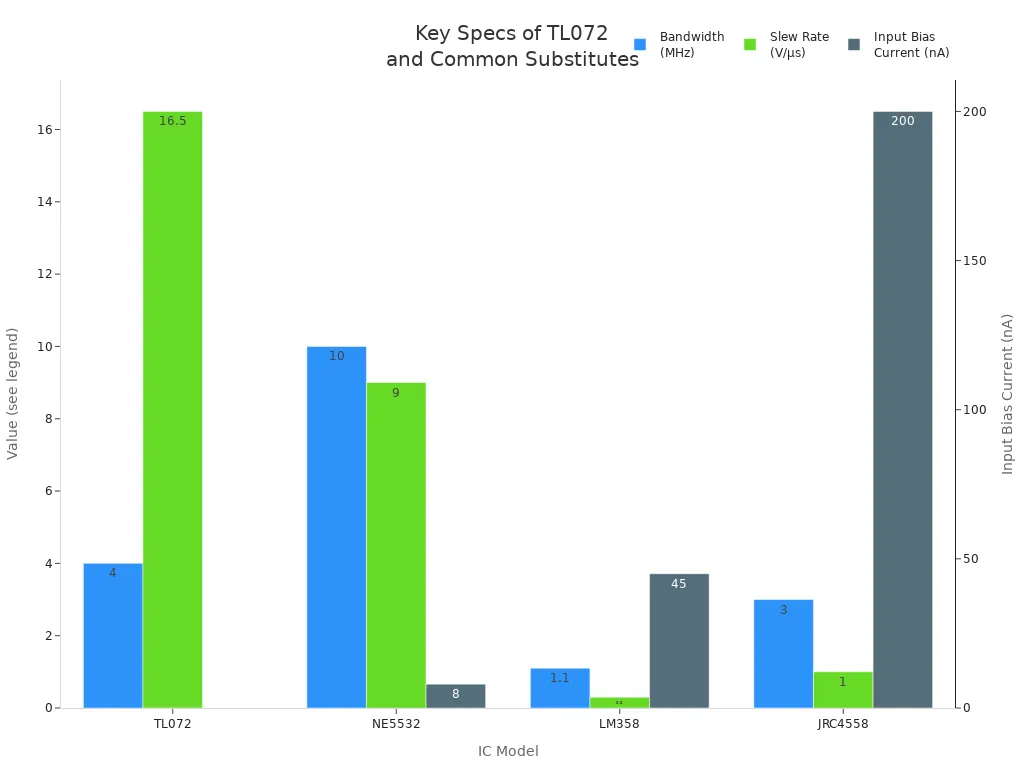
Pick a substitute based on what your project needs. The NE5532 has less noise and more bandwidth, but it uses more power. The LM358 works with one power supply and costs less, but it is slower and noisier. The JRC4558 is used in guitar pedals because of its sound. The OPA827 is great for very low noise and high accuracy, but it can be expensive.
Note: Always check if the new IC fits your circuit’s voltage and performance needs before you use it.
You gain many benefits when you choose the TL072 operational amplifier for your projects. Its dual op-amp design, high input impedance, and low noise make it perfect for audio and signal circuits. The clear pinout helps you connect it easily. Always check the datasheet before you start. This helps you match the TL072 to your needs and avoid problems.
Understanding key specs like voltage range, noise, and output features lets you pick the best op-amp for each job.
|
Feature |
Why It Matters |
|---|---|
|
Handles fast signals |
|
|
Low noise |
Keeps your audio clear |
|
Dual op-amp configuration |
Saves space and adds flexibility |
Try the TL072 in your next circuit and see how it improves your results.
FAQ
What is the main advantage of using the TL072 in audio circuits?
You get low noise and high input impedance with the TL072. This helps your audio signals stay clear and strong. The dual op-amp design also lets you build stereo or multi-channel systems easily.
Can you use the TL072 with a single power supply?
Yes, you can use the TL072 with a single supply from 4.5V to 40V. For best performance, use a dual supply like ±15V. This gives you better signal swing and less distortion.
Does the TL072 work as a comparator?
The TL072 is not designed for comparator use. If you use it as a comparator, you may see slow response or odd output. Choose a real comparator IC for fast and accurate switching.
How do you reduce noise when using the TL072?
-
Keep your circuit layout short and neat.
-
Place decoupling capacitors close to the power pins.
-
Connect all unused inputs to ground or a set voltage.
What are some common substitutes for the TL072?
You can try NE5532, JRC4558, or LM358 as substitutes. Each has different noise, speed, and voltage features. Always check if the substitute matches your project’s needs.