Understanding Crystal Oscillator Circuits: Design Principles and Applications in Electronic Systems
A crystal oscillator circuit uses quartz crystal vibrations to make steady signals. These signals help create exact and stable frequencies for electronics. Such circuits are important for devices like clocks, radios, and microcontrollers. The quartz crystal vibrates at a set speed, keeping things accurate. Without these circuits, electronics would have trouble staying in sync or doing timing tasks well.
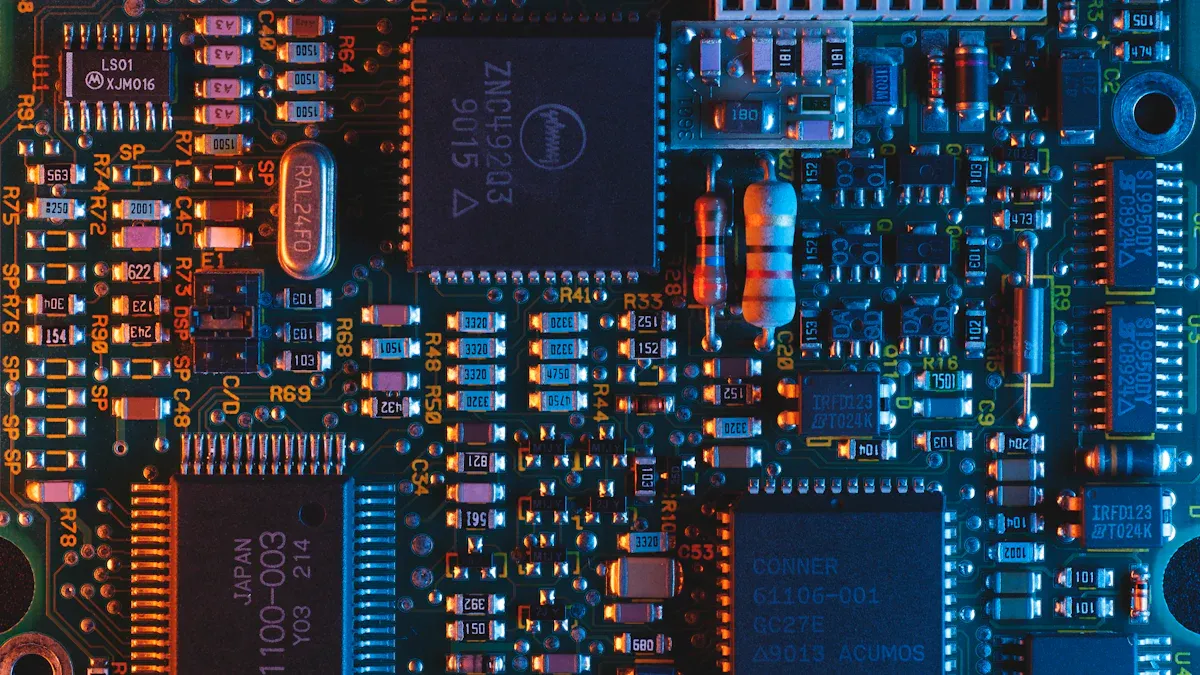
A crystal oscillator circuit uses quartz crystal vibrations to make steady signals. These signals help create exact and stable frequencies for electronics. Such circuits are important for devices like clocks, radios, and microcontrollers. The quartz crystal vibrates at a set speed, keeping things accurate. Without these circuits, electronics would have trouble staying in sync or doing timing tasks well.
Key Takeaways
-
Crystal oscillators use quartz to make steady frequencies for timing.
-
Picking the right quartz crystal is important for good results.
-
Think about frequency, load capacitance, and how temperature affects it.
-
Good design helps stability; keep wires short and reduce noise.
-
Fix problems like frequency changes by using good parts and layouts.
-
Crystal oscillators are key in radios, microchips, and medical tools.
How a Crystal Oscillator Circuit Works
The Principle of Piezoelectricity
Crystal oscillators use a special property of quartz called piezoelectricity. When you press or stress quartz, it makes an electric charge. The opposite also happens—electricity can make the quartz change shape a little. This back-and-forth energy change is how crystal oscillators work.
Quartz is great for this because it is stable and precise. It vibrates at a set frequency, making signals steady and reliable. The size and material of the quartz decide its vibration speed, which keeps the oscillation stable.
Tip: Quartz crystals have very high quality factors (Q), often between 10,000 and hundreds of thousands. This means they lose little energy and keep frequencies steady.
Resonance and Frequency Generation
Resonance is key to how crystal oscillators make steady frequencies. When placed in a circuit, the quartz vibrates at its natural speed. This speed depends on its size, shape, and cut. The circuit boosts these vibrations and sends them back to the quartz, creating a loop.
It starts with small voltage changes that excite the quartz's natural frequency. As vibrations grow, the circuit becomes steady. At this point, the loop gain equals one, and the oscillator makes a stable signal. The Barkhausen rule says the total phase shift in the loop must be 360 degrees for the oscillation to continue.
|
Aspect |
Description |
|---|---|
|
Phase Shift |
The amplifier shifts the phase by 180 degrees, and the filter adds another 180 degrees, making 360 degrees total. |
|
Startup Phase |
Small voltage changes excite the quartz, starting the oscillation. |
|
Steady-State Operation |
The loop gain becomes one, keeping the oscillation steady. |
|
Frequency Setting |
The quartz sets the frequency, which is more stable than LC circuits. |
|
Quartz Crystal Characteristics |
Quartz has high Q factors and stable frequencies, making it perfect for precise signals. |
Components of a Crystal Oscillator Circuit
A crystal oscillator circuit has several important parts that work together:
-
Quartz Crystal: The main part that sets the frequency. Its stability ensures accurate timing.
-
Amplifier: Makes the signal stronger and adds the needed phase shift.
-
Feedback Network: Sends the amplified signal back to the quartz to keep the loop going.
-
Load Capacitors: Adjust the frequency slightly and balance the quartz's electrical properties.
-
Power Supply: Gives the energy needed to keep the oscillation running.
Each part has a job to make sure the oscillator works well and stays steady. For example, load capacitors help fine-tune the frequency for better accuracy.
Note: These parts together keep the oscillator running without outside help, making it great for devices needing exact timing.
Design Principles of Crystal Oscillator Circuits
Choosing the Right Crystal
Picking the right crystal is key for stable and accurate frequencies. Crystals have unique features that affect how they work in circuits. To choose the best one, you need to check several things:
|
Criteria/Metric |
Description |
|---|---|
|
Look at data sheets for frequency and load capacitance details. |
|
|
Series Resonant Frequency |
The point where inductive and capacitive effects cancel out. |
|
Temperature Stability |
Crystals can change with temperature, which affects accuracy. |
|
Equivalent Circuit Representation |
Shows how the crystal behaves electrically and mechanically. |
Focus on electrical specs and resonant frequency to match your circuit. If you need better temperature stability, use a temperature compensated or oven controlled crystal oscillator. These types work well in changing environments.
Tip: Always check the crystal's quality factor (Q) and temperature stability. This ensures it fits your system's needs for accuracy and performance.
Circuit Design and Layout
How you design and arrange your circuit affects its stability and noise levels. Good practices can make your circuit work better. Follow these tips:
-
Signal Routing: Keep signal paths short and away from sensitive areas to avoid interference.
-
Power Supply Filtering: Use tools like ferrite beads and LDOs to reduce power noise. This helps keep the frequency steady.
-
Thermal Management: Place parts carefully to handle heat changes. This keeps the oscillator working well.
By following these steps, you can create a circuit with stable frequencies and low noise. For advanced designs, try a voltage controlled crystal oscillator. It lets you adjust the frequency for more flexibility.
Note: A good layout improves accuracy and prevents signal problems over time.
Ensuring Stability and Accuracy
Stability and accuracy are very important for any crystal oscillator circuit. To achieve these, focus on both the design and the parts you use. Here are some tips:
-
Reduce Phase Noise: Use high-quality crystals and amplifiers to keep signals clean.
-
Match Load Capacitance: Make sure the load capacitance fits the crystal's specs to avoid drift.
-
Use Feedback Control: A good feedback system keeps the frequency steady.
-
Handle Environmental Changes: Temperature can affect stability. Use temperature compensated crystal oscillators to fix this.
Callout: The figure of merit (FOM) helps measure oscillator performance. It looks at power use, cost, and accuracy to help balance design choices.
By focusing on these areas, you can make a reliable oscillator for many uses.
Overcoming Design Challenges
Making crystal oscillator circuits can be hard. Problems might affect how well they work or stay steady. Knowing these problems and fixing them helps make better circuits for different uses.
Managing Frequency Drift
Frequency drift means the oscillator's output changes over time. This happens because of temperature changes, old parts, or outside noise. To reduce drift:
-
Use Temperature Compensation: Pick TCXOs for places with changing temperatures.
-
Select High-Quality Crystals: Good crystals handle aging and environment changes better.
-
Shield Against Interference: Keep the oscillator away from electromagnetic noise sources.
Tip: A thermal cover can help keep the circuit steady in tough conditions.
Reducing Phase Noise
Phase noise is tiny changes in the oscillator's frequency. It can mess up signals, especially in communication systems. To lower phase noise:
-
Optimize Circuit Layout: Make signal paths short and avoid sensitive spots.
-
Use Low-Noise Amplifiers: Quality amplifiers keep signals clean.
-
Filter Power Supply Noise: Add capacitors or ferrite beads to block power noise.
Ensuring Long-Term Stability
Long-term stability is key for accurate timing. Focus on these areas to improve it:
|
Problem |
Fix |
|---|---|
|
Component Aging |
Use low-aging crystals and replace old parts often. |
|
Environmental Factors |
Protect the circuit from moisture and extreme temperatures. |
|
Load Capacitance Mismatch |
Match load capacitance to the crystal's needs. |
Callout: Test and calibrate regularly to keep the oscillator stable over time.
Handling Startup Issues
Some oscillators may not start or take too long to work. This can cause system problems. To fix startup issues:
-
Check Loop Gain: Make sure loop gain is just above one at startup.
-
Verify Feedback Network: Ensure the feedback gives the right phase shift.
-
Use Proper Load Capacitors: Wrong capacitors can stop the oscillator from starting.
Balancing Cost and Performance
Good oscillators can be expensive. If you need to save money, try these ideas:
-
Choose Resonators for Basic Applications: Resonators are cheaper for simple systems.
-
Use Programmable Oscillators: These let you change frequency without new parts.
-
Prioritize Key Features: Focus on what matters most, like stability, for your needs.
By solving these problems, you can build crystal oscillator circuits that work well and stay reliable for many uses.
Applications of Crystal Oscillator Circuits in Electronic Systems
Communication Devices
Crystal oscillators are very important in communication devices. They create steady signals that keep systems like radios and phones in sync. These signals help avoid problems like signal distortion or interference.
Key features of crystal oscillators in communication:
-
They keep frequencies steady for accurate timing.
-
Low phase noise ensures clear and reliable signals.
-
They work well in outdoor and space environments due to temperature stability.
-
Long-term stability makes them dependable for precise devices.
These qualities make crystal oscillators essential for modern communication. They allow fast data transfer and reliable connections.
Microcontrollers and Embedded Systems
In microcontrollers, crystal oscillators act like the circuit's heartbeat. They provide clock signals that control the timing of tasks. Without them, devices would not work accurately.
For example, in a microcontroller, the oscillator ensures tasks happen at the right time. This is important for things like robots, IoT devices, and cars. Programmable oscillators add flexibility by letting you change the frequency for different needs.
Using crystal oscillators gives embedded systems high accuracy and smooth performance.
Timing and Synchronization Applications
Crystal oscillators are crucial for timing and keeping systems in sync. They create exact frequencies that ensure devices work together properly. For example, in communication, they help send and receive signals at the right times.
|
Application Area |
Role of Crystal Oscillators |
|---|---|
|
Communication Systems |
Keep signals on time for encryption and decryption processes. |
|
Provide steady frequencies for timekeeping and syncing data. |
|
|
Aerospace and Defense |
Ensure precise timing for communication, navigation, and weapon systems. |
Crystal oscillators also keep digital circuits, like computers, running smoothly. In defense, they ensure systems stay reliable in critical situations.
Tip: Use temperature-compensated or oven-controlled oscillators for better stability in tough conditions.
Industrial and Medical Uses
Crystal oscillator circuits are very important for factories and hospitals. They give exact timing, which is needed for machines to work well. In factories, they help robotic arms move together smoothly. This makes production faster and more accurate. MEMS oscillators are used in tough places because they are strong. But crystal oscillators are better when accuracy is most important.
In hospitals, crystal oscillators are key for devices needing exact signals. Machines like ultrasound and MRI scanners use them to make clear images for doctors. Wearable health gadgets, like fitness trackers, use them to measure heartbeats and other signs correctly. As telemedicine grows, the need for reliable oscillators also increases.
Crystal oscillators keep signals steady, making them great for factories and hospitals. In factories, they stop machines from having timing errors. In hospitals, they make sure measurements stay correct, even in hard conditions. Their accuracy and dependability are why they are used in modern technology.
Tip: If the environment has extreme heat or shaking, MEMS or temperature-compensated oscillators can work better while staying accurate.
Picking the right oscillator helps machines and devices work well for a long time.
Crystal oscillator circuits are very important in today's electronics. They make exact signals using quartz's special piezoelectric ability. This keeps timing steady and accurate. To design them well, pick the right crystal, plan the layout carefully, and fix problems like noise or frequency changes. These circuits are used in communication tools, small systems, and medical machines, showing how useful they are.
The global need for these circuits shows their value. Their market is expected to grow from $2,115 million in 2021 to $2,760 million by 2030. Smaller sizes and better designs have made them more efficient. With more IoT devices and their use in cars and planes, their importance grows. These circuits help things work dependably in a world that needs precision.
FAQ
What is the difference between a crystal oscillator and a resonator?
A crystal oscillator makes very steady signals using quartz crystals. Resonators are similar but less accurate and cheaper. Oscillators are best for devices needing exact timing. Resonators work well for simpler and low-cost systems.
How do load capacitors affect a crystal oscillator circuit?
Load capacitors adjust the quartz crystal's frequency slightly. They help keep the signal steady by balancing the crystal's electrical features. Wrong capacitor values can cause problems like frequency changes or startup failure. Always use capacitors that match the crystal's needs.
Can temperature changes impact crystal oscillator accuracy?
Yes, temperature changes can affect the crystal's frequency. To fix this, use special oscillators that handle temperature shifts. These include temperature-compensated or oven-controlled types. They work well in outdoor or factory settings.
Are programmable oscillators better than fixed-frequency oscillators?
Programmable oscillators let you change the frequency without new parts. They are good for designs needing flexibility. Fixed-frequency oscillators are more stable and precise. They are better for systems needing steady timing.
How do you reduce phase noise in a crystal oscillator circuit?
To lower phase noise, use good-quality crystals and amplifiers. Design the circuit to keep signal paths short and avoid interference. Add capacitors or ferrite beads to block noise from the power supply.