Top PCB Assembly Companies for Different Industry Applications in 2025
Top manufacturers invest in advanced equipment and technical expertise. They use high-speed pick-and-place machines, modern SMT lines, and automated inspection systems.
Decision-makers seeking the best PCB Assembly Companies in 2025 should consider these leaders for major industry applications:
-
AT&S stands out for high-end technology and advanced production capacity.
-
Zhen Ding and Unimicron lead in sales volume and global market share.
-
Compeq and Nippon Mektron excel in reliability and industry certifications.
-
Würth Elektronik specializes in automotive and industrial sectors.
Rankings use quantitative metrics such as market share, revenue, and production data. Matching each company’s strengths to specific industry needs ensures optimal results.
Key Takeaways
-
Top PCB assembly companies excel in advanced technology, reliability, and industry specialization to meet diverse market needs.
-
Automotive, medical, consumer electronics, telecommunications, industrial, and aerospace sectors demand tailored PCB solutions with strict quality standards.
-
Leading firms use automation, AI, and IoT to improve production speed, accuracy, and cost efficiency while supporting sustainability goals.
-
Global leaders maintain strong supply chains, certifications, and testing processes to ensure on-time delivery and product reliability.
-
Choosing the right PCB assembly partner requires evaluating certifications, production capabilities, delivery records, and alignment with specific industry requirements.
Selection Criteria
Technology
Top manufacturers invest in advanced equipment and technical expertise. They use high-speed pick-and-place machines, modern SMT lines, and automated inspection systems. These tools allow them to handle complex multi-layer boards, prototypes, and quick-turn orders. Companies also offer Design for Manufacturing (DFM) support and value-added services like signal integrity analysis.
Leading firms demonstrate strong manufacturing capabilities, including both SMT and THT assembly, scalability for different production volumes, and robust supply chain management. Environmental responsibility, such as RoHS and REACH compliance, also plays a key role.
Industry Focus
The PCB assembly market serves a wide range of industries. Automotive, consumer electronics, telecommunications, industrial automation, medical devices, and aerospace drive most of the demand. The market is valued at about $75 billion annually, with a projected growth rate of 7% from 2025 to 2033.
|
Market Attribute |
Details |
|---|---|
|
End-User Industries |
Consumer Electronics, Automotive, Medical Devices, Industrial Electronics, Telecommunications, Aerospace and Defense, Others |
|
Geographic Regions |
North America, Europe, Asia-Pacific, Middle East and Africa, Latin America |
|
Major Players |
Benchmark Electronics, Celestica, Flex Ltd., Jabil, Key Tronic, Plexus, Sanmina, Sparton, TTM Technologies, Universal Scientific Industrial |
|
Market Size |
Approximately $75 billion annually |
|
Growth Rate (CAGR) |
Around 7% projected from 2025 to 2033 |
|
Market Characteristics |
Fragmented market with large and small specialized firms; technological advancements; regulatory impacts; regional dynamics |
Reliability
Reliability stands as a critical selection factor. Companies use automated optical inspection (AOI), X-ray inspection, and a range of electrical tests to ensure quality. They perform vibration, thermal shock, and environmental exposure tests to validate durability.
Certifications such as ISO 9001, AS9100D, and ISO 13485 confirm adherence to strict quality standards. In-process inspections, traceability documentation, and advanced SMT capabilities further support reliability.
Services
Service performance indicators help identify the best partners. Top companies achieve 98% on-time delivery rates and yield rates up to 95%. They reduce costs by 15%-20% through lean manufacturing and maintain high customer satisfaction scores above 85%.
|
Service Performance Indicator |
Industry Benchmark / Target |
Improvement Suggestions / Notes |
|---|---|---|
|
Production Efficiency & Throughput |
30% improvement over traditional methods |
Adopt automation and real-time monitoring tools |
|
On-time Delivery Rate |
98% on-time delivery target |
Streamline supply chain processes |
|
Cost Per Unit |
15%-20% cost reduction |
Implement lean manufacturing principles |
|
Quality Control & Defect Reduction |
Yield rates up to 95% |
Invest in advanced quality inspection systems (e.g., 3D AOI) |
|
Customer Satisfaction Score |
85% or higher |
Conduct regular surveys and immediate follow-ups |
|
Net Promoter Score (NPS) |
50+ |
Enhance customer service touchpoints |
|
Response Time to Inquiries |
Within 24 hours |
Invest in automation tools and staff training |
|
Repeat Order Rate |
40% of clients |
Foster customer loyalty through engagement |
Comprehensive testing, strict quality control, and compliance with safety standards like UL 796 and 5G testing ensure that products meet all requirements. Regular audits, advanced inspection technologies, and continuous staff training support consistent quality and timely delivery.
Global Leaders

Market Position
Top PCB Assembly Companies hold strong positions in the global market due to their advanced technology, high production capacity, and broad customer base. Market analysis from DataIntelo and Business Research Insights highlights several leaders for 2025. These companies show consistent growth, with the market expected to reach over USD 21 billion by 2032 at a 10% CAGR. The following table summarizes the estimated annual revenue, market share, and key strengths of the top players:
|
Company |
Estimated Annual Revenue (USD) |
Market Share (%) |
Key Strengths |
|---|---|---|---|
|
Zhen Ding Technology |
6-8 |
High-volume production, diverse PCB types, strong in FPC |
|
|
Unimicron |
Approximately 4.5 Billion |
5-7 |
Advanced technologies, HDI PCBs, large capacity |
|
TTM Technologies |
Approximately 3 Billion |
4-5 |
Aerospace & defense, complex boards, quick-turn services |
|
Nippon Mektron |
Approximately 2.5 Billion |
3-4 |
Automotive and industrial, high-reliability PCBs, flexible boards |
|
Samsung Electro-Mechanics |
Approximately 2.2 Billion |
3-4 |
Advanced HDI, semiconductor packaging, high density PCB solutions |
|
Ibiden |
Approximately 2 Billion |
2-3 |
IC substrates, complex multilayer PCBs, high-end boards |
|
Kingboard Chemical |
Approximately 1.8 Billion |
2-3 |
High-volume production, cost-effective solutions, wide range of PCB materials |
These companies lead the market by combining financial strength, advanced manufacturing, and a focus on innovation.
Industry Reach
Global leaders in PCB assembly serve a wide range of industries and maintain manufacturing sites across multiple regions. Companies like Zhen Ding Technology and Unimicron operate advanced automated assembly lines and testing devices. Their products support applications from consumer electronics to automotive and aerospace.
Electronics manufacturing service providers such as Foxconn, Flex, Jabil, and Sanmina have extensive supply chain networks and serve diverse sectors. However, their technology systems continue to evolve, and they work to improve production efficiency and supply chain management.
|
Company |
Global Manufacturing Reach |
Technological Capabilities |
Industry Applications |
Distribution and Strategic Approach |
|---|---|---|---|---|
|
Zhen Ding Tech |
Automated assembly, advanced testing |
Single-layer to multi-layer PCBs |
Efficient, timely distribution; eco-friendly practices |
|
|
Meiko Electronics |
Sites worldwide |
Automated, modular production |
Telecommunications, automotive |
Strategic locations for fast delivery; flexible production |
|
Summit Interconnect |
US-based, strategic acquisitions |
Lean manufacturing, advanced technologies |
Aerospace, defense, medical devices |
Quick turnaround, efficient production, focus on sustainability |
|
Suntak Technology |
Modern facilities in China |
High-precision, multi-layer PCBs |
Telecommunication, medical, automotive |
Innovation in rigid and flexible PCBs; new materials and processes |
These PCB Assembly Companies continue to expand their reach by investing in new technologies and building strong distribution networks. Their ability to serve multiple industries and regions positions them as reliable partners for global customers.
Regional PCB Assembly Companies
North America
North America features several leading PCB Assembly Companies, including TTM Technologies, Sanmina, Jabil, Flex, and Benchmark Electronics. These companies support industries such as automotive, aerospace, medical, and telecommunications. They focus on advanced electronics and quick-turn prototyping. North American firms benefit from strong supply chains and skilled labor. The region’s market growth comes from rising electric vehicle sales and increased adoption of advanced electronics. Industry research uses interviews with experts and data from government and market reports to validate company performance. This approach ensures reliable insights for decision-makers.
Asia-Pacific
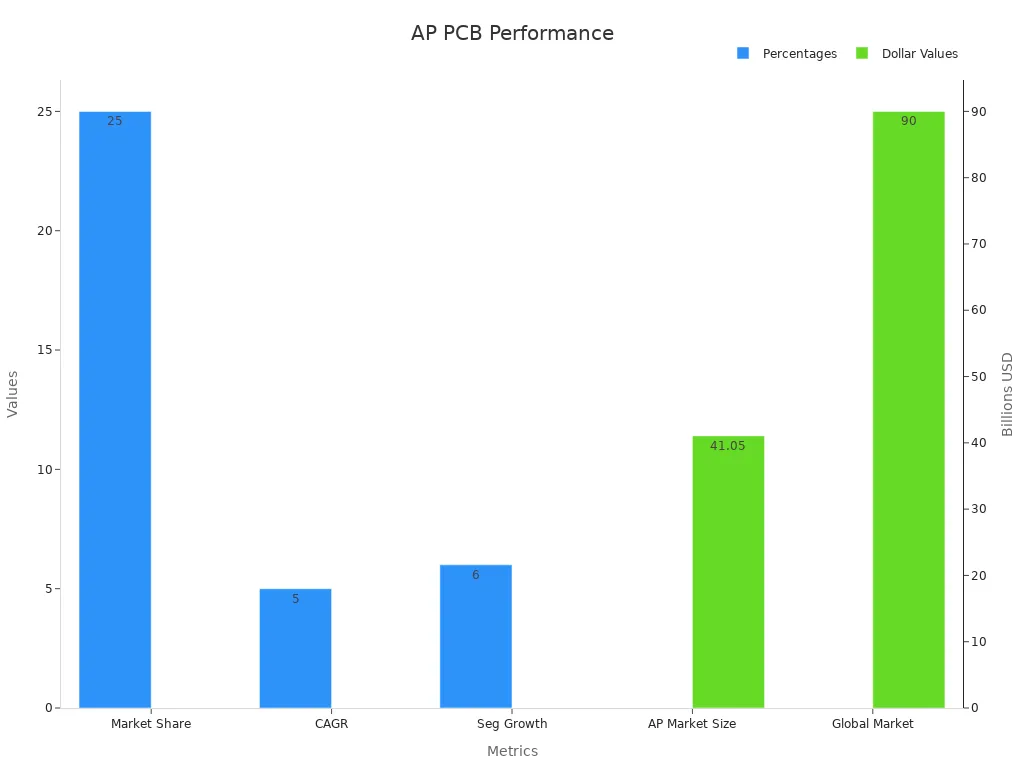
Asia-Pacific dominates the global PCB assembly market. Companies like Shenzhen Kinwong, JLCPCB, and PCBWay lead in production capacity and technology. The region holds over 25% of the global market share and reached a value of more than USD 41 billion in 2024. Growth drivers include high demand for consumer electronics, rapid industrialization, and strong government support. Asia-Pacific companies invest in advanced technologies such as HDI and rigid-flex PCBs. Skilled labor and robust infrastructure help maintain their competitive edge.
Europe
Europe’s PCB Assembly Companies, such as Eurocircuits, focus on quality and innovation. Germany produces over 30% of Europe’s PCBs, and standard multilayer boards make up 45% of production. Companies invest in R&D and eco-friendly solutions. The region faces challenges like higher raw material costs and regulatory requirements. However, growth in electric vehicles and 5G infrastructure drives demand. Market research combines data mining, expert interviews, and simulation models to provide accurate forecasts.
India
Indian PCB Assembly Companies, including Garg Electronic and Genus Electrotech, offer a wide range of capabilities. They produce single-sided, double-sided, and advanced HDI boards. These companies serve automotive, telecom, defense, and medical sectors. Government policies encourage local sourcing and investment in manufacturing parks. Indian firms follow international quality standards and adopt automation to improve efficiency. A skilled workforce and cost-effective production give them a regional advantage.
Industry Applications
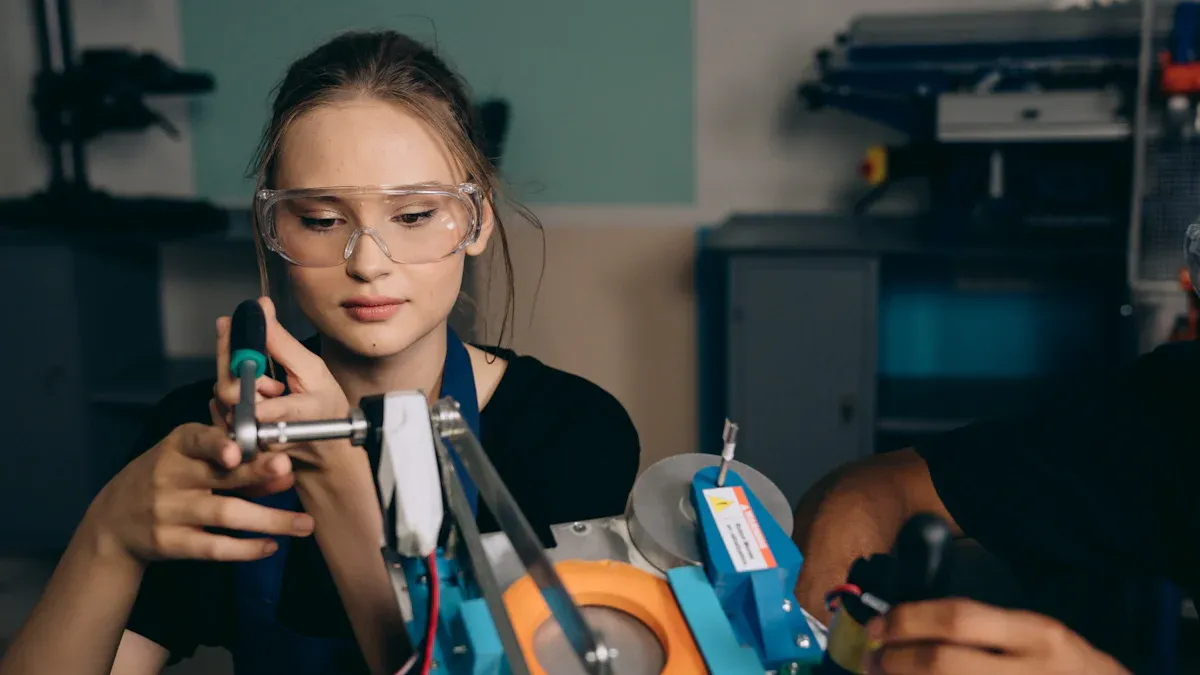
Automotive
PCB Assembly Companies play a vital role in the automotive industry. The Asia Pacific region leads this market, driven by a strong network of auto parts manufacturers and a surge in electric vehicle production. In 2021, China produced over 350 billion integrated circuits, a 37% increase from the previous year. Electric vehicle production in Asia Pacific rose by 50% between 2020 and 2021. These trends highlight the need for advanced PCB assemblies tailored to automotive electronics.
Top companies such as Zhen Ding Technology, Unimicron, and Shenzhen Kaifa Technology excel in this sector. They offer high-volume production, advanced SMT lines, and rigorous testing processes. Multi-layer PCBs are preferred for complex automotive systems, including GPS, lighting, and infotainment. Certifications like ISO 9001 and IATF 16949 ensure quality and reliability. Companies with experience in automotive electronics can meet the demands of electric and autonomous vehicles.
|
Company Name |
Specialized Technologies |
Certifications |
Key Automotive Benefits |
|---|---|---|---|
|
Zhen Ding Technology |
High-volume SMT, FPC |
ISO 9001, IATF 16949 |
Advanced electronics, reliability |
|
Unimicron |
HDI, Multi-layer PCBs |
ISO 9001, IATF 16949 |
Complex systems, scalability |
|
Shenzhen Kaifa Tech |
High-speed SMT, AOI, X-ray |
ISO 9001:2015 |
Large-scale, rigorous testing |
|
WT Microelectronics |
SMT, THT, End-to-end PCBA |
ISO 9001, ISO 14001 |
Strong supply chain, comprehensive QC |
The automotive PCB market is projected to reach USD 10.4 billion by 2032, with electric vehicles driving the largest share.
Medical
The medical sector demands precision, reliability, and strict regulatory compliance. PCB Assembly Companies serving this industry must use advanced manufacturing equipment, such as MY700 jet printers and Yxlon Cheetah X-Ray machines, to ensure high-quality assembly. In-line Automated Optical Inspection (AOI) and comprehensive testing verify placement and solder joints.
Leading companies like Rayming Technology and Shenzhen Kaifa Technology provide electronic design, rapid prototyping, and full traceability. They hold certifications such as ISO 9001 and ISO 13485, which are critical for medical device manufacturing. These companies focus on defect identification, documentation, and cleanliness protocols to prevent failures and ensure patient safety.
-
Suppliers demonstrate expertise in medical device regulations.
-
Advanced manufacturing processes and skilled teams support quality.
-
Certifications like ISO 13485 and FDA compliance are essential.
-
Comprehensive inspection and traceability maintain safety standards.
Medical device manufacturers rely on PCB assembly partners who can deliver precision, reliability, and compliance with strict industry standards.
Consumer Electronics
Consumer electronics drive high-volume PCB production. The market is expected to grow from USD 65 billion in 2024 to USD 95 billion by 2033. Companies in this sector specialize in mass production for smartphones, wearables, and home automation devices. They use advanced technologies such as HDI and rigid-flex PCBs to support miniaturization and multifunctionality.
Asia-Pacific companies, including JLCPCB, PCBWay, and Agile Circuit, lead in this field. They offer rapid prototyping, flexible manufacturing, and innovative online ordering systems. Certifications like ISO 9001:2015 and strong supply chain management ensure quality and speed.
-
High-volume production supports mass-market devices.
-
Multilayer and flexible PCBs enable compact, high-performance products.
-
Trends in miniaturization and smart devices drive demand for advanced PCB solutions.
PCB Assembly Companies in this sector focus on speed, scalability, and innovation to meet the needs of fast-evolving consumer markets.
Telecommunications
Telecommunications relies on advanced PCB assemblies for 5G networks, IoT devices, and high-speed data transmission. The market is projected to grow at a CAGR of 6.4% through 2030, with 5G networks expected to cover over 40% of the global population by 2025. IoT devices will exceed 30 billion by 2025, increasing the need for sophisticated PCB solutions.
Companies such as Viasion, Rayming Technology, and Hollison Electronics excel in telecommunications. They use high-precision SMT lines, rapid prototyping, and comprehensive testing. Certifications like ISO 9001 and ISO 14001 ensure quality and environmental responsibility.
-
Advanced SMT and THT assembly support high-frequency applications.
-
Rigorous testing and inspection guarantee reliability.
-
Strong supply chain management enables timely delivery.
The rapid expansion of 5G and IoT drives demand for PCB Assembly Companies with expertise in telecommunications technology.
Industrial
Industrial applications require robust, reliable PCB assemblies for automation, control systems, and smart manufacturing. Companies in this sector use machine-to-machine communications and closed-loop feedback systems to improve efficiency and yield. Certifications such as AS9100D, ISO 9001:2015, and RoHS compliance demonstrate adherence to strict quality standards.
Summit Interconnect and Agile Circuit stand out for their technical capabilities and problem-solving skills. They address challenges like through-hole assembly, soldering techniques, and fixture design. Their expertise ensures high reliability in demanding industrial environments.
Industrial customers benefit from PCB Assembly Companies that offer scalability, adaptability, and compliance with rigorous standards.
Aerospace
Aerospace applications demand the highest levels of quality, reliability, and traceability. Companies serving this sector must meet certifications such as AS9100D, NADCAP, ITAR, and IPC standards. They support complex assemblies, including flexible, rigid-flex, and hybrid PCBs, and handle components as small as 0201 metric.
TTM Technologies and Summit Interconnect lead in aerospace PCB assembly. They offer advanced inspection, functional testing, and protective processes like conformal coating. Their production flexibility supports low to medium volumes and high-mix requirements.
|
Capability Area |
Details |
|---|---|
|
Certifications |
|
|
PCB Types Supported |
Flexible, Rigid, Rigid-Flex, Hybrid, Ceramic |
|
Inspection & Testing |
AOI, X-Ray, Functional, RF, ICT, Burn-In, Thermal Aging |
|
Production Flexibility |
Low to medium volume, high mix capabilities |
Aerospace manufacturers depend on PCB Assembly Companies with proven expertise, advanced technology, and a commitment to meeting the most stringent industry standards.
PCB Assembly Companies Comparison
Strengths Overview
PCB Assembly Companies show unique strengths in technology, reliability, and industry specialization. The table below highlights how leading companies compare across these aspects:
|
Strength Aspect |
Evidence Summary |
|---|---|
|
Technology |
Advanced SMT placement with micron-level precision, automated through-hole insertion, and state-of-the-art machinery. Companies handle multilayer flex and RF PCBs and support both prototyping and mass production. |
|
Reliability |
Rigorous quality control with automated optical inspection, first article inspection, and x-ray inspection. Certifications like ISO 9001 and TL9000 ensure high standards. Companies follow lifecycle management and regulatory compliance. |
|
Industry Fit |
Compliance with industry-specific standards, such as FDA for medical devices. Companies manage complex designs and tight tolerances. They support certifications for automotive, medical, aerospace, and telecom sectors. On-time delivery and long-term partnerships are priorities. |
Foxconn Technology Group stands out for its advanced manufacturing and large-scale production. The company offers one-stop solutions, strong supply chain management, and strict quality control. Foxconn invests in research and development to improve assembly technologies and reduce costs. This approach helps Foxconn respond quickly to market needs.
Industry Fit
PCB Assembly Companies match their strengths to industry requirements using key metrics and service features. The table below shows how companies validate their fit for different sectors:
|
Metric |
Description |
Relevance to Industry Fit |
|---|---|---|
|
Measures equipment productivity, performance, and quality |
Benchmarks machine efficiency and output for industry standards |
|
|
Overall Resource Effectiveness (ORE) |
Includes human and material resources |
Assesses readiness and adaptability for high-mix or manual skill-dependent industries |
-
Fast turnaround capability helps meet urgent project needs in automotive and medical sectors.
-
On-time delivery records prevent production delays, which is vital for industries with strict schedules.
-
Global shipping and support allow companies to serve international clients.
-
Responsive communication and engineering guidance support complex projects.
-
Dedicated after-sales service ensures long-term reliability and compliance.
PCB Assembly Companies that combine advanced technology, strong reliability, and industry-specific expertise deliver the best value for customers across sectors.
Trends for 2025
Automation
Automation continues to transform electronics manufacturing. Companies now use advanced robotics, smart reflow ovens, and automated inspection systems to boost productivity and accuracy. The market for reflow ovens is growing at a 14.9% CAGR from 2025 to 2032. This growth comes from the integration of automation, IoT, and AI, as well as the need for energy efficiency and miniaturization. Automated lines reduce human error and speed up assembly, making it easier to meet tight deadlines. Improved lead times for critical components, such as DDR3/DDR4 memory and Flash NAND, also support faster production cycles. These changes help companies deliver high-quality products while keeping costs under control.
|
Segment |
CAGR (2025-2032) |
Key Growth Drivers |
|---|---|---|
|
Reflow Ovens |
14.9% |
Automation, IoT & AI, energy efficiency, miniaturization |
IoT & AI
The rise of IoT and AI is shaping the future of electronics. Smart devices, such as wearables and home automation products, require complex and reliable circuit boards. Automotive systems, including ADAS and electric vehicles, also depend on advanced electronics. Industrial automation uses IoT for sensing, data processing, and communication. Companies now use AI-driven analytics to monitor production in real time and adjust processes quickly. Intelligent quality control systems with machine vision detect micro-defects and improve inspection speed. Automation in warehousing and logistics streamlines inventory management and reduces costs.
-
Demand for smart consumer electronics and automotive systems is rising.
-
Industrial automation and IoT adoption require advanced PCBs.
-
AI enables real-time monitoring, dynamic process adjustment, and better quality control.
-
Flexible production lines support both small-batch and mass production needs.
Sustainability
Sustainability has become a top priority in electronics manufacturing. Companies adopt energy-saving measures and use renewable energy sources, such as solar and wind, in their facilities. Automation and smart sensors help reduce energy use and waste. Manufacturers choose recyclable metals and biodegradable polymers to make products more eco-friendly. They also follow ethical sourcing practices and design products for recycling and repair. Recycling programs recover valuable materials, while additive manufacturing reduces waste. Lean manufacturing principles help eliminate inefficiencies and maximize resource use.
Life cycle assessment metrics guide companies to select materials and designs that lower environmental impact. For high-value devices, longer lifespans and recycling-friendly designs matter most. For low-value devices, eco-friendly substrates and minimal use of critical raw materials help reduce the footprint.
Selecting the right partner requires careful evaluation. Decision-makers should match company strengths to specific industry needs. Technology, reliability, and specialization each play a key role. To choose the best fit in 2025, consider these steps:
-
Review certifications and industry experience.
-
Assess production capabilities and delivery records.
-
Monitor trends and company innovations.
Staying informed helps companies adapt and succeed in a changing market.
FAQ
What certifications should top PCB assembly companies have?
Top companies hold certifications like ISO 9001 for quality management, IATF 16949 for automotive, and ISO 13485 for medical devices. These certifications show strong quality control and industry compliance.
How do PCB assembly companies ensure product reliability?
They use automated optical inspection, X-ray testing, and strict quality checks. Many companies also perform environmental and vibration tests. These steps help prevent defects and ensure long-term performance.
Which industries benefit most from specialized PCB assembly services?
Automotive, medical, aerospace, telecommunications, and consumer electronics benefit most. Each industry requires unique standards, materials, and testing. Specialized companies meet these needs with tailored solutions.
How can decision-makers choose the right PCB assembly partner?
Decision-makers should review certifications, production capabilities, and delivery records. They should also check industry experience and customer reviews. A good partner matches company strengths to project requirements.
What trends will shape PCB assembly in 2025?
Automation, IoT, AI, and sustainability will drive change. Companies will use smart machines, eco-friendly materials, and real-time data. These trends improve efficiency, quality, and environmental impact.