The Evolution of Crystal Oscillators in Electronic Design
Have you ever wondered why crystal oscillators are so important? It all began in 1880 when Jacques and Pierre Curie discovered piezoelectricity. They found that some crystals, like quartz, create electricity when pressed or stressed. This amazing discovery made quartz useful for keeping time. Engineers used piezoelectricity to build stable oscillators for exact frequency control.
-
Crystal oscillators are very important in electronic devices.
-
They create exact frequencies to keep timing steady in systems.
-
These are used in phones, GPS, and medical machines.
-
Their value is clear in the world market.
-
In 2021, they were worth $2,115 million globally.
-
By 2026, they may grow to $2,760 million.
-
This shows they are trusted for precise timing needs.
-
From industries to daily life, they are essential tools.
-
They help technology work well and bring new ideas.
Key Takeaways
-
Crystal oscillators help devices like phones and GPS keep accurate time.
-
Their market is growing fast and may reach $2,760 million by 2026.
-
New technology makes crystal oscillators smaller and work better in tiny gadgets like smartwatches.
-
There are different types, like TCXO and VCXO, for specific uses.
-
As tech improves, crystal oscillators will stay important for IoT and 5G, helping send data correctly.
Historical Background of Crystal Oscillators
Discovery of Piezoelectric Properties
Have you ever wondered why crystal oscillators are so important? It all began in 1880 when Jacques and Pierre Curie discovered piezoelectricity. They found that some crystals, like quartz, create electricity when pressed or stressed. This amazing discovery made quartz useful for keeping time. Engineers used piezoelectricity to build stable oscillators for exact frequency control.
Fun Fact: Quartz crystals vibrate steadily, making them perfect for accurate timing.
Early Quartz Timing Technology
Quartz changed how timing devices worked in the early 1900s. Watches and clocks started using quartz crystals for better accuracy. By the 1950s, quartz oscillators were added to electronic systems for their precision. Early models were big, about 20 x 20 mm, and needed many parts. Thanks to new technology, they became much smaller. Today, they can be as tiny as 2.0 x 1.6 mm, fitting easily into modern gadgets.
|
Milestone/Development |
Description |
Year/Period |
|---|---|---|
|
Early 1900s |
Watches and clocks used quartz crystals for timing. |
1900s |
|
Mid 1900s |
Quartz oscillators were added to electronic devices. |
1950s |
|
20 x 20 mm package |
Early quartz oscillators were large and needed many parts. |
Early 1970s |
|
2.0 x 1.6 mm package |
Smaller designs fit into today’s compact devices. |
2020s |
|
Frequency stability |
Regular quartz oscillators vary within 50 ppm; top ones within 10 ppm. |
Ongoing |
|
Gigahertz range |
Modern oscillators now reach higher frequencies for new tech. |
Ongoing |
Adoption in Communication and Military Systems
During World War II, quartz oscillators became key for communication and military tools. Precise timing was crucial for radar and radios to work well. These oscillators helped send and receive signals reliably, giving armies an edge. After the war, they were used in civilian tech like phones and electronics. This was a big step in making crystal oscillators essential for modern devices.
Technological Advancements in Crystal Oscillators
Miniaturization and Enhanced Stability
Modern crystal oscillators are now smaller and work better. Engineers use methods like micro-machining to shrink their size. Thin-film deposition helps make designs more efficient. These changes let oscillators fit into small gadgets like phones and smartwatches. Surface-mount technology places them directly on circuit boards, saving space and money.
Did you know? Tiny wafer-level packaging keeps performance high while reducing size.
Today's oscillators are also more stable. They use less power and keep frequencies steady. This makes them perfect for devices needing exact timing. Below is a table showing key improvements:
|
Performance Metrics |
Miniaturization Benchmarks |
|---|---|
|
Works with other technologies |
|
|
Better frequency stability |
Fits into small electronic systems |
These upgrades have increased demand for crystal oscillators in industries like cars, phones, and medical tools.
Integration with PLLs and Programmable Features
Phase-locked loops (PLLs) have made oscillators more flexible. PLLs help create many frequencies, making them useful for different devices. This is important for phones and electronics that need exact timing.
Programmable features add even more options. You can adjust frequency and waveforms for specific uses. This is helpful for advanced systems like 5G networks and car electronics.
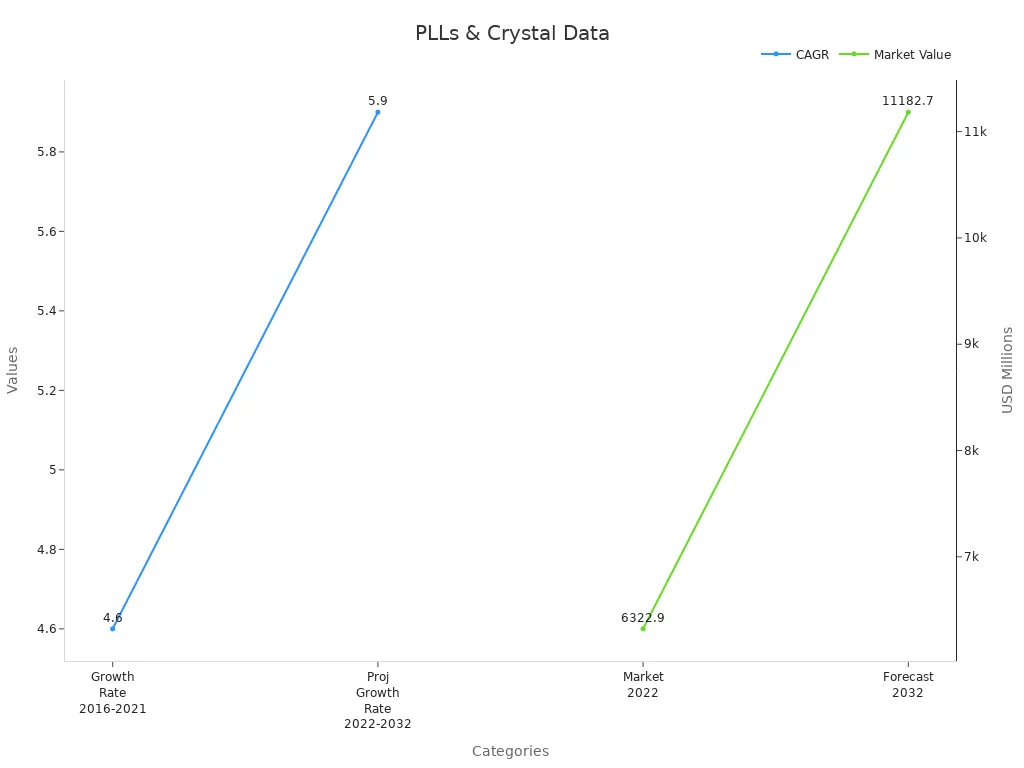
The market for oscillators with PLLs and programmable features is growing fast. Below is a table with key data:
|
Data Points |
Key Statistics |
|---|---|
|
Growth Rate (2016 to 2021) |
4.6% yearly increase |
|
Projected Growth Rate (2022 to 2032) |
|
|
Market Value (2022) |
USD 6,322.9 Million |
|
Forecast Value (2032) |
USD 11,182.7 Million |
Development of Voltage-Controlled Crystal Oscillators (VCXOs)
Voltage-controlled crystal oscillators (VCXOs) are a big step forward. They let you change the frequency by adjusting voltage. This makes them very flexible for different uses. VCXOs are used in industries like military, space, and factories.
Modern VCXOs work even in tough conditions. Some models handle heat up to +200°C. Tiny VCXOs, just 5 x 7 x 1.5 mm, fit into small designs. Advanced ones have low phase noise and jitter, making them very precise.
Here’s a table of VCXO features:
|
Feature |
Details |
|---|---|
|
Temperature Tolerance |
Works in heat up to +200°C. |
|
Size |
Small VCXOs measuring 5 x 7 x 1.5 mm. |
|
Phase Noise Performance |
Low noise of -150 dBc/Hz at 10 kHz offset. |
|
Jitter |
Very low jitter around 0.5 ps RMS. |
|
Supply Voltage |
Uses +3.0, +3.3, or +5.0 VDC. |
|
Applications |
Used in military, space, and factory systems. |
VCXOs are reliable and adaptable, making them vital for modern electronics.
Key Parameters and Types of Crystal Oscillators
Frequency Stability and Q Factor
Two key factors matter for crystal oscillators: frequency stability and the Q factor. Frequency stability shows how well an oscillator keeps its frequency steady. It works even when temperatures or conditions change. Stable oscillators are important for GPS and communication systems.
The Q factor measures how well energy loss is reduced. A higher Q factor means better focus on specific frequencies. This helps in reducing interference in RF designs. High-Q oscillators also lower phase noise, making signals clearer. These are useful for fast data communication.
Tip: Always check both frequency stability and Q factor for top performance.
Types of Crystal Oscillators (TCXO, OCXO, VCXO)
There are different types of crystal oscillators for various uses. Here’s a simple breakdown:
-
TCXO (Temperature-Compensated Crystal Oscillator): Adjusts for temperature changes. Stability ranges from 0.1 to 2 ppm/°C. Used in GPS and telecom devices.
-
OCXO (Oven-Controlled Crystal Oscillator): Keeps crystals at a steady temperature. Offers high stability of 0.01 ppm/°C. Found in military and science tools.
-
VCXO (Voltage-Controlled Crystal Oscillator): Frequency changes with voltage adjustments. Used in aerospace and factories.
|
Oscillator Type |
Key Features |
Stability (ppm) |
Temperature Range (°C) |
Common Uses |
|---|---|---|---|---|
|
TCXO |
Handles temperature shifts |
0.1 to 2 |
-40 to +85 |
GPS, telecom |
|
OCXO |
Very accurate |
0.01 |
70 to 90 |
Military, science |
|
VCXO |
Voltage-adjustable |
Varies |
-40 to +85 |
Aerospace, factories |
Applications in Modern Electronic Design
Crystal oscillators are crucial in today’s technology. They provide accuracy and reliability for many devices. For example, GPS systems use quartz timing for stable signals. Low-noise oscillators improve communication networks.
In healthcare, quartz oscillators ensure precise medical equipment performance. They also power IoT devices, connecting smart homes and cities. Engineers keep improving circuits to reduce noise and boost stability. This ensures oscillators meet modern tech demands.
Note: From satellites to smartphones, crystal oscillators drive innovation today.
Crystal Oscillators vs. Alternative Timing Sources
Comparison with MEMS Oscillators
Crystal oscillators and MEMS oscillators have key differences. MEMS oscillators handle temperature changes and shocks better. They work well even in tough conditions. Their small size helps them fit into tiny devices easily.
Crystal oscillators, however, are more accurate and stable over time. They use quartz crystals for precise frequency control. MEMS oscillators depend on PLLs, which can cause more noise and jitter. This makes crystal oscillators better for tasks needing very low noise.
|
Quartz Crystal Oscillator |
MEMS Oscillator |
|
|---|---|---|
|
Accuracy (ppm) |
<1 |
|
|
Phase Jitter / Phase Noise |
Lower |
Higher |
|
Size and Integration |
Larger |
Smaller, chip-integrable |
|
Shock Resistance |
Moderate |
High |
|
Cost |
Higher |
Cost-effective manufacturing |
Note: MEMS oscillators are cheaper and fail less often. But they still can't match the low noise of crystal oscillators.
Advantages of Quartz Timing Technology
Quartz timing is the best for accurate timing. It stays stable and doesn’t age quickly. This makes it great for GPS, communication, and medical devices. Quartz oscillators use natural quartz vibrations for steady performance. They don’t have sudden frequency changes.
They also use less power and start up faster than MEMS oscillators. Their simple design makes them reliable for long-term use. These features explain why quartz oscillators are the top choice for critical systems.
Limitations of Non-Quartz Timing Solutions
Other timing sources, like RC oscillators, are less accurate. RC oscillators have about 30,000 ppm accuracy, which isn’t good for precise tasks. Ceramic resonators and SAW oscillators work for some uses but aren’t as stable as quartz.
MEMS oscillators are improving but still have issues with noise and jitter. They also age mechanically, causing frequency drift. For very precise timing, these problems make non-quartz options less dependable.
|
Oscillator Type |
Accuracy (ppm) |
Key Characteristics |
|---|---|---|
|
RC Oscillators |
~30,000 |
Simple, low-cost, less accurate. |
|
Quartz Crystal Oscillators |
10 |
High stability, widely used as a standard for comparison. |
|
MEMS Oscillators |
<1 |
Superior temperature stability, shock resistance, and integration capabilities. |
|
SAW Oscillators |
Varies |
Less accurate than quartz, but useful for specific applications. |
|
Ceramic Resonator Oscillators |
Varies |
Offers advantages for specific needs, but generally less accurate than quartz. |
Tip: For important systems, choose quartz oscillators for better accuracy and reliability.
Future Trends in Crystal Oscillator Technology
New Materials for Better Performance
New materials are improving how crystal oscillators work. Companies are using advanced materials to make them use less power and adjust to temperature changes faster. These upgrades make oscillators much better than older models. For instance, oven-controlled crystal oscillators (OCXOs) now handle temperature changes 1,000 times better.
Better manufacturing methods also make oscillators stronger and more reliable. Surface-mount technology (SMT) and smaller designs help them last longer and stay stable. Engineers are testing new ceramics and plastics for oscillator cases. These materials make oscillators tougher and better for high-frequency tasks.
Tip: Choose oscillators with new materials for better stability and strength.
Helping IoT and 5G Technologies
Crystal oscillators are key to making IoT and 5G work well. These systems need exact timing to send and receive data correctly. 5G networks use oscillators to keep signals steady for fast communication. IoT devices, like smart home gadgets and factory sensors, depend on oscillators for accurate connections.
The growth of 5G and IoT is boosting the demand for oscillators. By 2035, the market for crystal oscillators could reach USD 7,967 million, growing at 6.9% yearly. This shows how important oscillators are for new technologies.
Note: As 5G and IoT grow, crystal oscillators will stay vital for accurate timing.
Staying Important in High-Tech Systems
Crystal oscillators are still crucial for advanced technology. Their steady frequencies are key for designing reliable electronic systems. Industries like telecom and automation need them for exact timing. Parts like capacitors and resistors also help improve performance, especially in low-power devices.
New tech like 5G and IoT makes oscillators even more important. They provide precise clocks for collecting and processing data in digital systems. Features like low noise, minimal jitter, and short-term stability ensure top performance.
Callout: Crystal oscillators are essential for high-tech systems, keeping them reliable and accurate.
Crystal oscillators have changed how electronics are designed over time. Their story started with piezoelectric discoveries and grew into small, powerful parts. Today, they are used in important devices like phones, computers, and IoT gadgets. They help create steady signals and keep timing accurate.
Smaller and more advanced oscillators are in high demand, especially for IoT. Experts predict quartz oscillators will grow 9.6% yearly from 2025 to 2031. This shows how valuable they are becoming. With better materials and technology, crystal oscillators will keep improving and stay important in modern electronics.
Tip: As tech improves, crystal oscillators will stay key for reliable and innovative designs.
FAQ
1. What is a crystal oscillator, and why is it important?
A crystal oscillator uses quartz to make exact frequencies. It helps keep time in devices like watches and GPS. Its steady performance makes it vital for today’s technology.
2. How does a crystal oscillator work?
Quartz vibrates when electricity flows through it. These vibrations create a steady signal. This signal helps keep time or sync circuits in electronics.
3. What makes quartz better than other materials for oscillators?
Quartz has special properties that make it vibrate steadily. It handles temperature changes well, giving better accuracy than ceramics or MEMS.
4. Can crystal oscillators handle extreme conditions?
Yes, some crystal oscillators work in very tough places. They can handle heat up to +200°C and are used in space, military, and factories.
5. Are crystal oscillators still relevant with new technologies like MEMS?
Yes! MEMS is improving, but quartz is still more accurate. It’s used in important systems like GPS, telecom, and medical tools.
Tip: For high precision, crystal oscillators are the best choice.