SMT Assembly: A Comprehensive Guide to Surface Mount Technology in Electronics Manufacturing
Surface Mount Technology (SMT) assembly is key to making modern electronics. It attaches parts directly to the surface of circuit boards. This method allows smaller designs and faster production. It also skips the need for drilled holes, making assembly quicker and more flexible.

Surface Mount Technology (SMT) assembly is key to making modern electronics. It attaches parts directly to the surface of circuit boards. This method allows smaller designs and faster production. It also skips the need for drilled holes, making assembly quicker and more flexible.
SMT assembly has changed electronics by improving gadgets, cars, medical tools, and space tech.
Key Facts:
-
In 2023, 6,212 SMT assembly lines were shipped worldwide. High-speed lines made up 46.66% of these.
-
Over 56% of U.S. factories now use AI-based inspection systems. These systems find mistakes better and save money.
-
Consumer electronics use SMT the most, making up 33% of its global use.
These improvements show how SMT makes reliable, affordable products and helps technology grow in many fields.
Key Takeaways
-
SMT assembly helps make electronics smaller and lighter. This improves speed and efficiency in devices.
-
Using machines in SMT lowers worker costs and makes production faster. It also improves product quality and reliability.
-
Checking and testing often in SMT finds mistakes early. This ensures products are good before being sold.
-
Knowing SMT's pros and cons helps companies pick the right tools for their needs.
-
SMT's future includes smarter AI and green methods. This makes electronics better and kinder to the planet.
What Is SMT Assembly?
Overview of Surface Mount Technology
Surface mount technology (SMT) is a way to attach electronic parts directly to printed circuit boards (PCBs). Unlike older methods, it skips drilling holes, making assembly faster and easier. This method uses surface-mount devices (SMDs) that are smaller and lighter than older components.
SMT has grown a lot since it started. IBM created it in the 1960s for small computers. By the 1980s, it became popular for faster assembly. By 1990, SMT replaced through-hole technology as the main way to build advanced PCBs. Today, it’s used in almost all electronics, like phones and medical tools.
|
Year |
Milestone |
What Happened |
|---|---|---|
|
1960s |
First Created |
IBM made SMT for small computer parts. |
|
1980s |
Widely Used |
SMT became common and sped up assembly. |
|
1990 |
Main Method |
SMT became the top way to build PCBs. |
|
Now |
Everyday Use |
SMT is key in nearly all electronics. |

This technology changed electronics by allowing smaller designs and faster assembly.
Key Features of SMT PCB Assembly
SMT PCB assembly has special features that make it better than older methods:
-
Compact Design: Smaller parts fit more tightly on PCBs.
-
Automated Processes: Machines do most of the work, reducing mistakes and speeding up production.
-
Advanced Inspection: Tools like AOI and X-rays check for errors and ensure good soldering.
-
Data-Driven Improvements: Tracking and analyzing data improves quality and efficiency.
|
Feature |
What It Does |
|---|---|
|
Careful inspections to ensure high standards. |
|
|
Error Detection |
AOI and X-rays find problems and check soldering. |
|
Data Tracking |
Tracks parts and uses data to improve processes. |
These features make SMT PCB assembly the best choice for modern electronics.
Comparison with Through-Hole Technology
SMT and through-hole technology work differently. Through-hole puts parts with leads into drilled holes, while SMT places parts directly on the board.
|
Aspect |
Through-Hole Technology |
Surface Mount Technology (SMT) |
|---|---|---|
|
Part Size |
Bigger parts with pins or leads. |
Smaller parts without leads. |
|
Part Density |
Fewer parts fit on the board. |
More parts fit in less space. |
|
Assembly Speed |
Slower because it needs manual work. |
Faster with machines doing the work. |
|
Cost |
Costs more due to manual labor. |
Cheaper because machines handle assembly. |
|
Fixing Mistakes |
Easier to fix because leads are accessible. |
Harder to fix and needs special tools. |
|
Heat Handling |
Handles heat better. |
More sensitive to heat. |
|
Strength Against Damage |
Stronger against shocks and vibrations. |
Weaker against physical damage. |
SMT is faster, cheaper, and allows flexible designs. But through-hole is still used for strong or heat-resistant applications.
SMT Manufacturing Process
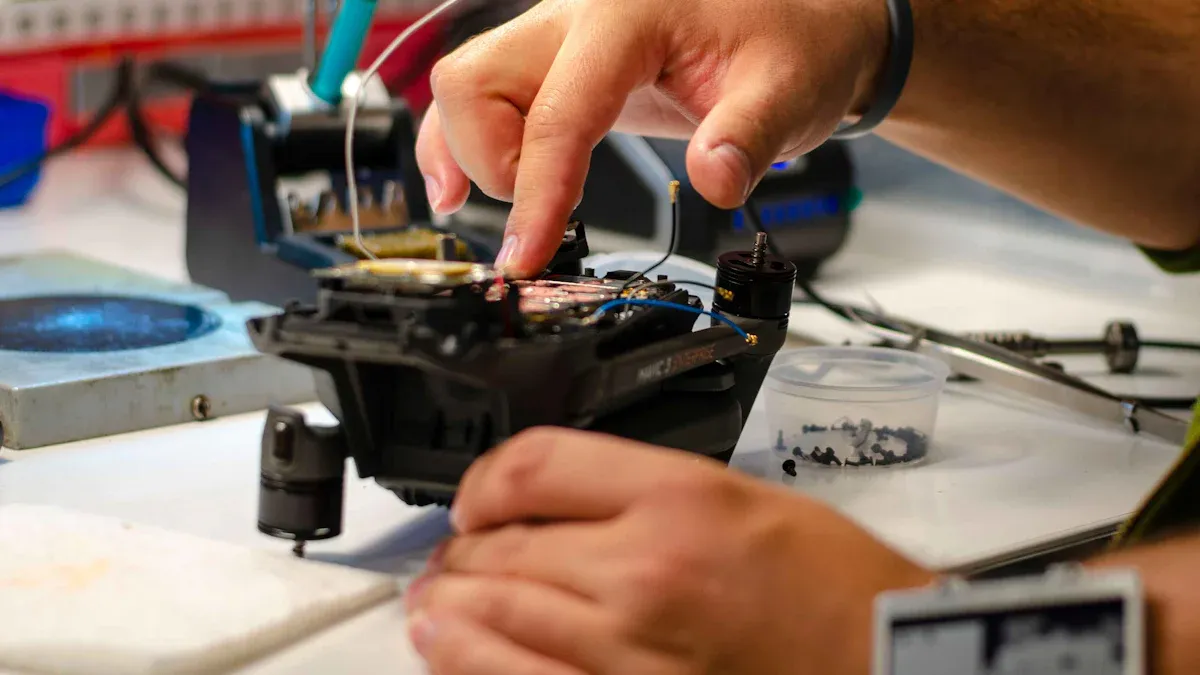
The SMT process has steps to make quality electronics. Each step is important for creating reliable products. The main steps are applying solder paste, placing components, and reflow soldering.
Solder Paste Application
Solder paste application is the first step in SMT assembly. It adds a thin layer of paste to the PCB. This paste helps stick parts to the board and conducts electricity.
Follow these tips for good results:
-
Let the paste warm to room temperature before opening it.
-
Stir the paste gently by hand for one minute. Avoid machines, as they can ruin the paste.
-
Use a stencil to apply paste evenly on PCB pads. Make sure the paste rolls smoothly during printing.
|
Category |
Tip |
|---|---|
|
Preparation |
Warm paste to room temperature before use. |
|
Stir by hand for even mixing. |
|
|
Stencil Application |
Use stencils for accurate paste placement. |
|
Add fresh paste often to keep quality high. |
|
|
Environmental Conditions |
Keep the workspace at 22°–26°C with 45% ± 5% humidity. |
Keep the workspace cool and dry to avoid problems like paste slumping. After applying the paste, move quickly to the next step to prevent drying.
Component Placement
Component placement is the most important part of SMT assembly. Machines place small parts (SMDs) onto the PCB where the paste is applied. Accuracy is key to align parts correctly.
Modern tools make placement faster and better:
-
Cameras check if parts are aligned properly.
-
Motion control systems move the PCB precisely.
-
Software creates diagrams to reduce mistakes.
-
Nozzles pick up and place parts accurately.
-
Monitoring systems warn operators about problems during placement.
These tools make placement quick and correct. Regularly cleaning feeders and nozzles prevents errors and keeps the process smooth.
Reflow Soldering
Reflow soldering is the last step in SMT assembly. It heats the PCB to melt the solder paste. This creates strong connections between parts and the board. Temperature control is very important to avoid damage.
Several things affect soldering quality:
-
The paste’s melting temperature.
-
The design of the PCB pads and stencil.
-
The reflow profile, including heat time and peak temperature.
Studies show that improving the reflow profile boosts alignment by 10%. Longer heat times and higher temperatures make better connections. Keeping the workspace stable during this step also helps.
Reflow soldering is key to making durable and functional products. Good settings ensure your SMT assembly meets top standards.
Inspection and Testing
Inspection and testing are important for making sure SMT assembly works well. These steps find mistakes early, saving time and money. Using smart tools helps factories make reliable products.
Why Inspection and Testing Matter
Every part of SMT assembly needs to be accurate. Small problems, like crooked parts or bad soldering, can cause devices to fail. Inspection and testing check if each PCB works as planned. They also catch problems before products are sold, avoiding recalls or breakdowns.
Common Inspection and Testing Methods
Factories use different ways to check and test SMT assemblies. Each method has a special job to make sure quality is good at every step.
|
Purpose |
|
|---|---|
|
Visual Inspection |
Checks bare boards, parts, and solder paste before assembly. |
|
Automated Optical Inspection (AOI) |
Uses cameras to find mistakes after reflow by comparing images. |
|
In-Circuit Testing (ICT) |
Tests how parts work to find missing or broken pieces. |
|
X-ray Inspection |
Looks at solder joints with X-rays to check their quality. |
These methods catch mistakes at different times. For example, visual checks find early issues, while AOI and X-rays focus on finished boards.
Tips for Effective Inspection
Follow these tips to get better inspection results:
-
Train Your Team: Teach workers how to use inspection tools correctly.
-
Use Good Equipment: Buy high-quality AOI and X-ray machines for better accuracy.
-
Set Clear Rules: Decide what good solder joints and alignment should look like.
-
Watch for Patterns: Study inspection data to fix repeated problems.
Pro Tip: Use more than one inspection method. For example, AOI finds surface problems, and X-rays check hidden solder joints.
Testing for Electrical Performance
Testing makes sure your PCB works in real-life situations. In-circuit testing (ICT) is very useful. It checks if parts work and finds missing or broken connections. Running these tests ensures your product works before shipping.
Inspection and testing are key for making great SMT assemblies. Using the right tools and methods helps meet industry rules and impress customers.
Advantages and Disadvantages of SMT Assembly
Benefits of Surface Mount Technology
Surface mount technology has many benefits for making modern electronics. A big advantage is its support for small designs. Tiny parts can be placed close together, fitting more on the board. This makes devices faster and able to do more in less space.
Another benefit is saving money when making lots of products. Machines handle most of the work, cutting labor costs and speeding up production. SMT also allows parts on both sides of the board, doubling the space for components.
|
Advantage |
Description |
|---|---|
|
Makes smaller, lighter devices with faster circuits. |
|
|
Saves money and time with automated assembly. |
|
|
Adds parts to both sides of the board. |
|
|
Improved Signal Integrity |
Shorter connections improve performance and reduce interference. |
|
High-Frequency Performance |
Works well for high-frequency signals with fewer problems. |
These features make SMT great for building fast, efficient, and powerful electronics.
Limitations of SMT PCB Assembly
Even with its benefits, SMT has some downsides. One problem is that the process is complicated. It needs special machines and trained workers, which can cost more at the start. Fixing SMT parts is also tricky. The small size and tight spacing make repairs harder to do by hand.
SMT parts can break more easily from heat because of their small size and light solder joints.
SMT is also not good for parts that get very hot or carry a lot of electricity. The solder joints might fail if exposed to extreme heat changes, which can make the product less reliable.
|
Disadvantage |
Description |
|---|---|
|
Complexity |
Needs advanced tools and skilled workers. |
|
Small parts and tight spaces make fixing harder. |
|
|
Solder joints can break under high heat or temperature changes. |
While SMT has many advantages, knowing its limits helps you choose the best option for your needs.
Components and Equipment in SMT PCB Assembly
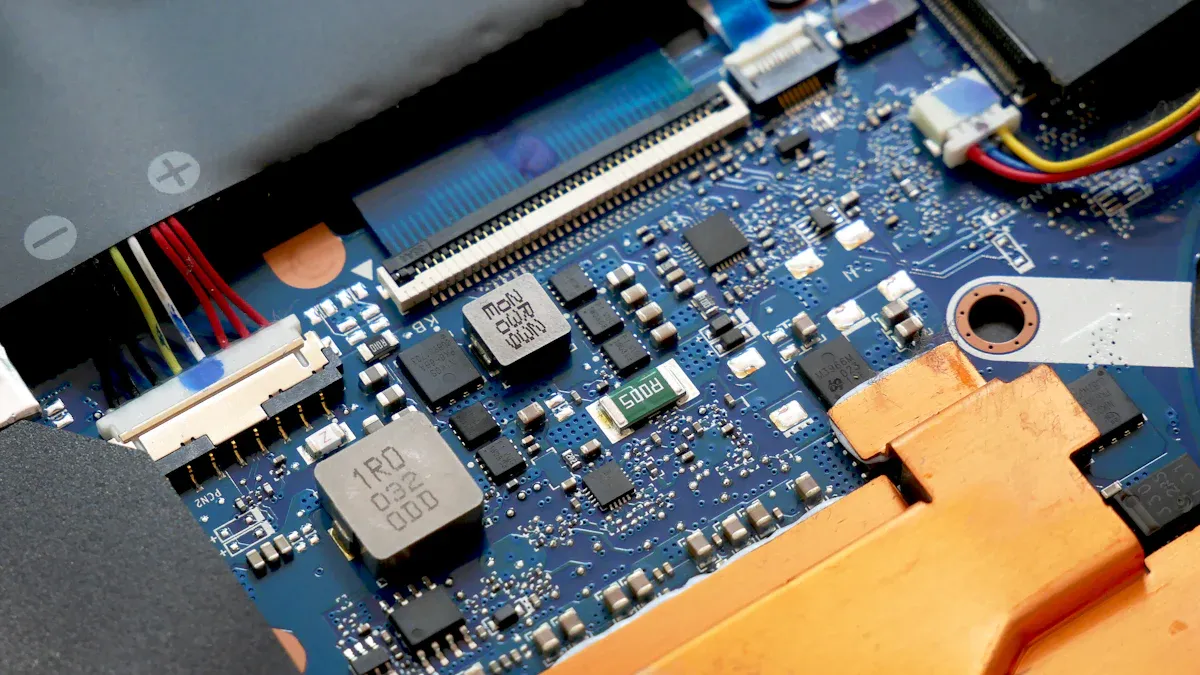
Types of SMT Components
SMT components, called surface mount devices (SMDs), are key parts of electronics. They are smaller and lighter than older components, making them perfect for compact designs. These components are divided into two groups:
-
Active Components: These include transistors, diodes, and integrated circuits (ICs). They need power to work and help process signals.
-
Passive Components: These include resistors, capacitors, and inductors. They don’t need power and control current and voltage.
Here’s a simple table of common SMT components:
|
Component Type |
Description |
|---|---|
|
Active Components |
Transistors, diodes, and ICs that need power to work. |
|
Passive Components |
Resistors, capacitors, and inductors that don’t need power. |
|
Inspection Equipment |
Tools like AOI and X-ray machines check for mistakes. |
SMT components come in sizes like 1206 (3.0 x 1.5 mm) and 603 (1.6 x 1.0 mm). These small sizes allow more parts to fit on a board, making devices more powerful.
Essential SMT Equipment
Special machines are used in SMT assembly to make sure everything works well. Important tools include:
-
Pick-and-Place Machines: These machines quickly and accurately place parts on PCBs.
-
Reflow Ovens: These ovens heat solder paste to connect parts to the board.
-
Inspection Tools: AOI and X-ray machines check for errors to ensure quality.
Using these machines speeds up production and reduces mistakes. For example, reflow ovens improve soldering, and AOI systems catch alignment problems early.
Role of Automation in SMT Assembly
Automation is very important in SMT assembly. It makes production faster, cheaper, and more reliable. Machines like pick-and-place systems help assemble parts quickly and with fewer errors.
Here’s how automation helps:
|
Benefit |
Description |
|---|---|
|
Machines save time and reduce mistakes, lowering costs. |
|
|
Faster machines meet market demands quickly. |
|
|
Improved reliability |
Shorter signal paths make devices work better and last longer. |
Automation also helps make smaller, smarter devices. As technology advances, automation keeps SMT assembly efficient and ready for new challenges.
Applications of Surface Mount Technology
Consumer Electronics
Surface mount technology helps make small and powerful gadgets. It’s used in phones, laptops, gaming consoles, and smartwatches. SMT lets makers add more parts to tiny boards, making devices faster and better.
The need for smaller electronics keeps growing. For example:
-
SMT inspection tools may grow from $885 million in 2023 to $1.65 billion by 2032. This is because devices are getting more complex.
-
The global SMT market might pass $6.29 billion in 2024 and reach $16.5 billion by 2037.
These numbers show how SMT helps build smarter and more reliable electronics.
|
Sector |
How SMT Is Used |
Why It’s Important |
|---|---|---|
|
Consumer Electronics |
Makes small and light circuit boards for many devices. |
Handles tiny parts and improves device performance. |
Automotive and Transportation
Cars use SMT for advanced features like electric batteries and self-driving systems. It helps make dense circuit boards for safety controls and entertainment systems.
Here are some examples:
-
A European car company used SMT to fix battery monitoring problems. Their solution is now in production and growing.
-
A global supplier needed a steering system part. New SMT lines helped meet strict rules, and they’ve supplied parts for four years.
These examples show how SMT improves car electronics, making them safer and more reliable.
|
Sector |
How SMT Is Used |
Why It’s Important |
|---|---|---|
|
Automotive |
Builds electronics for electric cars and self-driving systems. |
Helps with growing EV demand and better car features. |
Medical Devices and Healthcare
SMT has changed medical devices, making them more accurate and useful. It’s used in diagnostic tools, health trackers, and life-saving items like pacemakers.
For instance, SMT added biodegradable coatings to stents, improving patient care. SMT is also used in over 76 countries, showing its global impact.
Other benefits include:
-
Better imaging tools for accurate diagnoses.
-
Health monitors that give real-time data for doctors.
-
Improved treatments, like drug delivery systems for long-term illnesses.
SMT is key to modern healthcare, helping patients and creating new medical solutions.
|
Evidence Type |
What SMT Does |
Why It Matters |
|---|---|---|
|
Biodegradable Polymer Coating |
Adds special coatings to stents, making them work better. |
Improves medical device quality and patient outcomes. |
|
Global Presence |
Used in over 76 countries for healthcare manufacturing. |
Shows SMT’s worldwide importance in medical technology. |
|
Recognition |
Recognized by India’s government for helping heart health. |
Proves SMT’s role in advancing healthcare solutions. |
Aerospace and Defense
Surface Mount Technology (SMT) is very important in aerospace and defense. These fields need electronics that work well in tough conditions. SMT assembly helps make small, strong, and efficient circuit boards.
Aerospace systems use SMT for navigation, communication, and control. Small SMT components help create lightweight electronics for planes and spacecraft. These boards handle extreme heat, vibrations, and radiation. This makes sure systems like navigation and communication work perfectly during missions.
In defense, SMT assembly is used in radar, drones, and missile systems. Automation in SMT reduces mistakes and improves quality. This accuracy is critical for military tools, where even small errors can cause problems.
Why is SMT great for aerospace and defense?
-
It improves production quality and speeds up processes.
-
Automation lowers mistakes, ensuring reliable performance.
-
SMT is the main way to build PCBs in these fields.
-
Aerospace boards work well in harsh environments.
-
These boards are key for navigation and control systems.
Did You Know? Automation in SMT assembly places parts with extreme accuracy. This precision is vital for systems that must work perfectly under pressure.
By using SMT, aerospace and defense makers meet strict demands. The technology keeps systems reliable, efficient, and ready for modern challenges.
Challenges and Best Practices in SMT Assembly
Common Issues in SMT Manufacturing
Making products with SMT can have problems that slow things down. Factories may face shortages of materials or workers. Planning mistakes can also cause delays and raise costs.
For example:
-
IBM Bromont had delays from missing materials and fewer workers. They fixed this by planning better for the future.
-
A PCB factory had slowdowns at workstations. They added a new schedule system to speed things up.
|
Case Study |
Problems Found |
Solutions Used |
|---|---|---|
|
IBM Bromont |
Missing materials and fewer workers |
Made a long-term plan to balance work and supplies. |
|
PCB Factory |
Workstations slowing down |
Used better scheduling to improve speed and order completion. |
|
Chip Maker |
Poor planning with spreadsheets |
Upgraded tools to work faster and fill partial orders. |
Fixing these problems helps factories make SMT PCB assemblies faster and better.
Best Practices for Efficient SMT Processes
To make SMT PCB assembly work well, follow smart practices. Use traceability systems with software and hardware. These systems help check quality and meet rules.
Automated assembly lines are also helpful. They make work faster and more accurate. Inspection tools spot mistakes early, saving time and materials. Keeping stencil printing smooth ensures strong solder joints.
More tips for better results:
-
Use standard part sizes to avoid machine adjustments.
-
Work with suppliers to get good parts on time.
-
Add nano-coatings and lasers for better stencil printing.
Tip: Study production data often to find problems early. Fixing issues quickly improves how well your factory works.
By following these steps, you can make SMT PCB assembly faster and more reliable.
Future Trends in SMT Technology
Smaller and Denser PCBs
People want smaller, faster, and stronger devices. This pushes SMT assembly to improve. Miniaturization helps fit more parts on tiny boards. This is very important for gadgets like phones and laptops that need small designs.
New SMT methods, like custom PCBs and better assembly, make tiny devices more reliable. For example:
|
Evidence Type |
What It Does |
|---|---|
|
Small layouts shrink device size and fit more parts. |
|
|
Component Size |
Tiny SMT parts allow packed circuit designs. |
|
Thermal Management |
Heat-safe materials keep dense boards working well. |
These updates make SMT great for light, high-performing products. As people want smaller devices, SMT will keep improving to meet these needs.
AI and Robots in SMT Assembly
AI and robots are changing how SMT assembly works. Machines like pick-and-place tools put parts exactly where they belong. AI-powered tools find mistakes early, saving time and money.
AI also helps manage supplies and fix machines before they break. It studies data to make work faster and smoother. This matches Industry 4.0 ideas, which focus on smart factories.
The SMT equipment market shows this change. Experts say it will grow 5.67% yearly from 2025 to 2030. Its value may rise from $11.5 billion to $15.2 billion. This shows how AI and robots are making SMT faster and better.
Eco-Friendly SMT Manufacturing
Making SMT more eco-friendly is now a big goal. Companies are reusing materials and cutting waste. For example, Benchmark reused shipping boxes in 2023. This saved 37.7 metric tons of trash from landfills.
Benefits of being eco-friendly include:
-
Saving money by reusing materials.
-
Recycling and fixing more items.
-
Using less packaging.
|
Benefits of Reuse and Recycling |
Problems to Solve |
|---|---|
|
Saves money |
Hard to agree on reuse and repair plans. |
|
More recycling |
Suppliers don’t always share responsibility. |
Customers and governments want greener solutions. By going eco-friendly, SMT makers can meet these demands and help the planet.
SMT assembly has changed how we use modern electronics. It helps make small, powerful devices like phones and medical tools. As technology grows, new ideas like smaller parts, 3D designs, and smarter factories are coming. The industry is also working to be more eco-friendly, making electronics in a greener way. Learning about these changes can help you see how electronics will shape the future and affect your life.
FAQ
What’s the difference between SMT and SMD?
SMT is how parts are attached to a circuit board. SMDs are the small parts used in this process. Think of SMT as the method and SMD as the pieces.
Can SMT parts be fixed if they break?
Yes, but it’s harder than fixing older parts. Special tools like hot air stations are needed to replace broken pieces. You must be careful to avoid damaging the board.
Why is SMT better for today’s electronics?
SMT makes devices smaller, lighter, and faster. It allows more parts to fit on boards, which is great for phones, laptops, and medical tools. Machines also make production quicker and cheaper.
Are through-hole parts still used?
Yes, they are used in things like industrial machines and power systems. These parts handle heat and stress better than SMT parts.
How does automation help SMT assembly?
Automation makes work faster and more accurate. Machines like pick-and-place tools and cameras do repetitive tasks perfectly, so you can focus on creating new ideas.