Quality Inspection Service Providers for Electronic Components and Their Comparison to Industry Standards
Reliable Quality Inspection Service providers are very important in electronics. Comparing these providers to industry standards helps companies be more reliable.
Reliable Quality Inspection Service providers are very important in electronics. Comparing these providers to industry standards helps companies be more reliable. It also helps them follow rules and lower risks.
-
Industry standards give clear rules and help keep things the same. They stop big changes in quality.
-
These standards have safety rules to lower dangers and stop products from breaking.
-
Following these rules makes people trust the product more. It also helps the product sell better.
-
Obeying the law helps companies avoid fines and keeps their good name.
Provider skill, following standards, and picking carefully are needed for good results.
Key Takeaways
-
Quality inspection services find problems early. This keeps electronic parts safe and reliable. - Following industry standards helps companies follow safety rules. It also helps them earn customer trust. - Top providers use advanced tools like X-rays and AI. These tools help them find hidden defects fast and correctly. - Picking providers with the right certifications is important. Good reports also show they do high-quality inspections. - Regular training helps providers get better. Clear steps protect the supply chain from fake parts.
Quality Inspection Service Overview
Service Types
A Quality Inspection Service checks electronic parts in many ways. These checks help companies find problems early. They also help keep products safe and working well. The most common inspections are:
|
Inspection Type |
Description |
Frequency/Utilization Stage |
|---|---|---|
|
Looks at raw materials and parts for problems before making products. |
Done at the start to stop bad parts from being used. |
|
|
In-Process Inspection |
Watches products during making to find mistakes or things that do not match. |
Happens during production at certain times. |
|
Final Quality Inspection |
Checks finished products to make sure they look and work right. |
Done at the end before sending out products. |
|
Statistical Sampling |
Uses samples to check some products, saving time and money. |
Used at all inspection steps. |
Other ways to inspect include:
-
Looking for clear problems with your eyes.
-
Using a multimeter or oscilloscope to test electrical parts.
-
Testing how strong and easy to put together parts are.
-
Using X-ray and digital microscopes to see inside parts.
-
Using acid decapsulation to look at inside pieces.
Each type of Quality Inspection Service helps catch problems before customers get the products.
Industry Role
Quality Inspection Service providers stop bad or fake parts from getting into the supply chain. They follow steps to do this:
-
Check parts when they arrive to find fake or broken ones.
-
Use microscopes and tests to make sure parts are real.
-
Do a last check before shipping to send only good parts.
Note: These services also help with supplier programs and teach engineers. This helps companies buy from good sources and spot fakes fast.
Quality Inspection Service providers help keep the supply chain strong by:
-
Finding problems early, which saves money and time.
-
Stopping bad products from reaching customers.
-
Building trust by keeping quality the same.
-
Using set steps and trained workers to keep quality high.
The world market for these services is getting bigger. In 2024, it was $1.7 billion. By 2035, it may be $2.7 billion. This shows how important good inspection is for electronics makers.
Industry Standards

Key Standards
Strict industry standards are very important for checking electronic parts. They help keep products safe and reliable. These rules also make sure companies follow the law. Standards tell companies how to make good products. The table below lists some important standards and what they require:
|
Standard |
Scope and Key Requirements |
|---|---|
|
Quality management system; reduces complaints, lowers costs, and improves market opportunities. |
|
|
Electromagnetic compatibility; ensures products resist interference and function correctly in real-world environments. |
|
|
UL (Underwriters Laboratories) |
Safety testing and certification; validates components for safety and performance, especially for North America. |
|
RoHS |
Restricts hazardous substances; improves safety and environmental impact. |
|
SAE AS6081 |
Counterfeit mitigation; sets requirements for detecting and avoiding fake electronic parts. |
|
IDEA-STD-1010 |
Visual inspection criteria; helps identify counterfeit or substandard components. |
|
MIL-STD-202 |
Environmental testing; verifies durability under stress, vibration, and temperature extremes. |
|
IECQ |
Quality assessment for electronic components; supports global supply chain reliability. |
|
Electrostatic discharge (ESD) control; protects sensitive components from ESD damage. |
IPC-A-610 is used all over the world. It gives clear rules for checking electronic assemblies.
These standards cover things like safety, strength, and tracking parts. They help stop bad parts and fakes from getting through. They also help keep quality the same every time.
Certification Frameworks
Certification frameworks are important for making sure companies follow the rules. They make companies write down steps, train workers, and keep work areas safe. For example, ANSI/ESD S20.20 needs companies to have written ESD rules, teach workers, and ground workstations. Companies must pick ESD leaders, use safe materials, and check rules often.
-
All workers who touch sensitive parts must get training.
-
Workstations must be grounded and checked often.
-
ESD-safe packaging and handling keep parts safe.
-
Companies do checks and fix problems to get better.
-
Companies check suppliers to make sure they follow ESD rules.
Certification groups check if companies follow the rules. They do this every year to keep companies up to date. These frameworks help people trust the supply chain. They also lower risks from static or fake parts.
Leading Providers
Top Companies
Some companies are leaders in checking electronic parts. These companies are known all over the world. They have good reputations and follow industry rules. Here are some of the top companies:
-
Pro QC
-
Sensible Micro
-
IBS Electronics
-
SMT Corp
-
White Horse Laboratories
Other big companies are TÜV SÜD, Intertek, Met Labs, UL, Curtis-Straus, NTS, and Dayton T. Brown. These companies work in many countries. They join groups like ERAI to help find and report fake parts.
The best companies have these things:
-
Certifications like ISO 9001:2015, ISO 14001:2015, and SAE AS6081:2012
-
Strong quality systems
-
Good ways to stop fake parts
-
Follow international rules
-
Work in many places around the world
-
Good names and join professional groups
Companies with these strengths help make sure electronic parts are safe and high quality.
Service Highlights
Each top company has special services to help with checking electronic parts. The table below shows some important services and features:
|
Service Category |
Unique Offerings and Features |
|---|---|
|
Specialized Inspections |
Watch production, sort out bad parts, check suppliers online, and do checks for online stores |
|
Personalized Services |
Give each client a manager, make custom reports, and use checklists clients want |
|
Report Delivery |
Send reports fast, sometimes on the same day |
|
Geographic Coverage |
Inspectors work all over the world, especially in Asia |
|
Pricing |
Prices are clear and fair, with no secret costs |
|
Experience |
More than 18 years working in quality control |
|
Product Categories Covered |
Check many things like computers, phones, speakers, and accessories |
|
Factory & Supplier Audits |
Check factories for social and environmental rules and do big supplier checks |
|
Production Development |
Check first products and how things are made |
|
Production Quality Control |
Check before, during, and after making products |
|
Product Inspection |
Check products before shipping and watch when loading containers |
|
Laboratory Testing |
Test for rules like REACH, LFGB, and RoHS |
Many companies have their own labs with new technology. These labs use X-rays, digital microscopes, and acid decapsulation to look at parts. Companies use systems that can grow and change to handle lots of work and give quick results. In-house labs let companies control and change tests. Contract labs give more choices and special tests.
Top companies use their skills, new tools, and worldwide teams to give good Quality Inspection Service for electronic parts.
Provider Comparison
Standards Alignment
Top providers in electronics follow strict standards and certifications. These rules help them give safe and reliable inspection services. The table below shows how top providers match their work with big industry standards:
|
Standard/Certification |
Description |
Industry/Application |
Alignment Aspect |
|---|---|---|---|
|
ISO 9001 |
Quality Management System focusing on customer satisfaction, continuous improvement, and documented procedures verified by certification audits. |
General across industries |
Provides a framework for quality management systems ensuring consistent quality and process control. |
|
AS9100 |
Aerospace-specific quality management system incorporating ISO 9001 with added aviation, space, and defense requirements. |
Aerospace |
Ensures compliance with aerospace quality and safety standards required by manufacturers and suppliers. |
|
ISO/TS 16949 |
Automotive industry standard focusing on error avoidance and standardized requirements for development, production, and installation. |
Automotive |
Streamlines supplier certification, ensuring consistent quality across automotive supply chains. |
|
ISO 17025 |
Laboratory competence standard ensuring valid test results and calibration accuracy. |
Testing laboratories, research, regulatory bodies |
Demonstrates technical competence and management system compliance for reliable testing and calibration. |
Providers help their teams by getting certifications from the American Society for Quality. Some examples are Certified Quality Improvement Associate (CQIA) and Certified Quality Engineer (CQE). These show that workers know the rules and care about quality. Providers also join professional groups and follow government rules to keep their services current.
Strengths & Weaknesses
Top providers use special inspection methods to find problems early. This helps make products work better and last longer. The table below lists common inspection methods and what they do:
|
Inspection Method |
Defect Types Detected |
Improvement in Detection Rates and Benefits |
|---|---|---|
|
X-Ray Inspection (2D & 3D) |
Hidden solder defects, gaps, misaligned parts, internal faults in BGAs and multilayer PCBs |
Enables non-destructive internal inspection; AI-enhanced systems detect up to 99.9% of defects; 3D X-ray provides detailed volumetric views for complex designs |
|
Automated Optical Inspection (AOI) |
Visual defects such as weak solder joints, missing parts, solder bridges, open circuits |
Reduces false defect alerts by 18%, ensures consistent and reliable inspections, speeds up defect detection, lowers manual inspection costs |
|
Solderability Testing |
Weak solder joints and solder quality issues |
Ensures solder joints are strong and reliable, preventing early failures |
|
Functional Testing |
Electrical faults under simulated real-world conditions |
Verifies board functionality, detects operational faults that visual or X-ray inspections might miss |
|
In-Circuit Testing (ICT) |
Open circuits, shorts, improper connections |
Detects electrical faults at the component level, ensuring circuit integrity |
|
Burn-In Testing |
Latent defects under stress conditions |
Stresses boards with heat, voltage, and cycles to reveal hidden weaknesses, improving long-term reliability |
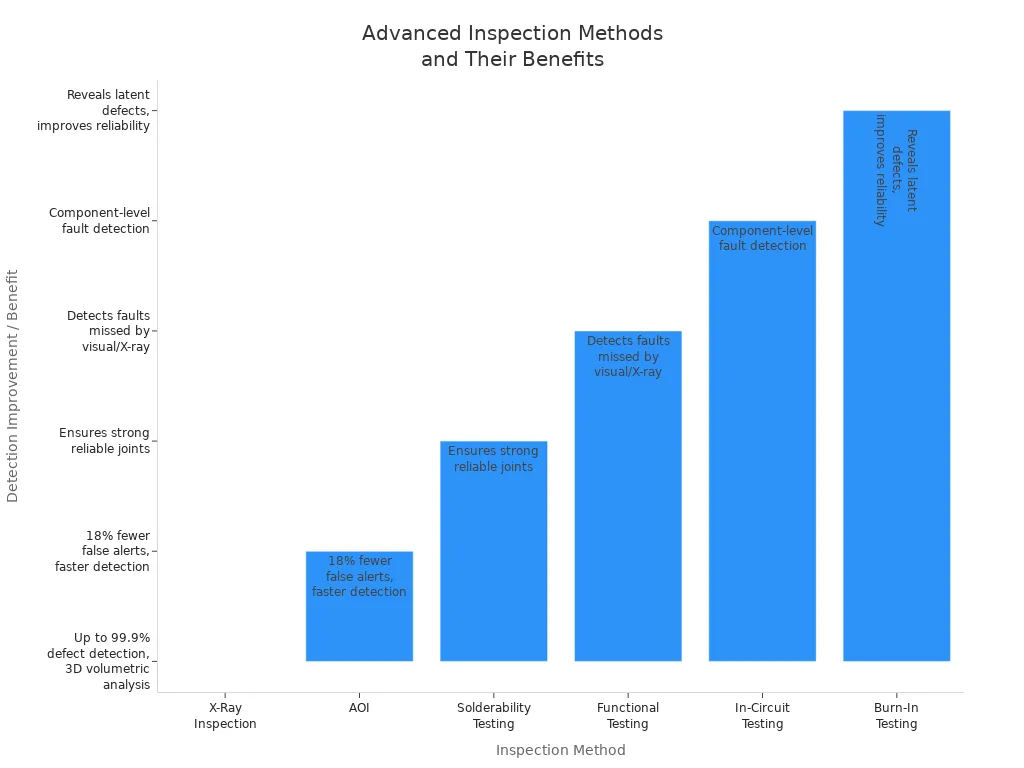
Providers with their own labs can test parts quickly and in many ways. They use X-ray, AOI, and solderability tests to find hidden and surface problems. Functional and in-circuit tests check if boards work right. Burn-in testing finds problems that only show up when stressed. These tests help providers catch more problems and make better electronic parts.
Reporting is another way providers stand out. The table below explains how different things affect reports and client choices:
|
Aspect of Reporting Practice |
Description |
Impact on Client Decision-Making |
|---|---|---|
|
Defined roles of quality managers, inspectors, and team leaders with specified escalation paths |
Ensures quick resolution of quality issues and accountability, enabling clients to trust the accuracy and timeliness of reports |
|
|
Documentation Systems |
Use of structured documentation and digital tools for real-time data collection and analysis |
Provides clients with transparent, comprehensive, and standardized quality data supporting informed decisions |
|
Inspection Procedures |
Detailed inspection and testing methods, including calibration and sampling |
Clients receive reliable and consistent quality information, reducing uncertainty in decision-making |
|
Non-Conformance Management |
Defined authority levels and corrective action procedures |
Clients benefit from timely corrective measures and prevention of recurring issues, enhancing confidence in quality outcomes |
|
Integration of Lean Six Sigma |
Continuous monitoring and data-driven improvements aligned with business goals |
Enhances reliability and effectiveness of reporting, supporting clients’ strategic quality decisions |
Strengths of Leading Providers:
-
They follow global standards and have certifications.
-
They use advanced inspection methods like X-ray, AOI, and burn-in testing.
-
They give fast and clear reports using digital tools.
-
Their staff have special industry certifications.
-
They offer flexible services for many industries.
Weaknesses to Consider:
-
Some providers cost more because they use new technology.
-
Smaller providers may not have every inspection method.
-
Not all providers work everywhere, so response times can change.
Tip: Companies should look at each provider’s inspection methods, certifications, and reports before picking a Quality Inspection Service. This helps make sure the provider meets industry standards and business needs.
Selection Tips
Accreditation
When picking a quality inspection provider, check their accreditations first. Accreditation groups make sure providers follow strict rules and have real skills. The table below shows some important accreditation groups in electronics:
|
Accreditation Body |
Description |
Relevance to Electronics Industry |
|---|---|---|
|
ANAB (ANSI National Accreditation Board) |
Biggest group for many types of accreditation in North America |
Makes sure inspection groups are skilled and fair |
|
UKAS (United Kingdom Accreditation Service) |
Main UK group for accreditation |
Checks inspection groups for electronics quality |
|
CNAS (China National Accreditation Service for Conformity Assessment) |
China’s main group for accreditation |
Makes sure electronics are made the right way |
|
EIAC (Emirates International Accreditation Centre) |
Dubai’s government group for accreditation |
Checks inspection groups for electronics quality |
|
IECQ (International Electrotechnical Commission Quality Assessment System) |
International group for electronic parts |
Focuses on quality in electronics supply chains |
|
Germany’s main group for accreditation |
Checks groups using world standards |
|
|
Certification programs for selling products worldwide |
Helps with product testing and certification everywhere |
Providers with these accreditations follow world rules and can be trusted.
Technology
New technology helps make inspections better and more exact. Providers using AI-powered machine vision can find tiny problems people may not see. These systems learn from lots of pictures and can check new products fast. They also make fewer mistakes and help keep quality high. For example, 3D vision and hyperspectral imaging can look inside parts and check what they are made of. Edge AI lets inspections happen right away on the production line, making things faster and easier. Providers with these tools can do hard jobs and give better results.
Expertise
A provider’s experience and knowledge are very important. Companies should pick providers who have:
-
Teams who know how to make and check products
-
Ability to make special plans for each client
-
Strong technical skills and hands-on practice
-
All services, like testing, certification, and clear reports
-
Honest and detailed test reports
-
Good name and happy clients
-
Training for workers all the time
-
Access to new equipment and can change when needed
Providers with these skills can fix hard problems and change when needed.
Compliance
Providers must keep up with new industry rules. They do this by joining groups, checking for risks, and keeping good records. They also get checked often and update their certifications, like ISO 9001. Providers work with experts and vendors to stay up to date with new rules and technology. They track every step to make sure they follow all the rules. This careful work helps clients trust that inspections meet the newest standards.
Tip: The best providers give custom services and help all the time. They listen to what clients want, use flexible systems, and always try to get better. This makes sure inspections fit each job and keep up with changes in the industry.
Quality Inspection Service Best Practices
Risk Mitigation
A good Quality Inspection Service uses many steps to stop fake and bad parts. Companies buy parts only from trusted and certified vendors. They keep records and use traceability systems to track each part. This starts when parts arrive and ends when they ship out. Tracking helps companies find and fix problems fast.
Regular checks look for problems with labels, codes, and packaging. Teams use special tools like X-ray analysis and chemical tests to find fakes or defects. In-house labs and certified engineers do these tests to meet strict standards. Staff learn how to spot fake parts and use safe packaging to stop tampering.
Detailed reports and records help companies prove parts are real and high quality. Each part gets a barcode, and records can be checked anywhere. This system helps companies act fast if there is a problem.
Continuous Improvement
Best practices include regular audits and training for staff. Companies check themselves at least once a year to find problems. They update rules to match new industry standards and use technology to keep records current.
Staff join training with case studies and quizzes. This helps everyone learn about new risks and rules. Companies use data to find risky areas and see how they fix problems. They ask staff to help with quality and share ideas.
Self-checks, feedback, and rule updates help companies improve over time. These steps keep inspection services strong and ready for new problems.
Picking providers who follow or go beyond industry standards helps keep electronic parts safe and dependable. When companies check and compare providers carefully, they get many good things:
-
They lower risks by using up-to-date data and digital tools.
-
They keep the supply chain strong by spotting problems early and having more than one supplier.
-
They follow new rules and do not make expensive mistakes.
-
They keep products safe from fake parts and protect customers.
-
They make good relationships with suppliers and work better.
Companies should always choose Quality Inspection Service providers who follow standards and can be trusted.
FAQ
What is the main purpose of a quality inspection service provider?
A quality inspection service provider looks for problems in electronic parts. They check for broken or fake parts. This helps companies keep products safe and working well. It also makes sure they follow important rules.
How do inspection providers detect counterfeit electronic parts?
Providers use special tools like X-ray machines and microscopes. They also use chemical tests to check parts. Labels, barcodes, and packaging are checked too. These steps help find fake or bad parts before customers get them.
Why do industry standards matter in electronic component inspection?
Industry standards give clear rules for safety and quality. When providers follow these rules, companies avoid problems and follow the law. This also helps customers trust the products.
What certifications should a reliable inspection provider have?
A good provider has certifications like ISO 9001, AS6081, and IECQ. These show the provider uses strong quality checks and works to stop fake parts.
Can inspection services be customized for different products?
Yes. Providers can make special inspection plans for each product. They look at what the product is, how risky it is, and what the client wants. This way, every inspection fits the project’s needs.