Power Line Communication: Technical Principles and Industrial Applications
Power line communication sends power and data through electrical wires. This technology lets factories and utilities share information using wires they already have.

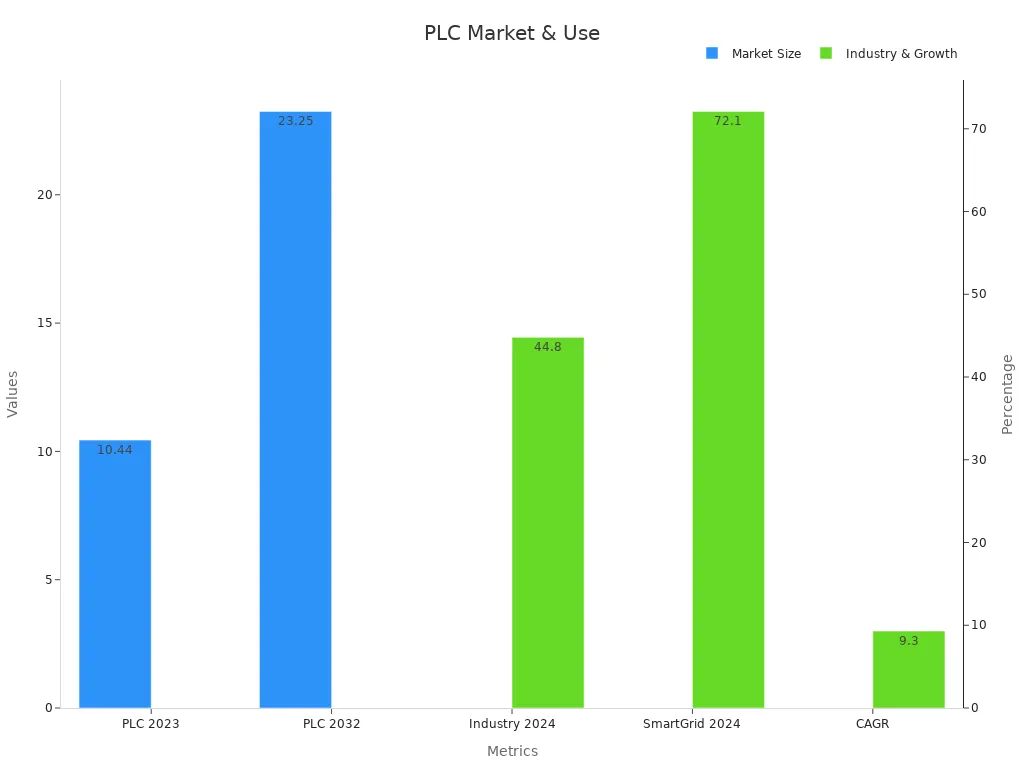
Power line communication sends power and data through electrical wires. This technology lets factories and utilities share information using wires they already have. It is a cheaper choice for many industries. In 2023, the global PLC market was worth USD 10.44 billion. Industrial use made up 44.8% of this market. The table below shows important numbers:
|
Metric/Segment |
Value/Percentage |
|---|---|
|
Global PLC Market Size (2023) |
USD 10.44 Billion |
|
Forecast Market Size (2032) |
USD 23.25 Billion |
|
CAGR (2023-2032) |
9.3% |
|
Industrial End-Use Market Share |
44.8% |
|
Energy Management & Smart Grid Share |
72.1% |
Many industries use power line communication for automation and maintenance. Studies show that power line communication is often more reliable than wireless. It also costs less when wires are already in place.
Key Takeaways
-
Power line communication sends data and power through power wires. This saves money and time because you do not need new cables.
-
Narrowband PLC is good for long-distance and steady communication. It works well in loud and busy factories. Broadband PLC is faster but works best for short distances.
-
PLC helps smart grids and factories watch and control machines right away. This makes energy use better and helps with automation.
-
Using PLC lowers repair costs and helps with checking things from far away. It sends data safely over power lines, even in hard places.
-
In the future, PLC will get faster and connect more IoT devices. It will use new technology like AI to make it quicker, safer, and more flexible.
Technical Principles
Power Line Communication Basics
Power line communication sends power and information through the same wires. Factories and utilities do not need to put in new cables. A power line communication modem puts a special signal onto the power line. Receivers take away the normal 50 or 60 Hz power and get the data. Utilities use wave traps to stop high-frequency signals from reaching sensitive equipment. Coupling capacitors safely connect transmitters and receivers to high-voltage lines. These capacitors let carrier signals pass but block the main power. Repeaters help signals travel far without getting weak. This makes sure information moves well over long distances. Power line transmission can send messages one way or both ways. This is important for smart grids and industrial automation.
Note: Power line communication lets utilities send commands and get data. This helps them watch and control things in real time.
Data Transfer Methods
Sending data over power lines uses different methods for good results. Early systems used simple ways like amplitude shift keying and frequency shift keying. Newer systems use digital wire technology, like orthogonal frequency-division multiplexing, to send more data and use less power. Tests like RFC 6349 and TCP throughput check how well these systems work. These tests look at speed, delay, and how often data must be sent again. Field tests use the same setups to get fair results. Statistical design sets rules for what counts as good and checks for bias. This helps make sure each method works well. Industries use this information to pick the best way to send data.
Modulation Techniques
Modulation techniques are very important in power line transmission. Amplitude modulation, frequency modulation, and phase modulation are often used. Binary phase shift keying works well when there is a lot of noise. The bit error rate for binary phase shift keying is BER = 1/2 erfc(√(Eb/No)), where Eb is bit energy and No is noise spectral density. Digitalize and Forward methods make the signal clearer by taking out noise before sending it again. This lowers the bit error rate. Advanced systems use many subcarriers and fast symbol rates. For example, 16-QPSK modulation can send data at 36 Mbps with a symbol time of 4000 ns and about 83% efficiency. Modulation efficiency is η = (m² Px) / (1 + m² Px), which shows how well power is used to send information. Tests in factories show that noise and interference are common. So, checking the site and watching the system all the time is needed for good communication.
Frequency Bands
Picking the right frequency band is very important for strong power line communication. The low voltage grid has different impedance, signal loss, and noise. These things change how well signals move. Field tests help find the best bands for factories. The table below shows important bands and how they work:
|
Frequency Band |
Description |
Performance Metrics |
Techniques Used |
|---|---|---|---|
|
10 kHz - 95 kHz (CENELEC A) |
Narrowband PLC for industrial use |
OFDM: up to 32 kbps at ~4 dB SNR; FSK: 2 kbps at 12 dB SNR, BER 10^-4 |
OFDM with coding, interleaving for noise reduction |
|
10 kHz - 490 kHz (FCC band) |
Wider band, higher data rates |
Effective rates >100 kbps |
OFDM with adaptive tone mapping, robust mode |
|
10 kHz - 450 kHz (ARIB band) |
Similar to FCC in bandwidth and performance |
Similar improvements as FCC band |
OFDM with advanced channel coding, robust mode |
Techniques like adaptive tone mapping and channel estimation help use frequencies better. Two layers of forward error correction and mesh routing make the system more reliable and safe.
Channel Challenges
Power line communication has some problems with the channel. Power lines were not made for sending data, so there is noise, interference, and signal loss. Impulsive noise causes bit errors, especially in narrowband channels. Tests show that phase shift keying works better than amplitude or frequency shift keying when there is noise. Broadband channels also have noise, which changes the channel transfer function and error rates. Signal loss gets worse at higher frequencies, and channel impedance changes over time. These things make it hard to keep data moving smoothly. Noise checks in buildings show high noise, especially from 3 to 30 MHz. Engineers use advanced modulation, error correction, and always watch the channel to fix these problems.
Tip: Good power line communication needs people to know about noise, signal loss, and changes in the channel.
Types of PLC
Narrowband PLC
Narrowband PLC uses low-frequency bands from 3 kHz to 500 kHz. It sends data over power lines in factories and other places. This type works well because it can handle noise and tricky wiring. Engineers pick narrowband PLC for smart meters and remote control. It gives steady connections, even when there is a lot of noise.
Long studies show that noise in narrowband PLC channels follows certain patterns. These patterns change how well data moves. In factories, narrowband PLC keeps packet error rates under 10%. This is important for smart meters. The bit error rate can get better by up to 10 dB compared to wireless at a BER of 10^-3. This makes narrowband PLC a good choice for factory automation.
|
Statistical Measure |
Importance in Industrial NB-PLC |
|---|---|
|
Noise Characterization |
Changes how protocols are made and work |
|
Signal-to-Noise Ratio |
SNR above 4 dB is needed for good results |
|
Packet Error Rate |
Should be less than 10% for smart meters |
|
Bit Error Rate |
10 dB better than wireless at BER 10^-3 |
|
Impedance Variations |
Changes signal strength and quality |
Note: Narrowband PLC protocols like PRIME and G3-PLC have different speeds and strength. PRIME can send data faster but may not handle distortion as well.
Broadband PLC
Broadband PLC uses higher frequencies from 1.8 MHz to 250 MHz. This lets it send data much faster. It is good for fast internet and home networks. Broadband PLC can send up to 500 Mbps over short wires. But the speed drops if the wires are long. For example, at 200 meters, speed can go below 80 Mbps because of signal loss.
Broadband PLC changes how it sends data based on signal-to-noise ratio. This helps keep data moving. But if it changes too much, it can slow down and become less steady, especially with lots of noise. The kind of cable also matters. Some cables let data move faster, while others lose more signal.
Broadband PLC works best where people need fast data, like smart grids and monitoring systems. It can send data quickly, but it may not be as steady as narrowband PLC in noisy factories.
Electrical Distribution Networks
Infrastructure Overview
Electrical distribution networks are very important for getting power to people. These networks have high voltage power lines that move electricity far. Medium voltage lines take power from substations to towns and factories. Low voltage lines bring power right to homes, offices, and factories. Each part helps make sure power gets where it should go safely.
Most countries built these networks over many years. The power lines reach cities, small towns, and even the countryside. Engineers made these systems to carry lots of electricity. They also made them strong so they last a long time. Because these networks already reach almost every building, they are good for new things like power line communication.
Power line communication uses the same wires that carry electricity. This means companies do not need to put in new wires or dig up roads.
Integration with PLC
Power line communication works well with electrical distribution networks. Engineers put PLC devices at important spots in the network. These devices send and get data signals while electricity moves through the wires. This works on all parts of the network, from high voltage lines to low voltage lines.
This way saves a lot of money. Companies use the wires they already have. They do not need to pay for new wires or build wireless towers. Maintenance teams can check equipment and fix things faster. PLC helps utilities and factories get more out of their power lines.
Tip: Using PLC with electrical networks lets companies improve their systems without spending a lot of money.
Industrial Applications

Smart Grids
Smart grids use power line communication to link devices and systems. Utilities put smart meters in homes and factories. These meters send data over power lines to control centers. Street lights use PLC to change brightness and report problems. This helps people watch and control the grid right away, making it more reliable.
-
PLC uses wires that are already there, so it costs less and upgrades are faster.
-
Narrowband PLC is good for sending data far, like for meters and finding problems.
-
Broadband PLC is better for fast data in cities and advanced energy work.
-
Hybrid PLC mixes both types to be more flexible.
-
Governments help PLC grow by giving support and money.
|
Metric/Segment |
Statistic/Value |
Significance for Smart Grid Management |
|---|---|---|
|
Global Market Size (2024) |
Shows how big the PLC market is now |
|
|
Projected Market Size (2034) |
USD 32.6 billion |
Means PLC will keep growing a lot |
|
CAGR (2025-2034) |
10.8% |
Tells us the market is growing fast |
|
Energy Management & Smart Grid Share |
72.1% |
Most PLC is used for smart grids |
|
Narrowband PLC Market Share |
66.4% |
Narrowband is picked for long-distance smart grid jobs |
|
Hardware Segment Share |
61.2% |
Shows hardware is very important for PLC |
|
Industrial End Use Share |
44.8% |
PLC is used a lot in factories and energy systems |
|
North America Market Share (2024) |
48.4% (USD 5.6 billion) |
North America uses PLC the most for smart grids |
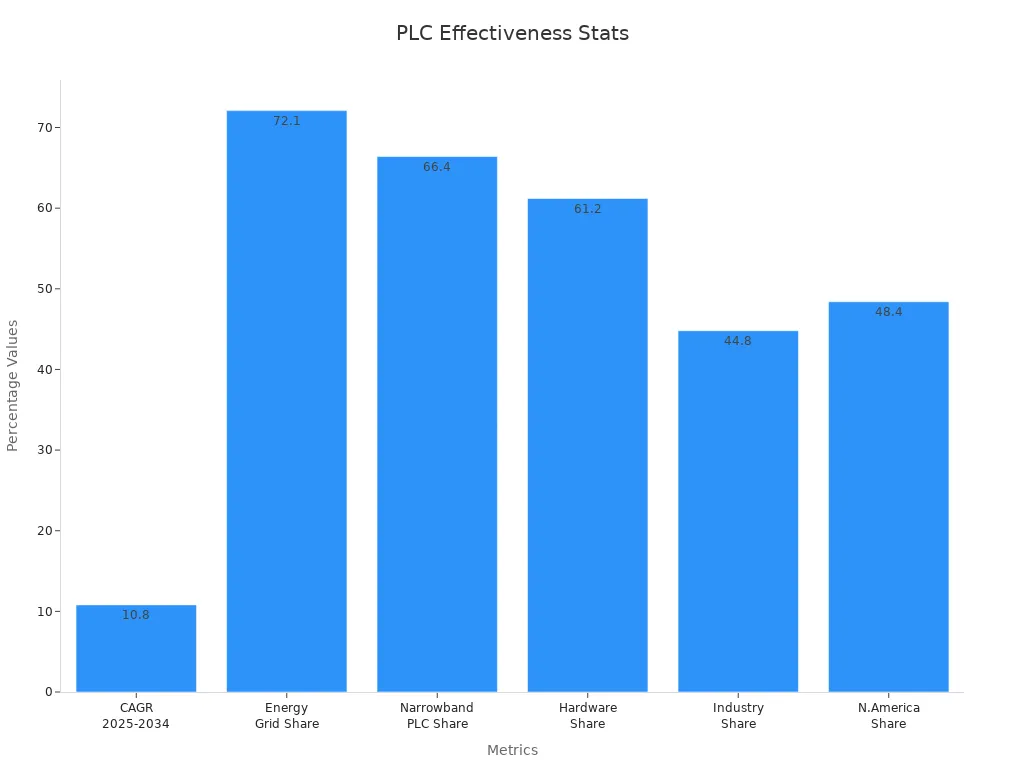
Smart grids with PLC can find problems, fix themselves, and manage energy better. They use things like dynamic thermal rating, demand response, and energy storage. PLC helps connect solar panels and electric cars. Utilities can send commands and get data right away. This makes the grid more flexible and better for the environment.
Note: Smart grids need PLC to send information well, but engineers must solve problems like making sure devices work together and keeping data safe.
Industrial Automation
Factories use power line communication to control machines and processes. PLC connects sensors, controllers, and robots without needing new wires. This makes setting up faster and saves money. PLC helps control conveyor belts, check motors, and manage lights. City street lights also use PLC to turn on and off at the right times.
-
PLC is easy to use in old or new factories.
-
Two-way communication lets workers watch and control machines from one place.
-
Automation networks can grow and change easily with PLC.
|
Application Example |
PLC Benefit |
Resulting Improvement |
|---|---|---|
|
Conveyor Belt Control |
Real-time data exchange |
Faster response to changes |
|
Motor Monitoring |
Continuous status updates |
Early fault detection |
|
Lighting Automation |
Remote scheduling |
Lower energy use |
Engineers have to deal with noise and making sure devices work together. They use special ways to keep signals clear. Standards help different devices talk to each other. Checking and updating systems often makes them work better.
Tip: Using PLC in factories cuts down on repairs and saves money, so factories run better.
Remote Monitoring
Remote monitoring uses power line communication to get data from far away machines. Factories and utilities watch pumps, transformers, and sensors all the time. PLC sends data over long distances, even in tough places. This helps companies find problems early and plan fixes.
|
Feature |
Performance Data |
Relevance to PLC in Remote Industrial Monitoring |
|---|---|---|
|
Amplifier Power Consumption |
Less than 400 µA per amplifier (OP1177 family) |
Lets people watch up to 128 channels with little power, which is good for far away places |
|
Data Isolation Technology |
iCoupler® digital isolators with data rates up to 100 MSPS and 2.5 kV isolation |
Makes sure data moves fast and safely over power lines, even in hard places |
|
Isolated RS-485 Transceiver |
Supports data rates up to 20 Mbps with 2.5 kV isolation (ADM2486) |
Helps send data quickly and safely in industrial PLC networks |
|
Signal Processing Capability |
ADSP-BF531 Blackfin DSP processor for FFT/DFT calculations |
Lets people study signals and find problems in power line signals |
Remote monitoring systems need to use little power and keep data safe. PLC uses digital isolators and special amplifiers to do this. Advanced signal processing helps find problems fast. These things make PLC a good choice for watching oil fields, water plants, and power stations.
Note: PLC helps remote monitoring by giving strong data links, even where wireless does not work.
Future Trends
Emerging Standards
Power line communication standards keep changing as people want faster and better data sharing. Studies say the PLC market will grow from $11.43 billion in 2024 to $20.51 billion by 2029. This means it will grow by 12.4% each year. New rules and devices help this growth. One example is Qualcomm’s QCA7006AQ, which works for smart grids and cars that connect to the grid. These devices use HomePlug Green PHY rules, so they fit energy and smart city needs. Companies like Qualcomm, Cypress Semiconductor, STMicroelectronics, and Texas Instruments are leaders in making these new tools. They work on hardware, software, and services for homes, businesses, and factories. People want things to work faster and use less energy, so companies keep improving. Because of this, industries will get better PLC systems for smart factories and cities.
IoT Integration
Power line communication helps connect Internet of Things devices in factories and smart grids. Some trends show how this is happening:
-
The PLC market should reach $18.04 billion by 2031. It will grow by 9.3% because of smart grids and more IoT devices.
-
New tech like G.hn, G3-PLC, adaptive modulation, and stronger cybersecurity make PLC faster and safer.
-
PLC uses wires that are already there, so it saves money and time for factories.
-
Factories use PLC to link sensors and controllers. This lets them watch and control things right away.
-
Companies like ABB, Schneider Electric, and Siemens spend money to make PLC better for IoT in factories.
-
Engineers try to fix problems like signal loss and noise, so PLC works even better.
Innovation in PLC
New ideas are shaping the future of power line communication. Engineers make new chips and programs to send more data and cut down on mistakes. Artificial intelligence and machine learning help PLC systems change quickly when things are different. Smart cities use PLC for street lights and traffic, especially in North America. As more things connect to the grid, PLC needs to be faster and safer. Companies test new ideas in real factories and cities to make sure they work. These steps help PLC stay a good choice for talking between machines in the future.
Power line communication is very useful in factories and other industries. It sends data and power through the same wires that are already there. This helps companies save money because they do not need to put in new wires. PLC can work with many kinds of lights. It lets people control things right away. You can use PLC in places like factories, parking lots, and solar farms.
-
You can turn lights and machines on or off using normal powerlines
-
It helps check how much energy is used and if something is wrong
-
It makes wiring easier in cars and buildings
These things make PLC a good choice for today’s industries.
FAQ
What is the main advantage of power line communication in factories?
Power line communication uses the wires already in the building. This means companies do not need to buy new cables. It saves money and makes upgrades faster. Factories can keep working with less time stopped.
Can power line communication work with wireless networks?
Yes. Many factories use both PLC and wireless together. Using both helps cover more places and makes the system stronger. Engineers mix them to fit different jobs.
How does PLC handle electrical noise?
Engineers use special ways to send signals and fix mistakes. These help PLC systems block out noise and keep data clear. Checking the system often also helps it work better.
Is PLC safe for sensitive equipment?
|
Safety Feature |
Description |
|---|---|
|
Wave Traps |
Stop high-frequency signals |
|
Coupling Capacitors |
Block power surges |
These tools keep sensitive machines safe from bad signals.
Where do companies use PLC most often?
-
Smart grids
-
Factory automation
-
Watching machines from far away
-
Controlling street lights
These uses help companies send data well and save money.