Power Line Communication and how data travels through your electrical wiring
Power Line Communication and how data travels through your electrical wiring

You may be surprised, but your home's wires can carry more than electricity. With power line communication, you send data through the same wires as your lights and appliances. This technology uses high-frequency signals. These signals travel with the normal electrical current. You do not need new cables. Power line communication separates the frequencies for data and electricity. This lets both use the same wires without causing issues.
Key Takeaways
-
Power line communication lets data move through your home's electrical wires. This means you do not need to put in new cables.
-
There are two main types of PLC. Narrowband is for simple and slow things like smart meters. Broadband is for fast internet and streaming at home.
-
PLC is good in places where Wi-Fi is weak. It gives you strong and fast internet when you plug adapters into wall outlets.
-
Interference and signal loss can make PLC work less well. Using the right frequency bands and filters helps keep your connection strong.
-
Always use encryption and keep your devices updated. This protects your data and keeps your power line network safe.
Power Line Communication Basics
How It Works
You can use powerline technology to send electricity and data together. A device makes a data signal first. It changes digital information into a modulated signal. This signal travels with the normal electrical current. You do not need new cables for this.
Power line communication puts high-frequency data signals on the low-frequency power wave. Think of the powerline as a highway. Electricity is like a slow truck. The data signal is a fast sports car. Both move together but stay in different lanes. The wires in your house act like a waveguide. They carry high-frequency signals without mixing them with the power current.
Modern powerline technology uses special modulation methods. Orthogonal Frequency Division Multiplexing (OFDM) splits the data signal into smaller channels. This helps avoid noise and interference. Devices use error correction codes. These codes keep the data reliable, even with some electrical noise.
Tip: You can plug a powerline adapter into any outlet. The adapter sends the modulated signal through the wires. Another adapter gets the signal in a different room. This makes sending data easy and fast.
Power line communication hardware has transceivers. These change electrical signals into digital data and back. Engineers use special tools to test how well the system works. These tools check for errors and measure signal strength. They help make the powerline network more reliable.
Frequency Bands
Powerline technology uses different frequency bands. This keeps data and electricity separate. Standard power uses a very low frequency, like 50 or 60 Hz. Data signals use much higher frequencies, usually above 3 kHz. This stops the two signals from mixing.
Different uses need different frequency ranges:
-
Low frequencies (24 kHz to 500 kHz) are good for smart meters and grid communication.
-
Medium frequencies (100 kHz to 1 MHz) are used for indoor device communication.
-
High frequencies (above 1 MHz) work for broadband internet over power lines.
Rules limit the frequency bands for powerline communication. These rules stop interference with radio and wireless services. For example, many broadband systems use up to 100 MHz. They must follow strict rules to avoid problems for radio signals.
|
Frequency Range |
Typical Use Case |
Data Rate |
|---|---|---|
|
24 kHz – 500 kHz |
Smart grids, metering |
Low (hundreds of bps) |
|
100 kHz – 1 MHz |
Home automation, device control |
Medium (kbps) |
|
2 MHz – 100 MHz |
Broadband internet, streaming |
High (Mbps) |
Powerline technology can change frequency and modulation to fit different places. This lets you use broadband for fast internet or narrowband for simple controls. The powerline network can send many types of data. It is a strong tool for homes and businesses today.
PLC Types and Applications
Narrowband vs Broadband
There are two main types of powerline technology. One is narrowband, and the other is broadband. Narrowband works at lower frequencies, under 500 kHz. It is good for sending small amounts of data. People use it for smart meters and grid control. Broadband uses much higher frequencies, up to 250 MHz. It can send lots of data very fast. This makes it great for high-speed internet and streaming.
Here is a quick comparison:
|
Aspect |
Narrowband PLC |
Broadband PLC |
|---|---|---|
|
Frequency Range |
Up to 250 MHz |
|
|
Data Rate |
Low (hundreds of bps to kbps) |
High (up to 240 Mbps) |
|
Typical Use |
Smart grid, metering |
Broadband over power lines, internet |
|
Latency |
Higher |
Lower |
|
Robustness |
Good for simple needs |
Advanced error correction |
Narrowband is used for smart grid technology and meter reading. Broadband brings fast internet and gigabit connections to homes.
Home Networking
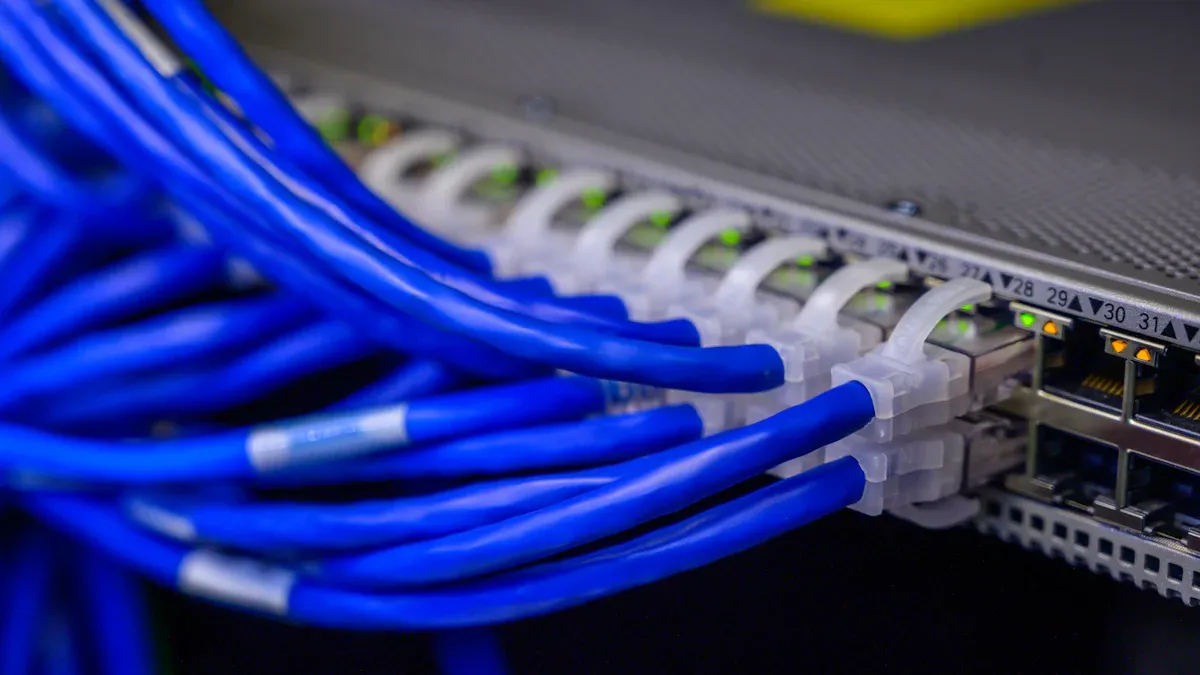
You can use broadband over power lines for a fast home network. Plug a powerline adapter into any wall outlet. It sends broadband signals through your house wiring. Another adapter in another room gets the signal. This gives you fast internet without needing new cables.
Tests show broadband powerline networks work for streaming and gaming. They also work for smart home devices. Standards like IEEE 1901 and HomePlug help devices work together. You get reliable broadband and fast speeds for all your needs.
Tip: Use broadband over power line in rooms with weak Wi-Fi. You get strong, fast internet anywhere you have an outlet.
Smart Grids
Powerline technology is important for smart grids. Utilities use narrowband for meter reading and control. Broadband helps with advanced grid monitoring and management. You can find powerline networks in cities and factories. They give reliable communication, even with electrical noise.
Smart grid technology needs powerline for safe, real-time data. This keeps your electricity supply steady and efficient. Powerline also helps manage home energy and connects smart home devices to the grid.
Performance and Compatibility
Data Speeds
Powerline systems give different data speeds. The speed depends on the technology and frequency band. Modern broadband PLC standards use frequencies from 2 to 30 MHz. These can reach up to 500 Mbps. That is fast enough for internet and streaming. Narrowband PLC works at lower frequencies. It can go up to 234 kbps. In most homes, you get about 200 Mbps. This is good for video calls and gaming.
|
PLC Category |
Frequency Band |
Typical Data Speeds / Throughput |
|---|---|---|
|
Broadband PLC (IEEE 1901-2010) |
2–30 MHz |
Up to 500 Mbps |
|
Narrowband PLC (IEEE 1901.2) |
10–490 kHz |
Up to 234 kbps |
|
High-frequency PLC |
Around 2–100 MHz |
Around 200 Mbps |
Note: Your home’s wiring and electrical noise can change the speed.
Range and Reliability
Powerline works best inside one building. You can send a data signal up to 300 meters. The range depends on your wiring and how many devices you use. Reliability can change because of noise and interference. Other electronics can cause problems. Things like mains impedance and RF impedance affect the signal. Real homes have more problems than lab tests show. International standards help design better systems. But there are still some gaps in the rules.
-
Appliances can make noise and hurt the signal.
-
Big networks may need more setup to work well.
-
Safety and electromagnetic rules also matter for reliability.
Device Support
You can connect many devices to a powerline network. Compatibility depends on the standards your devices use. Newer standards help different brands work together. Companies keep making these standards better. This helps performance and makes devices work together. Researchers tested powerline with smart batteries. They checked bit error rates and symbol error rates. These tests show PLC works with smart grids, electric vehicles, and home automation. You can use your old wiring. You do not need new cables for each device.
Tip: Use adapters and devices with the same PLC standard for best results.
Challenges
Interference
Power line communication has many problems with interference. The wires in your house were made for power, not data. They pick up noise from things like appliances and light dimmers. Even radio signals from outside can add noise. This noise can mess up your data and slow your network.
A study called "Accurate Impedance Measurement Technology for Power Line Communication Considering Noise Interference" talks about these issues. It says noise, impedance mismatch, and changing loads make things tricky. The researchers made a new way to measure impedance. They used multi-frequency signals and real-time processing. This helps them get better results, even with noise. The study also found that impedance changes with frequency. This can change how well your data moves through the wires.
Reports from Switzerland and Austria talk about wireless emissions from PLC systems. These reports show PLC can sometimes cause radio interference. This happens mostly in the HF bands. Many groups work to stop this interference and protect other services.
Note: Filters and picking the right frequency bands can help lower interference in your power line network.
Signal Attenuation
Signal attenuation means your data signal gets weaker as it moves. Many things can cause this, like resistance and impedance mismatches. The skin effect also makes signals weaker. When the signal gets weak, your data slows down and is less reliable.
Engineers use decibels (dB) to measure how much the signal drops. They check how much weaker the signal is at the end of the wire. Impedance mismatches can cause return loss. This makes the signal bounce back and causes more errors. Simulations show higher frequencies lose more signal. Twisting wires in the cable can help stop some of these problems.
|
Aspect |
Description |
|---|---|
|
Higher frequencies lose more signal because of the skin effect and poor shielding. |
|
|
Eye diagram |
Shows how the signal shape changes, which makes it harder for devices to read data. |
|
Crosstalk |
Noise from one wire can get into another, but twisting wires helps block this noise. |
Security
Security is very important for power line communication. Your data moves through wires that others in the building can reach. This makes it easier for someone to listen or attack your network.
A report from the National Research Council says power line systems are part of the electric grid’s critical infrastructure. More devices on the grid bring new risks. Articles about cybersecurity in power grids talk about hacking and malware. They also mention unauthorized access. Experts say you should use strong network security and protect your devices. You should update your devices often. Use secure protocols and watch your network for strange things.
Tip: Always use encryption and keep your devices updated to protect your power line network from cyber threats.
When to Use Power Line Communication
Ideal Scenarios
You might wonder when PLC is the right choice. PLC works in many places because it uses your current wiring. Here are some simple things to think about:
-
Frequency needs: Pick narrowband PLC for slow data and long distances, like smart meters or grid control. Use broadband PLC for fast data, like streaming or gaming at home.
-
Application type: PLC is good for smart grids, home networks, building automation, and cars. It also helps machines talk to each other in factories.
-
Cost savings: PLC saves money since you do not need new wires.
-
Speed and reliability: Broadband PLC gives fast internet and video. Narrowband PLC gives steady connections over long distances.
-
Environment: PLC works in homes, offices, and factories. Lots of electrical noise can make it work less well, so check your area.
-
Market trends: More smart grids, smart homes, and electric vehicles use PLC every year.
-
Region: North America and Europe use PLC a lot because they have strong rules and good wiring.
You can see how PLC fits in different places in this table:
|
Scenario / Application |
PLC Suitability |
Advantages |
Limitations |
|---|---|---|---|
|
Smart Grids |
Highly suitable |
Uses old wires, reliable, low delay |
Noise near transformers |
|
Home Networks |
Suitable |
Easy to set up, works with smart devices |
Not much coverage |
|
Building Automation |
Suitable |
Cheap, helps save energy |
Needs to grow with building |
|
Industrial Automation |
Suitable |
Reliable, works with machines |
Lots of electrical noise |
|
Densely Populated Areas |
Advantageous |
Saves money, proven technology |
Depends on the place |
|
Environments with heavy noise |
Less suitable |
— |
Works worse with noise |
Tip: PLC is great for things that stay in one place, like smart meters, sensors, or home hubs. It is best when you want to connect lots of devices without adding new wires.
PLC vs Wi-Fi
You might wonder if PLC or Wi-Fi is better for you. Both have good and bad points. PLC uses your electric wires, but Wi-Fi uses radio waves. Here is a simple comparison:
|
Metric / Condition |
Power Line Communication (NB-PLC) |
Wi-Fi (RF) |
Notes |
|---|---|---|---|
|
Up to 200 kbps (NB-PLC); higher for BB-PLC |
Up to several Gbps |
Wi-Fi is faster for big files |
|
|
Signal Penetration |
Good through walls and metal |
Weaker through obstacles |
PLC works better in thick buildings |
|
Reliability in Noise |
Strong in noisy places |
Can drop with interference |
PLC handles noise better |
|
Setup |
Just plug in adapters |
Needs router and good signal |
PLC uses your wall outlets |
|
Scalability |
Good for many fixed devices |
Good for moving devices |
Wi-Fi is better for phones and tablets |
PLC gives a steady connection where Wi-Fi has trouble, like thick walls or noisy factories. Wi-Fi is better for things that move and open spaces. You can use both together for the best results.
Note: Pick PLC if you want a wired-like connection without new wires, especially for smart home devices or places where Wi-Fi is weak.
Power line communication lets you send data through your home’s electrical wiring. You can use your existing wires for both power and internet. Many studies show PLC works well in real homes and businesses. You save money because you do not need new cables. PLC gives you a strong network for smart devices, streaming, or business needs.
Think about your space and needs. PLC could be the right choice for your next network upgrade.
FAQ
What devices can you connect with power line communication?
You can use power line communication with many devices. It works with computers, smart TVs, and game consoles. You can also connect smart home devices. Power line adapters work with most things that use Ethernet. You just need a power outlet and the right adapter.
Does power line communication slow down if you use many devices?
Yes, the speed can get slower with more devices. Each device uses part of the total bandwidth. If many devices are working, you might see slower speeds.
Can power line adapters work in old houses?
Power line adapters usually work in old houses. The quality of your wiring matters for how well it works. If the wires are damaged or on different circuits, you might get lower speeds.
Is power line communication safe for your data?
Power line adapters use encryption to keep your data safe. You should always use a strong password. This helps stop people from getting into your network.
Will power line communication interfere with Wi-Fi or radios?
You might notice some interference with radios on some frequencies. Most new adapters have filters to help with this problem. Power line communication does not mess up your Wi-Fi signal.