Oscillator Integrated Circuits: Types, Applications, and Selection Guide for Electronic Design
Oscillator integrated circuits make steady signals. These signals help electronic systems work well. You need oscillators for exact timing and frequency control. Devices like computers, phones, and clocks use them.
Oscillator integrated circuits make steady signals. These signals help electronic systems work well. You need oscillators for exact timing and frequency control. Devices like computers, phones, and clocks use them. These circuits are very important for keeping things in sync. They also help with communication in electronic design. Linear and nonlinear oscillator types have special uses. Some make smooth sine waves. Others make square or pulse signals. Modern oscillator ICs can keep frequency very steady, about ±50 ppm. They can have jitter as low as 0.1 ps. Their phase noise can be as low as -138 dBc/Hz.
|
Parameter |
Typical Value |
Context |
|---|---|---|
|
Frequency stability |
±50 ppm |
Crystal oscillators over time and temperature |
|
Jitter |
as low as 0.1 ps |
Enables better timing margins and SNR |
|
Phase noise |
-138 dBc/Hz at 1 kHz |
Indicates low noise performance |
Picking the right oscillator for your design is important. It helps your electronic device work well and saves energy.
Key Takeaways
-
Oscillator ICs make steady signals. These signals help devices work on time and together.
-
There are many types of oscillators. Some are linear, nonlinear, crystal, RC, LC, MEMS, and programmable. Each type has a special job in electronics.
-
Picking the right oscillator depends on what frequency you need. You also look at stability, power use, output type, temperature range, package, and cost.
-
New MEMS and programmable oscillators are very small. They are reliable and easy to set up. This makes them good for hard places to work.
-
Oscillator ICs are important in many areas. They are used in consumer electronics, communication, cars, factories, and medical devices.
Oscillator Integrated Circuits Overview
What Are Oscillator ICs
Oscillator integrated circuits make steady signals in electronics. These circuits are very important for timing and clocks. An oscillator IC uses power to make a regular signal. The signal is often a square or sine wave. This signal helps other parts keep time. You can find oscillator ICs in computers and smartphones. They are also in digital watches.
Oscillator ICs have changed a lot over time. The first phase-shift oscillator circuit was made in 1958. Early oscillator ICs had only a few parts. They used some transistors, resistors, and capacitors. Later, engineers put more transistors on each chip. The table below shows how oscillator ICs got better:
|
Integration Level |
Transistor Count |
Time Period |
Examples and Significance |
|---|---|---|---|
|
10-100 transistors |
1960s |
Early oscillator ICs, simple timing circuits |
|
|
Medium-Scale Integration (MSI) |
100-1,000 transistors |
Late 1960s-1970s |
More complex oscillator circuits and logic |
|
Large-Scale Integration (LSI) |
1,000-10,000 transistors |
1970s |
Used in early microprocessors |
|
Very Large-Scale Integration (VLSI) |
10,000-1 million transistors |
1980s |
Enabled modern computing and advanced clock generation |
|
Ultra-Large-Scale Integration (ULSI) |
Over 1 million to billions of transistors |
1990s-2000s |
Supported powerful computers and SoCs |
|
System-on-Chip (SoC) |
Billions of transistors |
2000s onwards |
Integrated oscillator ICs with processors and memory |
|
3D ICs and Advanced Packaging |
Vertical stacking |
2020s onwards |
High-density, efficient oscillator circuits |
Why Oscillators Matter
Oscillators are needed in every electronic device you use. They help with data transfer and communication. Without a good oscillator, devices would not work right. Oscillator ICs help with clock generation and frequency control. They also help make signals for Wi-Fi and GPS.
Today, companies want smaller and better oscillator ICs. They want high frequency stability and low power use. You can see these changes in phones and wearables. 5G networks also use these new oscillator ICs. Asia-Pacific makes most oscillator ICs, but other places are growing too. Companies like Microchip, Murata, and Silicon Labs try to make the best oscillator ICs.
Tip: When you pick an oscillator IC, think about the frequency, stability, and size you need for your project.
Oscillator ICs help cars, smart homes, and medical devices work well. You use their accuracy and reliability every day. As technology gets better, oscillator ICs will get smaller and smarter. This will help your devices work even better.
Types of Oscillator ICs
Oscillator ICs come in many types. Each type has special features and uses. Some circuits make smooth, repeating signals. Others make sharp, digital pulses. Knowing the differences helps you pick the right one for your project.
Linear Oscillators
Linear oscillators make smooth, sinusoidal signals. You use these when you need a clean and steady frequency. They work well in audio, radio, and communication systems. The LM324 is a common example. It gives low input offset voltage and low input bias current. This means less noise and more exact signals. You can use it for pulse width modulation, tone generation, and voltage-controlled oscillators.
Here are some reasons why linear oscillators are good for electronics:
-
They keep a steady output even if things change.
-
They use less power, which is good for batteries.
-
They have low noise, so signals stay clear.
-
They work well even when the temperature changes.
The table below shows how linear and nonlinear oscillator ICs are different:
|
Performance Aspect |
Linear Oscillators |
Nonlinear Oscillators |
|---|---|---|
|
Frequency Bandwidth |
Narrow, steady |
Wide, adapts to random and changing vibrations |
|
Dynamic Behavior |
Single stable state |
Can have multiple stable states and chaotic effects |
|
Output Power |
One peak in average output |
Two peaks in average output due to nonlinear effects |
|
Load Performance |
Best with resistive loads |
Works better with resistive-reactive (RL) loads over a wide frequency range |
|
Efficiency Strategy |
Power factor correction, load tuning |
Similar, but considers nonlinear dynamics |
Linear oscillators are reliable for most steady-state uses.
Nonlinear Oscillators
Nonlinear oscillators make signals that are not smooth, like square or pulse waves. These ICs can do more complex jobs. You use them when you need a wider frequency range or want to handle changing conditions. Nonlinear circuits can have more than one stable state and even act in a chaotic way. This helps with energy harvesting and advanced signal processing.
You might use nonlinear oscillators for:
-
Projects that need to handle random or changing vibrations.
-
Designs where you want to get more power and efficiency at low conductance.
-
Circuits that use double peaks in output power.
Nonlinear oscillators often use special math and analysis to work better.
Crystal Oscillators
Crystal oscillators use a quartz crystal to set the frequency. You use these when you need high accuracy and stability. Crystal oscillators are found in clocks, computers, and communication devices. They help keep systems in sync.
The table below lists important features of crystal oscillators:
|
Specification / Feature |
Description |
Typical Values / Examples |
|---|---|---|
|
Equivalent Circuit |
Quartz crystal acts like a series-parallel RLC circuit |
Defines frequency behavior and resonance |
|
Frequency Range |
Standard frequencies from ~10 kHz to 30 MHz |
Common: 1 MHz, 4 MHz, 10 MHz, 16 MHz |
|
Quality Factor (Q) |
Measures sharpness of resonance; higher Q means better stability |
10,000 to 100,000 |
|
Frequency Tolerance / Stability |
Expressed in ppm; shows max frequency error |
10 MHz crystal with 100 ppm tolerance = 1 kHz max error (0.01%) |
|
Resonance Modes |
Series and parallel resonance; depends on mode and load capacitance |
Used below 30 MHz |
|
Overtone Mode |
Crystals can vibrate at odd multiples for higher frequencies |
3rd, 5th, 7th overtones |
Crystal oscillators can be very precise, up to ±1.5 parts per billion. They may change with temperature, so some designs use temperature compensation or digital control. Crystal-controlled oscillators are best for timing in important electronics.
Note: Crystal oscillators can be affected by electromagnetic interference, vibration, and humidity. Always think about where you will use them.
RC and LC Oscillators
RC and LC oscillators use resistors, capacitors, and inductors to set the frequency. RC oscillator ICs are good for low-cost, low-frequency jobs. LC oscillator circuits work better at high frequencies and are more stable.
Here is a table comparing RC and LC oscillators:
|
Metric |
RC Oscillator (Ring) |
LC Oscillator (LC-tank) |
|---|---|---|
|
Frequency Variation (PVT) |
Up to ~31.46% |
Around 7-9% |
|
Phase Noise (1 MHz offset) |
-82 dBc/Hz |
-110 dBc/Hz (better) |
|
RMS Jitter |
9.51 ps |
0.44 ps (lower) |
|
Power Consumption |
~18 mW |
<3 mW |
|
Area |
0.021 mm² |
0.061 mm² |
RC oscillators are cheap and easy to put on a chip. But they do not handle temperature and voltage changes well. LC oscillators are more stable and have less phase noise. This makes them good for radio and high-frequency uses. Voltage-controlled oscillators often use LC tanks for better accuracy.
Some oscillator ICs use both RC and LC circuits together. This lets you cover more frequencies and get better accuracy.
MEMS and Programmable Oscillators
MEMS and programmable oscillator ICs use silicon technology. You find these in modern devices where size, reliability, and flexibility are important.
MEMS oscillators give you:
-
High resistance to shock, vibration, and temperature changes.
-
Very small chip size.
-
No need for extra parts, which saves space and money.
-
Programmable output frequency, voltage, and rise/fall times.
Programmable oscillator ICs let you set the frequency and other settings after making the chip. This makes design faster and easier. MEMS oscillators put the resonator and oscillator circuit in one package. They often include temperature compensation and voltage regulators.
|
Technical Aspect |
|
|---|---|
|
Manufacturing Process |
Silicon-based, fewer defects, higher reliability |
|
Environmental Resilience |
Operate from -55˚C to +125˚C, robust against shock, vibration, and EMI |
|
Programmability |
Field programmable frequency, voltage, and stability |
|
Integration |
Resonator and oscillator circuit in one chip, includes PLL and temperature compensation |
|
Design Simplification |
No need for external buffers or dividers, reduces complexity |
|
Application Suitability |
Used in AI data centers, automotive, aerospace, and communications |
You should use MEMS and programmable oscillator ICs when you need high reliability, small size, and easy setup. These oscillators often work better than old types in tough places and hard jobs.
Tip: MEMS oscillators and programmable ICs help you finish projects faster and make your system more reliable.
Oscillator ICs in Applications
Consumer Electronics
Oscillator ICs are used in many electronics you use every day. Phones, tablets, and laptops need exact timing to work right. Oscillators help these devices connect to Wi-Fi, Bluetooth, and 5G. The need for oscillator ICs is getting bigger each year. In 2023, the market was worth $4.06 billion. By 2032, it could be $5.0 billion. Most of this growth comes from DC-10 MHz oscillators. These circuits help your favorite gadgets keep good timing. New designs focus on saving power and making things smaller. This means your devices last longer and fit in your pocket.
|
Statistic Description |
Value/Detail |
|---|---|
|
Global Oscillator ICs Market Size (2023) |
USD 4.06 billion |
|
Projected Market Size (2032) |
USD 5.0 billion |
|
Key Devices Using Oscillators |
Smartphones, laptops, tablets |
|
Drivers of Growth |
5G, Wi-Fi 6, IoT, miniaturization |
Communication Systems
Oscillator ICs are very important in communication systems. You need them for steady signals in 5G, satellite, and microwave networks. These circuits give stable frequency, small size, and low power use. Quartz crystal and BAW oscillators keep signals steady and quiet. Voltage-controlled oscillators let you change frequencies for different uses. OCXOs give the best stability for GPS and telecom. Good timing is needed for data transfer and syncing. Without a good oscillator, your calls and internet would not work.
-
Microwave oscillators on chips help new 5G and photonic systems.
-
Single-chip oscillators make devices smaller and stronger.
-
Oscillators create carrier signals and timing for communication.
Microcontroller Oscillator Uses
Almost every electronic device has a microcontroller oscillator circuit. These circuits set how fast your microcontroller works. You can pick internal RC oscillators, external crystal oscillators, or MEMS oscillators. Internal RC oscillators are cheap and start up fast, but are less accurate. External crystal oscillators are more stable and exact. MEMS oscillators are tiny and handle shocks well. You have to think about cost, accuracy, and power when choosing one.
Tip: Use a low-power oscillator in battery devices to save energy.
Industrial and Automotive
Oscillator ICs are used in factories, robots, and electric cars. They help machines run on time and avoid mistakes. MEMS oscillators work well in tough places. They can handle shaking and big temperature changes. In cars, oscillator ICs help control batteries, engines, and safety systems. Crystal oscillators like SMD3215 meet strict car rules. They have very low jitter and are very reliable. You count on these circuits for safe and smooth driving.
|
Metric / Feature |
MEMS Oscillators |
Quartz Oscillators |
|---|---|---|
|
Failure Rate |
Below 1 DPPM |
Higher due to fragility |
|
Operating Temperature Range |
Up to 125°C |
Narrower range |
|
Automotive Standards |
Often less compliant |
Medical and Specialized
Oscillator ICs are used in medical and special devices. You find them in implants, brain recording, and wireless health monitors. Super-regenerative oscillators and injection-locked frequency dividers help with low-power signals in implants. Ring oscillator-based ADCs record brain signals clearly. These circuits must be quiet and very reliable. You trust oscillator ICs for safe and correct medical devices.
-
CMOS transceivers use oscillators for Medical Implant Communication Service.
-
Oscillator ICs help send wireless data in implants.
-
Special oscillators make signal processing in medical devices more exact.
Note: Oscillator ICs affect chip design, performance, and security in many fields. You get better reliability and accuracy in every use.
Oscillator IC Selection Guide
Picking the right oscillator helps your system work well. You want your device to be accurate and reliable. There are many things to think about before you choose. This guide will help you look at your options and pick the best one for your circuit.
Frequency and Stability
First, check what frequency your project needs. Some oscillators are good for low frequencies. Others can go up to very high frequencies. Frequency stability shows how much the output changes over time or with temperature. If the stability is high, your device keeps good timing even if things change.
Quartz crystal oscillators are great for keeping steady timing. That is why they are used in devices that need exact time. SPXO types are good for most uses. TCXO models keep the frequency steady even when it gets hot or cold. SAW oscillators are used for wireless signals because they have low phase noise. VCXO types let you change the frequency a little with a control voltage. This is helpful in telecom and phase-locked loop circuits.
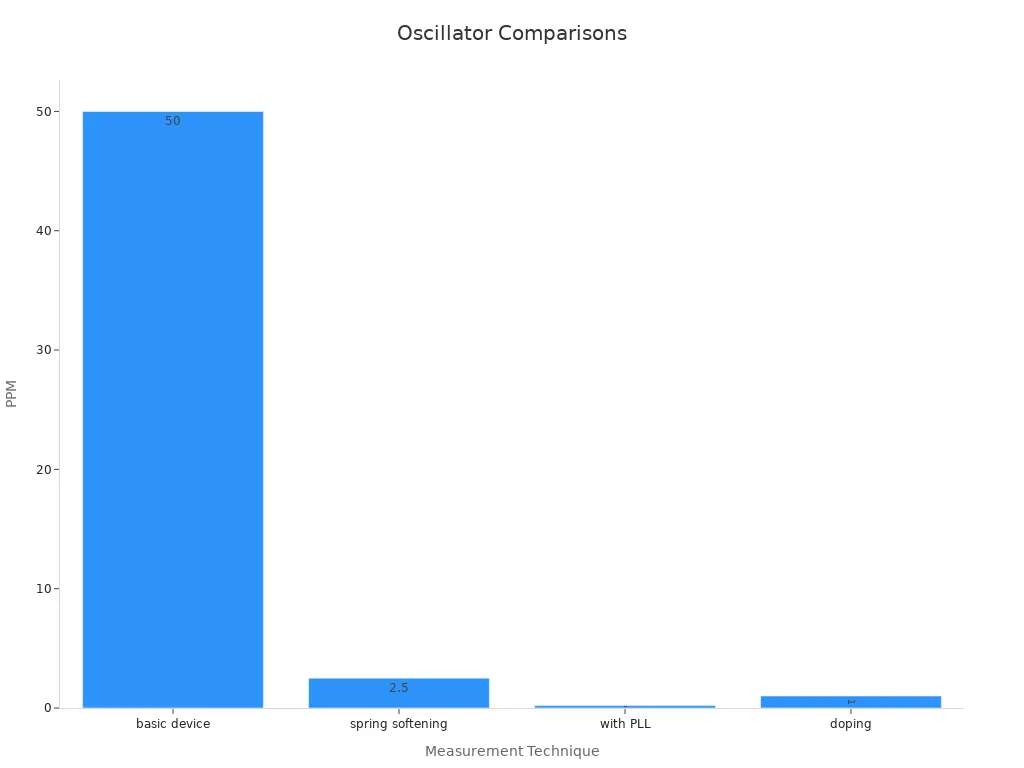
MEMS oscillators have gotten better at keeping steady frequency. They can go from ±50 ppm to 0.2 ppm with special tricks. Doping and PLL methods can make them even more stable. The chart below shows how different methods help with temperature changes:
Tip: For the best timing, pick an oscillator with low TCf and high stability. This helps your device stay on time in any condition.
Output and Waveform
You need to pick the right output and waveform for your system. Sine wave outputs are best for analog RF and communication. They have smooth signals and low noise. Square wave outputs are used in digital electronics. They give sharp timing signals.
Different oscillators give different waveforms. Quartz and SAW types give clean and accurate signals. MEMS and ceramic types can also work well, but you should check their signal quality. DDS technology uses less power and gives flexible waveforms. PLL-based designs have very pure signals but are not as easy to tune.
|
Technology |
Power Consumption |
Spectral Purity |
Tuning Flexibility |
Waveform Flexibility |
Implementation Complexity |
|---|---|---|---|---|---|
|
DDS |
Low |
Medium |
High |
High |
Low |
|
DAC + FPGA |
Medium |
Medium-High |
Yes |
Medium |
High |
|
Analog PLL |
Medium |
High |
No |
Low |
Medium |
Think about how fast the oscillator starts up. Fast start-up is good for systems that need to work right away.
Power and Temperature
Power use is important, especially for battery devices. MEMS and new crystal oscillators use less power. If you want your battery to last, pick one with low power use.
Temperature can change how steady the frequency is. TCXO and MEMS types handle temperature changes well. Tests like MTOL show that higher frequencies can make the oscillator heat up and age faster. You should check how reliable your oscillator is, especially if your device will get hot or cold.
-
MEMS oscillators work from -55°C to +125°C.
-
Crystal oscillators may not work in as wide a range but are very accurate.
-
MTOL testing helps you know how long your oscillator will last.
Note: Always look at the temperature range and power use in the datasheet before you buy.
Package and Integration
Oscillator ICs come in many package types. SMT lets you put parts right on the board. This saves space and makes things more reliable. Plastic packages are cheap and easy to use. Some designs use two chips or 3D stacking for better performance.
|
Packaging/Integration Type |
Description |
Impact on Performance and Application |
|---|---|---|
|
Mounted on PCB surface |
High density, compact, reliable |
|
|
Chip Packaging |
Protective encasing |
Better durability, longer life |
|
Dual-Chip Packaging |
Two chips in one |
Space-saving, multifunctional |
|
Through-Hole Packages |
Leads through PCB holes |
Strong, but less suited for high frequency |
|
3D IC |
Vertical stacking |
Shorter interconnects, better energy use |
|
Mixed-Signal IC |
Analog + digital in one |
Multifunctional, common in modern designs |
Pick a package that fits your board and can handle your environment. For high-frequency or tough places, 3D ICs or strong chip covers can help your device work better.
Cost and Availability
Price and how easy it is to get the part matter too. MEMS oscillators often cost less because they use simple parts. Quartz oscillators can cost more because they use special materials.
-
More people want small, accurate oscillators for 5G, IoT, and cars.
-
MEMS and silicon types are smaller and use less power, which saves money.
-
Tariffs and supply problems can make prices go up or cause delays.
-
Surface-mount oscillators are popular because they are easy to put on boards.
|
Estimated Market Share (%) |
Innovation Focus and Response to Market Challenges |
|
|---|---|---|
|
SiTime Corporation |
18-22% |
AI-powered MEMS oscillators, ultra-low jitter, customizable timing solutions |
|
Murata Manufacturing Co. |
14-18% |
AI-enhanced crystal oscillators, temperature compensation, compact IoT solutions |
|
TXC Corporation |
12-16% |
AI-optimized quartz oscillators, automotive-grade products |
|
Epson Electronics America |
8-12% |
AI-assisted timing products including VCXOs, TCXOs, SAW oscillators |
|
Abracon LLC |
6-10% |
AI-driven low-power, high-frequency clock generators for RF and industrial use |
Plan for possible delays and think about having extra parts or more than one supplier.
Selection Checklist
Use this checklist to help you pick the right oscillator:
-
What frequency does your project need?
-
How steady and accurate does it have to be?
-
What output and waveform work best (sine, square, differential)?
-
What is the most power it can use?
-
What temperatures will your device face?
-
What package fits your board and environment?
-
How much can you spend?
-
Are there risks of delays or shortages?
-
Do you need voltage control or programmable features?
-
How important are phase noise, start-up time, and load sensitivity?
|
Selection Criteria |
Key Considerations |
|---|---|
|
Frequency & Stability |
Needed frequency, stability, TCf, accuracy |
|
Output & Waveform |
Sine/square/differential, purity, phase noise, start-up time |
|
Power & Temperature |
Power use, temperature range, reliability, MTOL/HTOL data |
|
Package & Integration |
SMT, chip, dual-chip, 3D IC, mixed-signal, board space, mechanical needs |
|
Cost & Availability |
Price, supply chain, tariffs, lead time, extra suppliers |
|
Special Features |
Voltage control, programmability, resistance to environment, vibration/shock rating |
Remember: The best oscillator balances stability, accuracy, power, and price. Always check datasheets and test your choice to make sure it works well.
Oscillator integrated circuits help many electronic devices work. There are different types you can pick for your project. Each type is good for things like timing, talking between devices, or control. If you pick the right features, your device will work better. Use the selection guide to look at your choices for your next project. For harder projects, you should learn more or ask someone who knows a lot. This way, you can make sure your device is strong and works well every time.
FAQ
What is the main job of an oscillator IC?
An oscillator IC makes a steady signal. This signal helps your device keep time. It also controls the frequency in your device. This makes your electronics work right. It keeps everything working together.
How do I choose the right oscillator IC for my project?
First, think about what frequency you need. Check how steady and strong the signal should be. Look at how much power it uses and how big it is. Read the datasheet for each IC. Pick one that fits your device and your budget.
Can I use MEMS oscillators instead of crystal oscillators?
Yes, you can use MEMS oscillators in many devices. MEMS types are good for small and tough gadgets. They can handle shaking and big temperature changes. Some MEMS oscillators also cost less than crystal ones.
Why does phase noise matter in oscillator ICs?
Phase noise is extra noise mixed with your signal. Less phase noise means your signals are clearer. This is important for radios, clocks, and talking between devices.
Do oscillator ICs affect battery life?
Yes, oscillator ICs always use some power. If you pick one that uses less power, your battery lasts longer. Always check how much power it uses before you choose one.