Designing Effective Circuit Protection Circuits: Key Components and Topologies for Engineers
You deal with many electrical dangers in today’s electronic systems.

You deal with many electrical dangers in today’s electronic systems. Some common dangers are:
-
Overcurrent events like overloads and short circuits. These can hurt your devices.
-
Overvoltage spikes from lightning or switching surges. These can harm sensitive electronics.
-
Ground faults and arc faults. These can cause fires or shock hazards.
Circuit Protection helps stop equipment failure, safety risks, and expensive downtime. If you pick the right plan for each danger, you make your systems safer and more reliable.
Key Takeaways
-
Pick the right protection parts like fuses, polyfuses, TVS diodes, and MOVs for your circuit’s needs and where it will be used. Use good protection setups like series current limiting, shunt voltage clamping, and crowbar circuits to stop too much current or voltage. Put protection parts close to important parts and use good grounding and decoupling to make things safer and work better. Plan your design by looking at risks, picking the right parts, and testing your circuit to make sure it works well. Check and take care of protection devices like MOVs and fuses often to keep your system safe and stop problems.
Circuit Protection Components

Fuses and Polyfuses
Fuses and polyfuses are common tools for Circuit Protection. They help stop damage from too much current.
-
Fuses keep your circuit safe by breaking the path if current is too high. Inside, a thin wire melts when there is too much current. This stops electricity and keeps your devices safe. You can find fuses in cars, computers, power supplies, and big power lines.
-
Polyfuses are also called resettable fuses. They work in a different way. When too much current flows, their resistance goes up. This limits the current and protects your circuit. When the device cools, the polyfuse resets and works again. Polyfuses are used where changing a fuse is hard, like in phone chargers or aerospace equipment.
Tip: Pick polyfuses if you want them to reset on their own. Use regular fuses if you want fast action and easy replacement.
Here is a quick comparison:
|
Feature |
Fuses |
Polyfuses (Resettable Fuses) |
|---|---|---|
|
Action after trip |
Must replace |
Resets automatically |
|
Speed |
Fast |
Slower |
|
Precision |
High |
Lower |
|
Cost over time |
Higher (needs spares) |
Lower |
|
Size |
Larger |
Compact |
|
Use in harsh temps |
Good |
Can be affected |
You should choose the right type based on how fast you need protection, how easy it is to replace parts, and the environment.
TVS and ESD Diodes
TVS diodes and ESD diodes protect electronics from voltage spikes. When a sudden high voltage happens, a TVS diode quickly sends the extra energy away. This keeps the voltage safe for your parts.
TVS diodes act very fast. They can handle big surges from lightning, static, or switching. You use them in computers, communication gear, and outdoor electronics. ESD diodes work in a similar way. They protect against static shocks that can ruin small chips.
Note: Always put TVS or ESD diodes close to the part you want to protect. This gives the best Circuit Protection.
MOVs and Inductors
MOVs and inductors help with voltage surges and spikes.
MOVs are special resistors. When voltage is normal, they do nothing. If voltage gets too high, they start to conduct and take in the extra energy. This keeps your circuit safe from sudden surges, like those from switching or lightning. MOVs are used in power supplies and motor controls.
Inductors store energy in a magnetic field. They slow down sudden changes in current. If you turn off a coil quickly, it can make a high voltage spike. An MOV can stop this spike, but sometimes a diode is better for very sensitive parts.
Warning: MOVs get weaker over time. Each surge makes them less strong. They can fail by shorting, which can cause fire, or by opening, which leaves your circuit unprotected. Check MOVs often and replace them if you see cracks or color changes.
Here are some tips for using MOVs:
-
Add a thermal fuse to stop overheating.
-
Keep MOVs away from heat and water.
-
Replace MOVs after many surges or if they look damaged.
Crowbar Devices
Crowbar devices give strong protection against big overvoltage events. When voltage gets too high, a crowbar device makes a short path. This quickly brings the voltage down and keeps your equipment safe.
You use crowbar circuits in wind turbines and power systems. When a fault happens, the crowbar acts fast to protect electronics. After the danger is gone, you must reset the system to start again.
Crowbar devices are simple and not expensive. They work well where you need to protect against sudden, big faults.
Protection ICs
Protection ICs put many protection features in one small chip. You can use them to save space and make your design simpler. Some ICs protect against overcurrent, overvoltage, and even temperature problems.
Here are some reasons to use protection ICs:
-
They make your design smaller and easier to build.
-
They lower the chance of mistakes during assembly.
-
They use less power and can be more reliable than using many separate parts.
But if a protection IC fails, you often need to change the whole chip. It can also be harder to find the exact problem compared to using separate parts. In important systems, you must think about the benefits of easy design versus the cost and repair problems.
Tip: Use protection ICs for small, reliable designs. Use separate parts if you want easy repair or want to avoid supply problems.
Protection Topologies
When you make a plan for Circuit Protection, you must pick the right setup. Each setup helps with different electrical problems. Here are some of the most important ones.
Series Current Limiting
Series current limiting setups keep your circuit safe by controlling current. You put a limiting part in line with your load. This part acts when current gets too high.
Here is a table that shows common series current limiting setups and how they work:
|
Topology |
Operation Principle |
Key Characteristics and Effects |
|---|---|---|
|
Constant Current-Limiting |
Keeps output current at a set limit during overload by watching peak inductor current. |
Output voltage drops when overloaded; makes more heat; can get hot and stressed. |
|
Foldback Current-Limiting |
Lowers output current as output voltage drops, which limits heat and stress. |
Keeps transistor safe; less heat; may need to turn off and on to work again. |
|
Hiccup Mode Current-Limiting |
Turns the converter on and off during overload (short bursts, then rest). |
Lowers average current and heat; lets it cool down; works again after the problem is gone. |
You use these setups in power supplies and battery chargers. Each way has good and bad points:
-
More parts mean higher cost and more things to build.
-
The circuit can get hot, so you need to handle heat well.
-
The current limit can change if it gets hot or cold.
-
The voltage to your load might drop when limiting.
-
Foldback may not work well with things like motors or lamps.
Tip: Always check how much power your limiting parts can handle. If you forget about heat, your protection might not work.
Some new designs use smart current sources and special programs. These help the circuit react faster and more accurately, especially in DC fault ride-through uses.
Shunt Voltage Clamping
Shunt voltage clamping keeps your circuit safe from voltage spikes. You connect a clamping part between the power line and ground. When voltage is normal, the part does nothing. When voltage jumps up, the part turns on and sends extra energy to ground.
Here is a table that shows common clamping parts and how fast they react:
|
Component Type |
Response Time |
|---|---|
|
TVS Diodes |
~1 picosecond |
|
Metal-Oxide Varistor (MOV) |
~1 nanosecond |
|
Avalanche/Zener Diodes |
<1 microsecond |
|
Gas Discharge Tubes (GDT) |
<5 microseconds |
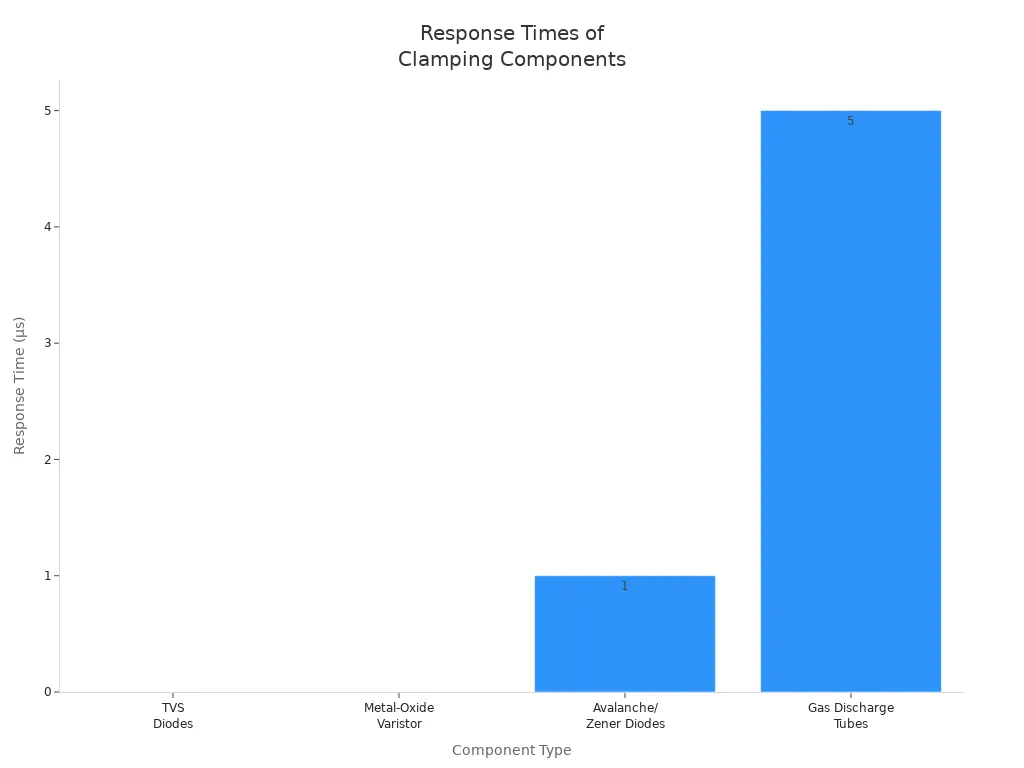
TVS diodes act the fastest. MOVs and Zener diodes are also quick. Gas discharge tubes are slower but can handle bigger surges. You pick the right part based on how fast and strong you need the protection.
When you work with fast digital circuits, remember these tips:
-
Use shunt resistors with low resistance to stop voltage loss.
-
Pick parts with low inductance for fast signals.
-
Make sure the power rating fits your needs.
-
Put the clamping part close to what you want to protect.
Note: Good placement and low-inductance parts help your Circuit Protection work better in fast circuits.
Crowbar Circuits
Crowbar circuits give strong overvoltage protection. When voltage gets too high, the crowbar part shorts the output to ground. This blows a fuse or trips a breaker, cutting off power to keep your equipment safe.
Crowbar circuits use thyristors or SCRs. They work well in big power systems like power supplies and wind turbines. But they are slower than new comparator plus MOSFET circuits. Crowbars can stress your power supply before the fuse blows. They do not reset by themselves, so you must fix the problem and change the fuse before starting again.
Alert: Crowbar circuits are simple and good for big faults, but they are slower and not as flexible as newer ways.
Switch Protection
Switch protection keeps your transistors and switches safe from shorts and overloads. You can use a fuse for simple protection, like in battery packs and low-voltage circuits. Fuses are easy to use and work well.
For better protection, you can use a transistor and a sensing resistor. When current gets too high, the transistor turns off the switch. For example, if you want to cut off at 2A, use a resistor that drops 0.6V at that current (R = 0.3Ω). Handle heat by using large PCB areas and good soldering.
In big or sensitive circuits, you can use special tricks like Miller clamps and desaturation detection. These help protect new switches, like SiC and GaN devices, and make things safer.
Tip: Always pick a fuse or breaker that is about 150% of your normal current. This stops false trips but still keeps your circuit safe.
Decoupling and Grounding
Decoupling and grounding are very important for good Circuit Protection, especially in PCB design. Decoupling capacitors block voltage spikes and noise. Put them close to each IC’s power pins. Use different sizes to block many kinds of noise.
Good grounding gives a safe path for fault currents and lowers noise. Here are some best ways to do it:
-
Use a solid ground plane in your PCB.
-
Keep ground paths short and wide.
-
Do not coil extra ground wire inside panels.
-
Use ground vias and stitching to keep return paths short.
-
Connect ground wires with smooth bends and short lengths.
-
Not checking ground resistance after setup.
-
Forgetting to reconnect ground paths after moving things.
-
Using ground wires that are too small for fault currents.
-
Coiling extra wire, which makes impedance higher.
-
Not thinking about the whole grounding system when designing.
Decoupling and grounding also help with heat control and EMI shielding. They keep your signals clean and your equipment safe from surges and leaks.
Remember: Good decoupling and grounding make your Circuit Protection much better, especially in fast and high-power designs.
Circuit Protection Design Guide
Threat Assessment
Begin by finding all the electrical dangers in your design. Use safe design ideas and special tools to help you. Good risk management means you look for problems early and make a plan.
-
Try software like SafetyCulture to make checklists and watch for dangers.
-
Make your design easy to check and fix.
-
Test and look over your system before you use it.
You can also use rules like MIL-STD-882E. This rule helps you find dangers, check risks, and keep track of them as your system is used.
Component Selection
Pick protection parts that fit what your circuit needs. Use the table below to compare what matters most:
|
Criteria |
Description |
|---|---|
|
Should be higher than your normal circuit voltage. |
|
|
Maximum Current |
Must handle the biggest surge or short-circuit current. |
|
Response Time |
Needs to be fast enough for your job. |
|
Energy Absorption |
Must survive the largest surge energy. |
|
Environmental Conditions |
Think about temperature, humidity, dust, and shock. |
|
Reliability |
Pick parts that last long and work well. |
|
Certifications |
Look for UL or other marks for safety and quality. |
High humidity and heat can cause rust or cracks. Pick parts with coatings or made from rust-proof materials for tough places.
Topology Choice
Pick a protection setup that works for your circuit.
-
Think about what can go wrong, like too much voltage or current.
-
Follow the rules for your type of project.
-
Balance size, cost, and how well it works.
-
Decide if you need isolation or special things like fast action.
Also think about saving power, the voltage range, and how easy it is to add the setup to your design.
Integration Tips
When you add protection to your PCB, use these tips:
-
Keep high-voltage parts far apart so they do not spark.
-
Use short, wide lines for ESD diodes and put them near connectors.
-
Add current-limiting resistors close to parts that need extra care.
-
Use coatings to keep out dust and water.
-
Follow safety rules for space and insulation.
Tip: Use pull-up or pull-down resistors to keep unused pins safe. Always test your Circuit Protection on real boards before you finish.
You can keep your circuit safe by picking good parts and planning the layout well. Always look for ESD protection, fuses, and enough space between parts. Use capacitors and diodes to stop surges and spikes. Make sure relay coils have flyback diodes to protect them. Use this checklist to check your design:
-
Make sure all inputs have ESD and fuse protection.
-
Look for ways to stop overvoltage, overcurrent, and reverse polarity.
-
Put decoupling capacitors close to ICs and connectors.
-
Try out your design with simulation tools.
Keep learning about new ways to protect circuits. Check your designs often so they do not fail.
FAQ
What is the main reason to use circuit protection?
You use circuit protection to stop damage from too much current or voltage. This keeps your devices safe and helps prevent fires or electric shocks. Good protection also makes your electronics last longer.
How do I choose the right fuse for my project?
Pick a fuse with a current rating just above your normal load. Check the voltage rating and make sure it matches your circuit. Look for fast-acting fuses for sensitive parts and slow-blow fuses for motors or lamps.
Where should I place ESD diodes on my PCB?
Place ESD diodes as close as possible to the connectors or sensitive chips. This stops static electricity before it can reach and damage your important parts.
Can I use both MOVs and TVS diodes together?
Yes, you can use both. MOVs handle large surges, while TVS diodes react faster to small spikes. Using both gives you better protection for different types of voltage events.
What is the best way to test my circuit protection?
You can use a surge generator or ESD gun to test your design. Watch how your circuit reacts. Make sure all protection parts work as planned and nothing gets too hot or fails.