Counter Integrated Circuits: Types, Applications, and Selection Criteria
Counter integrated circuits are very important in digital electronics. These ICs help systems count things and keep track of time. They also help systems do things in the right order. Engineers use different counter ICs to watch digital events.
Counter integrated circuits are very important in digital electronics. These ICs help systems count things and keep track of time. They also help systems do things in the right order. Engineers use different counter ICs to watch digital events. They use them to measure time and control steps in a process. The world market for ICs is getting bigger every year. Experts think it will reach $849.28 billion by 2029. More people want digital devices and counter ICs, so the market grows.
Counter ICs are used in simple digital clocks and in complex communication systems. As digital technology gets better, we need more accurate and reliable counter ICs.
Key Takeaways
-
Counter integrated circuits help digital systems count things. They also help keep track of time and control processes. They do this in a way that is accurate and efficient.
-
Synchronous counters update all parts at the same time. This makes counting fast and exact. Asynchronous counters work one step at a time. They use less power but are slower.
-
There are different types of counters. These include binary, decade, Mod-N, and preset counters. Each type has a special job in clocks, timers, communication, and memory systems.
-
Picking the right counter IC means thinking about a few things. You need to look at counting direction, speed, and power use. You should also check output format, compatibility, and display needs.
-
Engineers face some problems like signal delays and power use. They also deal with noise and chip size limits. New technologies help make counter ICs work better.
Types of Counter Integrated Circuits
Counter integrated circuits have different types. Each type works best for certain jobs in digital systems. Engineers pick the right counter IC for what they need. The next parts talk about the main types of digital counters and what makes them special.
Synchronous Counters
Synchronous counters use one clock signal for all flip-flops. Every flip-flop gets the clock pulse at the same time. This lets the counter update all bits together. Synchronous digital counters are good for fast digital circuits. They work quickly and are very accurate. These counters often have features that help fix errors. Synchronous counter ICs are great for jobs that need exact counting and steady work.
Tip: Synchronous counters can handle fast signals better than other digital counters.
Asynchronous Counters
Asynchronous counters are also called ripple counters. They work in a different way. The first flip-flop gets the clock pulse. Each next flip-flop gets its signal from the one before it. This makes a ripple effect. Asynchronous counter ICs are simple and use fewer logic gates. But they have delays that get worse with more flip-flops. These delays can make them less accurate when counting fast. They do not have features to fix errors, so extra circuits may be needed.
Binary Counters
Binary counters show numbers in binary form. Each stage in the counter IC doubles how high it can count. For example, a 4-bit synchronous binary counter counts from 0 to 15. Binary digital counters are used a lot in electronics. They help with things like memory and dividing frequencies. These counters can be synchronous or asynchronous. Binary counter ICs are an easy way to count digital events.
Decade Counters
A decade counter counts from 0 to 9 and then starts over. This counter IC is also called a divide-by-10 counter. Decade counters are used in clocks, calculators, and displays. They change binary counting into decimal numbers. Most decade counter ICs use four flip-flops and extra logic to reset after ten. Engineers use decade digital counters when they need to show numbers in decimal form.
Note: Decade counters help connect digital counters to seven-segment displays.
Mod-N Counters
Mod-N counters count up to a set number, N, and then go back to zero. N can be any whole number. For example, a Mod-6 counter counts from 0 to 5. Mod-N counter ICs are good for systems that need special counting ranges. These digital counters can be synchronous or asynchronous. Mod-N counters help control timing and order in many digital jobs.
Preset Counters
Preset counters let users pick a starting value. The counter IC starts counting from this number. Engineers use preset digital counters when they need to start from a certain value. These counters can count up or down. Preset counter ICs often have pins to load the starting value. This makes digital systems more flexible.
Performance Comparison Table
The table below shows how the two main types of counter ICs compare:
|
Counter Type |
Key Performance Characteristics and Limitations |
|---|---|
|
Synchronous Counters |
All flip-flops use the same clock and update together. These counters are faster and only have one cycle of delay. They have features to fix errors. Synchronous counters are good for fast counting and are more accurate. |
|
Asynchronous Counters (Ripple Counters) |
Flip-flops work one after another, making a ripple effect. These counters are slower because of delays. They may need extra steps to match outputs. They lose accuracy at high speeds. Asynchronous counters do not fix errors. Their design is simple and uses fewer logic gates. |
The biggest differences between synchronous and asynchronous digital counters are delay and accuracy. Synchronous counters are better for fast counting. Asynchronous counters are easier to make but not as good for quick counting.
Counter IC Applications
Digital Clocks
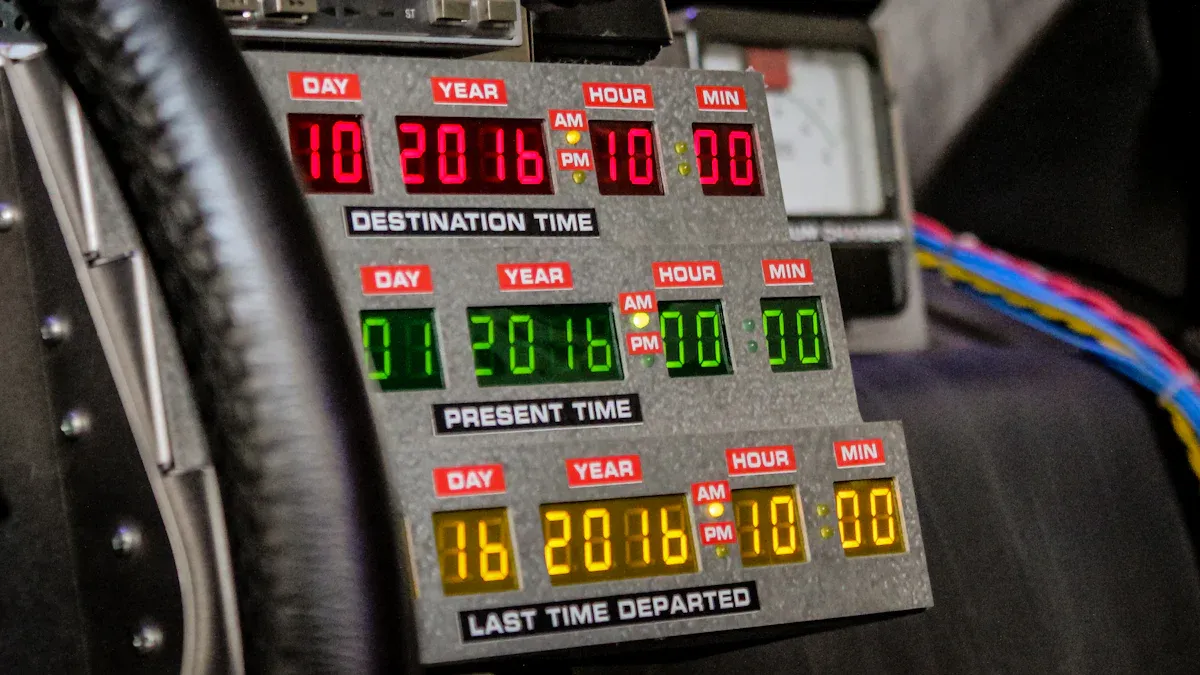
Digital clocks need counter ICs to keep time right. These counters count pulses from a crystal oscillator. Synchronous counters help the display change at the right time. Up/down counters let clocks move time forward or backward. Many clocks use binary counters and decade counters for hours, minutes, and seconds. These jobs need counters that work well and use little power.
Timers
Timers in digital systems use counter ICs to measure time. Engineers put digital counters in kitchen timers and stopwatches. They also use them in industrial controllers. The counter counts pulses to keep track of time. Synchronous counters make timers work fast and on time. Timer jobs often use preset counters to start at a set number. These uses like that counter ICs are simple and can change easily.
Frequency Counters
Frequency counters check how often a signal repeats. These jobs use pulse counters to count each signal change. Synchronous digital counters help frequency counters work fast. Engineers use frequency counters in radios and lab tools. They also use them in communication systems. The counter IC splits the clock and counts pulses for good results. Frequency counters need to count quickly and correctly.
Event Counting
Event counting is a main use for counter ICs. People use them in homes and factories. Parking systems use digital counters to count cars in and out. Robots use auto-reversing counters to watch which way they move. Pulse counters see each event and add to the count. These jobs need data right away and must work well. Counter ICs save money and work for many event counting needs.
Memory Addressing
Memory addressing uses counter ICs to pick memory spots. Binary counters go through addresses as data moves. Synchronous counters help systems get to memory fast. These jobs need exact counting and quick answers. Counter ICs help with big memory groups and lots of data.
Communication Systems
Communication systems use counter ICs to pick channels and split frequencies. Up/down counters split frequencies and match signals. Pulse counters help control data and cut down noise. Digital counters in these systems must be fast and use little power. These jobs like that counter ICs are flexible and work well.
Counter ICs are important in many digital jobs. Their flip-flop design lets them count both ways and fit many uses.
Selection Criteria
Picking the right counter ic for a digital system takes some thought. Every job is different, so engineers must find what fits best. The list below shows what to look at when choosing a good counter ic.
Counting Sequence
The counting sequence tells how the counter ic keeps track of things. Some systems only need to count up. Others need to count down or both ways. Synchronous counters can often count up and down. This makes them good for digital clocks and splitting signals. Asynchronous counters, like ripple counters, usually just count up. For example, the 4029 and 4516 synchronous counter ic models let you pick the counting direction. Picking the right sequence helps the counter work with the system’s logic.
Tip: Always make sure the counter ic can count the way you want before you use it.
Modulus and Output Format
The modulus is how many numbers the counter goes through before starting over. Decade counters have a modulus of 10. Binary counters use powers of two. Some counter ic models, like the 4017 and 4026, have a set modulus. Others let you set or change the modulus. The output format is also important. Some counters give binary outputs. Others can show numbers on displays. For example, the 4026 counter ic connects to a 7-segment display. This makes it easy to see the numbers. Picking the right modulus and output format helps the counter fit the job.
|
Counter IC |
Counting Sequence |
Modulus Control |
Output Format |
|---|---|---|---|
|
4020, 4040 (Ripple) |
Up (ripple) |
Fixed (powers of two) |
Binary |
|
4029, 4516 (Synchronous) |
Up/Down |
Presettable |
Binary |
|
4017 (Decade) |
Up |
Fixed (10) |
Sequential |
|
4026 (Decade) |
Up |
Fixed (10) |
7-segment display |
Speed and Power
Speed and power use are big things to think about. Fast counting needs a counter that can keep up. Synchronous counters, like the 4510 and 4516, are good for fast jobs. They update all outputs at the same time. Asynchronous counters, like the 4020 and 4060, can be slower. They may have delays because of the ripple effect. Power use depends on the ic’s type and how fast it runs. CMOS counter ic models use less power. But if you run them faster, they use more power. Tricks like changing voltage and speed can save energy. Engineers must balance speed and power for the best results.
-
How much energy each switch uses depends on load and voltage.
-
Even when not counting, some power can leak out.
-
Fast counter ic models may need help to stay cool.
Compatibility
Compatibility means the counter ic works well with other parts. Voltage, logic levels, and how things connect all matter. Most CMOS counter ic models work from 3V to 15V. Engineers must check if this matches the rest of the system. If you mix CMOS and TTL, you might need extra parts like pull-up resistors. When using more than one counter, you must match clock and enable signals. Good compatibility helps the system work better and have fewer mistakes.
Note: Always check the counter ic’s voltage and logic levels before hooking it up to other parts.
Display Needs
What you want to show affects which counter ic you pick. Some jobs need to connect right to a display. Others just need binary outputs. The 4026 counter ic has a driver for 7-segment displays. This is great for digital clocks and timers. The 4017 counter ic gives outputs for simple lights. For bigger displays, engineers use binary counters with extra decoders. Picking the right output for the display makes the design easier.
-
Counters with display drivers save space and money.
-
Binary outputs let you make custom displays.
-
Good counter ic models have features for easy display use.
To pick the best counter ic, you must think about counting sequence, modulus, speed, power, compatibility, and display needs. You should also look at how long it will last and how easy it is to get. Engineers need to check for defects, how hard it is to make, and cost. This helps make sure the counter ic fits the job and the budget.
Synchronous vs Asynchronous Counters
Differences
Synchronous counters and asynchronous counters do not work the same way. Synchronous counters use one clock signal for all flip-flops. Every flip-flop gets the clock pulse at the same moment. This lets the counter update all outputs together. Asynchronous counters are also called ripple counters. They send the clock pulse from one flip-flop to the next. The signal moves through each stage one after another. Each stage updates at a different time. This makes a difference in speed and accuracy. Synchronous counters can handle fast digital signals better. Asynchronous counters get slower as more stages are added.
Pros and Cons
|
Type |
Pros |
Cons |
|---|---|---|
|
Synchronous |
Fast operation, high accuracy, easy to predict timing |
Uses more logic gates, higher power in some cases |
|
Asynchronous |
Simple design, fewer logic gates, lower cost, energy efficient |
Slower at high speeds, more delay, less accurate for fast counting |
Synchronous counters work well in digital circuits that need to be fast. They use more logic gates, so the ic can be bigger. Asynchronous counters use fewer gates, so the ic is smaller and costs less. A study found asynchronous counters can save up to 51% energy. This happens when they run at low supply voltages. That makes asynchronous counters good for digital jobs that need to save energy.
Note: Synchronous counters are best for fast digital systems. Asynchronous counters are good for simple or low-power designs.
Use Cases
Engineers use synchronous counters in digital clocks and frequency counters. They also use them for memory addressing. These jobs need fast and accurate counting. Synchronous counters help digital systems keep good timing. Asynchronous counters are used for event counting and simple timers. They are also used in low-power digital devices. Parking systems and basic displays often use asynchronous counters. When a system needs to save energy, asynchronous counters are a good choice. Both types of counter ic are important in digital electronics. The choice depends on how fast, accurate, or energy-saving the system needs to be.
Challenges
Propagation Delay
Propagation delay is a big problem for counters today. When circuits get more complex, signals take longer to move. This can slow down the whole system. In fast jobs, even tiny delays matter a lot. They can make things work less well. Studies show that wire delay is now as bad as device delay. This slows down digital counters. Engineers use 3D ICs and stack parts on top of each other. This makes wires shorter and cuts down delay. Through-Silicon Vias (TSVs) help pulse counters work faster. They let signals travel a shorter path. But adding more stages can cause timing mistakes. This is a bigger risk in fast pulse counters.
Power and Noise
Power use and noise are big problems for pulse counters. When counters run fast, they use more power and get hot. This can make them unstable and not last as long. Noise from TSVs and other parts can get into the circuit. This can cause mistakes in pulse counters. Studies show that guard rings and shields help block noise. Integrated inductors also help keep counters accurate. Engineers use these tricks to protect pulse counters from noise. Phase noise tests show that TSVs close together can hurt how circuits work. Careful layout is needed for high-speed counters to work well.
Integration Limits
Integration limits decide how many counters fit on one chip. Digital systems want more features in less space. Engineers try to add more counter functions to small chips. But flat ICs cannot get much smaller now. So, engineers use 3D stacking instead. TSVs let them stack parts, but this brings new problems. Studies show that cracks can form in TSVs from heat, power, or stress. These cracks can make pulse counters fail over time. New materials like Cu-Cu wafer bonding help with heat and power. This helps counters work better and last longer. Still, engineers must design carefully to stop failures and keep counters working for years.
Engineers keep finding new ways to fix problems with delay, power, noise, and fitting more counters on chips. These ideas help counters and pulse counters work well in new digital systems.
Counter integrated circuits are very important in digital electronics. Engineers use different counters for many things. These include time management, digital cameras, and home appliances. Each counter type has its own good points and some limits. Picking the right counter depends on what the job needs. It is smart to check the counter type, speed, power use, output, and how reliable it is. Good testing makes sure the counter works well. Using the right counter helps systems work better and last longer.
-
Look at the counter type and details
-
Make sure speed and power fit the job
-
Check the output and if it matches other parts
-
Think about how reliable and well-tested it is
FAQ
What are counters in digital electronics?
Counters are special circuits that count things like pulses. They keep track of how many times something happens. Counters can show the number on a display. Engineers put counters in clocks and timers. They also use them in control systems. These circuits help keep things in order and measure time in devices.
How do counters differ from timers?
Counters keep track of how many times something happens. Timers measure how long something takes. Both use almost the same circuits. Counters are for counting, but timers are for timing. Engineers sometimes use both together in digital systems. This helps them control things better.
Where do engineers use counters in real life?
Engineers put counters in digital clocks and calculators. They also use them in big machines at factories. Counters help run traffic lights and elevators. They also help control production lines. You can find counters in communication systems and memory devices. They help keep track of things and make sure everything works in order.
What types of counters exist?
There are many kinds of counters. Synchronous counters change all parts at the same time. Asynchronous counters change one part after another. Other types are binary, decade, Mod-N, and preset counters. Each type is good for different jobs in digital systems.
Can counters count both up and down?
Some counters can go up and down. These are called up/down counters. Engineers use them when they need to add and subtract numbers. Digital clocks and reversible counters use them. Up/down counters are useful for many digital jobs.
Tip: Always look at the datasheet to see if a counter can count both ways.