Choosing Between TIP41C and TIP42C for Audio Amplifiers
When you make an audio amplifier, you often pick between the tip41c transistor and the tip42c power transistor. The tip41c transistor is an npn type. The tip42c power transistor is a pnp type. You usually use both transistors together in push-pull designs. This is because they handle both positive and negative voltages. The npn transistor works with positive voltage. The pnp transistor handles the negative side. Using the right transistor for each voltage helps your amplifier work better. It also helps it last longer.
When you make an audio amplifier, you often pick between the tip41c transistor and the tip42c power transistor. The tip41c transistor is an npn type. The tip42c power transistor is a pnp type. You usually use both transistors together in push-pull designs. This is because they handle both positive and negative voltages. The npn transistor works with positive voltage. The pnp transistor handles the negative side. Using the right transistor for each voltage helps your amplifier work better. It also helps it last longer.
Key Takeaways
-
TIP41C is an NPN transistor. It works with positive voltage. TIP42C is a PNP transistor. It works with negative voltage. They work best together in push-pull audio amplifiers.
-
Using TIP41C and TIP42C together makes sound better. It lowers noise. It helps the amplifier last longer. They handle both halves of the audio signal.
-
Always match the transistor type to the voltage side it controls. Check datasheets for voltage, current, and power ratings before you choose.
-
Use heat sinks with these transistors. This stops them from getting too hot. It keeps your amplifier safe and working well.
-
Never swap TIP41C and TIP42C in the same circuit spot. Using the right pair gives balanced sound. It also makes the amplifier work better.
TIP41C Transistor vs TIP42C Power Transistor
NPN and PNP Differences
It is important to know how the tip41c transistor and the tip42c power transistor are different. The tip41c transistor is an npn type, but the tip42c power transistor is a pnp type. This difference changes how each one works in your amplifier. The npn tip41c transistor turns on when you put a positive voltage on its base. It is good for the positive part of your audio signal. The pnp tip42c power transistor turns on when you put a negative voltage on its base. It handles the negative part of the signal.
Because these transistors have different polarity, you can use them together in a push-pull amplifier. The npn tip41c transistor controls the high side, and the pnp tip42c power transistor controls the low side. This lets your amplifier work with both halves of an AC signal. You get better sound, less noise, and the amplifier works better.
Electrical Characteristics
You should look at the electrical features of the tip41c transistor and the tip42c power transistor before picking one. Both transistors have about the same gain and frequency response. This makes them work well together in audio amplifiers. Here is a table that shows their main features:
|
Parameter |
TIP41C (NPN) |
TIP42C (PNP) |
|---|---|---|
|
Current Gain (hFE) Range |
15 to 75 |
15 to 75 |
|
Current Gain Bandwidth (fT) |
Minimum 3 MHz @ 500 mA |
Minimum 3 MHz @ 500 mA |
|
Collector-Emitter Voltage |
100 V (min) |
100 V (min) |
Both the tip41c transistor and the tip42c power transistor have the same voltage rating and gain. This means you can use them together without problems. Both can handle a lot of power and work well in tough audio circuits.
Application Areas
You will see the tip41c transistor and the tip42c power transistor in the output part of audio amplifiers. The npn tip41c transistor is used for the positive swing, and the pnp tip42c power transistor is used for the negative swing. This setup is popular in push-pull and class AB amplifiers.
-
You can use these transistors in:
-
Home audio amplifiers
-
Car audio systems
-
Power supply circuits
-
Motor drivers
-
You get the best results when you use both types together. The npn and pnp transistors work together to give clear sound and strong power. You also get less noise and your amplifier lasts longer.
When you pick between the tip41c transistor and the tip42c power transistor, always match the transistor to the voltage side it will control. This helps your circuit work well and gives you the best sound.
Transistor Roles in Audio Amplifiers
Output Stage Functions
The output stage sends the final sound to your speakers. This part uses transistors to make the signal stronger. Picking the right transistor gives you better sound and makes the amplifier work well. The output stage deals with high current and voltage. So, you need transistors that can handle power and not get too hot. A good output stage helps your amplifier work better and last longer.
Push-Pull Configuration
A lot of audio amplifiers use a push-pull setup. In this setup, you use both an NPN and a PNP transistor. Each one works on half of the sound wave. The NPN transistor handles the positive side. The PNP transistor takes care of the negative side. This setup makes the amplifier work better and stay cooler. You also get less distortion, so the sound is clearer.
Here is a table that shows how a single transistor in class A compares to a push-pull class AB design with both NPN and PNP transistors:
|
Aspect |
Class A Amplifier (NPN) |
Class AB Push-Pull (NPN & PNP) |
|---|---|---|
|
Transistor conduction |
Continuous throughout the waveform |
Each conducts for half the cycle |
|
Power output |
Low (0.0048W to 2W) |
Higher (~5W) |
|
Heat dissipation |
Very high (34W) |
Much lower (4W) |
|
Efficiency |
Low |
Improved |
|
Distortion |
Higher |
Lower with proper biasing |
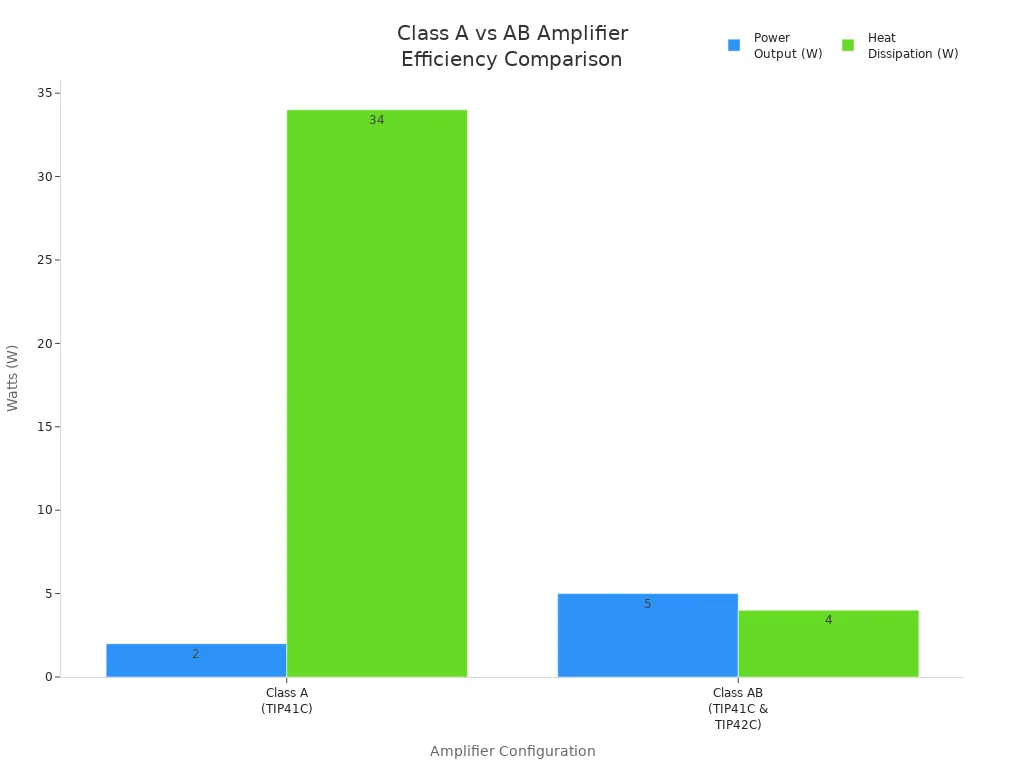
Using a push-pull setup with both types of transistors makes the amplifier better. You get more power, less heat, and clearer sound.
Single-Ended Use
You may think about using just one transistor for the output stage. Some people try using only one, like the NPN type, in a simple circuit. They often have problems. Voltage drops can show up in places you do not expect. The power supply can have trouble when it is working hard. These problems can make the amplifier work poorly and be unstable. Most audio amplifiers do not use just one transistor. They use both types together for better balance and higher efficiency. This way, you get better sound and more steady power.
Choosing the Right Transistor
Circuit Requirements
You have to pick the right transistor for your amplifier. First, check if your circuit needs an NPN or a PNP device. The tip41c transistor is an NPN type. The TIP42C is a PNP type. For best results, use both in a push-pull output stage. Look at your load impedance and supply voltage. If the impedance is low, more current will flow. You need a transistor that can handle this extra power. Both the tip41c transistor and TIP42C can handle up to 6A of current and 65W of power. Always read the datasheet to check the features before you choose.
If your circuit is single-ended, you only need one kind of transistor. For push-pull or class AB designs, you need both NPN and PNP types. This gives you balanced sound and better performance.
Voltage and Power Considerations
You must make sure your transistor can handle the voltage and power in your amplifier. Both the tip41c transistor and TIP42C can handle up to 100V and 65W. If your supply voltage is high or your load impedance is low, the transistor will need to handle more current and heat. If you go over these limits, the transistor can get too hot and break. Always use a heat sink and keep your levels at least 20% below the maximum. This keeps your amplifier safe and working well.
|
Transistor |
Type |
Max Collector-Emitter Voltage (Vce) |
Max Power Dissipation (W) |
Max Collector Current (A) |
Application in Audio Amplifiers |
|---|---|---|---|---|---|
|
TIP41C |
NPN |
100 |
65 |
6 |
Audio amplification, needs heat management |
|
TIP42C |
PNP |
100 |
65 |
6 (negative polarity) |
High-wattage audio, clear and powerful sound |
Selection Tips
Here are some tips for picking between the tip41c transistor and TIP42C:
-
Use TIP41C for NPN spots and TIP42C for PNP spots.
-
Use both for push-pull or class AB amplifier designs.
-
Check the voltage, current, and power ratings in the datasheet.
-
Make sure your transistor matches the polarity and power your circuit needs.
-
Always use a heat sink to stop overheating.
-
Do not swap TIP41C for TIP42C or the other way around in the same spot. They have different polarities, so only use them together as a pair.
Picking the right transistor helps your amplifier work well and last longer. Always check your circuit’s needs and the datasheet before you decide.
Compatibility and Substitution
Interchangeability
You may think about switching a TIP41C with a TIP42C. These two transistors look almost the same. But you cannot put one in the other's place. The TIP41C is an NPN transistor. The TIP42C is a PNP transistor. Each one works on a different part of the audio signal. If you use the wrong one, your amplifier will not work right. You might even break some parts.
When you build a push-pull amplifier, you need both types. The NPN transistor works with positive voltage. The PNP transistor works with negative voltage. You must put each transistor in the right spot. If you use only one type, the sound will not be balanced. The quality will go down.
Tip: Always look at your circuit diagram before you put in a transistor. Make sure you pick the right type for each spot.
Safe Practices
You want your amplifier to work well and last a long time. Follow these safe steps when you use transistors:
-
Read the datasheet for each transistor. Check the voltage and current numbers.
-
Use a heat sink to keep your power transistors cool. Too much heat can hurt them fast.
-
Never force a transistor into a spot if the pins do not match.
-
Test your amplifier with low power first. This helps you find mistakes before they cause harm.
-
Keep your transistors in a dry place. Water can make them not work right.
Here is a simple checklist for safe swapping:
|
Step |
Action |
|---|---|
|
Identify transistor |
Check if it is NPN or PNP |
|
Match ratings |
Compare voltage and power specs |
|
Check pinout |
Make sure the pins line up correctly |
|
Test circuit |
Power up slowly and watch for problems |
Note: You cannot swap a TIP41C for a TIP42C or the other way around in the same spot. Always use the right transistor type for your project.
You need to pick the right transistor for your circuit. For balanced audio amplifiers, use both TIP41C (NPN) and TIP42C (PNP). When you use both, you get strong sound and good performance.
-
Pick the right transistor for each voltage side.
-
Add heat sinks to keep things cool.
-
Look at datasheets for voltage, current, and power.
-
Use the right biasing and stay within safe limits.
The right transistor pair helps your amplifier last longer and sound better.
FAQ
What happens if you swap TIP41C and TIP42C in your amplifier?
You cannot swap these transistors. TIP41C is NPN, and TIP42C is PNP. Each one works on a different voltage side. Swapping them can damage your circuit or cause it to stop working.
Can you use only one type of transistor in a push-pull amplifier?
No, you need both NPN and PNP transistors for a push-pull design. TIP41C handles positive signals. TIP42C handles negative signals. Using only one type will cause distortion and poor sound quality.
How do you know which transistor to use in your circuit?
Check your circuit diagram. Use TIP41C for NPN positions and TIP42C for PNP positions. Always match the transistor type to the voltage side it controls. Review the datasheet for voltage and current ratings.
Do you need a heat sink for TIP41C and TIP42C?
Yes, you should use a heat sink. Both transistors handle high power and can get hot. A heat sink keeps them cool and helps your amplifier last longer.
What is the main benefit of using TIP41C and TIP42C together?
You get balanced sound, higher efficiency, and less distortion. Using both types lets your amplifier handle the full audio signal. This setup gives you clear and powerful sound.