A Complete Guide to RF Components in Today’s Electronics
RF components are very important for wireless technology. Engineers use RF components to send and get signals. These signals are in things like smartphones, radios, and Wi-Fi routers
RF components are very important for wireless technology. Engineers use RF components to send and get signals. These signals are in things like smartphones, radios, and Wi-Fi routers. Every RF system needs these parts to work with high-frequency signals. RF components have things like filters, amplifiers, and antennas. RF circuits are found in TVs, medical scanners, and car systems. Many businesses need RF components for good communication. RF technology helps connect people, machines, and data everywhere. Knowing about RF components helps engineers make better products. RF design skills help them fix real-world problems. Learning about RF components gives more chances in electronics and communication jobs.
Key Takeaways
-
RF components like antennas, amplifiers, and filters help send and get wireless signals in many devices.
-
Passive RF parts shape and protect signals but do not add power. Active parts make signals stronger and use outside power to work.
-
Good RF design matches impedance, picks the right materials, and uses careful PCB layout. This keeps signals strong and clear.
-
RF components are in electronics, telecom, cars, planes, and medical tools. They help people talk and stay safe.
-
New trends like making things smaller and using better materials help build smaller, smarter, and more reliable RF devices for the future.
RF Components Overview
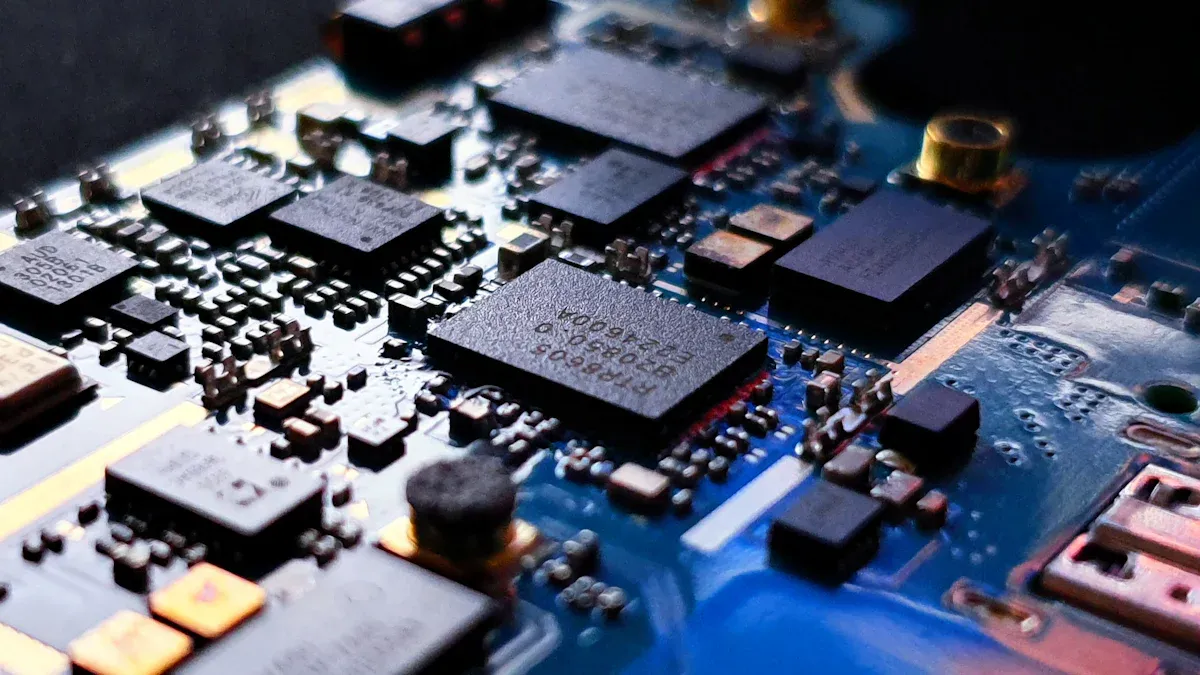
RF components are very important in electronics. These parts help devices send and get signals at high frequencies. Engineers use RF components in things like wireless communication and radar. Every RF component has a special job in the circuit. Some parts control how signals move. Others make signals stronger, switch them, or change them. Designers need to know how each part works. This helps them build strong and safe RF systems.
RF components are split into two groups: passive and active. Both groups are needed in modern electronics. Passive RF components do not give energy to the signal. Active RF components need extra power and can change or boost the signal.
Below is a table that lists the main types of RF components, examples, and what they do:
|
Category |
Examples |
Primary Functions in Electronic Circuits |
|---|---|---|
|
Passive Components |
Impedance matching, signal filtering, frequency tuning without amplification |
|
|
Active Components |
Transistors, Diodes, Amplifiers, Mixers, Switches, Oscillators |
Signal amplification, frequency conversion, switching, signal generation requiring external power |
|
Antennas |
Dipole, Monopole, Patch, Horn antennas |
Interface between guided RF signals and free-space waves; signal transmission and reception |
|
Connectors & Cables |
SMA, BNC, N-Type, TNC connectors; coaxial cables |
Ensure signal integrity through impedance matching, minimal loss, and secure connections |
Passive RF Components
Passive RF components shape and control signals but do not add energy. These parts are resistors, capacitors, inductors, ferrite beads, and transformers. Each one does something special in RF circuits.
-
Resistors help match impedance and set bias. At high frequencies, resistors can act like coils or capacitors. Engineers use special film resistors to stop unwanted effects.
-
Capacitors store energy and filter signals. Ceramic capacitors work well at high frequencies. They stay steady and lose little energy. Multilayer ceramic capacitors (MLCC) are used a lot in RF designs.
-
Inductors store energy in a magnetic field. They help filter signals and block noise. Multilayer inductors keep their value steady even when it gets hot or cold.
-
Ferrite beads lower electromagnetic interference (EMI) and radio-frequency interference (RFI). They block high-frequency noise in circuits.
-
Transformers move signals from one part of a circuit to another. They also help match impedance between different parts.
Here is a table that shows common passive RF components and what they do:
|
Passive RF Component |
Role in Modern Electronics |
Key Characteristics and Examples |
|---|---|---|
|
Resistors |
Impedance matching, biasing |
Can become inductive at high frequencies; film resistors have parasitic capacitance; used in various forms like wire-wound and film |
|
Capacitors |
Filtering, decoupling, noise rejection |
Store energy electrostatically; ceramic capacitors preferred for high-frequency stability and low ESR; examples include multilayer ceramic capacitors (MLCC) |
|
Inductors |
Energy storage, filtering, EMI mitigation |
Wire coils with parasitic capacitance and resistance; multilayer inductors offer thermal stability and consistent inductance |
|
Ferrite Beads |
EMI and RFI suppression |
Used to reduce electromagnetic interference by attenuating high-frequency noise |
|
Transformers |
Signal coupling, impedance transformation |
Passive devices that transfer energy between circuits without power generation |
Passive RF components help keep signals clean and steady. They also protect circuits from noise and interference. Designers pick these parts based on what the RF system needs.
Active RF Components
Active RF components need outside power to work. These parts can make signals stronger, switch them, or change them. They are important in wireless communication and other RF systems.
-
Transistors work as switches or amplifiers. They control signals and make weak signals stronger.
-
Diodes let current go one way. They help with signal detection, mixing, and switching.
-
Amplifiers make RF signals stronger. Low-noise amplifiers (LNA) boost weak signals from antennas. Power amplifiers (PA) make signals strong enough to travel far.
-
Mixers join two signals to make new frequencies. This is important in radios and wireless devices.
-
Switches control where a signal goes in a circuit. They help send signals to different parts of the system.
-
Oscillators make steady RF signals. These signals set the timing for many wireless systems.
Active RF components help engineers build circuits that can send and get signals over long distances. These parts let people design advanced RF systems for phones, radios, and other wireless devices.
In short, both passive and active RF components are needed for modern electronics. Passive RF components shape and protect signals. Active RF components boost and control signals. Together, they are the backbone of every RF system.
Key Passive Components
Resistors, Capacitors, Inductors
RF circuits need resistors, capacitors, and inductors to work well. These rf components help control and shape rf signals. Resistors set how much current flows in rf designs. Capacitors store energy and let rf signals pass through. They block direct current from moving forward. Inductors keep energy in magnetic fields. They stop high-frequency noise and help filter rf signals. Engineers pick these rf components for their steady performance. Each part must handle fast speeds in rf systems. Choosing the right resistors, capacitors, and inductors keeps rf signals strong and clear.
Transformers, Crystals, Resonators
Transformers are important in rf circuits. They move energy between different parts of a system. These rf components also help match impedance and keep circuit sections apart. Crystals and resonators set exact frequencies in rf devices. Crystals use quartz vibrations to keep rf signals steady. Resonators, made from ceramics, help pick certain rf frequencies. These rf components make sure radios and transmitters work at the right frequency. Engineers need these parts for stable and accurate rf systems.
Impedance Matching
Impedance matching is very important in rf circuits. It helps rf components send power without losing signal. Engineers use different ways to do this:
-
They put capacitors and inductors together to match impedance.
-
They make sure the source and load impedance are equal for best results.
-
They build L and T networks to fix unwanted reactance and match resistance.
-
They use the loaded Q factor to change between parallel and series forms, making matching easier.
-
They check their designs with simulation tools to see if the matching network works.
Impedance matching helps rf signals move easily through the circuit. If matching is bad, signals can get weak and rf components may not work well. Every rf system needs good impedance matching to work right.
Tip: Good impedance matching makes signals stronger and stops unwanted reflections in rf circuits.
Key Active Components
Amplifiers
Amplifiers are very important in rf systems. These rf components make weak signals stronger. This helps devices use the signals better. Receivers can pick up faint signals from antennas because of amplification. Engineers use different amplifiers for different jobs. Low-noise amplifiers (LNAs) help signals stay clear at the start. Broadband amplifiers work with many frequencies. RF power amplifiers send strong signals to transmitter antennas. These are used in wireless, radar, and TV systems. Solid-state microwave amplifiers give high gain and wide bandwidth. They are used for advanced rf jobs.
|
RF Amplifier Type |
Typical Application in Communication Systems |
|---|---|
|
Low-Noise Amplifiers (LNAs) |
Amplify weak signals received by antennas, improving signal quality at the receiver front-end. |
|
Broadband Amplifiers |
Provide flat frequency response over a wide range, suitable for wideband communication systems. |
|
RF Power Amplifiers |
Boost low-power RF signals to drive transmitter antennas in wireless communication, TV transmission, radar, and RF heating. |
|
Solid-State Microwave Amplifiers |
Used where high gain and wide bandwidth are required, such as in advanced communication and radar systems. |
These active rf components make sure rf signals stay strong and clear.
Mixers, Oscillators, Switches
Mixers, oscillators, and switches are important rf components. Mixers join two signals to make new frequencies. This is called frequency conversion. It helps devices move signals up or down. Oscillators give a steady frequency for mixers to use. Switches control where rf signals go in a circuit. They let circuits pick or send signals where needed.
-
Mixers change high-frequency signals to lower ones in receivers.
-
Mixers also move signals for sending or getting them.
-
Radar uses mixers to check speed and position.
-
Satellites use mixers for sending and getting signals.
-
Mixers help with phase detection in special loops.
These active rf components help rf systems work well and be flexible.
ADCs and DACs
ADCs and DACs connect analog rf signals to digital processing. These rf components let devices sample and make rf signals very fast. High-resolution ADCs help signals stay clear and strong. This means less extra amplification is needed. Important things to check are sampling rate, number of bits, signal-to-noise ratio, and dynamic range. In new rf systems, ADCs and DACs help with digital beamforming, software radios, and radar. These active rf components help engineers build strong and flexible rf systems.
Tip: Picking the right rf components for making and changing signals helps communication, radar, and wireless systems work better.
Filters and Antennas
Types of Filters
Filters are important in rf systems. These rf components help pick which signals can go through a circuit. There are different kinds of rf filters. The most common ones are bandpass, low pass, and high pass filters. Each filter does something special. Low pass filters let signals lower than a set frequency go through. High pass filters let higher signals move forward. Bandpass filters only let signals in a certain range pass.
Engineers use these rf components in many areas. In telecommunications, high pass filters block low sounds and keep high ones clear. This helps cell networks, Wi-Fi, and satellites work better. Aerospace and military systems use high pass filters for radar and safe talking. Home electronics use these filters to get better signals and send data by blocking noise.
Good filters help rf signals stay strong and clean. Picking the right rf components for filtering makes devices work better when there are lots of signals.
Antenna Types
Antennas are important rf components that send and get signals. Different antennas are used for different rf jobs.
-
Dipole antennas have two metal parts. They are used for radio and TV.
-
Monopole antennas have one part and a ground. Car radios and phones use them.
-
Loop antennas are shaped like a circle. They are good for low signals and finding direction.
-
Patch antennas are flat and small. GPS, Wi-Fi, and phones use them when space is tight.
-
Yagi-Uda antennas point in one direction and have many parts. TV and wireless systems use them.
-
Helical antennas are shaped like a spring. They make round signals and work in satellites and planes.
These rf components are found in phones, radios, GPS, and smart devices. Engineers pick antennas based on what the rf system needs, the frequency, and how much space there is.
Tip: Using the right antenna for the rf job makes signals stronger and more reliable.
RF Front-End Design
Integration of Filters, Amplifiers, Antennas
RF front-end design puts many rf components together. This makes the system strong and reliable. Filters take out signals that are not needed. They help keep only the good signals. This keeps signals clear and stops interference. Amplifiers, like low-noise amplifiers, make signals stronger. They do this without adding much noise. These rf components help make signals easy to hear or see. They also help with clear talking or data. Antennas let the system send and get signals from outside. They change how far signals go and how good they are.
When engineers put these rf components together, they think about many things:
-
They pick each rf component for what the system needs.
-
They match impedance to stop signal loss and bouncing.
-
They work to keep noise low so signals stay clear.
-
They use computer tools and test models before building.
-
They try to balance gain, bandwidth, cost, and power use.
-
They also watch heat and follow safety and quality rules.
Putting rf components in the right place and using shields stops interference. Good design helps power move well and keeps signals strong.
Signal Integrity
Signal integrity means keeping rf signals strong and clear. Signals must stay good as they move through the front end. Many things can hurt signal quality in rf systems. Some problems are noise, bad signals, and losing power. Engineers look for trouble like wrong line impedance, changes at vias or branches, and voltage drops in power and ground.
Big problems for signal integrity are:
-
Bouncing signals from impedance changes.
-
Voltage drops and noise from bad power and ground.
-
More interference when frequencies are higher.
-
Signals getting weak from via stubs and trace stubs.
-
Ground bounce from ground levels moving up and down.
Engineers use controlled impedance and short signal paths to fix these. They also use good decoupling. They pick the best materials for high frequencies. Careful design and layout of rf components help keep signals strong and steady.
PCB Design for RF
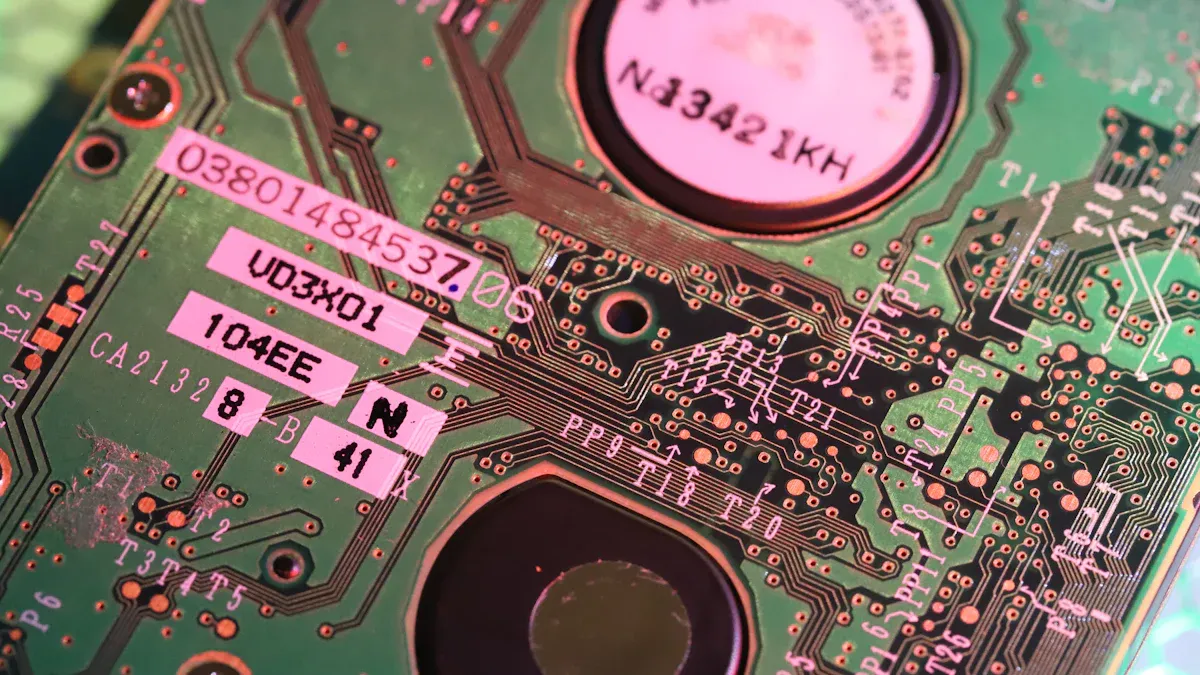
Material Selection
Engineers choose special materials for rf circuit boards. The right material helps rf signals move fast and stay strong. Several important factors guide this choice:
-
Dielectric constant (Dk) affects how fast rf signals travel. Low Dk materials, usually less than 4, help keep signal loss low.
-
Dissipation factor (Df) shows how much energy the material loses. A low Df, below 0.005, keeps rf signals clear.
-
Thermal conductivity (TC) helps move heat away from hot spots. High TC materials work better in high-power rf circuits.
-
Coefficient of thermal expansion (CTE) shows how much the material grows or shrinks with temperature. Matching CTE between copper and the board keeps rf components safe.
Some high-performance materials for rf boards include Rogers RO3000, RO4000, Panasonic Megtron6, and Isola MT40. These materials balance Dk, Df, TC, and CTE for strong rf performance. Cost and how easy it is to make the board also matter.
Trace Design and Grounding
Trace design and grounding shape how rf signals move on a board. Good design keeps signals strong and stops noise. Engineers use several methods:
-
Ground is not perfect at high rf frequencies. Inductance and reactance can cause voltage changes across the ground plane.
-
Via stitching connects ground planes with many small holes. This lowers impedance and keeps ground steady.
-
More grounding vias shorten the return path for rf currents. This helps keep rf signals clean.
-
Return currents follow the path under the signal trace. Good grounding controls these paths and stops unwanted rf radiation.
-
Via fences surround rf traces. They act like a cage and block outside noise.
Poor grounding or not enough vias can hurt rf signal quality. Good trace design and grounding help control impedance and keep rf components working well.
PCB Stack-Up
PCB stack-up means how engineers arrange the layers in an rf board. The right stack-up helps control signal paths and keeps rf signals strong. Most rf boards use a ground plane close to the signal layer. This setup lowers noise and keeps impedance steady. Engineers often use four or more layers for complex rf circuits. They place power and ground layers in the middle. This helps shield rf signals and lowers interference. Careful stack-up planning protects rf components and keeps the whole system working well.
Tip: Good PCB stack-up, material choice, and grounding all work together. They help rf circuits perform at their best.
Applications of RF Components
Consumer Electronics
RF components are used in many things people use daily. These parts help devices work better and make users happy. Many electronics need strong and clear signals. Some examples are:
-
Televisions use rf amplifiers to make signals stronger. This helps the picture and sound get better.
-
Radios use rf amplifiers to pick up weak signals. This makes it easier to hear music or news.
-
Wireless routers use rf amplifiers to boost Wi-Fi signals. This gives better range and stronger connections at home or work.
RF components help these devices send and get signals for wireless use. People get better sound, video, and internet because of these rf parts.
Telecom and Wireless
Telecom and wireless systems need rf components for fast and steady service. Cell phones, base stations, and satellites all use rf circuits. These systems must send and get signals far away. RF amplifiers, filters, and antennas keep signals clear. Mixers and oscillators help change signal frequencies for different jobs. Networks like 4G, 5G, and Wi-Fi use rf technology. Engineers use special rf components for high speeds and many users. Good rf design keeps calls, texts, and data moving well.
Automotive, Aerospace, Medical
RF components help cars, planes, and medical devices do more things. Each area has special needs for safety and how well things work. The table below shows some main needs:
|
Requirement Category |
Details |
|---|---|
|
Quality Standard |
|
|
Environmental Durability |
Must handle heat, cold, shaking, and hard hits |
|
Technology Used |
LTCC technology for good performance, reliability, and small size |
|
Applications Supported |
ADAS, self-driving, seat sensors, smart keys (BLE, UWB, NFC) |
|
Connectivity |
Wi-Fi, Bluetooth, 4G/5G/LTE |
|
Telematics |
V2X, DSRC, GNSS |
|
Product Portfolio |
Many filters, baluns, couplers, splitters, hybrids with custom options |
|
Manufacturing Experience |
Over 30 years making high RF parts in small sizes |
Cars use rf components for wireless links between cars and roads. Planes use rf for safe flying and finding their way. Medical devices use rf to send data and images fast and safely. These areas need rf parts that last long and work in hard places.
Selecting RF Components
Key Criteria
Engineers think about many things when picking rf components. The right rf part helps the system work well and last longer. First, they check the frequency range. Each rf component must work with the right signals. Next, they look at power handling. Some rf parts need to handle strong signals. Others only work with weak ones. Size and shape are important too. Many new devices need small rf components for tight spaces. Reliability matters a lot. Engineers pick rf parts that can handle heat, cold, and shaking. Cost is also important. Good rf components should not cost too much. They must fit the project budget. Engineers also check if rf parts work well with other parts. They use datasheets to compare rf components and make smart choices.
Tip: Testing rf components in real circuits helps engineers find the best match for their design.
Common Challenges
Getting and using rf components can be hard. Engineers face problems like supply chain delays or sudden high demand. Sometimes, a needed rf part is no longer made. This makes it hard to find a replacement. Good relationships with suppliers help get better prices and steady delivery. Talking often with suppliers helps with planning and teamwork.
Engineers use different ways to fix these problems:
-
Use more than one supplier to lower risks.
-
Buy from trusted sellers to make sure rf parts are real.
-
Keep designs flexible so other rf parts can be used.
-
Make plans with suppliers for quick action during problems.
-
Use technology to watch inventory and find risks early.
Putting rf components on a PCB has its own problems. Good via design is needed for strong signals and matching impedance. Engineers must place vias in the right spots. They use special stack-ups to control impedance. This stops signal loss and keeps rf working well.
Note: Careful layout and planning help stop interference and make rf circuits more reliable.
Trends in RF Components
Miniaturization
RF components are getting smaller as technology grows. Many companies want tiny devices that still work well. Medical devices now use small RF connectors for wireless features like Bluetooth and Wi-Fi. These connectors help make wearable and implantable devices safer and better. Some connectors are less than a millimeter tall. This means future devices can be even smaller and work better.
-
Miniaturization uses higher frequency bands, like millimeter waves. These need special materials to keep signals strong.
-
Smaller connectors need careful manufacturing, like micro-milling, to stay stable.
-
New locking features help keep tiny connectors in place.
-
Good heat control is important, so engineers use materials that move heat away fast.
-
Advanced materials, like conductive plastics and nanotechnology coatings, make parts smaller and stronger.
-
Small RF parts help new things like IoT, smart cars, and 5G networks.
-
Designers also care about the environment. They pick recyclable materials and use efficient ways to make parts.
Miniaturization lets engineers build smaller, smarter, and more reliable devices for many uses.
New Materials
Engineers use new materials to make RF components better. Rogers Corporation and other companies make printable dielectric materials for 3D printing. These materials let engineers design complex shapes and control how signals move. This helps make better antennas and new types of circuits.
-
Graphene helps antennas and rectifiers work better. It carries electricity well and bends easily.
-
Nanomaterials, like nanowires, help rectifiers work better.
-
Flexible materials, like PET and polyimide, make RF parts last longer and work in tough places.
-
Metamaterials and 2D materials, like transition metal dichalcogenides, have special properties for strong RF harvesting.
Studies show graphene-based rectifiers can collect up to 50% more energy. These new materials help engineers make RF components that are faster, more efficient, and last longer.
Industry Standards
Industry standards guide how engineers design and use RF components. Groups like the FCC in the U.S. and ETSI in Europe make rules for frequency bands and power levels. These rules help keep devices safe and stop interference.
-
Standards make sure devices meet safety limits, like Specific Absorption Rate (SAR), to protect people.
-
The FCC’s Modular Approval process makes it easier to approve new products.
-
Engineers often use pre-certified modules to meet rules faster.
-
Standards push companies to test better and make devices more reliable, especially for new things like 5G.
-
Industry partnerships help companies follow new rules and make sure devices work together.
Following industry standards is important for safe, reliable, and legal RF products today.
RF components are very important in today’s electronics. They help devices send, get, and use signals. Here are some key ideas:
-
Antennas, amplifiers, and filters keep signals strong and clear.
-
Checking and caring for equipment stops problems and makes it last longer.
-
Watching power and how the system works keeps things running well.
Learning about new ideas and tips helps engineers make better systems. Readers can learn more about RF design to follow new technology.
FAQ
What does RF stand for in electronics?
RF means "radio frequency." Engineers use this word for signals that travel fast. These signals move through air or wires. RF signals help radios, phones, and Wi-Fi routers work. They let these devices send and get information.
Why do engineers use impedance matching in RF circuits?
Impedance matching helps RF signals move easily between parts. When engineers match impedance, signals do not get lost. This keeps the signal strong and clear in the circuit.
How do filters improve RF systems?
Filters let only some signals go through. They block noise and other signals that are not wanted. This makes the main signal stronger. It also helps devices work better.
Can RF components work in harsh environments?
Many RF components can handle heat, cold, and shaking. Engineers choose special parts for cars, planes, and medical tools. These parts follow strict rules for safety and reliability.