74HC08 vs U74HC08: Are They Direct Replacements?
The 74HC08 is commonly used in electronics and control boards as a quad 2-input AND gate from the High-Speed CMOS family. When comparing 74HC08 vs U74
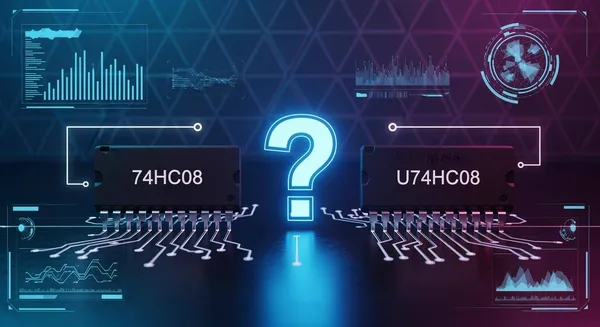
The 74HC08 is commonly used in electronics and control boards as a quad 2-input AND gate from the High-Speed CMOS family. When comparing 74HC08 vs U74HC08, many engineers believe the U74HC08 can serve as a replacement for the 74HC08 at 5V. However, it’s important to review the datasheets for both 74HC08 and U74HC08 to spot any differences. For example, output current and supply voltage may vary, as shown below:
Parameter | 74HC08 | U74HC08 |
|---|---|---|
Output Current (High) | 4 mA | 0.4 mA |
Supply Voltage | 5V | N/A |
Before swapping a 74HC08 for a U74HC08, always check the pinout and electrical specifications. This careful comparison of 74HC08 vs U74HC08 will help you avoid issues in your circuit.
Key Takeaways
The 74HC08 can give up to 4 mA, but the U74HC08 only gives 0.4 mA. Pick the one that matches your circuit’s current needs.
Both chips have the same pin layout, so you can swap them in most projects. Always check the datasheet for more details.
Both ICs work with voltages from 2V to 6V, which fits many uses. Make sure your project uses a voltage in this range.
The U74HC08 is cheaper for logic circuits that do not need high output current. Test your circuit after you make any changes.
Pinout & Logic Function
74HC08 vs U74HC08 Pin Compatibility
You often need to check the pinout before replacing any IC in your project. The 74hc08 and U74HC08 both come in standard 14-pin dual in-line packages. Each pin on the 74hc08 ic matches the same function on the U74HC08. This means you can usually swap these chips without changing your circuit board layout. Pin 1 and Pin 2 serve as the first AND gate inputs, while Pin 3 is the output. The pattern repeats for the other gates. You will find that the power supply pin (Vcc) and ground (GND) are in the same positions for both ICs. This makes the replacement process straightforward for most users.
Tip: Always double-check the datasheet for your specific manufacturer. Some rare versions might have small differences.
Logic Gate Functions
Both the 74hc08 and U74HC08 implement the same logic function. Each IC contains four independent 2-input AND gates. These gates output a HIGH signal only when both inputs are HIGH. You can use these gates to build logic circuits that require precise control.
Here is a quick comparison of the logic gate features:
Feature | 74HC08 | U74HC08 |
|---|---|---|
Number of Gates | 4 independent AND gates | |
Output Logic | HIGH when all inputs HIGH | HIGH when all inputs HIGH |
Voltage Range | 2V to 6V | 2V to 6V |
High-Level Output Current | 4 mA at 5V | 0.4 mA |
You will see that both chips perform the same basic logic tasks. The main difference lies in the output current. The 74hc08 can drive more current than the U74HC08. If your project uses the 74hc08 ic to power LEDs or other loads, you should check if the U74HC08 can handle the same job.
The 74hc08 remains a popular choice for consumer electronics, industrial control boards, and communication modules. The U74HC08 offers a cost-effective alternative, especially when you need a direct replacement with similar logic functions.
Electrical Specs Comparison
Voltage & Current Ratings
When you look at the electrical ratings for the 74hc08 and U74HC08, you see some key differences. Both chips work with voltages from 2.0V to 6.0V. This means they fit many electronics and control boards. Always check the input and output voltage levels before you swap the ic. The table below shows the voltage levels for the 74hc08:
Parameter | 74HC08 |
|---|---|
Input Voltage (Vin) | 0V to Vcc |
Output Voltage (Vout) | 0V to Vcc |
High-Level Input Voltage (VIH) | Minimum 2V |
Low-Level Input Voltage (VIL) | Maximum 0.8V |
Working Voltage Range | 2.0V to 6.0V |
The 74hc08 ic can give more output current than the U74HC08. If your project needs to light up LEDs or power other things, check if the U74HC08 gives enough current. If you use a chip with less output current, you might get weak signals or your device might not work.
Note: Always look at the datasheet for your ic. Some manufacturers may have different current ratings.
Propagation Delay
Propagation delay shows how quickly the chip reacts to changes. The 74hc08 and U74HC08 both switch fast, which is good for high-speed circuits. Most 74hc08 chips work up to 36 MHz. You can see this in the table below:
Type number | fmax (MHz) |
|---|---|
74HC08BQ | 36 |
74HC08D | 36 |
74HC08PW | 36 |
If your project needs fast logic, both chips work well. Still, check the datasheet for the exact propagation delay because it can change by manufacturer.
Other Key Specs
You should also check things like power use and temperature range. The 74hc08 uses CMOS technology, so it saves power. This is good for devices that use batteries. The U74HC08 also saves power, so it is used in many consumer electronics and communication modules.
Check the temperature range for your ic. Most chips work from -40°C to +85°C.
Look at the noise margin if your circuit is in a noisy place.
Tip: Always match the specs of your new chip to your project. This helps you avoid problems and keeps your devices working well.
74HC08 vs U74HC08: Practical Use
When Replacement Is Safe
You can often use the U74HC08 as a direct replacement for the 74hc08 in many projects. Both chips share the same pinout and logic function. If your circuit uses a standard 5V supply and does not need high output current, the swap works well. For example, you might use the 74hc08 ic in a simple LED indicator circuit. If the LED draws less than 0.4 mA, the U74HC08 will work as an equivalent. Many consumer electronics and control boards use the 74hc08 vs u74hc08 chips in similar ways.
Here are some safe replacement scenarios:
Your circuit uses the 74hc08 only for logic signals, not for driving heavy loads.
The supply voltage stays between 2V and 6V.
The output current needed is less than 0.4 mA per output.
You checked the datasheets and found no special features used in your design.
Tip: Always test your circuit after swapping chips. Even small differences can affect sensitive designs.
Risks & Considerations
You need to watch out for some risks when you replace the 74hc08 with the U74HC08. The biggest difference between 74hc08 vs u74hc08 is the output current. The 74hc08 can drive up to 4 mA, but the U74HC08 only handles 0.4 mA. If your project uses the chip to power LEDs, relays, or other devices, the U74HC08 may not work. You might see dim LEDs or no response at all.
Other important points to consider:
Some circuits use the 74hc08 in timing or high-speed logic. The propagation delay of the U74HC08 could be slightly different. Always check the datasheet for timing specs.
The temperature range and noise margin may vary between brands. If your device works in harsh environments, compare these specs.
The difference between 74hc08 and 74ls08 is also important. The 74ls08 belongs to the LS (Low Power Schottky) family. It has different voltage and current ratings. Do not swap a 74ls08 for a 74hc08 or U74HC08 without checking the datasheet.
The 74hc08/74ls08 alternatives list includes many equivalents, but not all chips match every spec. Always confirm the functionality of the 74c08/74ls08 ic before using a substitute.
Some users ask about the difference between 74hc and 74hct. The 74hct family is compatible with TTL logic levels, while 74hc is not. Make sure you choose the right family for your system.
Note: Always read the datasheet for your exact ic. Manufacturers may change specs or add features. Careful checking helps you avoid problems and keeps your project running smoothly.
If you need a replacement for the 74hc08, the U74HC08 is a good choice for most logic circuits. For higher current needs, look for other equivalents. Always match the specs to your application for the best results.
Manufacturer & Quality
UniOhm and Other Brands
Many companies make the 74hc08 ic. Texas Instruments sells SN74HC08 and SN74LS08. UniOhm makes the U74HC08. It is used in many consumer electronics and control boards. Other brands also make 74hc08 and 74ls08 alternatives. You have lots of choices for replacements.
Texas Instruments sells SN74HC08 and SN74LS08.
UniOhm makes U74HC08 for cheaper solutions.
Other brands have equivalents for different needs.
When you pick an ic, check the brand’s reputation. Some brands are known for high reliability. Others offer lower prices. You need to balance cost and quality for your project. If you want to know the difference between 74hc08 and 74ls08, compare products from different brands. This helps you find the best one for your needs.
Reliability & Certification
You want your ic to work well and last long. Most big manufacturers test their chips for safety and reliability. They follow strict certification rules for good performance. The table below shows common certifications for 74hc08 and U74HC08 chips:
Certification Standard | Details |
|---|---|
ESD Protection Exceeds JESD 22 | Yes |
200-V Machine Model (A115-A) | Yes |
Operating Temperature | 0°C to 70°C |
Storage Temperature | -65°C to 150°C |
2000-V Human Body Model (A114-A) | Yes |
Exceeds 1000-V Charged Device Model (C101C) | Yes |
Lead-Free & Fully RoHS Compliant | Yes |
Halogen and Antimony Free | Yes |
Always check the datasheet for your ic to see these certifications. This helps you avoid problems in your design. If you need the 74c08 or 74ls08 ic for tough places, look for chips with strong ESD protection and wide temperature ranges. The difference between 74hc and 74hct can change compatibility, so check these specs before picking equivalents.
Tip: Reliable chips help your devices work better and last longer. Always pick certified products for important projects.
Difference Between 74HC08 and 74LS08
Logic Family Comparison
You may ask how the 74HC08 and 74LS08 are different. Both chips do the same job as quad 2-input AND gates. But they come from different logic families. The 74HC08 uses High-Speed CMOS technology. The 74LS08 uses Low-Power Schottky TTL. This changes how you use each chip.
Here is a table that shows the main differences:
Logic Family | Output Current Capability | |
|---|---|---|
74HC08 | 2V to 6V | Higher |
74LS08 | 5V | Lower |
The 74HC08 works with more voltages. You can use it in many circuits. The 74LS08 only works at 5V. You must check your power supply before using it. The output current is also different. The 74HC08 can give more current. This helps when you need to power small things.
Tip: Always match the logic family to your system. Mixing CMOS and TTL chips can cause voltage problems.
Power & Performance Differences
You should look at power and speed when picking these chips. The 74HC08 runs faster. It can give higher output current at high levels. The 74LS08 uses less power. It has better noise immunity but is slower.
Here is a table for a quick comparison:
Feature | 74HC08 | 74LS08 |
|---|---|---|
Technology | High-speed CMOS | Low-power Schottky TTL |
4 mA at 5V | 0.4 mA | |
Output Current (Low Level) | N/A | Up to 8 mA |
Speed | Higher speed | Lower speed |
Voltage Range | Wider voltage range | Limited voltage range |
Power Consumption | Higher power consumption | Lower power consumption |
Noise Immunity | Moderate | Good |
If you need fast logic, the 74HC08 is better. If you want strong noise immunity and low power use, pick the 74LS08. Always check the datasheet for your ic before you decide.
Remember: The right chip depends on your circuit’s needs. Think about voltage, speed, and power before you choose.
Specs Summary Table
Key Specs Overview
You often need a quick way to compare ICs before making a choice. The table below shows the main specs for the 74HC08, U74HC08, and 74LS08. You can see how each chip handles voltage, output current, and speed. This helps you pick the right part for your project.
IC Type | Logic Family | Voltage Range | Output Current (High) | Output Current (Low) | Max Frequency | Power Use |
|---|---|---|---|---|---|---|
74HC08 | High-Speed CMOS | 2V–6V | N/A | 36 MHz | Low | |
U74HC08 | High-Speed CMOS | 2V–6V | 0.4 mA | N/A | 36 MHz | Low |
74LS08 | Low-Power Schottky | 4.75V–5.25V | 0.4 mA | 8 mA | ~25 MHz | Moderate |
You see that the 74HC08 and U74HC08 both belong to the High-Speed CMOS family. They work with a wide voltage range and use little power. The 74LS08 comes from the Low-Power Schottky family. It works only at 5V and uses more power. The output current for the 74HC08 is much higher than the U74HC08 and 74LS08 when the output is high. The 74LS08 can drive more current when the output is low.
Tip: If you need to drive LEDs or other loads, always check the output current in the datasheet.
Replacement Suitability
You want to know if you can swap these chips in your circuit. The 74HC08 is a widely used quad 2-input AND gate. Many manufacturers use it in consumer electronics, control boards, and communication modules. The U74HC08 is a popular substitute because it offers similar logic functions and pinout.
Here are some points to help you decide:
You can replace the 74HC08 with the U74HC08 in most logic-only circuits.
If your design needs higher output current, the 74HC08 works better than the U74HC08.
The 74LS08 fits only in 5V systems and gives more current when the output is low.
Always check the voltage range and output current before swapping chips.
🛠️ Note: For large-volume projects, the U74HC08 gives you a cost-efficient solution. You should always test your circuit after making a change.
You can use this summary table to choose the best IC for your needs. Always match the specs to your application for reliable results.
You can usually swap the U74HC08 for the 74HC08 in most logic circuits. Before you do this, check the datasheet for voltage, output current, and pinout. The U74HC08 is a cheaper choice for big projects in consumer electronics and control boards.
Tip: Think about what your project needs and test your circuit after you change chips. Picking the right chip helps you avoid problems and keeps your devices working well.
FAQ
Can you use U74HC08 instead of 74HC08 in all circuits?
You can use U74HC08 in most logic circuits that do not need high output current. Always check your circuit’s current needs and the datasheet before swapping.
What is the main difference between 74HC08 and U74HC08?
The main difference is output current. 74HC08 can drive up to 4 mA, while U74HC08 handles only 0.4 mA. This affects how much load you can connect.
Is U74HC08 reliable for industrial control boards?
Yes, you can use U74HC08 in industrial control boards if your design does not require high output current. Many manufacturers choose it for cost efficiency in large projects.
Do 74HC08 and U74HC08 have the same pinout?
Yes, both chips have the same 14-pin layout. You can place U74HC08 in the same socket as 74HC08 without changing your circuit board.